this week in art

AUTHOR EVENT — KATHRYN CALLEY GALITZ, “THE METROPOLITAN MUSEUM OF ART: MASTERPIECE PAINTINGS”

met-masterpieces

Barnes & Noble
150 East 86th St. at Lexington Ave.
Tuesday, December 13, free, 7:00
212-369-2180
www.rizzoliusa.com
stores.barnesandnoble.com

On December 13, the Met moves slightly northeast as museum curator and educator Kathryn Calley Galitz discusses her new book, The Metropolitan Museum of Art: Masterpiece Paintings (Skira Rizzoli, September 2016, $75), at the Barnes & Noble on Eighty-Sixth St. and Lexington Ave. The deluxe book examines five hundred classic works, divided into four chronological sections, “Before 1450,” “1450-1750,” “1750-1900,” and “After 1900,” from the ca. 3800-3700 BCE Central Iran “Storage Jar with Mountain Goats” to Kerry James Marshall’s 2014 “Untitled (Studio).” In addition to full-color photos of each piece, the book includes a bibliography and artist-based index. “Every painting has a story to tell. It should come as no surprise, then, that The Metropolitan Museum of Art: Masterpiece Paintings reveals so many intriguing stories,” Met director Thomas P. Campbell writes in the foreword, opposite Georges Braque’s “Still Life with Metronome (Still Life with Mandola and Metronome).” In her essay “Painting through the Ages,” Galitz explains, “As for the qualifier ‘masterpiece,’ it is indeed a loaded term whose inherent subjectivity goes without saying. We each have our own idea of what constitutes greatness, just as, over time, the canon of acknowledged masterpieces has been subject to the vagaries of taste — both scholarly and popular. . . . That a painting completed in 2015 is included in the same volume as works that have enjoyed masterpiece status for centuries may come as a surprise, but its presence forces us to question the imposition of an arbitrary time frame on the notion of a masterpiece.” Many of the reproductions are full pages, allowing readers to delve into the details of some of what makes these works so special. (Getting the prestigious front cover, by the way, is Jean Auguste Dominique Ingres’s “Joséphine-Éléonore-Marie-Pauline de Galard de Brassac de Béarn, Princesse de Broglie,” while Ogata Kōrin’s “Irises at Yatsuhashi [Eight Bridges]” occupies the back.) I started to list some of my personal favorites here, but that would have just gone on . . . and on . . . and on. The Metropolitan Museum of Art: Masterpiece Paintings is a beautifully designed book that will make you gasp again and again, much like a trip through the Met’s spectacular galleries does.

BROOKLYN MUSEUM FIRST SATURDAY: WORLD AIDS DAY

Marilyn Minter,  Blue Poles, enamel on metal, 2007 (private collection, Switzerland)

Marilyn Minter, “Blue Poles,” enamel on metal, 2007 (private collection, Switzerland)

Brooklyn Museum
200 Eastern Parkway at Washington St.
Saturday, December 3, free, 5:00 – 11:00
212-864-5400
www.brooklynmuseum.org

The Brooklyn Museum honors World AIDS Day with its free First Saturday programming on December 3. There will be live performances by MC and producer SCIENZE, the Brooklyn Ballet (The Brooklyn Nutcracker), and DJ Sabine Blaizin; a curator tour of “Marilyn Minter: Pretty/Dirty,” led by assistant curator Carmen Hermo; a Community Resource Fair focusing on political advocacy; a hands-on sketching workshop with live clothed models; pop-art talks of “Infinite Blue” led by teen museum apprentices; a Day With(out) Art / Visual AIDS screening of the video compilation Compulsive Practice, followed by a discussion with Juanita Mohammed of the Women’s AIDS Video Enterprise, feminist writer and Brooklyn College film department chair Alexandra Juhasz, and HIV and gay civil rights activist Justin B. Terry-Smith; and a screening of David Kornfield’s The Red Umbrella Diaries, followed by a talkback with documentary subjects Dale Corvino and Essence. In addition, you can check out such exhibits as “Iggy Pop Life Class by Jeremy Deller,” “Beverly Buchanan — Ruins and Rituals,” “The Dinner Party by Judy Chicago,” “Life, Death, and Transformation in the Americas,” “Marilyn Minter: Pretty/Dirty,” and “Infinite Blue”; admission to “Who Shot Sports: A Photographic History, 1843 to the Present” requires a discounted admission fee of $10.

CAROLEE SCHNEEMANN: FURTHER EVIDENCE — EXHIBIT C

Carolee Schneeman

Carolee Schneemann will be at P•P•O•W on December 2 to discuss her current dual exhibition (photo courtesy P•P•O•W Gallery)

Who: Carolee Schneemann
What: Artist talk in conjunction with two-gallery show
Where: P•P•O•W Gallery, 535 West 22nd St., third floor,
When: Friday, December 2, free, 7:00
Why: Multidisciplinary artist and activist Carolee Schneemann will add an exclamation point to her two-part show, “Further Evidence — Exhibit A” at P•P•O•W and “Further Evidence — Exhibit B” at Galerie Lelong, with “Further Evidence — Exhibit C,” a discussion at P•P•O•W on December 2 at 7:00 with art history and visual studies professor Soyoung Yoon. For more than fifty years, the provocative, groundbreaking Schneemann has been exploring gender identity and the female body through film, photography, and performance, often involving nudity. At P•P•O•W, “Further Evidence — Exhibit A” is highlighted by the 1995-96 multimedia installation “Known/Unknown: Plague Column,” which references a seventeenth-century Viennese column that blamed the bubonic plague on a witch; in her exhibition catalog essay, Yoon writes, “Is there a continuity between this representation of the plague and our more recent imagination about cancer, a link between witch hunts and the current warfare model of cancer treatment?” Also on view at P•P•O•W is “Fresh Blood — A Dream Morphology” from 1981-87, inspired by the form of the letter “V.” Meanwhile, at Galerie Lelong, “Further Evidence — Exhibit B” consists of 1983’s “Precarious,” about the torture of animals, the 2005 collage suite “Caged Cats,” and 2003-4’s “Devour,” which compares domesticity to disaster. Both exhibitions will remain on view through December 3.

JOHN ZORN: MUSIC FOR AGNES MARTIN

John Zorn returns to the Guggenheim for special program inspired by Agnes Martin

John Zorn returns to the Guggenheim for special program inspired by Agnes Martin

Who: John Zorn
What: Music for Agnes Martin
Where: Solomon R. Guggenheim Museum, 1071 Fifth Ave. at 89th St., 212-423-3587
When: Thursday, December 1, and Friday, December 2, 7:00
Why: In 1995, avant-garde legend John Zorn released Redbird, a pair of compositions inspired by Canadian-American abstract painter Agnes Martin. The album consisted of the nine-minute “Dark River” and the forty-one-minute title opus, featuring harp, cello, and percussion. On December 1 and 2, Zorn, who last month played and discussed his “Commedia dell’arte” suite as part of the Guggenheim’s “Works & Process” series, will perform in the Solomon R. Guggenheim Museum rotunda in conjunction with the current exhibition, “Agnes Martin,” which continues through January 11. The evening comprises four Zorn compositions: “Dark River,” with William Winant and Ches Smith on bass drums; 1977’s “Curling” (yes, based on the Olympic sport), performed by Dither (guitarists James Moore, Gyan Riley, Taylor Levine, and Josh Lopez); and the premiere of two new Martin-inspired works, “Praise,” with Carol Emanuel on harp, Ikue Mori on electronics, and Winant and Zorn on vibraphone and percussion, and “Blue Stratagem, performed by the American Brass Quintet (Kevin Cobb and Louis Hanzlik on trumpet, Eric Reed on horn, Michael Powell on trombone, and John Rojak on bass trombone). Advance tickets are sold out, but standby tickets will be available starting at 6:50 each night; after the performance, attendees are invited to view the exhibition.

MAIRA KALMAN: BOOK SIGNING AND POP-UP STORE

my-favorite-things

Who: Maira Kalman
What: Book signing and pop-up store
Where: Julie Saul Gallery, 535 West 22nd St. between Tenth & Eleventh Aves., sixth floor, 212-627-2410
When: Saturday, November 19, free admission, 3:30 – 6:00
Why: Artist Maira Kalman will be at Chelsea’s Julie Saul Gallery on Saturday for a special holiday shopping opportunity, signing copies of her books and various items made by M&CO., the design firm founded by her late husband, Tibor Kalman. Kalman, who was born in Tel Aviv and raised there and in the Bronx, will be personalizing copies of Hurry Up and Wait, Girls Standing on Lawns, My Favorite Things, Beloved Dog, and Weather, Weather; vintage watches, Elements of Style tote bags, postcards, Einstein pins, and handkerchiefs will also be available for purchase. As a bonus, the festivities will include sherry and cookies. And while at the gallery, be sure to check out the current exhibits, Andrea Grützner’s “Erbgericht/Guesthouse” and Sally Gall’s “Selections from Aerial.”

TREASURED NOH PLAYS FROM THE DESK OF W. B. YEATS

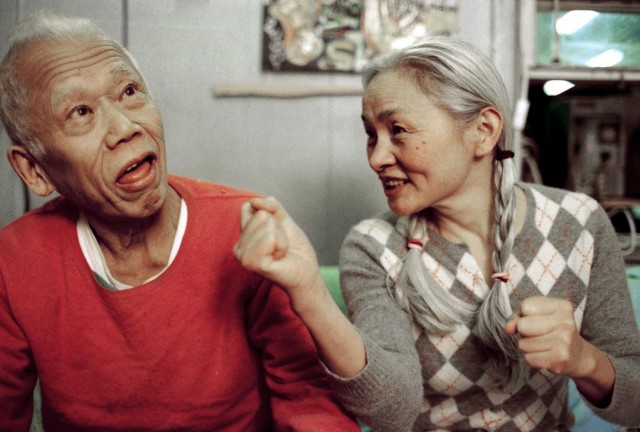
Living National Treasure Tomoeda Akiyo and Kita Noh Theater Company will be at Japan Society to perform works that inspired W. B. Yeats (photo © Seiichiro Tsuji)

Living National Treasure Tomoeda Akiyo and Kita Noh Theater Company will be at Japan Society to perform noh works that inspired W. B. Yeats (photo © Seiichiro Tsuji)

TRADITIONAL THEATER
Japan Society
333 East 47th St. at First Ave.
Saturday, November 19, $40, 7:30, and Sunday, November 20, $60, 5:00
212-715-1258
www.japansociety.org

In 1913, Ezra Pound introduced W. B. Yeats to the Japanese noh drama, and by 1916, Pound published English translations of fifteen noh plays and Yeats had written At the Hawk’s Well, which was directly inspired by the Japanese form. In honor of the centennial of that literary moment, Japan Society will be hosting two noh programs performed by the Kita Noh Theater Company, led by Tomoeda Akiyo, who was named a Japanese Living National Treasure in 2008. The first program, on November 19, consists of highlights from Nishikigi, Kumasaka, Tamura, Shojo, and Kagekiyo, presented in such styles as maibayashi, shimai, and subayashi, which differ in use of masks, costumes, chants, and music. Williams College music professor Dr. W. Anthony Sheppard will also give a talk about noh’s influence on Yeats. In addition, the related exhibition, “Simon Starling: At Twilight (After W. B. Yeats’s Noh Reincarnation),” a multimedia installation in which Turner Prize winner Starling reinterprets Yeats’s At the Hawk’s Well for the modern era, will stay open until 7:15; the performance will be followed by a Meet-the-Artists reception. On November 20 at 5:00, the second program will feature full versions of Kayoi Komachi and Shojo-midare, from Yeats’s collection, preceded at 4:00 by a lecture by Princeton University professor Dr. Tom Hare. (There will also be an “Image-in-Focus Series: Tomoeda Akiyo” gallery talk at 2:00.) Tickets for both events are sold out, but there will be a waitlist at the box office beginning one hour before showtime.

DIANE ARBUS: IN THE BEGINNING

Diane Arbus, Lady on a bus, N.Y.C., gelatin silver print, 1957 (© The Estate of Diane Arbus, LLC. All Rights Reserved)

Diane Arbus, “Taxicab driver at the wheel with two passengers,” gelatin silver print, 1956 (© The Estate of Diane Arbus, LLC. All Rights Reserved)

The Met Breuer
945 Madison Ave. at 75th St.
Tuesday – Sunday through November 27, suggested admission $12-$25
212-535-7710
www.metmuseum.org

The Met Breuer doesn’t just invite visitors into the early work of photographer Diane Arbus in the sensational show “diane arbus: in the beginning.” It ingeniously immerses them in the world that so attracted the New York City artist in her formative years, allowing museumgoers to make their own path through the people she encountered. “We’re looking at 1956 to 1962, made primarily in New York City, from Times Square to Coney Island to the Lower East Side, the same terrain that so many other artists of the era covered, offer[ing] this artist a new way of understanding who we are and who we might be. You feel the authentic quality of each of the individuals,” curator Jeff Rosenheim says in a Met Breuer video. “She seems to be able to separate the individual from the society. That is the power of a great Diane Arbus picture, that incessant need to know, and to record, and to follow her own eyes to wherever it took her, is defining of her career.” Consisting of more than one hundred works, most of which have never been shown publicly before and were printed by Arbus herself, the exhibition features photographs mounted on two sides of large rectangular stanchions arranged in rows in the gallery, allowing people to weave in and around Arbus’s fascinating landscape. Born in 1923 in New York City, Arbus got her first camera from her husband in 1941. (She was married for twenty-eight years to actor and photographer Allan Arbus, best known for playing psychiatrist Sidney Freedman on the M*A*S*H television series.) By the mid-to-late fifties, Arbus was documenting a wide variety of men, women, and children primarily in New York City as well as sideshow performers in Palisades Park, strippers in Atlantic City, and female impersonators on Long Island. One of her favorite haunts was Hubert’s Dime Museum and Flea Circus, where she photographed freaks, but none of her pictures were exploitative.

Diane Arbus, “Lady on a bus, N.Y.C.,” gelatin silver print, 1957 (© The Estate of Diane Arbus, LLC. All Rights Reserved)

Diane Arbus, “Lady on a bus, N.Y.C.,” gelatin silver print, 1957 (© The Estate of Diane Arbus, LLC. All Rights Reserved)

“I do feel I have some slight corner on something about the quality of things. I mean it’s very subtle and a little embarrassing to me but I really believe there are things which nobody would see unless I photograph them,” she said. She also noted, “For me the subject of the picture is always more important that the picture. And more complicated.” Most of her subjects were well aware they were being photographed and posed for the camera, although some were caught unaware. In “Miss Stormé de Larverie, the Lady Who Appears to Be a Gentleman, N.Y.C. 1961,” an elegant trans person, cigarette in hand, sits confidently on a park bench. In “Miss Makrina, a Russian Midget, in her kitchen, N.Y.C. 1959,” a small woman pauses while cleaning. In “Kid in a hooded jacket aiming a gun, N.Y.C. 1957,” a child in a winter coat points a gun at the camera. In “Seated female impersonator with arm crossed on her bare chest, N.Y.C. 1960,” the subject is topless, his anatomy clashing with his makeup and hairstyle. And in “A Jewish giant at home with his parents in the Bronx, N.Y. 1970,” a man hunches over, towering above his parents in their living room. There are also photos of a tattooed man, the Human Pincushion, scenes from movies, a family relaxing on their expansive lawn, a trapeze act, and an old lady in a hospital bed nearing her last breath. In the early 1960s, Arbus would switch to a 2¼-inch square-format Rolleiflex camera, continuing to capture a different side of America, but “in the beginning” wonderfully reveals where it all started. “A photograph is a secret about a secret. The more it tells you the less you know,” Arbus, who committed suicide in 1971 at the age of forty-eight, famously said. The same can be said for this must-experience exhibit.