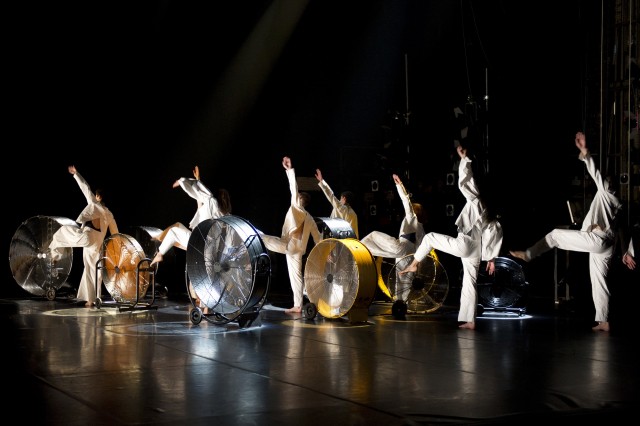
New York premiere of “I’m going to toss my arms—if you catch them they’re yours” is part of Trisha Brown Dance Company program at BAM (photo by Laurent Philippe)
BAM Howard Gilman Opera House
30 Lafayette Ave. between Ashland Pl. & St. Felix St.
January 30 – February 2, $20-$70, 7:30
718-636-4100
www.bam.org
www.trishabrowncompany.org
This past fall, BAM bid farewell to Pina Bausch as Tanztheater Wuppertal presented the final work by the legendary German choreographer, “…como el musguito en la piedra, ay si, si, si…” (Like moss on a stone), who died in 2009 at the age of sixty-nine. Now BAM is saying goodbye to another dance master as Trisha Brown brings her last two pieces to the Howard Gilman Opera House from January 30 to February 2. Now seventy-six, the Washington State-born Brown has been presenting dance at BAM since January 1976. How to describe her eclectic style? In fall 1993, influential multimedia artist and choreographer Yvonne Rainer wrote in BOMB magazine, “The task of describing Trisha Brown’s unique form of dancing is daunting. Its inscrutable blend of zaniness, athleticism, delicacy, and logic, always evading mimetic clichés, similarly eludes language, like a half-forgotten word or phrase that can’t quite roll off the tip of the tongue.” The Trisha Brown Dance Company will be performing two programs at BAM. The first (January 30, February 1-2) consists of 1987’s Newark (Niweweorce), featuring audiovisual elements by minimalist Donald Judd and Peter Zummo and lighting by Ken Tabachnick; the New York premiere of Les Yeux et l’âme, set to music by William Christie and Les Arts Florissants from Jean-Philippe Rameau’s Pygmalion, with lighting by Jennifer Tipton and costumes by Elizabeth Cannon; the New York premiere of I’m going to toss my arms—if you catch them they’re yours, with video by Burt Barr, costumes by Kaye Voyce, and lighting by John Torres, set to Alvin Curran’s “Toss and Find”; and 1966’s Homemade, a solo danced by Vicky Shick, with an original film by theatrical happenings mainstay Robert Whitman. The second program (January 31) comprises Newark (Niweweorce), I’m going to toss my arms—if you catch them they’re yours, Homemade, and the thirtieth-anniversary presentation of the 1983 BAM commission Set and Reset, a collaboration with Laurie Anderson, Robert Rauschenberg, and Beverly Emmons. The company features Neal Beasley, Cecily Campbell, Tara Lorenzen, Megan Madorin, Leah Morrison, Tamara Riewe, Jamie Scott, Stuart Shugg, Nicholas Strafaccia, and Samuel Wentz. In conjunction with the performances, John Rockwell, Wendy Perron, and Stephen Petronio will participate in an “Iconic Artist Talk: On Trisha Brown” on February 2 at 5:00 at the BAM Fisher Fishman Space.

 “You call this a film?” Jafar Panahi asks rhetorically about halfway through the revealing documentary This Is Not a Film. After several arrests beginning in July 2009 for supporting the opposition party, the highly influential and respected Iranian filmmaker (Crimson Gold, Offside) was convicted in December 2010 for “assembly and colluding with the intention to commit crimes against the country’s national security and propaganda against the Islamic Republic.” Although facing a six-year prison sentence and twenty-year ban on making or writing any kind of movie, Panahi is a born storyteller, so he can’t stop himself, no matter the risks. Under house arrest, Panahi has his friend, fellow director Mojtaba Mirtahmasb (Lady of the Roses), film him with a handheld DV camera over ten days as Panahi plans out his next movie, speaks with his lawyer, lets his pet iguana climb over him, and is asked to watch a neighbor’s dog, taking viewers “behind the scenes of Iranian filmmakers not making films.” Panahi even pulls out his iPhone to take additional video, photographing New Year’s fireworks that sound suspiciously like a military attack. Panahi is calm throughout, never panicking (although he clearly does not want to take care of the barking dog) and not complaining about his situation, which becomes especially poignant as he watches news reports on the earthquake and tsunami disaster in Japan. “But you can’t make a film now anyhow, can you?” Mirtahmasb — who will later be arrested and imprisoned as well — asks at one point. “So what I can’t make a film?” Panahi responds. “That means I ask you to take a film of me? Do you think it will turn into some major work of art?” This Is Not a Film, which was smuggled out of Iran in a USB drive hidden in a birthday cake so it could be shown at Cannes, is indeed a major work of art, an important document of government repression of free speech as well as a fascinating examination of one man’s intense dedication to his art and the creative process. Shortlisted for the Best Documentary Academy Award, This Is Not a Film is screening January 30-31 at the Maysles Institute as part of the “Oscar Buzz” series, which continues February 15-16 with the Oscar-nominated Detropia, followed by Q&As with codirectors Rachel Grady and Heidi Ewing, and culminates with a free Oscar viewing party on February 24 that includes unlimited refills of organic popcorn

 In June 2011, the Korean Cultural Service’s Korean Movie Night series presented Lim Woo-seong’s



 “A great virtuoso madman,” “scary,” “a motherfucker,” “a lovable rogue,” “a dope addict,” “the hammer of the gods,” “a force of nature,” “horrible,” “the world’s greatest drummer” — these are just some of the terms of affection heaped on legendary drummer Ginger Baker by his friends, relatives, and musical colleagues at the beginning of Jay Bulger’s propulsive documentary, Beware of Mr. Baker. In 2009, after spending three months with Baker and his family in South Africa, Bulger published the in-depth article “The Devil and Ginger Baker” in Rolling Stone. Two years later, Bulger went back to expand the story into a feature-length film, but Baker was not about to make it easy for him, continually insulting his questions, calling him names, and even cracking him in the nose with his cane. “He influenced me as a drummer but not as a person,” Bad Company and Free drummer Simon Kirke says of Baker, an opinion shared by many in this revealing film. Baker might be crotchety, but he also opens up to Bulger, particularly in describing when, as a child during WWII, he would hear the bombings outside, sounds that would have an impact on his playing. Bulger speaks with such other percussionists as the Rolling Stones’ Charlie Watts, Rush’s Neal Peart, the Grateful Dead’s Mickey Hart, Metallica’s Lars Ulrich, the Police’s Stewart Copeland, Vanilla Fudge’s Carmine Appice, and Pink Floyd’s Nick Mason, as well as such former Baker bandmates as Eric Clapton, Jack Bruce, and Steve Winwood, who all rave about Baker’s remarkable abilities behind the kit while also delving into his self-destructive behavior, which led him through a parade of groups, home countries, and spouses. “I don’t know if it’s his ability to move on or it’s his inability to stay,” points out Baker’s third wife, Karen Loucks Rinedollar, a statement that applies to both Baker’s personal and professional lives.