
Poverty, destitution, and an overriding strangeness rule the day in Axis Company production of LAST MAN CLUB (photo by Dixie Sheridan)
Axis Company
One Sheridan Sq. between West Fourth & Washington Sts.
Thursday – Saturday through March 30, $20, 8:00
866-811-4111
www.axiscompany.org
Last October, the excellent Axis Company production of Last Man Club had to end its run early because of Hurricane Sandy. The show is now back, running Thursday through Sunday through March 30, giving people another chance to see Axis artistic director Randy Sharp’s unusual Grapes of Wrath meets The Road Warrior tale. In a depression-era middle America Dust Bowl that could double as a barren postapocalyptic landscape, a small family of ragged men and women tries to survive as sandstorms swirl around their deteriorating farm. Friends and kin took off with all the money, leaving the overly practical and far-too-trusting Major (David Crabb) in charge of the mumbling, OCD-riddled Pogord (Spencer Aste), who is waiting for the tank truck to show so that his dried-out sheets can be wetted down; the quirky, ultra-strange Wishful Hi (Lynn Mancinelli), who wears crazy goggles and sees ghosts; and would-be singer Saromybride (Britt Genelin), who wonders whether they should have all headed out to California with the others. As the worst dust storm in modern history approaches, two drifters arrive one at a time: first Middle Pints (George Demas), who has an idea he wants to present to the town’s local Last Man Club, then Henry Taper (Brian Barnhart), who says he’s a scientist on his way to the city to help figure out how to stop the terrible drought. “I can’t take it no more. I really can’t,” Pogord says. “It’s the end of the world,” Wishful Hi proclaims. Writer-director Sharp’s (Hospital) unpredictable dialogue and subtle plot shifts bring a compelling elegance to the proceedings while also making the play relevant to such twenty-first-century concerns as poverty, unemployment, climate change, the housing crisis, war, and a lack of faith in government. Karl Ruckdeschel’s costumes and the simple but effective set cast the production in browns and grays that emphasize the growing destitution, while solid acting all around gives the play an honesty despite the surreal craziness going on. Last Man Club might be set in the past and hint at the future, but it is, sadly, also firmly rooted in the here and now.



 Stanley Kubrick’s Dr. Strangelove, or How I Stopped Worrying and Learned to Love the Bomb is one of the grandest satires ever made, the blackest of black comedies. With the threat of nuclear annihilation looming over the United States and the Soviet Union, General Jack D. Ripper (Sterling Hayden) has a meltdown, becoming obsessed with protecting the country’s “precious bodily fluids” and threatening to launch the bombs. While President Merkin Muffley (Peter Sellers) tries to make nice with the Soviets, General Buck Turgidson (George C. Scott) gets caught up in all the military excitement, Colonel Bat Guano (Keenan Wynn) defends the Coca-Cola Company, Group Captain Lionel Mandrake (Sellers) can’t get anyone to listen to him, and Major T. J. “King” Kong (Slim Pickens) prepares for the ride of his life. Based on Peter George’s novel Red Alert and written by George, Kubrick, and Terry Southern, Dr. Strangelove is hysterically funny and wickedly prescient, an absolute hoot from start to finish, featuring razor-sharp dialogue, inspired slapstick, and just enough truth to scare the hell out of you. (Be sure to watch for Peter Bull not being able to stop laughing as Sellers goes crazy in a wheelchair at the end.) A DCP projection of the film is screening March 21-28 as part of the IFC Center series “The Films of Stanley Kubrick,” which includes every one of the director’s feature works as well as A.I. Artificial Intelligence, a collaboration with Steven Spielberg, all shown in advance of the March 29 theatrical release of Rodney Ascher’s Room 237, a documentary that delves into the many metamysteries surrounding The Shining.


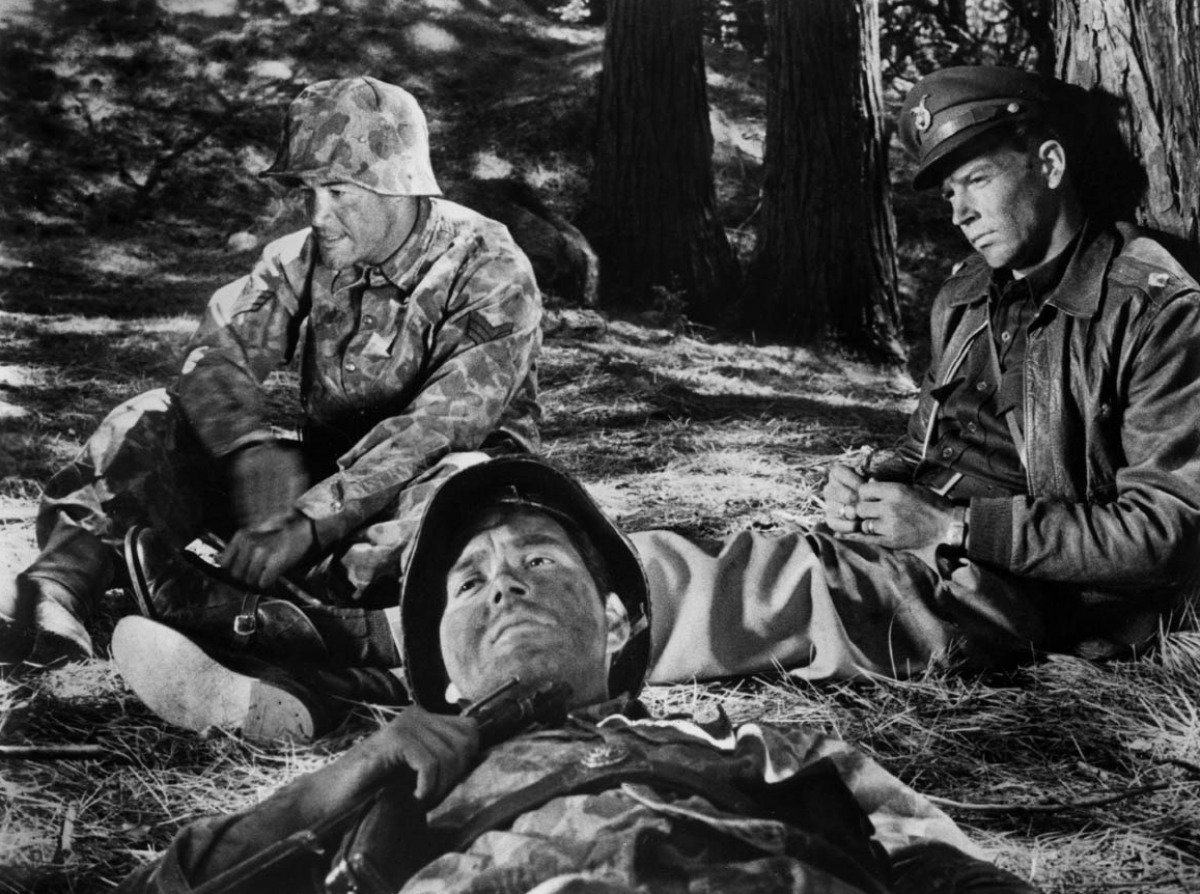
 The IFC Center is preparing for the March 29 theatrical release of Rodney Ascher’s documentary Room 237, which delves into metamysteries surrounding Stanley Kubrick’s The Shining, with the terrific series “The Films of Stanley Kubrick,” screening every one of the Bronx-born ex-pat’s feature works, most of which are being projected in DCP. Kubrick’s 1953 seldom-seen psychological war drama, Fear and Desire, will be shown March 20-25 in high definition. His first full-length film, made when he was twenty-four, Fear and Desire is a curious tale about four soldiers (Steve Coit, Kenneth Harp, Paul Mazursky, and Frank Silvera) trapped six miles behind enemy lines. When they are spotted by a local woman (Virginia Leith), they decide to capture her and tie her up, but leaving Sidney (Mazursky) behind to keep an eye on her turns out to be a bad idea. Meanwhile, they discover a nearby house that has been occupied by the enemy and argue over whether to attack or retreat. Written by Howard Sackler, who was a high school classmate of Kubrick’s in the Bronx and would later win the Pulitzer Prize for The Great White Hope, and directed, edited, and photographed by the man who would go on to make such war epics as Paths of Glory, Full Metal Jacket, and Dr. Strangelove, or How I Learned to Stop Worrying and Love the Bomb, Fear and Desire features stilted dialogue, much of which is spoken off-camera and feels like it was dubbed in later. Many of the cuts are jumpy and much of the framing amateurish. Kubrick was ultimately disappointed with the film and wanted it pulled from circulation; instead it was preserved by Eastman House in 1989 and restored twenty years later, which is good news for film lovers, as it is fascinating to watch Kubrick learning as the film continues. His exploration of the psyche of the American soldier is the heart and soul of this compelling black-and-white war drama that is worth seeing for more than just historical reasons. “There is a war in this forest. Not a war that has been fought, nor one that will be, but any war,” narrator David Allen explains at the beginning of the film. “And the enemies who struggle here do not exist unless we call them into being. This forest then, and all that happens now, is outside history. Only the unchanging shapes of fear and doubt and death are from our world. These soldiers that you see keep our language and our time but have no other country but the mind.” Fear and Desire lays the groundwork for much of what is to follow in Kubrick’s remarkable career, all of which can be seen March 20-28 at IFC.