twi-ny recommended events

TRIBECA FILM FESTIVAL: BIG BAD WOLVES

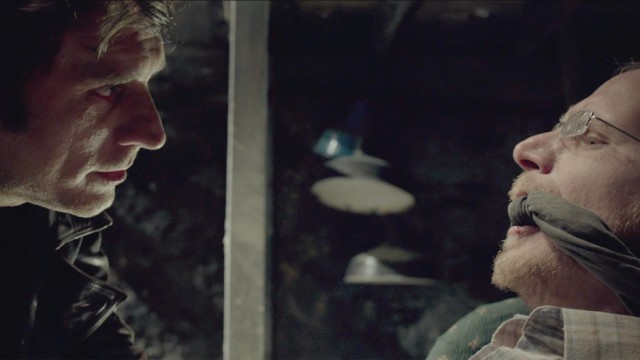
Cop (Lior Ashkenazi) must determine how far he will go to get the truth out of suspected child killer (Rotem Keinan) in brutal black comedy

Cop (Lior Ashkenazi) must determine how far he will go to get the truth out of suspected child killer (Rotem Keinan) in brutal black comedy

BIG BAD WOLVES (Navot Papushado & Aharon Keshales, 2013)
Monday, April 22, AMC Loews Village 7, 4:00
Wednesday, April 24, Clearview Cinemas Chelsea, 10:00
www.tribecafilm.com

Israeli film critic Aharon Keshales and his former student Navot Papushado follow up their 2011 Israeli slasher flick, Rabies, with the gory, ultraviolent black-comedy thriller Big Bad Wolves. Award-winning actor Lior Ashkenazi stars as Miki, a cop who is sure that Bible teacher Dror (Rotem Keinan) is behind the grisly kidnap, rape, and murder of a young girl. Miki and his partner, Rami (Menashe Noy), and two thugs try to beat the truth out of Dror, against the direct orders of their commanding officer, Zvika (Dvir Benedek). When the illegal interrogation winds up on YouTube, Miki is relieved of duty — with Zvika’s blessing to continue to go after Dror. But when Gidi (Tzahi Grad), the father of the dead girl, joins the chase, things threaten to get out of control — and quickly become even crazier. Big Bad Wolves is a sly, smart take on such genre pictures as Oldboy, Se7en, and Quentin Tarantino’s Reservoir Dogs, Pulp Fiction, and Inglourious Basterds, featuring generous amounts of brutal torture along with some very funny bits involving Jewish mothers. Writer-directors Keshales and Papushado keep the audience guessing right up to the very end as the main characters rarely do what is expected and hysterical comic scenes show up at rather inopportune moments. While playing with the standard elements of the revenge flick and the cop-on-the-edge tale, the dark, atmospheric Big Bad Wolves also explores the unbreakable bond between parents and children, lending more than a touch of gravitas to the wild, unpredictable proceedings, which are not for the faint of heart.
SOUTHERN DISCOMFORT

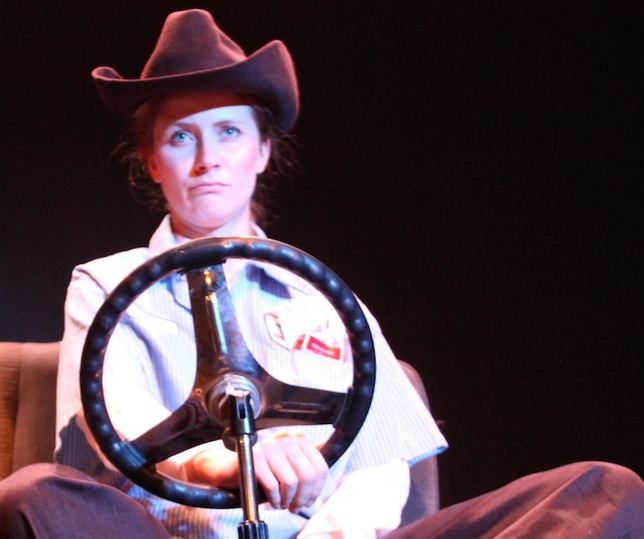
(photo by Ewa Skowska)

Proud southerner Elisabeth Gray takes on six roles in new one-woman show (photo by Ewa Skowska)

TRIPLE DISTILLED SOUTHERN GOTHIC
SoHo Playhouse, the Huron Club
15 Vandam St.
Monday nights at 8:00 through May 13, $20
866-811-4111
www.sohoplayhouse.com
www.newumbrella.org

Southern native Elisabeth Gray evokes the ghosts of Tennessee Williams, Walker Percy, and Flannery O’Connor in her new one-woman show, Southern Discomfort. Over the course of seventy minutes, Gray explores personal loneliness as she portrays six characters in seven vignettes, ranging from nineteen-year-old Josh Robinson Riddle, a one-handed North Carolina lad working at a gun show, to ninety-one-year-old South Carolinian Penelope Weaver, who bookends the New Umbrella production with her aging mind’s meanderings. Gray, who was born and raised in the South and recently made her Broadway debut in various small roles in the short-lived Breakfast at Tiffany’s, also plays twenty-seven-year-old Alabamian Julia Hanover, who is obsessed with crooked faces; forty-one-year-old Tennessee truck driver Jonny Stutts, who discusses porn with an unseen traveling companion; fifty-two-year-old Cheri Kane, who is giving a speech at the Olive Branch Mississippi Women’s Historical Society announcing that the club has accepted its first black member; and sixty-three-year-old William Ernest Fells, a Georgia man eulogizing his deceased wife. In the show — which is subtitled Triple Distilled Southern Gothic and runs Monday nights through May 13 in the Huron Club bar downstairs at the SoHo Playhouse, with free bourbon-and-lemonade cocktails — Gray and director Daniel Zimbler take on such topics as racism, sexism, guns, ideals of beauty, violence against women, love, family, and the Civil War without getting preachy or pedantic. Sometimes Gray’s point is too abstract, as in the pieces involving Weaver, but otherwise she employs a careful subtlety while avoiding clichés and stereotypes. She also involves the audience by occasionally using various paying customers as characters in her stories, pointing them out in the crowd and addressing them directly. (Try to get their early if you want a table instead of sitting on a stool at the bar or on a long couch.) At its heart, Southern Discomfort works because there’s a basic truth inherent in Gray’s telling; in the program notes, she explains that all of the characters are based on actual people she has known, resulting in believable situations that touch on both the comic and the tragic.

BLUES FOR SMOKE

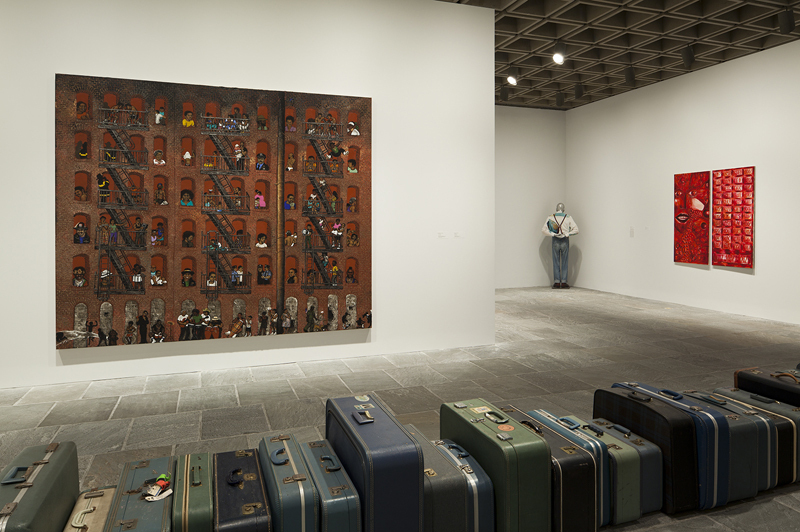
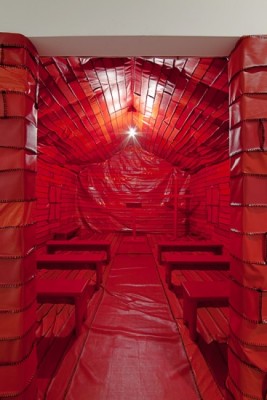
Rodney McMillian, “Asterisks in Dockery,” mixed-media installation, 2012 (photo by Sheldan C. Collins)

Rodney McMillian, “Asterisks in Dockery,” mixed-media installation, 2012 (photo by Sheldan C. Collins)

Whitney Museum of American Art
945 Madison Ave. at 75th St.
Wednesday – Sunday through April 28, $14-$18 (pay-what-you-wish Fridays, 6:00 – 9:00)
212-570-3600
www.whitney.org

In 1960, jazz pianist and composer Jaki Byard released his solo debut, Blues for Smoke, an improvisatory record that features on its cover a train puffing out dark clouds as it makes its way down the tracks. The album lends its name to an exciting multimedia exhibit at the Whitney that examines the impact of the blues on the arts. The show is highlighted by David Hammons’s extraordinary 1989 installation, “Chasing the Blue Train,” which greets visitors on the third floor. A blue train makes its way across tracks that take it through a tunnel covered in coal and a landscape with upturned piano tops as John Coltrane’s 1957 Blue Train album plays from a boom box, the work riffing on Coltrane’s name (coal, train) while celebrating the blues. Zoe Leonard’s “1961, 2002-Ongoing” consists of a row of suitcases of different shades of blue, evoking impermanence and creating a mystery about what might be inside; nearby, Martin Kipperberger’s “Martin, into the Corner, You Should Be Ashamed of Yourself” is a life-size replica of the artist standing in the corner, suffering from a case of the blues. Specially commissioned for the show, Kori Newkirk’s “Yall” consists of a shopping cart nearly completing a circle of blue on the floor, calling to mind exclusion, homelessness, and failed capitalism. Kira Lynn Harris lines a stairwell and entrance with silver Mylar in “Blues for Breuer,” paying tribute to the architect of the Whitney building, which will be taken over by the Met in 2015 when the Whitney moves downtown.

Installation view, Blues for Smoke (photo by Sheldan C. Collins)

Works by Martin Wong, Martin Kipperberger, Zoe Leonard, and others form a blues aesthetic at the Whitney (photo by Sheldan C. Collins)

Curated by Bennett Simpson in consultation with Chrissie Iles, “Blues for Smoke” also features works by Romare Bearden, Carrie Mae Weems, Glenn Ligon, Liz Larner, Jean-Michel Basquiat, Rachel Harrison, Mark Morrisroe, Alma Thomas, Beauford Delaney, Kara Walker, William Eggleston, and Lorraine O’Grady, all contributing to the overall examination of the blues aesthetic. A media room includes viewing stations where people can watch classic performances, while Stan Douglas’s “Hors-champs” plays continuously in its own space on the first floor, offering a unique view of a live recording on the front and back of a screen hanging from the ceiling. In addition, the Whitney is hosting a series of live events that continue through the end of the exhibition, which closes April 28, including “Blues for Smoke: Matana Roberts, Keiji Haino, and Loren Connors” on April 20 at 8:00 (featuring a solo performance by Roberts and a duo guitar improvisation by Haino and Connors), “Through the Lens of the Blues Aesthetic: An Evening of Short Films Selected by Kevin Jerome Everson” on April 25 at 7:00, the live concert “Blues for Smoke: Annette Peacock” on April 26 at 7:00, and the three-day “Blues for Smoke: Thomas Bradshaw,” in which the playwright will be creating a new piece that will be shown April 26-28.

EARTH DAY 2013: THE FACE OF CLIMATE CHANGE

The forty-third annual Earth Day focuses its attention on global warming this year with its personal theme, “The Face of Climate Change,” inviting people to go to the website, upload a photo, and tell their own story about how they’ve been directly affected by the somehow controversial topic and asking them to “be part of the solution.” Grand Central Terminal will host three days of special events, April 20-22, including presentations by Aimee Follette (“How Food Choices Have the Power to Nurture Us and Heal Our Planet”) and Patricia Moreno (“Be a Powerful Force for Positive Change in the World by Training Your Mind and Moving Your Body”), live performances by the Callen Sisters, Avidya & the Kleshas, and the cast of Annie, and screenings of such films as Dear Governor Cuomo and The Vanishing of the Bees. Among the exhibitors in Vanderbilt Hall will be 511 NY Rideshare/Commuter Link, Build It Green!NYC, Common Ground NYC, Global Justice For Animals and the Environment, Rwanda Women in Action, Sane Energy Project, and ThinkEco CoolNYC, among many others.

earth day

Over at the Javits Center, the Green Festival is open to the general public April 20-21, featuring presentations by Neil Chambers (“Resiliency and the Future of Cities”), Stefanie Iris Weis (“Bringing Eco-Sexy Back: Tools, Tips, and Tricks for a Sustainable Love Life”), Sacha Dunn (“Homemade Household Cleaners”), James Fischer (“Urban Beekeeping”), and others as well as a Recycled Runway Eco-Fashion Show and live performances by Reverend Billy and the Earthalujah Chorus and Circa ’95. Union Square will host exhibitor booths, a clothing swap, a CO2 E Drive Green Vehicle Runway Show, and live acts on April 21 and the C02 E Green Drive Project on April 22, while Solar One will have an Earth Day NY CO2 Car Drive on April 21 at 8:00 am.

ART SEEN: F FOR FAKE

F FOR FAKE

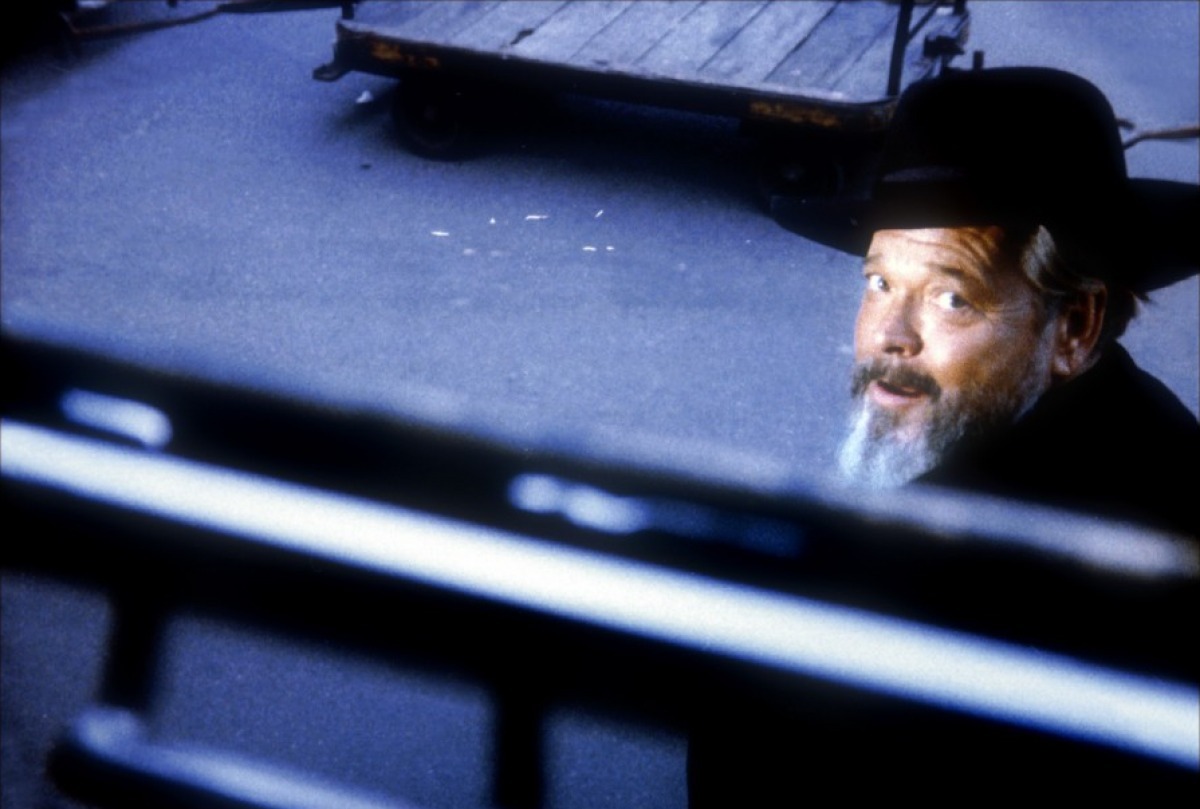
Orson Welles explores cinematic reality and artistic forgery in F FOR FAKE

F FOR FAKE (Orson Welles, 1976)
Nitehawk Cinema
136 Metropolitan Ave. between Berry St. & Wythe Ave.
April 20-21, 12 noon
718-384-3980
www.nitehawkcinema.com

Orson Welles plays a masterful cinematic magician in the riotous F for Fake, a pseudo-documentary (or is it all true?) about art fakes and reality. Exploring slyly edited narratives involving art forger Elmyr de Hory, writer Clifford Irving, Spanish painter and sculptor Pablo Picasso, and reclusive billionaire Howard Hughes, the iconoclastic auteur is joined by longtime companion Oja Kodar and a cast of familiar faces in a fun ride that will leave viewers baffled — and thoroughly entertained. Welles manipulates the audience — and the process of filmmaking — with tongue firmly planted in cheek as he also references his own controversial legacy with nods to such classics as Citizen Kane and The Third Man. It’s both a love letter to the art of filmmaking as well as a warning to not always believe what you see, whether in books, on canvas, or, of course, at the movies. F for Fake is screening April 20 & 21 at noon as part of the new Nitehawk Cinema monthly series “Art Seen,” which continues May 18-19 with Ben Shapiro’s Gregory Crewdson: Brief Encounters and June 22-23 with The Cool School and Paul McCarthy’s The Black and White Tapes. Each program will begin with an “Artist Film Club” presentation that includes one video from the 2013 Moving Image Art Fair.

LA RUTA

(photo by Lia Chang)

LA RUTA tells the story of illegal immigrants risking everything for a new life in America (photo by Lia Chang)

Multiple locations
Wednesday – Sunday through May 12, $25
212-244-3300
www.theworkingtheater.org

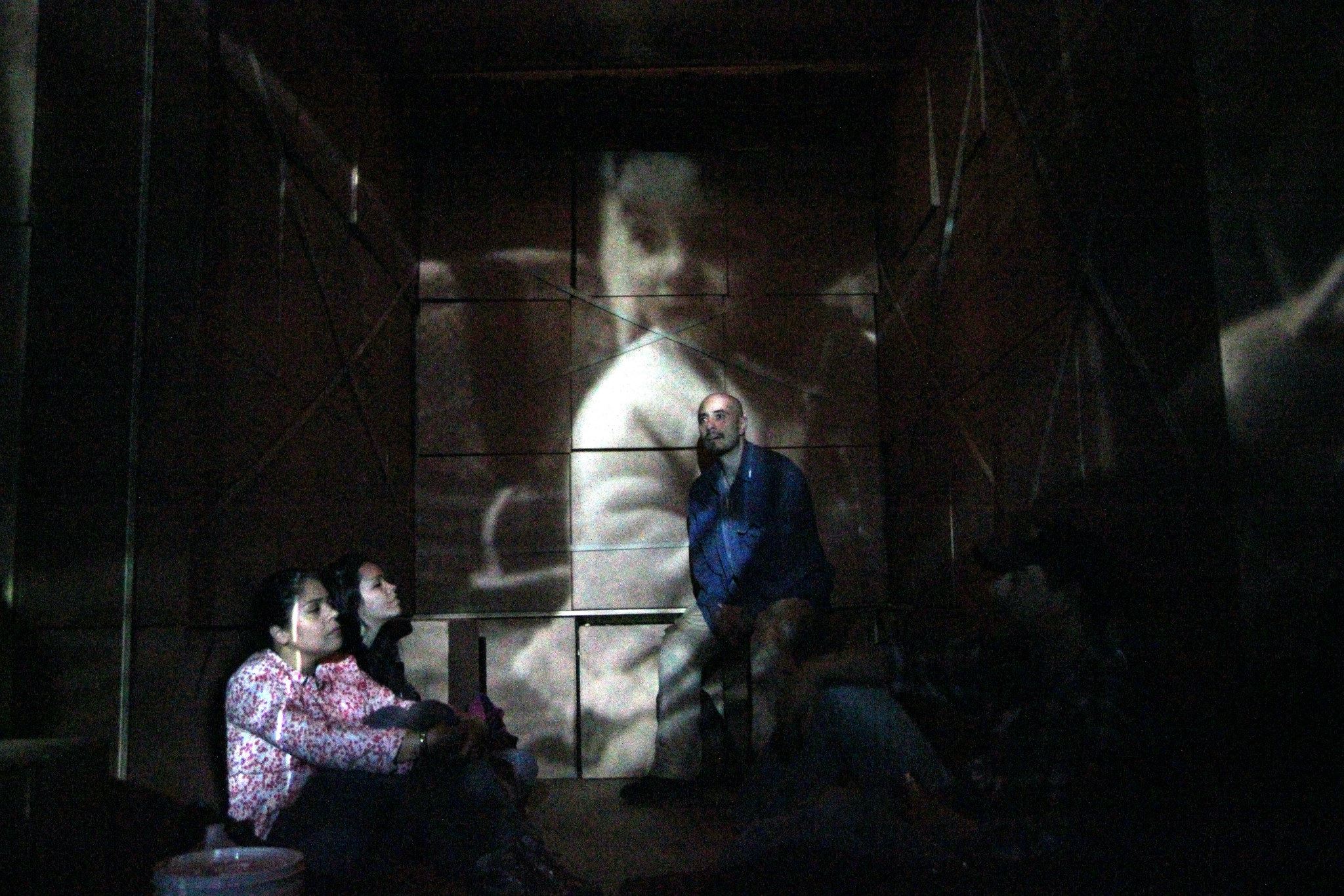
The controversial topic of illegal immigration takes center stage in the Working Theater’s timely and powerful La Ruta. Actually, “stage” is probably the wrong word, as the uniquely immersive production takes place primarily in a forty-eight-foot truck. Sharply written by Ed Cardona Jr. and skillfully directed by Tamilla Woodard, La Ruta begins as the audience, limited to thirty people per performance, gathers in a small tent, waiting to be hustled into a truck that will take them — along with a mysterious cargo — across the border into Texas. In charge of the journey is Raula (Sheila Tapia), a tough Hispanic woman who does not like being talked back to, leading to an immediate confrontation with Irma (Zoë Sophia Garcia), who has trouble keeping her mouth shut. The audience is soon pushed inside the truck, where they sit in darkness on big boxes. Raula relaxes in the front cab with the driver, Albert (Brian D. Coats), while Irma, Mabel (Annie Henk), and Francisco (Gerardo Rodriguez) are put in the back, where the unpredictable Juancho (Bobby Plasencia) is protecting the merchandise. Expert use of sound (Sam Kusnetz), light (Lucrecia Briceno), and projection (Dave Tennant and Kate Freer) makes it feel like the truck is actually moving as the story of each character unfolds, building to a shocking and unsettling climax.

Albert (Brian D. Coats) and Raula (Sheila Tapia) take a group of illegal immigrants into Texas in moving play (photo by Lia Chang)

Albert (Brian D. Coats) and Raula (Sheila Tapia) take a group of illegal immigrants into Texas in moving play (photo by Lia Chang)

La Ruta is adventure theater at its best, led by a strong, convincing performance by Tapia (CQ/CX), who has the primary responsibility of putting the audience on edge and keeping them there. Garcia, in her New York debut, is also excellent, her fear representative of the audience’s, constantly worrying about what is going to happen next. Since most of the play’s seventy-five minutes take place in close, dark quarters, claustrophobics should take note, but everyone else should rush to get the limited amount of tickets available for this smashing production. Of course, the audience gets only the tiniest taste of what it’s like for illegal immigrants who risk it all trying to make a new life in the supposed land of opportunity, able to return after the show to apartments that suddenly feel a whole lot more safe and comfortable. But if you really allow yourself to become lost in the tense drama, as if you’re also risking everything and not merely there as a theatrical spectator, you’re in for an unforgettable experience. La Ruta, which already played in the Bronx, continues alongside the Cathedral Church of St. John the Divine in Manhattan through April 28, then traveling to IBEW Local 3 Headquarters in Flushing May 1-5 and Snug Harbor on Staten Island May 8-12. The play is accompanied by a small but informative multimedia exhibit about immigration put together by the Magnum Foundation.

HERMAN’S HOUSE

HERMAN’S HOUSE

Jackie Sumell wants to build a dream home for a prisoner serving a life sentence in HERMAN’S HOUSE

HERMAN’S HOUSE (Angad Singh Bhalla, 2013)
Cinema Village
22 East 12th St. between University Pl. & Fifth Ave.
Opens Friday, April 19
212-924-3363
www.cinemavillage.com
www.hermanshouse.org

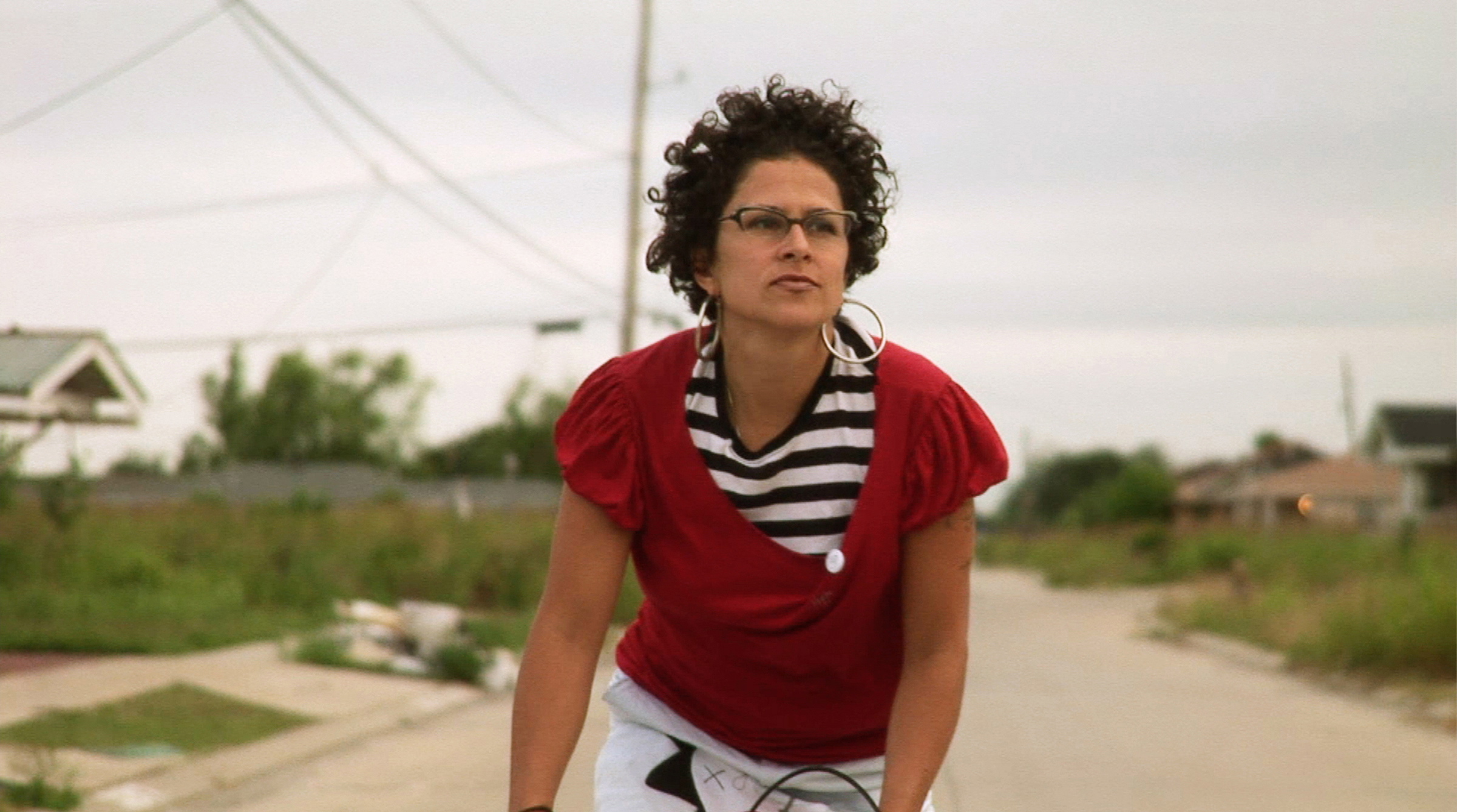
After attending a presentation in 2001 by Robert King, the former Angola 3 inmate, about the controversial conditions in the Louisiana State Penitentiary and the continued incarceration — in solitary confinement — of Albert Woodfox and Herman Wallace, Brooklyn-born multidisciplinary artist Jackie Sumell began a correspondence with Wallace that developed into a fascinating friendship that is explored in Angad Singh Bhalla’s debut documentary, Herman’s House. “I’m not a lawyer and I’m not rich and I’m not powerful, but I’m an artist,” Jackie says in the film. “And I knew the only way I could get him out of prison was to get him to dream.” She gets him to dream by having him describe, in exacting detail, the house he’d like to live in if he were to ever be released, and she goes ahead and designs it, working with architects on the blueprints. She also builds a scale model that becomes part of a traveling art exhibit, “The House That Herman Built,” which includes a precise re-creation in wood of Wallace’s six-by-nine-foot cell, his home for thirty-six years. Bhalla, who wrote, directed, and produced the film, while also serving as director of photography with Iris Ng, never shows Wallace on camera; instead, he paints a portrait of the New Orleans native —who was first convicted of bank robbery in 1967, then of killing a prison guard in 1972, eventually sentenced to life without parole for a crime he claims he didn’t commit — through a series of recorded phone conversations he has with Sumell over the years. Bhalla also visits with ex-convict Michael Musser, who got his life back on track because of Wallace; Wallace’s sister Vickie, who is not afraid to speak her mind; and King, who helped form the Angola chapter of the Black Panther Party with Wallace, Woodfox, and others. “You look at this house, you’re looking at me,” Wallace says. Indeed, viewers might never get to see Wallace, but by the end of the film, they will feel like they know him — and will hope for his release. But Bhalla never steers the narrative into a clarion call condemning the prison system and demanding Wallace’s freedom, instead allowing those elements to be subtle parts of this intriguing tale of a very unusual relationship.

Herman’s House opens April 19 at Cinema Village with a series of special discussions all weekend featuring such guest speakers as NYCLU senior staff attorney Taylor Pendergrass, WNYC reporter Anna Sale, Five Mualimmak of the NYC Jails Action Coalition, King Downing of the Campaign to End the New Jim Crow, executive director Soffiyah Elijah of the Correctional Association, and solitarywatch.com editor Jean Casella in addition to Bhalla and Sumell.