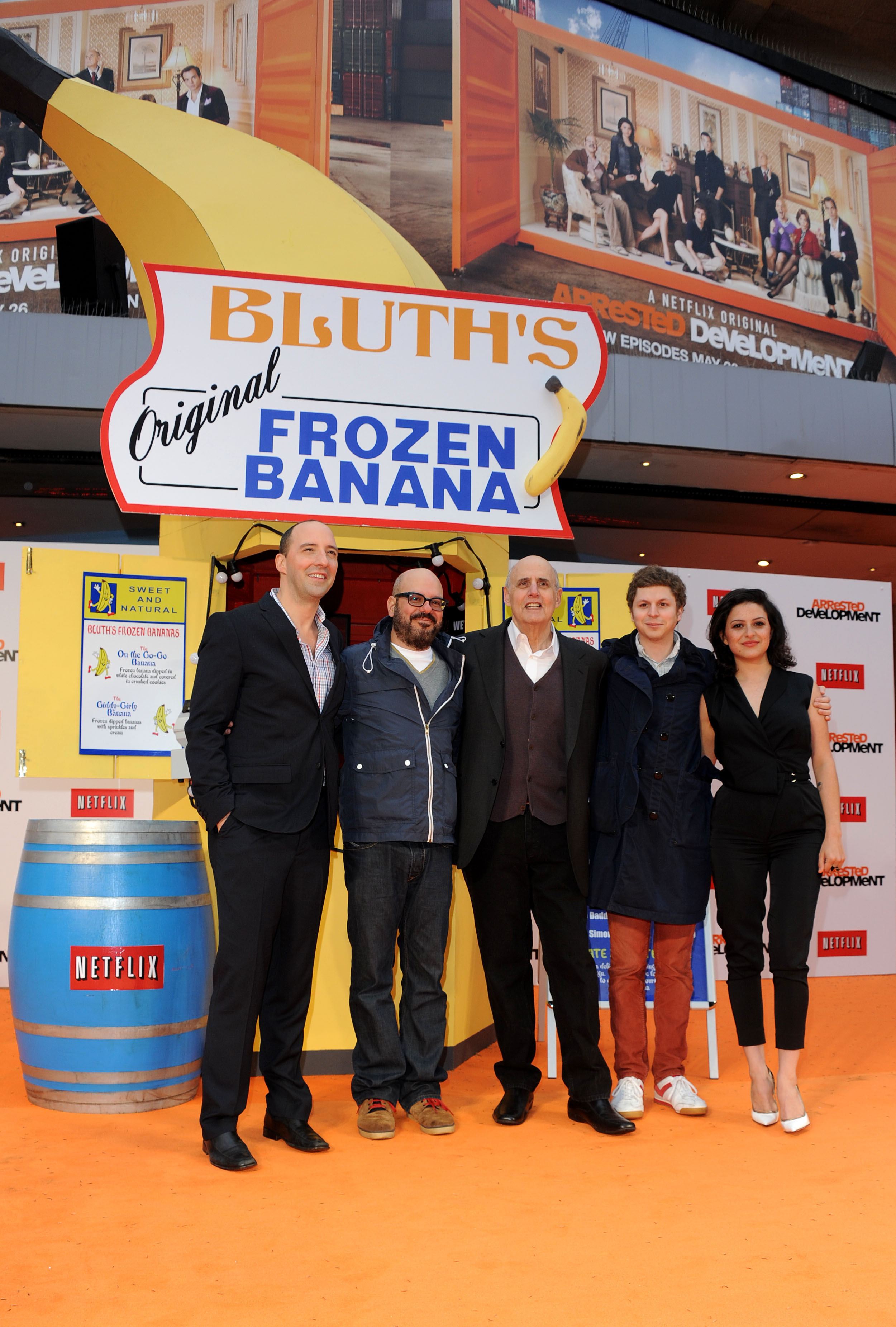
ARRESTED DEVELOPMENT will celebrate its return with free frozen bananas in New York on May 13 & 14 (photo by Stuart Wilson/Getty Images for Netflix)
Monday, May 13, Sixth Ave. at 50th St., free, 11:00 am – 6:00 pm
Tuesday, May 14, Columbus Circle, free, 12 noon – 7:00 pm
Wednesday, May 15, Yankee Stadium, Gate 6, 3:30 – 8:00
Thursday, May 16, Times Square, 11:00 am – 5:00 pm
www.netflix.com
Mitchell Hurwitz’s Arrested Development seems to have been in its own state of arrested development for years. The cult sitcom, which follows the trials and tribulations of the rather dysfunctional Bluth family, ran on Fox from 2003 to 2006, after which rumors have persisted that it would move to another network or maybe even be turned into a feature film. Ten years after its debut, however, Arrested Development is finally back, with fifteen new episodes airing on Netflix beginning on May 26. Everyone is joining in the fun, with Jason Bateman as Michael, Portia de Rossi as Lindsay, Will as Gob, Michael Cera as George Michael, David Cross as Tobias, Jeffrey Tambor as George, Jessica Walter as Lucille, and Ron Howard as the narrator; among the returning cast of guest characters are Henry Winkler as Barry Zuckerkorn, Mae Whitman as Ann Veal, Scott Baio as Bob Loblaw, and Liza Minnelli as Lucille Austero. To celebrate this new stage in the bizarre life of this wacky series, Bluth’s Original Frozen Banana stand, which the Bluth family started sixty years ago and had its official ribbon cutting fifty years ago, will be serving free treats across from Radio City Music Hall on Monday, May 13, from 11:00 am to 6:00 pm; in Columbus Circle on Tuesday, May 14, from 12 noon to 7:00 pm; in front of Gate 6 at Yankee Stadium on Wednesday, May 15, from 3:30 to 8:00; and in front of the Marriott Marquis in Times Square on Thursday, May 16, from 11:00 am to 5:00 pm, with a 12 noon reunion of the Never Nudes. Be on the lookout for stray fox feet, Mr. Bananagrabber, and spliffs, and never forget that “there’s always money in the banana stand.” And now, everyone join in: “Big yellow joint / big yellow joint / I’ll meet you down at the big yellow joint!”
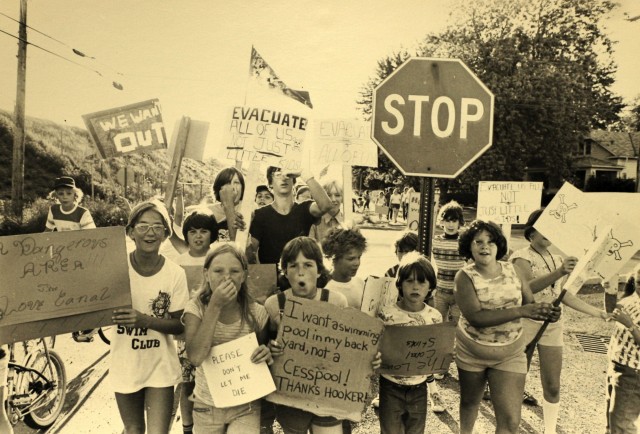
 A lot of documentaries wear their hearts on their sleeves, pushing a specific agenda, but as far as agenda go, A Fierce Green Fire: The Battle for a Living Planet has a pretty good one. Directed by Mark Kitchell (Berkeley in the Sixties), the film serves not only as a history of the environmental movement around the world but also demonstrates how one person can indeed make a difference. But the hundred-minute documentary does itself no favors by using several narrators who are certain to infuriate conservative Republicans and naysayers, ensuring that the film is most likely going to preach only to the converted and not spread its vital message to a more mainstream audience. A Fierce Green Fire is divided into five thematic sections, narrated by Robert Redford, Ashley Judd, Van Jones, Isabel Allende, and Meryl Streep, respectively. Using archival footage and new interviews, Kitchell examines David Brower and the Sierra Club’s fight to prevent a dam project in the Grand Canyon; Lois Gibbs’s struggle to prove the alarming health problems at Love Canal; Paul Watson, Sea Shepherd, and Greenpeace’s mission to save the whales; Chico Mendes’s bravery trying to protect the Amazon rainforest; and the continuing controversy over climate change as seen through the work of such activist organizations as Paul Hawken’s Blessed Unrest. Inspired by Philip Shabecoff’s 1993 book, the film features such talking heads as Whole Earth Catalog publisher Stewart Brand, Earth Day organizer Doug Scott, NRDC founder John Adams, former Sierra Club leader Carl Pope, environmental justice advocate Robert Bullard, Greenpeace cofounder Rex Weyler, WWF conservation biologist Thomas Lovejoy, and legendary naturalist Bill McKibben in addition to Gibbs, Hawken, and Watson. While it’s fascinating to learn that the environmental movement really took off once NASA broadcast images of the earth taken from space, revealing the beautiful fragility of the planet, much of the documentary is told in a fairly stagnant manner, more like an expanded news report than a theatrical film. Still, it shares some intriguing insights and, in celebrating a group of individuals from around the world who fought the power (and sometimes even won), goes a long way in showing that every little step matters. A Fierce Green Fire: is screening May 12 & 19 at 8:00 as part of the ongoing Symphony Space series Thalia Docs.

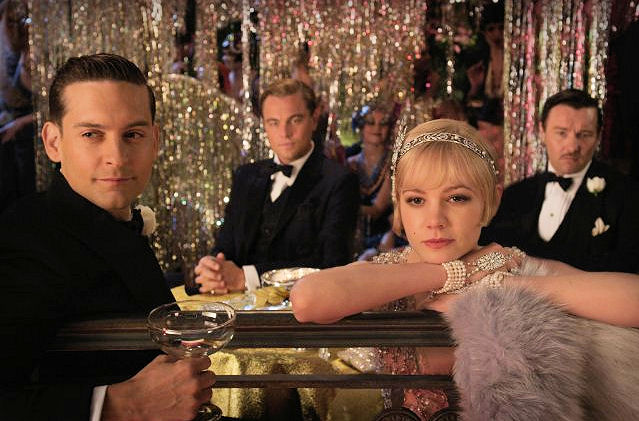
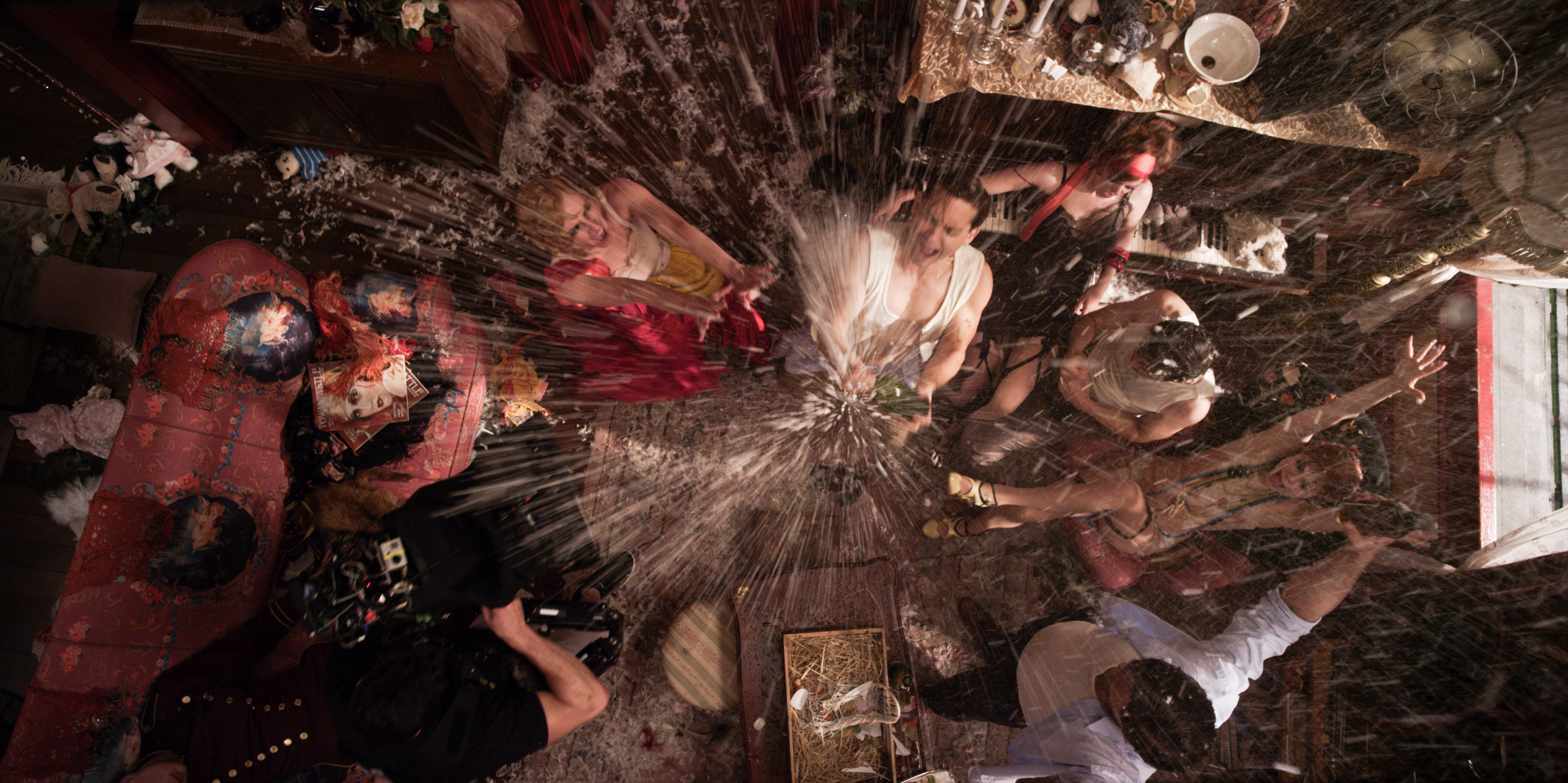
 Baz Luhrmann’s sumptuous version of The Great Gatsby is a dazzling reimagining of F. Scott Fitzgerald’s 1925 novel of old and new money and the American dream. The Australian director and his wife, costume and production designer extraordinaire Catherine Martin, have turned the classic tale into a lush spectacle without losing focus on the main story of life and love during the Roaring Twenties. Leonardo DiCaprio, who played the male lead in Lurhmann’s contemporary take on Romeo + Juliet, is superb as Jay Gatsby, the mystery man previously portrayed by Warner Baxter in 1926, Alan Ladd in 1949, Robert Redford in 1974, and Toby Stephens in 2000, adding a compelling level of vulnerability to the character. Gatsby has built a magnificent palace for himself on Long Island, hosting wild parties that he doesn’t care about; all he truly wants is Daisy (Carey Mulligan), a former love who has married successful businessman Tom Buchanan (Joel Edgerton) and lives in a mansion right across the bay. The villainous Tom is having an affair with the lower-class Myrtle Wilson (Isla Fisher), whose unaware husband, George (Jason Clarke), runs a gas station and garage in the Valley of Ashes. Although a loner, Gatsby befriends his neighbor, Nick Carraway (Tobey Maguire), a young, innocent bond trader who rents a modest home at the base of Gatsby’s enormous estate and whose cousin just happens to be Daisy. As Carraway is sucked into this glamorous, debauched society, which also includes wild and elegant golf champion Jordan Baker (Elizabeth Debicki), he is forced to reexamine his own hopes and dreams as he tries to find his place in the world.