FAME HIGH (Scott Hamilton Kennedy, 2012)
Quad Cinema
34 West 13th St. between Fifth & Sixth Aves.
June 7-13
212-255-2243
www.quadcinema.com
www.famehighmovie.com
“Fame High is where ambition and reality suffer a high-speed collision with no one walking away unscathed,” documentarian Scott Hamilton Kennedy writes in his director’s statement about his latest film. In Fame High, the Berkeley-raised Kennedy explores the hopes and dreams of students at the Los Angeles County High School for the Arts (LACHSA), known as the Fame High School of the West Coast, focusing on actress Ruby McCollister, jazz pianist Zak Astor, dancer Grace Song, and singer-songwriter Brittany Hayes. Kennedy, whose previous work includes OT: Our Town and the Oscar-nominated The Garden, serves as director, editor, and writer in addition to being one of the producers and cameramen for the film, in which he talks with the students as well as their parents and teachers, delving into such themes as talent, desire, fear, motivation, education, and responsibility. Fame High, which continues this week at the Quad, where Kennedy participated in a series of Q&As over the weekend, is no mere big-screen reality show; instead, it is the real deal, capturing the essence of what it takes to become an artist. Back in April 2009, Kennedy was featured in one of the very first twi-ny talks, in which he said about The Garden, “I learned a lot about never giving up when you believe in your heart what you are struggling for,” a statement that can also be applied to Fame High, which he discusses further below.
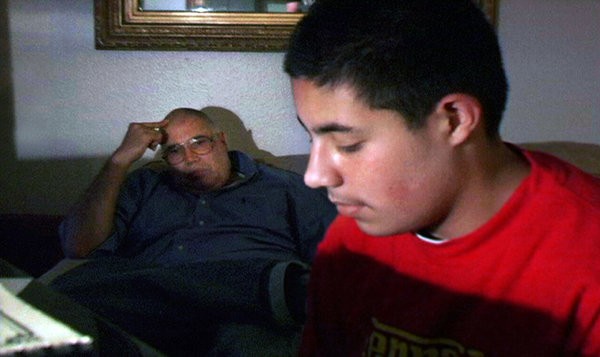
Jazz pianist Zak Astor and his father talk about their goals in FAME HIGH
twi-ny: What initially drew you to the project? Were you a fan of the original Fame movie and TV show?
Scott Hamilton Kennedy: As you can probably see in the title, I am definitely paying a bit of homage to Alan Parker’s wonderful Fame from 1980. But I had not seen that type of film done in a vérité format. I also had a great love for musicals (West Side Story, Guys and Dolls, and A Chorus Line, to name a few) from a very young age. I then had the pleasure of beginning my career as a filmmaker with music videos (including Jimmy Cliff’s great cover of “I Can See Clearly Now” for the John Candy film Cool Runnings). And I came to documentaries quite a bit later in my career. So with Fame High I wanted to try and mix these two seemingly disparate styles: the raw, soulful realism of vérité with the more magical world of musical and music videos. So, forgiving the long answer, that was the seed.
twi-ny: In the film, the protagonists have to audition over and over, in class, in a theater, at clubs, etc. How did you choose which kids to focus on? Did you have auditions?
Scott Hamilton Kennedy: In vérité documentary, there are a lot of things you can’t control, things that you take a leap of faith and hope blossom in an interesting way. One of the most important things you can control is casting, who you are going to follow, who is going to help bring this idea to fruition. So, yes, we interviewed lots of students on camera before deciding on the ones you see in the film.
twi-ny: When you were a kid, did you already know you wanted to be a filmmaker? If not, what were your dreams back then?
Scott Hamilton Kennedy: Unlike the incredibly talented and driven kids in Fame High, I came to my art of filmmaking much later in life. I loved, and you could even say I was addicted to, the complex emotional high that a good film could make me feel, but aside from a couple of hack video projects in college, my first directing experience was with my PA (production assistant) buddies all getting together to make an AIDS Public Service Announcement a year after graduating college. So I guess the “dream” of making movies was there from an early age, but the “doing” part came later.
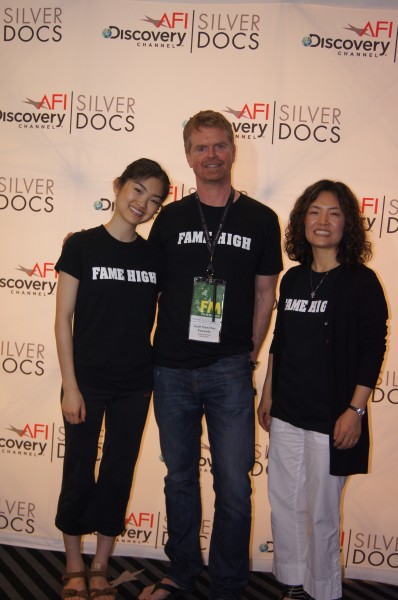
Director Scott Hamilton Kennedy poses with subject Grace Song and her mother at Silverdocs, where FAME HIGH was among the Best of the Fest winners
twi-ny: Several of the parents are featured in the film. You and your wife have two girls. Are either of them interested in the arts? What would you tell them if they wanted to become dancers, musicians, actresses, or filmmakers?
Scott Hamilton Kennedy: At seven and three and a half, our daughters (Tessa and Eden, respectfully) are still quite young, but they sure love things like our kitchen “dance parties” while making dinner, or creating puppet shows. And they both have a flare for the dramatic, I guess you could say, so we will see. I think my wife, Catherine, and I would try to support them in anything they showed a passion for. That said, I would try and be as clear-eyed as possible with them about the complexities and Sisyphean qualities of this wonderful and trying business. And from a simple accessibility front, they are already learning to operate a camera, and even some of the basic aspects of storytelling and editing.
twi-ny: Since you’re a parent, did you ever want to jump out from behind the camera and counsel any of the kids, parents, or teachers, particularly if you thought they were being treated unfairly or were treating others unfairly?
Scott Hamilton Kennedy: I have been asked this a lot, and it is a difficult question. The simple answer is no, I did not interfere, but it is a bit more complex than that. As a documentary filmmaker, I don’t see it as my job to get involved, and, more importantly, not judge in any way their journey. So while it is complicated sometimes, I do really try to stick to that. Not that I don’t have honest conversations about all aspects of the journey with both parents and children; I try very hard not to judge them or in any way make them think that I might have any better ideas than them on how to navigate this crazy journey called life.
twi-ny: Cuts in education often seem to start with the arts, and there are only so many schools like LACHSA. What do you see as the future of arts education?
Scott Hamilton Kennedy: The importance and benefits of arts education are undeniable, even if the individual has no inkling of wanting to pursue that art professionally. Playing an instrument, learning to act, perfecting dance skills are not just after-school activities; they are lifelong skills that teach students to think creatively, experience focused attention, and embrace risk — all necessary skills for the twenty-first century. Seeing the arts being the first thing cut is frustrating and confusing. While there are many aspects of American society and its education system that I greatly respect, I do think that — mostly because of our obsession with money — our value systems could be truly overhauled. Not to discount in any way the security that comes with knowing that your essential needs are covered financially, but it seems we are made to believe that money could solve all our problems, and that is just not the case. Money will never satisfy your soul, where art, without seeing it as any crazy “cure-all,” has far more potential to help us navigate and enjoy this “sad and beautiful world.”
And, if I may, I would love to point out an exciting and dauntingly ambitious aspect to our website, famehighmovie.com, and that is our Community page. There, anyone can fill out a form and share with us any art organization, school, class, performance in their community. We are especially asking people to share with us classes and performances that are available for free or greatly reduced prices to help democratize access to the arts. With a solid search tool as well, we hope this will become a sort of Wiki meets Yelp clearinghouse for an immense variety of art.


 The free Korean Movie Night series “Laughter and Love at the Box Office!” continues June 11 at Tribeca Cinemas with the bittersweet romantic tale Architecture 101. Former architect Lee Yong-zoo’s second feature film, following Possessed, examines the building of personal relationships as well as the construction of homes as a pair of grown-ups consider what might have been. When Seo-Yeon (Han Ga-in) enters the firm where Seung-Min (Uhm Tae-woong) works, the thirty-five-year-old architect appears initially not to know her, but it turns out that they explored the possibility of first love together fifteen years earlier at school. Lee cuts back and forth between the present, in which Seo-Yeon hires Seung-Min to rebuild a house for her, and the past, when Seung-Min (Lee Je-hoon) and Seo-Yeon (Bae Su-ji) are still figuring out what they want out of life and love, trying to understand the desire churning inside them. In the present, Seo-Yeon says she has been married for three years, and Seung-Min is secretly engaged to his assistant, Eun-Chae (Koh Joon-hee). Meanwhile, in the past, Seung-Min doesn’t know what to do about his feelings for Seo-Yeon, who seems to like one of his best friends, Jae-Wook (Yoo Yeon-seok). The past, present, and future meld into one over the musical theme of pop star Jeon Ram-whe’s sappy Korean ballad “Etude of Memory” as true love tantalizingly hangs just out of reach. Architecture 101 is a beautiful yet heartbreaking film with superb performances — Bae and Jo Jung-suk, who plays Nabddeuckyi, a confidant of the younger Seung-Min’s based on the director himself, both won Best New Actor awards for their portrayals — and a compelling narrative structure that builds to a powerfully emotional climax. “Laughter and Love at the Box Office!” concludes June 25 with Jo Sung-hee’s romantic fantasy hit A Werewolf Boy.