twi-ny recommended events

THE CONTENDERS 2013: CUTIE AND THE BOXER

CUTIE AND THE BOXER

Documentary tells the engaging story of a pair of Japanese artists and the life they have made for themselves in Brooklyn

CUTIE AND THE BOXER (Zachary Heinzerling, 2013)
MoMA Film, Museum of Modern Art
11 West 53rd St. between Fifth & Sixth Aves.
Tuesday, November 26, 8:00
Series continues through January 16
Tickets: $12, in person only, may be applied to museum admission within thirty days, same-day screenings free with museum admission, available at Film and Media Desk beginning at 9:30 am
212-708-9400
www.moma.org
www.facebook.com/cutieandtheboxer

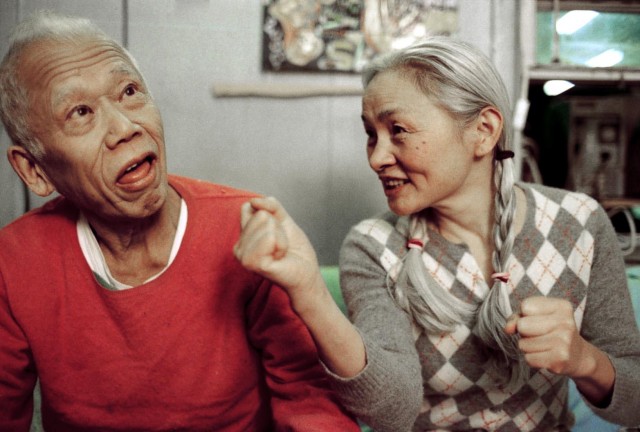
Zachary Heinzerling’s Cutie and the Boxer is a beautifully told story of love and art and the many sacrifices one must make to try to succeed in both. In 1969, controversial Japanese Neo Dada action painter and sculptor Ushio Shinohara came to New York City, looking to expand his career. According to the catalog for the recent MoMA show “Tokyo 1955-1970: A New Avant-Garde,” which featured four works by Ushio, “American art had seemed to him to be ‘marching toward the glorious prairie of the rainbow and oasis of the future, carrying all the world’s expectations of modern painting.’” Four years later, he met nineteen-year-old Noriko, who had left Japan to become an artist in New York as well. The two fell in love and have been together ever since, immersed in a fascinating relationship that Heinzerling explores over a five-year period in his splendid feature-length theatrical debut. Ushio and Noriko live in a cramped apartment and studio in DUMBO, where he puts on boxing gloves, dips them in paint, and pounds away at large, rectangular canvases and builds oversized motorcycle sculptures out of found materials. Meanwhile, Noriko, who has spent most of the last forty years taking care of her often childlike husband and staying with him through some rowdy times and battles with the bottle, is finally creating her own work, an R. Crumb-like series of drawings detailing the life of her alter ego, Cutie, and her often cruel husband, Bullie. (“Ushi” means “bull” in Japanese.) While Ushio is more forthcoming verbally in the film, mugging for the camera and speaking his mind, the pig-tailed Noriko is far more tentative, so director and cinematographer Heinzerling brings her tale to life by animating her work, her characters jumping off the page to show Cutie’s constant frustration with Bullie.
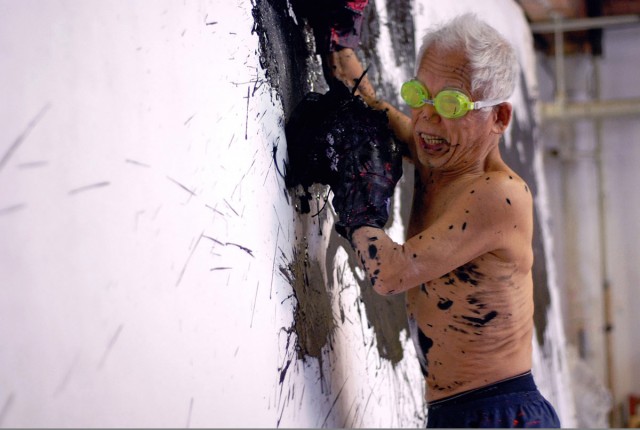
Ushio Shinohara creates one of his action paintings in CUTIE AND THE BOXER

Ushio Shinohara creates one of his action paintings in CUTIE AND THE BOXER

During the course of the too-short eighty-two-minute film — it would have been great to spend even more time with these unique and compelling figures — the audience is introduced to the couple’s forty-year-old son, who has some issues of his own; Guggenheim senior curator of Asian Art Alexandra Munroe, who stops by the studio to consider purchasing one of Ushio’s boxing paintings for the museum; and Chelsea gallery owner Ethan Cohen, who represents Ushio. But things never quite take off for Ushio, who seems to always be right on the cusp of making it. Instead, the couple struggles to pay their rent. One of the funniest, yet somehow tragic, scenes in the film involves Ushio packing up some of his sculptures — forcing them into a suitcase like clothing — and heading back to Japan to try to sell some pieces. Cutie and the Boxer is a special documentary that gets to the heart of the creative process as it applies both to art and love, focusing on two disparate people who have made a strange yet thoroughly charming life for themselves. Cutie and the Boxer is screening November 26 at 8:00 as part of MoMA’s annual series “The Contenders” and will be followed by a discussion with Heinzerling. “The Contenders,” which consists of exemplary films that MoMA believes will stand the test of time and continues with such films as Haifaa Al-Mansour’s Wadjda, Ryan Coogler’s Fruitvale Station, Alexander Payne’s Nebraska, and Richard Linklater’s Before Midnight.
THE MOBILE SHAKESPEARE UNIT: MUCH ADO ABOUT NOTHING

The Public Theater
425 Lafayette Ave.
November 25 – December 15, $20 general admission
212-967-7555
www.publictheater.org

The Public Theater’s Mobile Shakespeare Unit is back from its three-week tour of all five boroughs and other locations, bringing its free production of Much Ado About Nothing to places where people have limited or no access to the arts, including the Park Avenue Armory Women’s Mental Health Shelter in Manhattan, the Queensboro Correctional Facility and the Fortune Society in Queens, the Rose M. Singer Center and the Eric M. Taylor Center on Rikers Island, the DreamYard Project in the Bronx, and the Bedford Hills Correctional Facility in Westchester. The last stop is the Public Theater itself, where the Bard’s 1598-99 comedy about romantic mischief, mystery men, and marital mayhem will run from November 25 through December 15. The show is directed by Kwame Kwei-Armah (Detroit ’67, Elmina’s Kitchen), with choreography by Chase Brock (The Tempest, Spider-Man: Turn Off the Dark) and original music by Shane Rettig (The Unknown, the Atomic Grind Show). The cast features Michael Braun as Benedick, Samantha Soule as Beatrice, A. Z. Kelsey as Claudio and Conrade, Kerry Warren as Hero, Marc Damon Johnson as Don Pedro and Verges, Ramsey Faragallah as Leonato, Lucas Caleb Rooney as Dogberry and Don John, and Rosal Colón as Margaret, Borachia, and Friar Francis. Tickets are only $20, and there are only twenty-three performances, so you better act fast.

VIDEO OF THE DAY: “ADULT DIVERSION” BY ALVVAYS

“Is it a good time / or is it highly inappropriate?” Molly Rankin asks in “Adult Diversion,” the first single from Toronto’s Alvvays. You can decide yourself when the group plays Mercury Lounge (incorrectly identified as “Always”) on November 25, opening for Honey Wild, Hippy, and the Sanctuaries, and at Glasslands on November 26, headlining for Jacksie, Boytoy, and No Kill. Singer-guitarist Rankin, the next generation of Nova Scotia folk favorites the Rankin Family — her father, fiddler John Morris Rankin, died in a car accident in 2000 when Molly was twelve — formed Alvvays with her Cape Breton childhood neighbor, keyboardist Kerri Maclellan, later adding guitarist Alec O’Hanley, bassist Brian Murphy, and drummer Phil MacIsaac. The band has posted two songs online, the dreamy indie pop duo “Adult Diversion” and “Archie, Marry Me,” a pair of infectious tunes highlighted by Rankin’s lilting vocals. Alvvays is currently putting together its debut record for Royal Mountain, working with Canadian musician Chad VanGaalen, Graham Walsh of the Holy Fuck, and John Agnello (Sonic Youth, the Hold Steady). The disc is due next year, but you can catch the group this week and check out more of their sweet sound at these two area shows.

THE MIDDLE AGES ON FILM — SHAKESPEARE: A MIDSUMMER NIGHT’S DREAM

Warner Bros. production of Shakespeare play is a bizarre classic

A MIDSUMMER NIGHT’S DREAM (Max Reinhardt & William Dieterle, 2004)
Anthology Film Archives
32 Second Ave. at Second St.
Monday, November 25, 6:30, and Tuesday, November 26, 7:30
Series runs November 20 – December 1
212-505-5181
www.anthologyfilmarchives.org

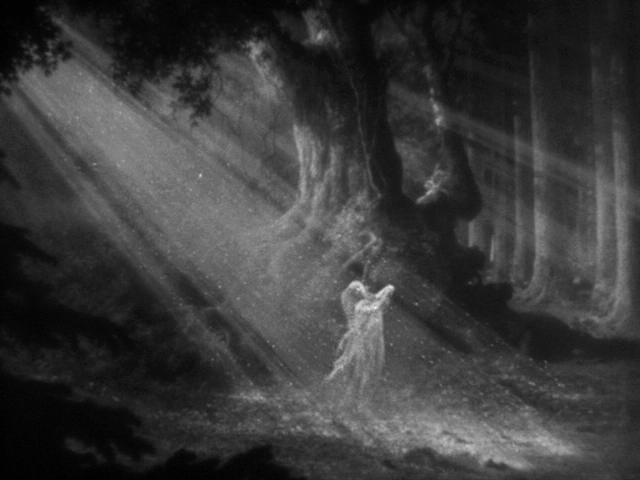
Max Reinhardt and William Dieterle’s 1935 adaptation of Shakespeare’s A Midsummer Night’s Dream is one freakishly weird flick. In a misty forest, fairies go around sprinkling love potions on sleeping humans, creating mixed-up relationships that even venture out into the realm of bestiality. “The course of true love never did run smooth,” Lysander tells Hermia, and that sums up this star-studded screwball comedy of a sort. Warner Bros. put together quite a lineup for this big-time production, with plenty of strange casting choices that end up working rather splendidly. James Cagney prances about as Bottom, Dick Powell plays Lysander, Olivia de Havilland makes her film debut as Hermia, Joe E. Brown is Flute, Billy Barty plays Mustardseed, and a teenage Mickey Rooney offers a delirious take on Puck, howling at the moon with sheer glee. The wacky movie also features Ian Hunter, Arthur Treacher, Victor Jory, and Anita Louise as the fairy queen Titania. A Midsummer Night’s Dream, which was nominated for four Oscars, including Best Picture, and won for Best Cinematography and Best Film Editing, will be screening November 25 & 26 as part of the Anthology of Film Archives series “The Middle Ages on Film: Shakespeare,” consisting of ten cinematic adaptations of several of the Bard’s history plays, set in the Middle Ages, including Grigori Kozintsev’s King Lear, Bela Tarr’s Macbeth, and Akira Kurosawa’s Ran and Throne of Blood. The twelve-day festival was curated in collaboration with professor and scholar Martha Driver, who notes about A Midsummer Night’s Dream, “In Reinhardt’s enchanted forest, the fairies, gnomes, and elves are inspired by German folk tradition. While the bewildered young lovers and the rude mechanicals are imported intact from Shakespeare’s original, the spinning of Titania’s wedding veil (before she beds Bottom) to the Wedding March of Felix Mendelssohn, a modest addition to Shakespeare’s play, remains surreal and haunting. Jimmy Cagney is a crackjack Bottom and Pyramus while Joe E. Brown inhabits the twin roles of Flute and Thisbe with panache.”

DOMESTICATED

(photo by Joan Marcus)

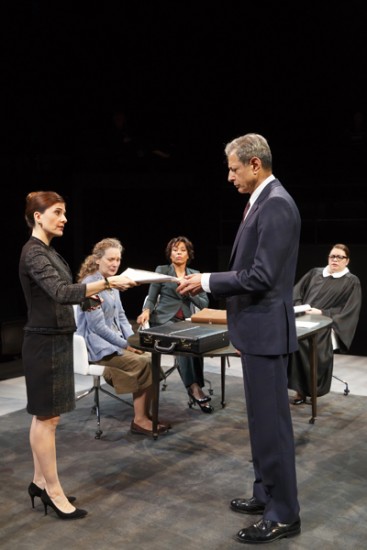
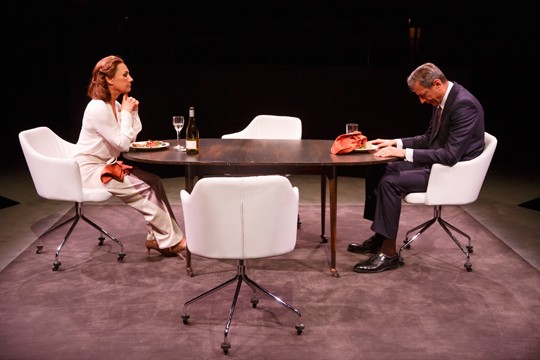
Laurie Metcalf and Jeff Goldblum play characters at opposite ends of the spectrum in Bruce Norris’s searing DOMESTICATED (photo by Joan Marcus)

Lincoln Center Theater at the Mitzi E. Newhouse
150 West 65th St. between Broadway & Amsterdam Ave.
Tuesday – Saturday through January 5, $87
212-362-7600
www.lct.org

In his previous play, the Tony- and Pulitzer Prize-winning drama Clybourne Park, Bruce Norris presented an examination of race and community in two distinct halves, the first act taking place in 1959, the second in 2009. In his follow-up, Domesticated, Norris (The Pain and the Itch, The Parallelogram) again divides his story into two parts, but this time it’s a bitter battle of the sexes, with the wife stating her case in the first act and the husband making his in the second. The torn-from-the-headlines plot begins as a disgraced cabinet member, gynecologist Bill “the Pulverizer” Pulver (Jeff Goldblum), holds a press conference to announce his resignation because of a sex scandal, with his wife, Judy (Laurie Metcalf), by his side but looking none too pleased. For nearly the rest of the first act, Judy does not allow Bill to say a word as she lets him have it, reevaluating their life together as more of Bill’s extracurricular activities come out and a young woman lies in a coma. Their high school age daughter, the rather chatty and self-involved Casey (Emily Meade), is furious about the whole situation, while their adopted Asian daughter, asthmatic thirteen-year-old Cassidy (Misha Seo), speaks only to introduce certain scenes, discussing the mating habits of various animals as if delivering a school report, with the female of the species growing more and more powerful over the course of the play. “The purpose of this presentation is to examine the nature of sexual dimorphism and the advantages and disadvantages thereby conferred,” she says early on, speaking into a microphone as video images are projected onto small screens hanging from the ceiling. “Sexual dimorphism is the physical differentiation by gender within a given species, and may include such diverse manifestations as size, color, and the presence or absence of anatomical parts such as ornamental feathers, horns, antlers, or tusks.”

The Pulverizer (Jeff Goldblum) has a whole lot of explaining to do in tense family drama (photo by Joan Marcus)

The Pulverizer (Jeff Goldblum) has a whole lot of explaining to do in tense family drama (photo by Joan Marcus)

By the end of the first act, Bill has pretty much been plucked clean, but in the second act he explains himself to anyone who will listen, from a bartender to a transgendered individual to a patient at the health clinic he cofounded. (The cast also includes Vanessa Aspillaga, Lizbeth Mackay, Mary Beth Peil, Karen Pittman, and Aleque Reid playing multiple roles, with Mia Barron as the Pulver family’s attorney and Robin De Jesus as the bar patron.) Judy and Bill then fight it out one last time in a brutal war of words that is both complex and surprising. For Domesticated, the Mitzi Newhouse has been arranged in a circle, with the action taking place in the small center space. Steppenwolf member Anna D. Shapiro, who’s directed five previous Norris plays in addition to winning a Tony for August: Osage County, has each scene overlap the next in the first act, creating a fast, fluid atmosphere that slows down considerably in the far more static second act. The show is set up like a classic courtroom drama, the prosecution presenting its case first, then the defense, and it holds up well despite the apparent one-sidedness of the argument. Some scenes fall flat, especially the ones involving an Oprah-like talk show host (Pittman), and the second act drags on too long as it documents Bill’s downfall, but it becomes alive again during its fiery conclusion. Metcalf (The Other Place) once more shows why she’s become one of New York’s most dependable, gifted, and eminently watchable stage actors, giving beautifully subtle nuances to a character who could have been one-note and repetitive. Goldblum is solid as well, easily transitioning from a silent film comedian in the first act to an overblown misogynist in the second, although the script occasionally lets him down as he does indeed grow repetitive. The play also features an important warning to all couples: Beware the triplewart seadevil. (On December 19, Goldblum and Metcalf will take part in a free Platform Series discussion in the Vivian Beaumont lobby at 6:00.)

THREE BY DAVID O. RUSSELL: THE FIGHTER

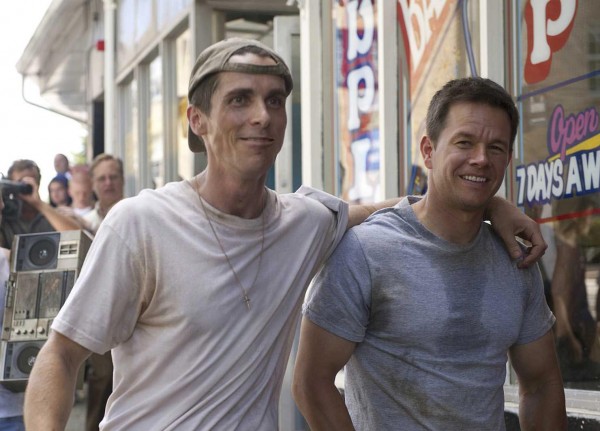
Brothers Dicky Eklund (Christian Bale) and “Irish” Micky Ward (Mark Wahlberg) go through good times and bad in THE FIGHTER

Brothers Dicky Eklund (Christian Bale) and “Irish” Micky Ward (Mark Wahlberg) go through good times and bad in David O. Russell’s THE FIGHTER

THE FIGHTER (David O. Russell, 2010)
Museum of the Moving Image
35th Ave. at 36th St., Astoria
Saturday, November 23, free with museum admission, 7:00
Series continues through December 19
718-777-6800
www.movingimage.us
www.thefightermovie.com

A lot of professional fighters face adversity in and out of the ring, but “Irish” Micky Ward took it to a whole new level on his quest to be welterweight champion of the world, as documented in the winning motion picture The Fighter. Ward (Mark Wahlberg) surrounded himself with his family, with his mother, Allice Eklund (Melissa Leo), as his manager, his half-brother, the Pride of Lowell (for once knocking down Sugar Ray Leonard), Dicky Eklund (Christian Bale), as his trainer, and his many big-haired sisters, including Tar (Erica McDermott), Little Alice (Melissa McMeekin), Pork (Bianca Hunter), Red Dog (Dendrie Taylor), and Beaver (Kate O’Brien), part of the team as well. Despite getting pummeled over and over again and continually finding his brother at a condemned crack house, Micky stands by the family until Dicky is back in prison and Micky finally decides to go with a new promoter. As his stock begins to rise again, he is deeply affected by his separation from his family, who are blaming the parting on his new girlfriend, local bartender Charlene (Amy Adams). Based on the true story of the Ward/Eklund clan of Lowell, Massachusetts, The Fighter is a poignant tale of fighting and family, of love and responsibility. Bale is a whirlwind as the effusive, drug-addicted Dicky, who dreams of helping his brother get a title shot even as he misses training sessions because of his dependence on crack. Leo, who nearly steals the show, is virtually unrecognizable as Alice, who can’t understand why Micky would go with a new crew and has quite a few battles of her own with Charlene. And Walhlberg, who trained for several years to get himself in shape for the film, is strong and solid as the conflicted yet determined potential boxing champion. Director David O. Russell (Three Kings) gives The Fighter a realistic feel, at times echoing the documentary that HBO made about Dicky in the movie, and even hiring Ward’s trainer, Mickey O’Keefe, to play himself. In fact, much of the cast got to meet their real-life counterparts, all of whom loved how they were portrayed onscreen, which is actually quite funny once you see how some of them come off. You don’t have to love boxing to love The Fighter, although fans of the sweet science will be impressed by the carefully choreographed fight scenes, complete with the original HBO commentary (and shot by some of the same cameramen). Nominated for six Academy Awards including Best Picture, Best Director, and Best Original Screenplay, with Leo winning Best Supporting Actress and Bale taking home the trophy for Best Supporting Actor, The Fighter is screening November 23 at the Museum of the Moving Image, kicking off the series “Three by David O. Russell” in anticipation of the December release of his latest film, American Hustle. The series continues December 7-8 with Silver Linings Playbook, followed by a special presentation of American Hustle on December 19, with Russell on hand to discuss it.


WORKS BY HANNA SCHAICH AND JANET BIGGS

EVELYN

Hanna Schaich’s EVELYN is one of three of her works that will mark her New York debut on November 23

Microscope Gallery
4 Charles Pl. at Myrtle Ave.
Saturday November 23, free (suggested donation $6), 7:00
347-925-1433
www.microscopegallery.com

Earlier this year, Brooklyn-based visual artist Janet Biggs teamed up with French-born Montréal installation artist Aude Moreau on a dual show at Smack Mellon as part of the “Brooklyn/Montréal” cultural exchange. Now Biggs is collaborating with German artist Hanna Schaich on a one-night-only project November 23 at Microscope Gallery in Bushwick. The evening will consist of three short films by Schaich, in her New York debut, and two by Biggs, selected by Schaich, followed by an in-depth conversation. The two works by Biggs, Brightness All Around and In the Cold Edge, were both shot during trips to the Arctic and investigate individual identity amid unique, dangerous environments. “There is clearly a performative side to my work that has to do with me physically and psychologically pushing myself or assuming some kind of risk in order to capture the images and action needed for a piece,” Biggs told us in a 2011 twi-ny talk. “I didn’t realize I was such a thrill seeker until I set out to make this kind of work. This part of my process is compelling enough that I often find myself looking for new challenges, although my exploration of the addictive nature of risky behavior is primarily as a witness to someone else’s action and off-camera.”

IN THE COLD EDGE

Janet Biggs fires a warning shot in the frozen north in her short film IN THE COLD EDGE

Schaich, who was born and raised in Berlin but is now based in Brooklyn as well, will be showing Evelyn, a portrait of an elderly woman going for a swim in a pool; Taking Over, which involves an ice-cream truck and an ice-skating rink; and Falling Into, which also deals with ice skating (and the Central Park Zoo). The latter two films evoke Biggs’s journeys to freezing zones, finding a common language between the filmmakers. “My artistic work focuses on body-related video performances and installations,” Schaich explains in her official artist statement. “My body is my tool in my artwork and takes up a large and important part of my conceptual work. Paradoxical action sequences and storylines, and playing with gender and gender roles, are key to my work.” Schaich and Biggs met earlier this year and have become fast friends, so this should be an intimate, fun, and fascinating evening.