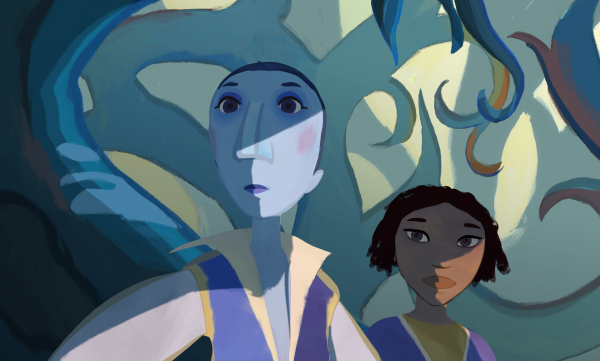
Ramo and Claire attempt to overcome class boundaries and find the creator in Jean-François Laguionie’s THE PAINTING
THE PAINTING (LE TABLEAU) (Jean-François Laguionie, 2012)
IFC Center
323 Sixth Ave. at West Third St.
Monday, December 30, 6:15
Series continues through January 2
212-924-7771
www.ifccenter.com
www.gkids.tv
 Jean-François Laguionie’s award-winning animated film, The Painting, has a very cool premise: The characters inside one of a painter’s works have organized a rigid class structure of the Alldunns, who have been completed and have sole access to the ritzy castle; the Halfies, who are not quite finished and are not allowed to join them; and the Sketchies, outlined figures who are terribly abused by the Alldunns. At the center of it all is an impossible Romeo and Juliet-like love story between the Alldunn Ramo (voiced by Adrien Larmande) and the Halfie Claire (Chloé Berthier). With the power-hungry Alldunns, led by the Great Chandelier (Jacques Roehrich), on the rampage, Ramo, the Sketchie known as Quill (Thierry Jahn), and Claire’s best friend, the Halfie Lola (Jessica Monceau), are on the run, trying to reunite the lovers and find the real-life painter so he can finish the Halfies and Sketchies and bring peace to the land. But soon they have fallen out of their painting and into the artist’s studio, where they meet characters from other works, including a reclining nude (Céline Ronte) and a self-portrait (Laguionie), and enter different canvases during their adventurous, and dangerous, search for the creator. Laguionie (Rowing Across the Atlantic, A Monkey’s Tale), who has been making animated films for five decades, has fun mimicking Modigliani, Matisse, Picasso, and other major artists, but his world-building doesn’t quite hold together as the characters continue on their colorful journey. He successfully walks that fine line between playful parable and melodramatic morality play, but things ultimately get away from him as the resolution nears. The Painting is screening December 30 at 6:15 at the IFC Center as part of the series “An Animated World: Celebrating 5 Years of GKIDS Classics,” paying tribute to GKIDS’ ongoing New York International Children’s Film Festival, which continues with such other animated works as Tono Errando, Javier Mariscal, and Fernando Trueba’s Chico & Rita, Goro Miyazaki’s From Up on Poppy Hill, and Jacques-Remy Girerd’s Mia and the Migoo.
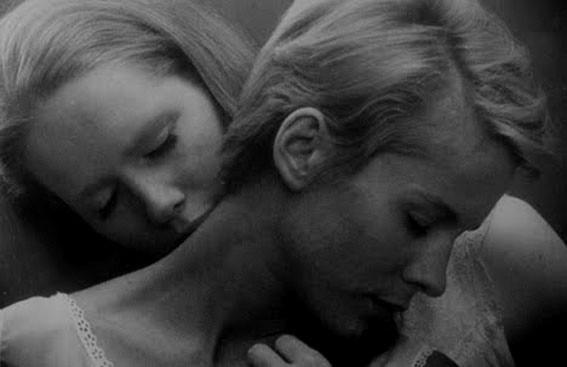
 Ingmar Bergman’s magnificently complex 1966 avant-garde masterpiece, Persona, is not just about the relationship between an actress who has suddenly decided to stop speaking and the young nurse caring for her but about the very power of film as a narrative device able to explore and examine the psychological behavior of characters both fictional and real. Persona opens with mysterious, penetrating music by Lars Johan Werle joined by the sound and image of a movie projector as the reel counts down from ten, featuring snippets of an erect male member, a cartoon, a child’s hands, a comedic silent ghost story, a tarantula, a bleeding slaughtered lamb, and a nail being hammered through a man’s palm before the camera takes viewers inside a hospital where a boy in a bed (Jörgen Lindström) starts reading Mikhail Lermontov’s mid-nineteenth-century book A Hero of Our Time, which the author describes as “a portrait, but not of one man only. . . . You will tell me, as you have told me before, that no man can be so bad as this; and my reply will be: ‘If you believe that such persons as the villains of tragedy and romance could exist in real life, why can you not believe in the reality of Pechorin?’ . . . Is it not because there is more truth in it than may be altogether palatable to you?” That passage relates to Bergman’s oeuvre as a whole but particularly to Persona, a film about identity, storytelling, and the medium itself.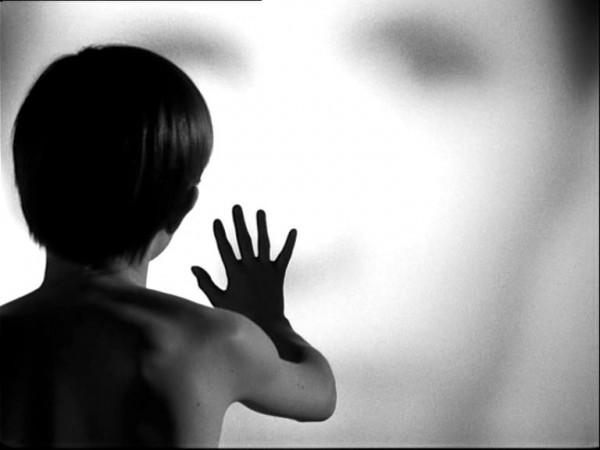



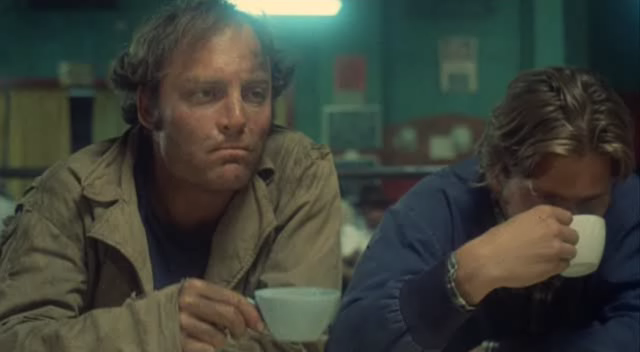
 Genre master and onetime boxer John Huston returned to the ring in Fat City, a gritty 1972 drama about a group of has-beens and never-will-be’s struggling to survive in Stockton, California. Stacey Keach stars as Billy Tully, a down-on-his-luck fighter looking to make a comeback at the ripe old age of twenty-nine. He spars at the local Y with eighteen-year-old Ernie Munger (Jeff Bridges) and likes what he sees in the kid, telling him to meet his old manager, Ruben (Cheers’ Nicholas Colosanto), who decides to take on the unseasoned youngster. While Ruben lands Ernie — who seems more interested in bragging about having scored with his girlfriend, Faye (Candy Clark), than training properly — his first few bouts, Tully gets day work picking vegetables and hangs out at a local gin joint with a seedy, whiskey-voiced barfly named Oma (an Oscar-nominated Susan Tyrrell). Legendary cinematographer Conrad Hall, who shot such wide-ranging gems as Cool Hand Luke, In Cold Blood, Butch Cassidy and the Sundance Kid, Marathon Man, and American Beauty, casts a gray pall over the proceedings as dashed hopes and dreams come falling down on these disillusioned perennial losers. In many ways Fat City, based on the novel by Leonard Gardner — who also wrote the screenplay — is an update of Elia Kazan’s On the Waterfront, but moved to the hard times of early ’70s America, when so many people had no way out. You do not have to be a fight fan to fall in love with this film. A clear influence on such auteurs as Martin Scorsese, Fat City is screening December 28 at 6:00 as part of the Museum of the Moving Image series “See It Big! Great Cinematographers,” which continues through December 29 with such other beautifully shot films as The Godfather, Persona, and Doctor Zhivago.