twi-ny recommended events

LIKE FATHER, LIKE SON

LIKE FATHER, LIKE SON

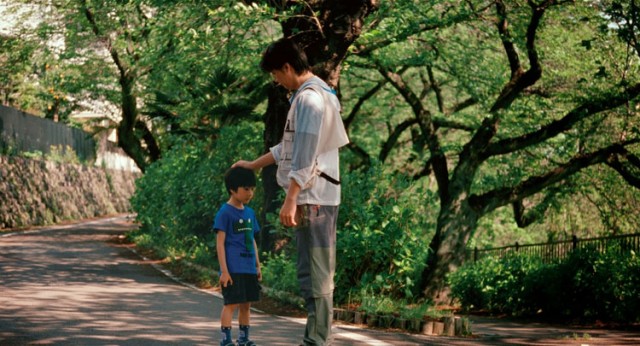
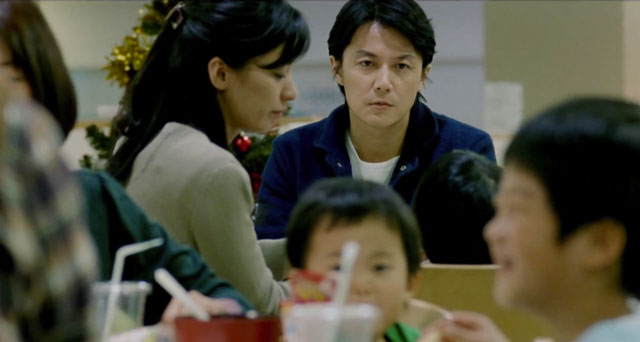
A father (Masaharu Fukuyama) must reevaluate his relationship with his son (Keita Ninomiya) in latest Hirokazu Kore-eda masterpiece

LIKE FATHER, LIKE SON (SOSHITE CHICHI NI NARU) (Hirokazu Kore-eda, 2013)
IFC Center, 323 Sixth Ave. at West Third St., 212-924-7771
Lincoln Plaza Cinema, 1886 Broadway at 63rd St., 212-757-2280
Opens Friday, January 17
www.ifcfilms.com

International cinema’s modern master of the family drama turns out another stunner in the Cannes Jury Prize winner Like Father, Like Son. Ryota Nonomiya (Masaharu Fukuyama) thinks he has the perfect life: a beautiful wife, Midori (Machiko Ono), a successful job as an architect, and a splendid six-year-old son, Keita (Keita Ninomiya). But his well-structured world is turned upside down when the hospital where Keita was born suddenly tells them that Keita is not their biological son, that a mistake was made and a pair of babies were accidentally switched at birth. When Ryota and Midori meet Yudai (Lily Franky) and Yukari Saiki (Maki Yoko), whose infant was switched with theirs, Ryota is horrified to see that the Saikis are a lower-middle-class family who cannot give their children — they have three kids, including Ryusei (Shôgen Hwang), the Nonomiyas’ biological son — the same advantages that Ryota and Midori can. Meanwhile, the two mothers wonder why they were unable to realize that the sons they’ve been raising are not really their own. As the two families get to know each other and prepare to switch boys, Ryota struggles to reevaluate what kind of a father he is, as well as what kind of father he can be.
LIKE FATHER, LIKE SON

LIKE FATHER, LIKE SON explores the power of blood connections and the concept of nature vs. nurture

Kore-eda, who previously investigated the lives of children and families in such beautiful, terrifically insightful films as Still Walking, Nobody Knows, and I Wish, wrote, directed, and edited Like Father, Like Son, imbuing the complex story with an Ozu-like austerity, examining a heartbreaking, seemingly no-win situation — one of every parent’s most-feared nightmares — with intelligence and grace. Musician and actor Fukuyama gives a powerfully understated performance as Ryota, a work-obsessed architect struggling to keep everything he has built from crumbling all around him. Novelist and actor Franky is excellent as his polar opposite, a man with a very different kind of verve for life. In Like Father, Like Son, Kore-eda, whose own father passed away ten years ago and who has a five-year-old daughter, once again explores the relationship between parents and children, this time focusing on the strong bonds created by both love and blood.


MAIDENTRIP

MAIDENTRIP

Teen sailor Laura Dekker goes on the journey of a lifetime in MAIDENTRIP

MAIDENTRIP (Jillian Schlesinger, 2013)
IFC Center
323 Sixth Ave. at West Third St.
January 17-23
212-924-7771
www.ifccenter.com
www.maidentrip.com

In 2009, thirteen-year-old Laura Dekker announced that she was going to try to become the youngest person to sail around the world solo. After a long battle with the Dutch court, the teen, who was born on a boat in New Zealand and spent her first five years at sea, took off on her journey in her thirty-eight-foot ketch appropriately dubbed Guppy. Laura’s inspiring — and controversial — story is told in the winning documentary Maidentrip. Jillian Schlesinger’s debut feature-length film follows Laura as she circumnavigates the globe by herself, sailing across long stretches of sometimes treacherous ocean and making stops to experience a variety of lands and cultures. The bulk of Maidentrip is told in Laura’s own voice, as she films herself on board Guppy and talks not only about her adventure but also about her personal life, including discussing the effects of her parents’ divorce on her and her sister when she was five. “I love being alone,” Laura says at one point. “And I guess, yeah, I feel like freedom is when you’re not attached to anything.” As serious as she is about sailing, she is still a teenager, dancing in front of the camera playfully and throwing a little hissy fit when a visitor annoys her. It all makes for an intimate coming-of-age story as Laura, who values her privacy, grows up in public. Should her parents, particularly her father, who she chose to live with, have allowed the teen to go on this trip in the first place? Is it the court’s responsibility to intercede in such situations? Schlesinger gets the controversy out of the way early, never again revisiting what many people will consider a wrongheaded and dangerous decision, but they’re likely to change their mind once they watch Laura persevere and flourish at sea. Winner of the Audience Award at the Cannes Film Festival and SXSW, Maidentrip opens January 17 at the IFC Center, with Schlesinger and producer Emily McAllister on hand to talk about the film at the 6:25 and 8:25 screenings on Friday and Saturday night.



BIG BAD WOLVES

Cop (Lior Ashkenazi) must determine how far he will go to get the truth out of suspected child killer (Rotem Keinan) in brutal black comedy

Cop (Lior Ashkenazi) must determine how far he will go to get the truth out of suspected child killer (Rotem Keinan) in brutal black comedy

BIG BAD WOLVES (Navot Papushado & Aharon Keshales, 2013)
Cinema Village, 22 East 12th St. between University Pl. & Fifth Ave., 212-924-3363
Film Society of Lincoln Center, Elinor Bunin Munroe Film Center, 144 West 65th St. between Broadway & Amsterdam Aves., 212-875-5600
Opens Friday, January 17
www.magnetreleasing.com

Israeli film critic Aharon Keshales and his former student Navot Papushado follow up their 2011 Israeli slasher flick, Rabies, with the gory, ultraviolent black-comedy thriller Big Bad Wolves. Award-winning actor Lior Ashkenazi stars as Miki, a cop who is sure that Bible teacher Dror (Rotem Keinan) is behind the grisly kidnap, rape, and murder of a young girl. Miki and his partner, Rami (Menashe Noy), and two thugs try to beat the truth out of Dror, against the direct orders of their commanding officer, Zvika (Dvir Benedek). When the illegal interrogation winds up on YouTube, Miki is relieved of duty — with Zvika’s blessing to continue to go after Dror. But when Gidi (Tzahi Grad), the father of the dead girl, joins the chase, things threaten to get out of control — and quickly become even crazier. Big Bad Wolves is a sly, smart take on such genre pictures as Oldboy, Se7en, and Quentin Tarantino’s Reservoir Dogs, Pulp Fiction, and Inglourious Basterds, featuring generous amounts of brutal torture along with some very funny bits involving Jewish mothers. Writer-directors Keshales and Papushado keep the audience guessing right up to the very end as the main characters rarely do what is expected and hysterical comic scenes show up at rather inopportune moments. While playing with the standard elements of the revenge flick and the cop-on-the-edge tale, the dark, atmospheric Big Bad Wolves also explores the unbreakable bond between parents and children, lending more than a touch of gravitas to the wild, unpredictable proceedings, which are not for the faint of heart.

BROADWAY WEEK 2014

broadway week

Multiple venues
January 21 – February 6, buy one ticket, get one free
www.nycgo.com/broadwayweek

Tickets are now on sale for the winter edition of Broadway Week, which runs January 21 through February 6 and offers theater lovers a chance to see new and long-running shows for half-price, as well as have an opportunity to pay a $20-$30 fee to upgrade to better seats. More than two dozen shows are participating, but they’re selling out fast, with the most popular selections being Beautiful: The Carole King Musical and Kinky Boots. But you can still get either regular two-for-one tickets or upgrades to such newer productions as A Gentleman’s Guide to Love and Murder, Matilda the Musical, After Midnight, The Glass Menagerie, The Bridges of Madison County, Bronx Bombers, Machinal, Outside Mullingar, No Man’s Land, Twelfth Night, and Waiting for Godot as well as such older favorites as Chicago, Jersey Boys, The Lion King, The Phantom of the Opera, Once, Pippin, Wicked, and Mamma Mia! Nope, sorry, but The Book of Mormon is not on the list.

J. P. MORGAN TOURNAMENT OF CHAMPIONS: SQUASH 2014

Grand Central

Grand Central hosts the seventeenth annual Tournament of Champions in specially designed court in Vanderbilt Hall

Grand Central Terminal, Vanderbilt Hall
42nd St. at Vanderbilt Ave.
January 17-24, $8-$50 1st round, $105-$400 finals
718-569-0594
www.tocsquash.com
www.grandcentralterminal.com

Billed as the “World’s Largest Squash Spectator Event,” the Tournament of Champions returns to Grand Central Terminal’s Vanderbilt Hall this week, kicking off eight days of squash matches and other related special events held in a specially installed ten-ton, four-walled glass court where you can either buy tickets for one of the coveted five hundred seats or just watch in a standing-room area for free. Things get under way January 16 with the free Red Bull Karim Darwish Challenge, in which the number-six-ranked squasher takes on eleven local players, from former college captains to a sixth-grade girl, in ten-minute back-to-back-to-back matches. The tournament itself runs from January 17 to 24, featuring such men as #2 Gregory Gaultier, #3 Nick Matthew, #4 Mohamed Elshorbagy, and #5 James Willstrop (top-ranked Ramy Ashour, who won last year and in 2008 and 2011, had to withdraw due to injury) and such women as #1 Nicol David, #2 Laura Massaro, #3 Raneem El Welily, and #4 Alison Waters. From January 17 to 19, you can also check out the Grand Open, a battle of amateurs. On January 19, Kids & Family Day consists of two sessions in which children can get autographs and free posters and maybe even play against a pro. And on January 24, Big Brothers Big Sisters of New York City hosts the ToC Pong Challenge, with Ping-Pong pairs fighting it out for fifteen minutes on a table tennis table in the all-glass court. The cheap seats go quickly — ticket prices start at $8 for the early rounds and reach $400 for the finals — so get yours now.

EDGAR G. ULMER — BACK FROM THE MARGINS: PEOPLE ON SUNDAY

PEOPLE ON SUNDAY (MENSCHEN AM SONNTAG) (Robert Siodmak & Edgar G. Ulmer, 1930)
Film Society of Lincoln Center
Elinor Bunin Munroe Film Center, Howard Gilman Theater
144 West 65th St. between Broadway & Amsterdam Aves.
Friday, January 17, 5:15
Series runs through January 17
212-875-5601
www.filmlinc.com

In 1930, a group of young filmmakers from Germany and Austria-Hungary got together to make an extremely low-budget silent picture about men and women just like themselves, the petite bourgeoisie of Berlin. Influenced by such documentaries as Dziga Vertov’s Man with a Movie Camera and such photographers as August Sander, the men — who would go on to become Hollywood legends — came up with the delightful seventy-three-minute People on Sunday, a light, refreshing mix of fiction and nonfiction about regular life in Germany on the heels of the Great Depression and at the dawn of the rise of National Socialism. A collaboration between directors Robert Siodmak (The Killers, Criss Cross) and Edgar G. Ulmer (The Black Cat, Detour), screenwriter Billie (Billy) Wilder (Double Indemnity, Sunset Boulevard), writer Kurt (Curt) Siodmak (The Wolf Man, The Beast with Five Fingers), cameraman Fred Zinnemann (From Here to Eternity, A Man for All Seasons), and cinematographer Eugen Schüfftan (Metropolis, Eyes without a Face), People on Sunday focuses on five ordinary folks who had never acted on-screen before, and each of whom returned to their jobs after filming was over: Somewhat goofy taxi driver Erwin Splettsdösser, flirty blond record salesgirl Brigitte Borchert, dashing wine merchant Wolfgang von Waltershausen, snooty film extra Christl Ehlers, and lackadaisical model Annie Schreyer. When Wolfgang comes upon Christl looking lost in the middle of the street, he asks her to join him at an outdoor café, and soon they have a date for the next day, Sunday. Wolfgang decides to bring along his friend Erwin, who is only too happy to leave his sleepy, bored wife, Annie, in bed. Christl, in the meantime, has brought along her friend Brigitte, and the four go on a double-date picnic that takes them to the beach, a lake, the woods, a park, and other outdoor locations. But when Wolfgang starts paying too much attention to Brigitte, Christl is none too happy.

PEOPLE ON SUNDAY

Soon-to-be-legendary Hollywood filmmakers examine a recreational day in the life of Berlin on PEOPLE ON SUNDAY

Directors Siodmak and Ulmer intersperse scenes of real urban life in Berlin with the picnic, giving the film a cinéma vérité quality. The characters both perform from a script and improvise as they get to know one another and their surroundings. It gets a little racy and it’s clearly male-centric, but People on Sunday is a splendid little tale whose place in cinema history is now being reexamined, not merely as a film by so many future superstars but also because it paved the way for the French New Wave and has influenced generations while offering a fascinating view of 1930 Berlin. People on Sunday is screening January 17 at 5:15 as part of the Film Society of Lincoln Center series “Edgar G. Ulmer: Back from the Margins,” which runs through January 18. Also being shown on January 17 is Ulmer’s Beyond the Barrier, The Light Ahead (Fishke the Lame), and Murder Is My Beat in addition to Michael Palm’s 2004 documentary, Edgar G. Ulmer: The Man Off-Screen. The series is presented in collaboration with Noah Isenberg, author of the new book Edgar G. Ulmer: A Filmmaker at the Margins (University of California, January 2014, $34.95), who wrote in a Criterion essay that “People on Sunday certainly tested the limits of filmmaking at the time. It broke new ground in the final phase of silent film production, introducing a fresh model of independent cinema (well before the term, as we understand it today, even existed) and a bare-bones realism that had a deep impact both con­temporaneously and for many years after.” On January 19, Isenberg will take part in the panel discussion “The Afterlives of Edgar G. Ulmer” with Arianné Ulmer Cipes and Stefan Grissemann at the Center for Jewish History.

VENGEANCE IS SHOHEI IMAMURA: A MAN VANISHES

A MAN VANISHES (NINGEN JŌHATSU) (Shôhei Imamaura, 1967)
Asia Society
725 Park Ave. East 70th St.
Saturday, January 18, free with advance RSVP, 6:30
Series runs January 17 – February 1
212-288-6400
www.asiasociety.org

Japanese filmmaker Shohei Imamura blurs the lines between reality and fiction in his cinéma vérité masterpiece, A Man Vanishes. The 1967 black-and-white documentary delves into one of Japan’s annual multitude of missing persons cases, this time investigating the mysterious disappearance of Tadashi Ôshima, a plastics wholesaler who vanished during a business trip. Imamura sends out actor Shigeru Tsuyuguchi (The Insect Woman, Intentions of Murder) to conduct interviews with Ôshima’s fiancée, Yoshie Hayakawa, who develops an interest in her inquisitor; Yoshie’s sister, Sayo, who quickly finds herself on the defensive; business associates who talk about Ôshima’s drinking, womanizing, and embezzling from the company; and several people who remember seeing Sayo together with Ôshima, something she adamantly denies despite the building evidence. Throughout the 130-minute work, the film references itself as being a film, culminating in Imamura’s pulling the rug out from under viewers and calling everything they’ve seen into question in an unforgettable moment that breaks down the fourth wall and explodes the very nature of truth and cinematic storytelling itself. It also explores individual identity and just how much one really knows those closest to them. Originally supposed to be the first of a twenty-four-part series exploring two dozen missing-persons cases, A Man Vanishes ended up being such a challenging undertaking that it was the only one Imamura made, but what a film it is; it would be more than a decade before he returned to fiction, with 1979’s Vengeance Is Mine, which led the way to a spectacular final two decades that also included The Ballad of Narayama, Eijanaika, Black Rain, The Eel, Dr. Akagi, and Warm Water Under a Red Bridge. The amazing A Man Vanishes is screening January 18 at 6:30 as part of the free Asia Society series “Vengeance Is Shohei Imamura,” a five-film, three-weekend salute to the two-time Palme d’Or winner, who passed away in 2006 at the age of seventy-nine, that begins January 17 with Endless Desire and continues with Vengeance Is Mine on January 24, The Ballad of Narayama on January 25, and Black Rain on February 1.