twi-ny recommended events

ACT ONE

(photo by Joan Marcus)

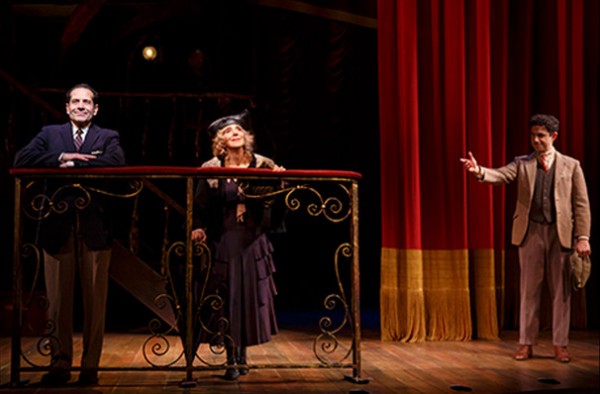
Tony Shalhoub, Andrea Martin, and Santino Fontana star in Lincoln Center adaptation of Moss Hart’s ACT ONE memoir (photo by Joan Marcus)

Vivian Beaumont Theater at Lincoln Center Theater
150 West 65th St. between Broadway & Amsterdam Ave.
Tuesday – Saturday through June 15, $77-$137
212-362-7600
www.lct.org

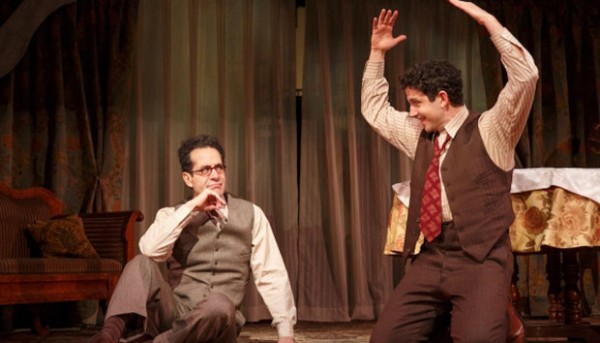
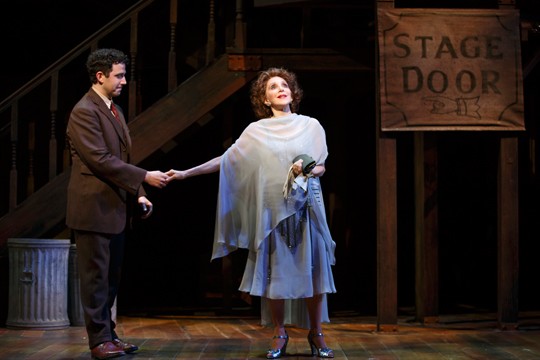
“These annals are not for those unsentimental about the theatre or untouched by its idiocies as well as its glories,” Moss Hart wrote in his beloved, highly influential 1959 memoir, Act One. “The theatre is not so much a profession as a disease, and my first look at Broadway was the beginning of a lifelong infection.” Pulitzer Prize-winning writer-director James Lapine (Sunday in the Park with George, Into the Woods) has adoringly adapted the theatrical bible into a superb new play, running through June 15 at the Vivian Beaumont. The play looks back at Hart’s theatrical education as the older Moss (Tony Shalhoub, in one of three roles) watches earlier versions of himself (Matthew Schechter as a boy, Santino Fontana as a naive young man) as his love of theater develops. When Hart was a child, he would sneak off to shows with his aunt Kate (Andrea Martin), much to the chagrin of his English-immigrant father (Shalhoub), who found it a waste of time and money, especially as the family struggled to pay the rent. Hart’s fascination continues through his teenage years, when he gets a job working for jaded old theatrical manager Augustus Pitou (Will LeBow).

(photo by Joan Marcus)

Aunt Kate (Andrea Martin) helps foster her nephew’s love of the theater (photo by Joan Marcus)

Following a series of coincidences and luck, Hart is soon collaborating with the famous Broadway playwright and director George S. Kaufman (Shalhoub), writing Once in a Lifetime upstairs in Kaufman’s ritzy home, where the literati come to celebrate themselves. While Hart is a bundle of nerves, worried that his good fortune could come crashing down at any moment, Kaufman is a whole different kind of bundle of nerves, an obsessive-compulsive man who is afraid of germs, washes his hands constantly, and lies on his back on the floor to think. These scenes between Hart and Kaufman are simply rapturous, the heart of the play — and they are also not from the book. Lapine tracked down the first draft of Once in a Lifetime, compared it to the produced version, and imagined what Hart and Kaufman’s collaboration might have been like. The relationship is handled masterfully as their creative process unfurls, continuing with an out-of-town tryout prior to the highly anticipated Broadway opening, fear of failure hovering over their every move.

(photo by Joan Marcus)

George S. Kaufman (Tony Shalhoub) and Moss Hart (Santino Fontana) collaborate on their first play together, ONCE IN A LIFETIME (photo by Joan Marcus)

Shalhoub (Golden Boy, Conversations with My Father) is ever stalwart in his multiple roles, transforming from the overheated Barnett Hart to the dapper Kaufman to the mature Moss with simplicity and grace. Fontana (Cinderella, Sons of the Prophet) has the appropriate stars-in-his-eyes look as Moss tries to establish the career of his dreams, sharing his news with such theater friends as Dore Schary (Will Brill) — who would go on to direct the all-star 1963 film adaptation starring George Hamilton as Hart and Jason Robards as Kaufman. Beowulf Boritt’s breathtaking, airy, multilevel rotating set seemingly has a life of its own as it travels from 1914 to 1930, depicting poverty and wealth, success and disappointment. Just as Hart’s memoir was a love letter to the theater, so is this estimable Lincoln Center adaptation, a warmhearted production that steers well clear of the kind of sentimentality that Hart and Kaufman so consciously avoided. “It is hard to realize now in these days of television, movies, radio, and organized play groups what all this meant to a child of those days,” Hart wrote in his memoir, which was always meant to be a single volume despite its title. “It was not only the one available source of pleasure and wonder, it was all of them rolled into one.” Such is the joy of this stage version of Act One as well.

FREE SUMMER DANCE 2014

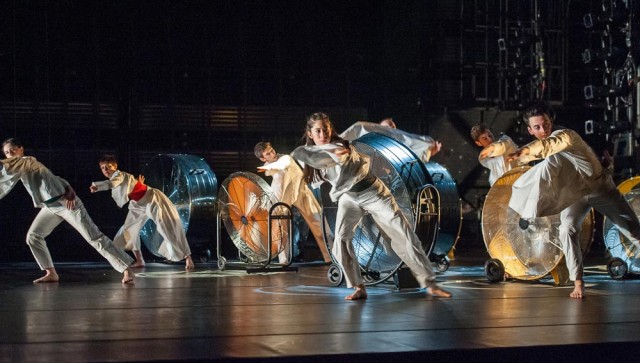
Trisha Brown’s “I’m going to toss my arms — if you catch them they’re yours” will be performed June 25-26 as part of the River to River tribute to the legendary company (© Laurent Phillipe)

Trisha Brown’s “I’m going to toss my arms — if you catch them they’re yours” will be performed June 25-26 as part of summer-long River to River tribute to the celebrated choreography (© Laurent Phillipe)

The highlight of this summer’s free dance programs is River to River’s tribute to Trisha Brown, including an exhibition, a conversation and Q&A, an open rehearsal, and live performances, taking place on Governors Island and other locations. Among the other festivals featuring dance are Lincoln Center Out of Doors, SummerStage, Hudson River Park’s Moondance, and Celebrate Brooklyn! Keep watching this space for updates as more events are announced.

Saturday, May 24
River to River Festival: Open Studio with Tere O’Connor, LMCC Arts Center at Governors Island, 2:00

Sunday, May 25
River to River Festival: Open Studio with Joanna Kotze, LMCC Arts Center at Governors Island, 3:00

Saturday, June 7
Red Hook Fest, with the Dance Cartel, Dendê and Band, Gallim Dance, Godsell Dance Collective, and Underground System, Louis J. Valentino Jr. Park & Pier, 12 noon – 7:00

Friday, June 13
Bryant Park Presents Modern Dance: Elisa Monte Dance, Buglisi Dance Theatre, Jennifer Muller/The Works, Bryant Park Stage, 6:00

Friday, June 20
Bryant Park Presents Modern Dance: Stephen Petronio Dance, NØA Dance, UnderOneDances, the Dash Ensemble, Bryant Park Stage, 6:00

SummerStage Presents Jason Samuels Smith, All Levels Open Dance Master Class with Jamal Jackson at 7:00, performance by tap-dancer Jason Samuels Smith and composer Owen “Fiidla” Brown at 8:00, Herbert Von King Park

Friday, June 20
through
Sunday, June 29

River to River Festival — Trisha Brown Dance Company: “Embodied Practice and Site Specifity,” exhibition, LMCC Arts Center at Governors Island

Friday, June 20
and
Sunday, June 22

River to River Festival — Eiko: Two Women, duet with Tomoe Aihara, LMCC Arts Center at Governors Island, 2:00

Friday, June 20, 3:00
and
Saturday, June 21, 1:00 & 3:00

River to River Festival — Vanessa Anspaugh: What Was Wasn’t Here, performed by Vanessa Anspaugh, Addys Gonzalez, and Bessie McDonough-Thayer, LMCC Arts Center at Governors Island

Saturday, June 21
SummerStage Presents ChoreoQuest: All Levels Open Dance Master Class with Jamel Gaines at 7:00, performance by ChoreoQuest at 8:00, Herbert Von King Park

Saturday, June 21
River to River Festival Living Room — Ephrat Asherie & Hector Arce-Espasas: Everyday I’m Hustlin’, VBar, South Street Seaport, 9:00

Sunday, June 22
River to River Festival — In Conversation: Susan Rosenberg on Trisha Brown, LMCC Arts Center at Governors Island, 4:30

Sunday, June 22, 7:00 & 8:00
and
Tuesday, June 24, 7:30

River to River Festival — enrico d wey: where we are right now, Pier 15, South Street Seaport

Monday, June 23
through
Wednesday, June 25

River to River Festival — untitled site-specific duet choreographed by Tere O’Connor, performed by Michael Ingle and Silas Riener, Elevated Acre, 1:00

Tuesday, June 24, 3:00
and
Wednesday, June 25, 3:00 & 5:00

River to River Festival — Souleymane Badolo: , of history (Virgule de l’histoire), John Street Church Courtyard

Wednesday, June 25
River to River Festival — Trisha Brown Dance Company: I’m going to toss my arms — if you catch them they’re yours, open rehearsal, Pier 15, South Street Seaport, 7:00

Wednesday, June 25, 2:45
and
Thursday, June 26, 1:45 & 3:45

River to River Festival — Reggie Wilson: …Moses(es), St. Cornelius Chapel, Governors Island

Thursday, June 26
River to River Festival — Trisha Brown Dance Company: I’m going to toss my arms — if you catch them they’re yours, performance, Pier 15, South Street Seaport, 4:00

Thursday, June 26, 5:00
Saturday, June 27, 1:00
and
Sunday, June 28, 1:00

River to River Festival — The Set Up: I Nyoman Catra by Wally Cardona & Jennifer Lacey, 120 Wall St.
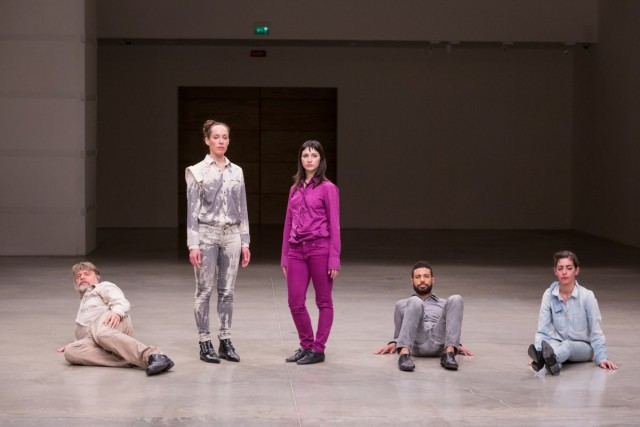
Maria Hassabis PREMIERE will move outside to Bowling Green

Maria Hassabi’s mesmerizing PREMIERE will move outside to Bowling Green

Friday, June 27
Bryant Park Presents Modern Dance: Take Dance, Steps Ensemble, BodyStories: Teresa Fellion Dance, Bryant Park Stage, 6:00

River to River Festival — In Conversation: Maria Hassabi, Paolo Javier & Kaneza Schall, Poets House, 7:00

Friday, June 27, 3:00
and
Saturday, June 28, 3:00 & 5:00

River to River Festival — Maria Hassabi: Premiere, Bowling Green

Saturday, June 28
and
Sunday, June 29

River to River Festival — Bronx Gothic: The Oval, Open Studios with LMCC artist in residence Okwui Okpokwasili, LMCC Arts Center at Governors Island, 3:00

Friday, July 4
Bryant Park Presents Modern Dance: Booking Dance Festival Edinburgh, with Art of Motion, Antara Bhardwaj, Barkin/Selissen Project, Buggé Ballet, Dzul Dance, Michael Mao Dance, Rebecca Stenn, Reed Dance, Synthesis Dance, and Compagnie Christiane Emmanuel, Bryant Park Stage, 6:00

Wednesday, July 2
SummerStage Presents Urban Bush Women, Laurie M. Taylor, and Soul Movement, Central Park, 8:00

Friday, July 11
SummerStage Presents Ballet Hispanico’s BHdos, All Levels Open Dance Master Class at 7:00, performance at 8:00, St. Mary’s Park

Saturday, July 12
SummerStage Presents Urban Bush Women, All Levels Open Dance Master Class at 7:00, performance at 8:00, St. Mary’s Park

Sunday, July 13
Moondance: Swing with David Berger Jazz Orchestra, Pier 84, Hudson River Park, lessons at 6:30, live music at 7:00

Wednesday, July 15
SummerStage Presents Ballet Hispanico and A Palo Seco, Central Park, 8:00

Thursday, July 17
Celebrate Brooklyn! Shen Wei Dance, Prospect Park Bandshell, 8:00

Friday, July 18
SummerStage Presents Harambee Dance Company, All Levels Open Dance Master Class at 7:00, performance at 8:00, Queensbridge Park

Sunday, July 20
Moondance: Salsa with Los Hermanos Colon, Pier 84, Hudson River Park, lessons at 6:30, live music at 7:00

Tuesday, July 22
Lincoln Center Out of Doors Brasil Summerfest — screening of Passinho Dance Off: The Movie, David Rubenstein Atrium, 6:30

Tuesday, July 22
Lincoln Center Out of Doors Brasil Summerfest — Behind the Groove: Welcome Party for A Batalha do Passinho, with DJ KS*360, David Rubenstein Atrium, 8:00

Thursday, July 24
Lincoln Center Out of Doors: Rennie Harris Puremovement (Get it, Church, Spirit Migrations, Students of the Asphalt Jungle) and A Batalha do Passinho, Damrosch Park Bandshell, 7:30
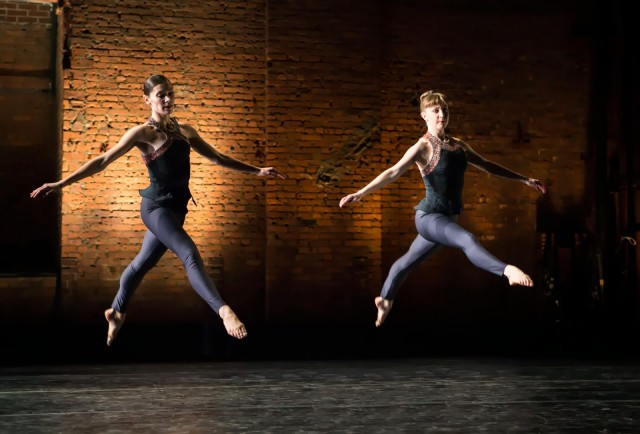
Pam Tanowitz’s PASSAGEN is part of Lincoln Center dance program (photo by Yi-Chun Wu)

Pam Tanowitz’s PASSAGEN is part of Lincoln Center dance program on June 25 (photo by Yi-Chun Wu)

Friday, July 25
Lincoln Center Out of Doors: Pam Tanowitz Dance (PASSAGEN featuring violinist Pauline Kim Harris, excerpt from The Spectators featuring FLUX Quartet) and eighth blackbird (Erase by Andy Akiho, Murder Ballades by Bryce Dessner, Counting Duets by Tom Johnson/“Études” by György Ligeti, these broken wings 3 by David Lang), Damrosch Park Bandshell, 7:30

Saturday, July 26
Lincoln Center Out of Doors — Family Day: Baby Loves Disco — A Family Dance Party, Roslyn and Elliot Jaffe Dr., 11:00 am and 2:00 pm; A Batalha do Passinho Dance Class, Hearst Plaza, 1:00; National Dance Day, Josie Robertson Plaza, 4:00

Sunday, July 27
Moondance: Swing with Vince Giordano & the Nighthawks, Pier 84, Hudson River Park, lessons at 6:30, live music at 7:00

Thursday, July 31
Celebrate Brooklyn! Dance Theatre of Harlem and Leyla McCalla, Prospect Park Bandshell, 7:30

Friday, August 1
Lincoln Center Out of Doors: Paul Taylor Dance Company (Fibers, Aureole, Piazzolla Caldera) and Pablo Ziegler’s New Tango Ensemble, Damrosch Park Bandshell, 7:30

Saturday, August 2
Lincoln Center Out of Doors: Camille A. Brown and Dancers (Mr. TOL E. RAncE) and Stew & the Negro Problem, Damrosch Park Bandshell, 7:00
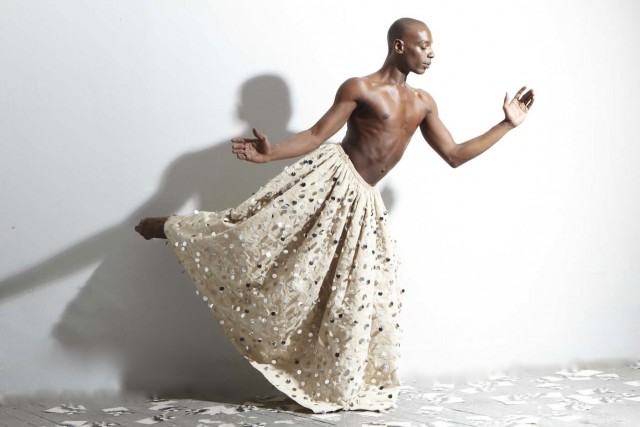
Germaul Barnes of Viewsic Expressions Dance will lead a master class at SummerStage program in East River Park on August 8

Germaul Barnes of Viewsic Expressions Dance will lead a master class at SummerStage program in East River Park on August 8

Sunday, August 3
Moondance: Salsa with Nu D’Lux, Pier 84, Hudson River Park, lessons at 6:30, live music at 7:00

Wednesday, August 6
Uptown Bounce: Summer Nights at 104th & Fifth — Throwback, with DJ D’Marquesina, DJ Grand Master Caz, breakdancers the NBS Crew, video projections and sidewalk art by the Murcielagos Fumando Collective, and discussion with Perla de Leon, 6:00

SummerStage Presents Spectrum Dance Theater and Sidra Bell Dance NY, Central Park, 8:00

Thursday, August 7
Lincoln Center Out of Doors: Ragamala Dance with Rudresh Mahanthappa (Song of the Jasmine), Kun-Yang Lin/Dancers (Be/Longing 2), and Chinese American Arts Council Dancers (From Chinatown with Love), Damrosch Park Bandshell, 7:30

Friday, August 8
SummerStage Presents Spectrum Dance Theater, All Levels Open Dance Master Class with Germaul Barnes at 7:00, performance at 8:00, East River Park

Saturday, August 9
SummerStage and Valerie Gladstone present Dance Off the Grid, Master Class with Evidence at 7:00, performance at 8:00, East River Park

Sunday, August 10
Moondance: Swing with George Gee Swing Orchestra, Pier 84, Hudson River Park, lessons at 6:30, live music at 7:00

Sunday, August 10
through
Saturday, August 16

Downtown Dance Festival, Battery Park

August 13
Uptown Bounce: Summer Nights at 104th & Fifth — Remix, with DJ D’Marquesina, DJ Grand Master Caz, Kelly Peters and his Generation X Hip Hop Dancers, video projections and sidewalk art by the Murcielagos Fumando Collective, and El Museo founder Raphael Montañez Ortiz in conversation with Chon Noriega, 6:00

Friday, August 15
SummerStage and the Firehouse Present: The Harlem Dance Caravan: Erasing the Boundaries, All Levels Open Dance Master Class with Theresa Lavington at 7:00, performance at 8:00, Marcus Garvey Park

Saturday, August 16
SummerStage and the Firehouse Present: The Harlem Dance Caravan: Erasing the Boundaries, All Levels Open Dance Master Class with Calvin Wiley at 7:00, performance at 8:00, Marcus Garvey Park
THE DANCE OF REALITY

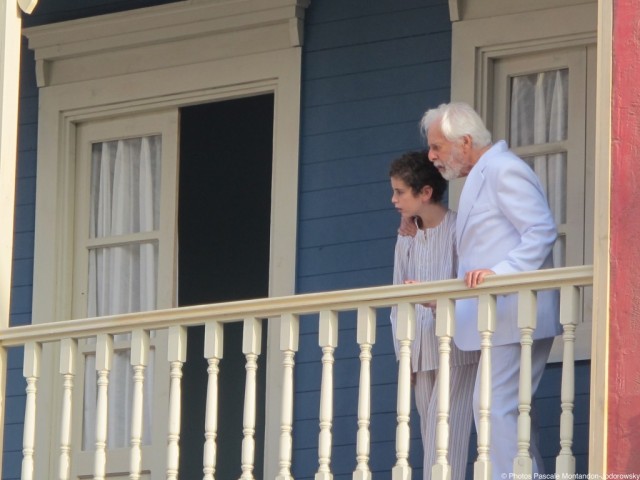
Alejandro Jodorowsky visits his hometown and his childhood self (Jeremias Herskovits) in THE DANCE OF REALITY

Alejandro Jodorowsky visits his hometown and his childhood self (Jeremias Herskovits) in THE DANCE OF REALITY

THE DANCE OF REALITY (LA DANZA DE LA REALIDAD) (Alejandro Jodorowsky, 2013)
Landmark Sunshine Cinema
143 East Houston St. between First & Second Aves.
Opens Friday, May 23
212-330-8182
www.landmarktheatres.com
www.danceofrealitymovie.com

Cult legend Alejandro Jodorowsky’s first film in twenty-three years is a deeply intimate, visually stunning journey into his childhood, a surreal Amarcord as only he can make it. In the gorgeous The Dance of Reality, the man behind such midnight-movie classics as 1970’s El Topo and 1973’s The Holy Mountain travels back to his hometown, the small coastal village of Tocopilla, Chile, where he relives and reimagines seminal moments in his life. The eighty-four-year-old Jodorowsky is often on-screen, melding past, present, and future, as his younger self (Jeremias Herskovits), sporting a gloriously ridiculous mound of golden curls, wanders among circus performers, amputees, and other oddballs and disenfranchised souls that would make Fellini proud. It’s a dazzling family affair in more ways than one: Jodorowsky’s son Brontis plays his father, Jaime, a Stalinist with a rather strong dislike for Chilean leader Carlos Ibáñez (Bastian Bodenhöfer), while son Adan plays the town anarchist (and composed the score) and son Cristóbal is a mystical theosophist. Jodorowsky’s mother, Sara (Pamela Flores), always wanted to be a singer, so he has the buxom woman deliver all her lines as if she is in an opera. And his wife, painter Pascale Montandon-Jodorowsky, designed the fantabulous costumes. “You and I have only been memories, never reality,” Jodorowsky says in voice-over. “Something is dreaming us. Give yourself to the illusion. Live!” Indeed, The Dance of Reality is like a dream, bathed in spectacular color and boasting a triumphant spirit even as death beckons.
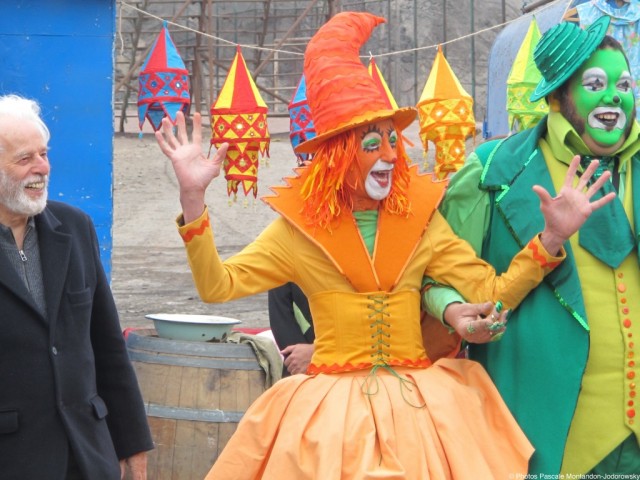
Alejandro Jodorowskys first film in twenty-three years is a colorful melding of past, present, and future

Alejandro Jodorowsky’s first film in twenty-three years is a colorful melding of past, present, and future

Even the publicity for the film is handled with typical Jodorowskian flourish. “I see no difference between poetry and film. I see no difference between stripping the body and the soul naked. I am who I am,” he says in an online video introduction in which he sits completely naked, adding, “In full honesty, undressed boy, undressed soul, in pure poetry.” Jodorowsky (Santa Sangre, Fando y Lis) undresses himself for all to see in The Dance of Reality, a lovingly poetic and personal work of art beautifully shot by Jean-Marie Dreujou. It is Jodorowsky, so it’s also wild and unpredictable, flabbergasting and confusing, mesmerizing and charming. It also marks a new phase in the career of the comic-book writer, philosopher, playwright, and self-described “atheist mystic” who vows not to wait another two decades for his next film (and not just because he is in his mid-eighties) and is currently preparing a MoMA exhibition that might involve him reading tarot cards for museum visitors. “Films should have a purpose, to open our consciousness,” he says in that video introduction. The Dance of Reality is another fascinating stop on Jodorowsky’s continuing voyage of opening people’s consciousness and, perhaps, as he adds, to “begin to change the world.”

STAND CLEAR OF THE CLOSING DOORS

STAND CLEAR OF THE CLOSING DOORS

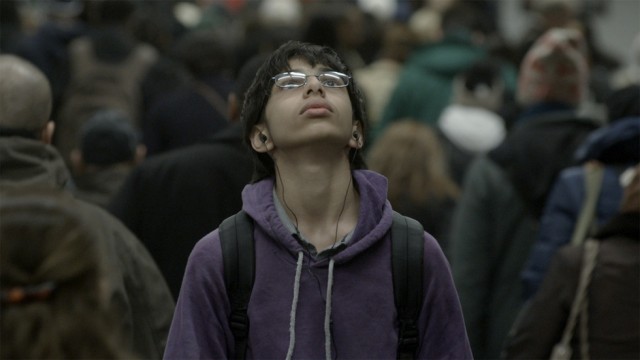
An autistic teen (Jesus Sanchez-Velez) goes on a subway adventure in STAND CLEAR OF THE CLOSING DOORS

STAND CLEAR OF THE CLOSING DOORS (Sam Fleischner, 2013)
Cinema Village
22 East 12th St. between University Pl. & Fifth Ave.
Opens Friday, May 23
212-924-3363
www.standclearclosingdoors.com
www.cinemavillage.com

It’s a sight New Yorkers see all too often: flyers on the streets and in the subways seeking help in finding a missing man, woman, or child, who is often autistic. Sometimes they have happy endings, like when fourteen-year-old Eliceo Cortez returned to his mother’s arms in Brooklyn. But other times, the search ends in tragedy, as when the remains of fourteen-year-old Avonte Oquendo were discovered in the East River. In his solo narrative feature debut, director Sam Fleischner tells the compelling story of thirteen-year-old Ricky (Jesus Sanchez-Velez), a boy with Asperger syndrome who wanders away one day after school, riding the subways while his mother, Mariana (Andrea Suarez Paz), desperately but calmly tries to find him. Mariana’s husband, Ricardo Sr. (Tenoch Huerta Mejía), is an illegal immigrant working on a job upstate, so he can’t come down to help, and she is hesitant to deal with the police, for obvious reasons. Meanwhile, her relationship with her teenage daughter, Carla (Azul Zorrilla), is strained because it was Carla’s job to pick up Ricky from a school that believes he would be better off in a special program elsewhere. Fleischner combines elements of his codirecting feature debut, Wah Do Dem, a fish-out-of-water tale about a Brooklyn musician who finds a new life in Jamaica, with Below the Brain, his visually stirring documentary about Brooklyn’s West Indian American Day Carnival, in the lovingly rhythmic, poetically paced Stand Clear of the Closing Doors. Fleischner cuts between Mariana’s New York City, where she has to continue to work as a cleaning woman for wealthy families even as her boy is missing, and Ricky’s skewed yet beautiful view of a city, both inviting and frightening, that he is lost in.
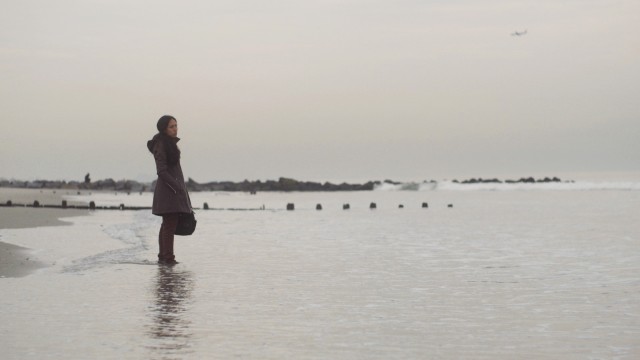
A mother (Andrea Suarez Paz) searches for her missing autistic son in compelling film set in Rockaway Beach

A mother (Andrea Suarez Paz) searches for her missing autistic son in compelling film set in Rockaway Beach

Despite the subject matter — a dedicated and loving mother trying to locate her missing child — the film has a serene, tranquil quality. There are no histrionics, no screaming or crying. There are no heavy political statements about illegal immigration or the flawed school system. Instead, Fleischner keeps things subdued, letting the story play out in a more natural and believable way, even as Hurricane Sandy approaches. (The film was shot on Rockaway Beach, where Fleischner lives; he had to make significant adjustments to incorporate the storm, which he does with a subtle effectiveness.) It’s hard to take your eyes off Sanchez-Velez, who is on the autism spectrum himself, as he meanders underground, making contact with strangers and seeking out food while taking in the sights — and sounds, which are practically a character unto themselves — of New York City. Suarez Paz, who Fleischner found on a crosswalk outside Prospect Park, gives a heartfelt performance as Mariana, maintaining a steadfast composure throughout. Marsha Stephanie Blake (Hurt Village, Queens Boulevard) offers fine support as a caring sneaker-store clerk who befriends Mariana. Written by Rose Lichter-Marck and Micah Bloomberg and wonderfully photographed by Adam Jandrup and Ethan Palmer, Stand Clear of the Closing Doors is a small gem of a film, a kind of Little Fugitive for the twenty-first century. And you’ll never look at a missing-child flyer the same way again. Winner of a Special Jury Prize at the 2013 Tribeca Film Festival, Stand Clear of the Closing Doors opens May 23 at Cinema Village, with Fleischner participating in Q&As following the 7:00 screenings on Friday and Saturday night.

MIZOGUCHI: OSAKA ELEGY

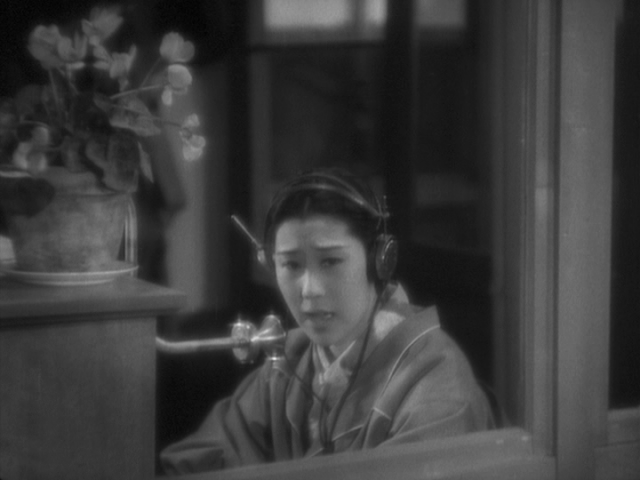
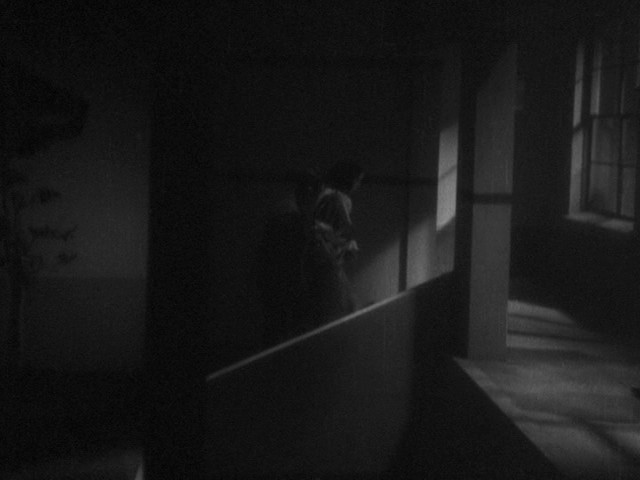
Isuzu Yamada stars as a modern woman trapped by traditional values in OSAKA ELEGY

Isuzu Yamada stars as a modern woman trapped by traditional values in OSAKA ELEGY

OSAKA ELEGY (NANIWA EREJII) (Kenji Mizoguchi, 1936)
Museum of the Moving Image
35th Ave. at 36th St., Astoria
Saturday, May 24, 7:00, and Saturday, May 31, 3:00, free with museum admission of $12
Series runs May 2 – June 8
718-777-6800
www.movingimage.us

If Osaka Elegy had been made by Ernst Lubitsch, George Cukor, or Billy Wilder, perhaps it would have been a screwball farce or a bittersweet romantic comedy. Instead, in the hands of Japanese auteur Kenji Mizoguchi, it is a searing, hard-hitting drama that began his poignant quartet of Fallen Women films. A companion piece to Sisters of the Gion — both films were made in 1936 with a similar cast and crew and both examine the changing roles of women in 1930s Japan, as tradition battles modernity — the black-and-white Osaka Elegy starts out with a bright, cheery, jazzy opening and beckoning neon lights that are not seen again till reflected in a river in the memorable finale, the music now very different. Isuzu Yamada (Throne of Blood, Tokyo Twilight) stars as Ayako Murai, a telephone operator at a pharmaceutical company who, because of the Japanese concept of giri, is responsible for repaying three hundred yen her drunkard father (Seiichii Takekawa) embezzled from his job. Desperate to keep him out of jail, she accepts an offer to become the mistress of her boss, Mr. Asai (Benkei Shiganoya), jeopardizing her potential relationship with coworker Nishimura (Kensaku Hara) and making an enemy out of her boss’s wife, Sumiko (Yoko Umemura). But when her brother, Hiroshi (Shinpachiro Asaka), needs another two hundred yen to complete his schooling, she considers an offer from another big shot at work, Mr. Fujino (Eitarō Shindō), continuing her downfall.

Darkness hovers throughout Kenji Mizoguchis OSAKA ELEGY

A shadowy darkness hovers over Kenji Mizoguchi’s OSAKA ELEGY

Written by Yoshikata Yoda (based on a story by Mizoguchi) and photographed by Minoru Miki, Osaka Elegy captures a pre-WWII Japan that is caught between traditional values and the promise of freedom of the modern world, particularly as it applies to women. Ayako wears contemporary clothing and wants to make decisions for herself but cannot escape the old ways. She is judged by nearly everyone she meets except for Dr. Yoko (Kunio Tamura), a modern-thinking man who ultimately cannot save her. While Ayako believes one can erase the past and follow true love, she is surrounded by loveless marriages, overpowering misogyny, and people afraid to break out of their expected roles. Mizoguchi, whose family sold his older sister into prostitution when he was a boy, went on to make such other powerful, female-centric, and tragic tales as Street of Shame and Women of the Night, commenting on the social conditions in twentieth-century Japan. The government actually banned the film in 1940, citing it as “decadent.” Osaka Elegy is screening May 24 at 7:00 and May 31 at 3:00 as part of the Museum of the Moving Image’s five-week tribute to the master auteur — who made more than eighty films, less than half of which still exist — which continues through June 8 with such other works as The 47 Ronin, Miss Oyu, The Crucified Lovers, and A Woman of Rumor.

LES MISÉRABLES

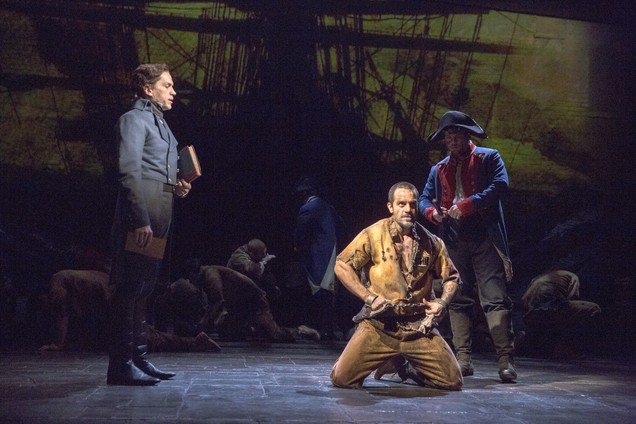
(photo by Matthew Murphy)

Javert (Will Swenson) is obsessed with Jean Valjean (Ramin Karimloo) in LES MISÉRABLES (photo by Matthew Murphy)

Imperial Theatre
249 West 45th St. between Broadway & Eighth Ave.
Tuesday – Sunday through October 19, $57-$285
www.lesmis.com/broadway

Let me preface this by publicly admitting that I have never read Victor Hugo’s massive 1820 novel, nor have I seen Richard Boleslawski’s 1935 film (starring Fredric March and Charles Laughton) or any previous stage production, many of which were met by tepid reviews at best. (The show debuted on Broadway in 1987, running for sixteen years, then was revived briefly in 2006.) My introduction to the world of Jean Valjean and Inspector Javert, Cosette and Éponine was via Tom Hooper’s tedious, overblown, yet Oscar-nominated 2012 movie. So my expectations were pretty low when I entered the Imperial Theatre to see this reboot of Cameron Mackintosh’s Broadway phenomenon. I can now understand the mania that surrounds the lavish musical, though I’m not quite part of the cult yet. Les Miz follows the endless pain and anguish of Valjean (Ramin Karimloo), prisoner 24601, who is released after spending nineteen years in prison for stealing a loaf of bread to help feed his sister’s family. As he tries to make something of his life in early-nineteenth-century France, he is hounded by Javert (Will Swenson), who wants him back behind bars. Over the course of seventeen years (1815-32), Valjean meets Fantine (Caissie Levy), a young woman forced into prostitution; raises her daughter, Cosette (Angeli Negron or McKayla Twiggs as a girl, Samantha Hill as a grown woman); and allies himself with a group of revolutionaries that include Éponine (Nikki M. James), Marius (Andy Mientus), Enjoiras (Kyle Scatliffe), and the brave boy Gavroche (Joshua Colley or Gaten Matarazzo).

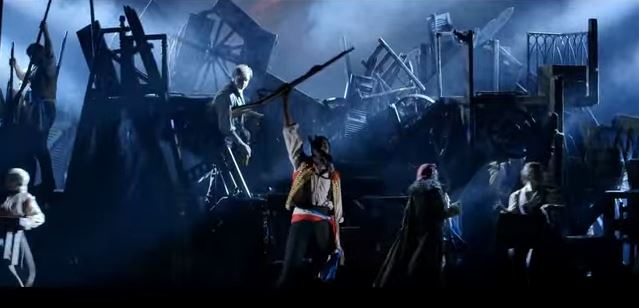
makes another triumphant return to the Great White Way (photo by Matthew Murphy)

LES MISÉRABLES makes another triumphant return to the Great White Way (photo by Matthew Murphy)

Directors James Powell and Laurence Connor have subdued the staging somewhat while including fabulous projections that enhance several scenes, replacing the famed rotating set with a series of dark, wood-based constructions (designed by Matt Kinley) that put the performers front and center. Indeed, as each one takes the stage, the audience cheers the character, who then breaks into familiar songs under the spotlight. There’s more a feeling of competition than usual with musical revivals as the crowd waits with bated breath to see how this new cast handles the beloved score, written by composer Claude-Michel Schönberg with English lyrics by Herbert Kretzmer. (The book is by Alain Boublil.) Karimloo makes an impressive Broadway debut as Valjean, establishing his admirable chops with his early “Soliloquy” and later nailing the epic “Bring Him Home.” (The role is played by Aaron Walpole or Nathaniel Hackmann on Thursdays so Karimloo can rest his voice.) Swenson (Priscilla Queen of the Desert, Hair) plays Javert with just the right boldness, making him a great foil for Valjean. Cliff Saunders and Keala Settle have the requisite amount of fun as the Thénardiers, chewing the scenery with “Master of the House,” Tony winner Nikki M. James (The Book of Mormon) gives a heartfelt performance as Éponine, leading the second act with a stirring “On My Own,” and Andy Mientus offers up a fine “Empty Chairs at Empty Tables” as Marius. Is this Les Misérables still over the top, at times bombastic, with treacly religious sentiment and sappy melodrama? Absolutely. But that’s also part of the charm, which it has in abundance.

PHIL LESH AND FRIENDS

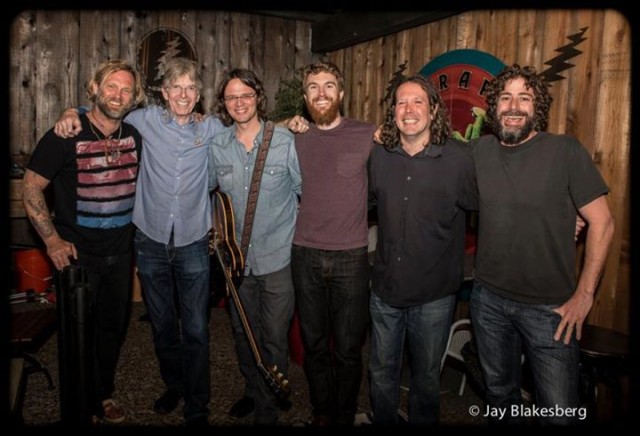
Phil Lesh & Friends will jam in Rumsey Playfield in Central Park on May 28

Phil Lesh & Friends will jam in Rumsey Playfield in Central Park on May 28 and 31

Rumsey Playfield, Central Park
Wednesday, May 28, $49.50 – $99.50, 6:00
Saturday, May 31, $49.50 – $99.50, 4:30
www.phillesh.net
www.thecapitoltheatre.com

It’s hard to believe, but it has been almost two decades since the death of Jerry Garcia brought an end to the “long, strange trip” that constituted the never-ending touring cycle of that most distinctive of rock bands, the Grateful Dead. After Garcia passed away in 1995, the other members of the band pursued various projects of their own, as well as combining forces in varying lineups known as the Other Ones, the Dead, and Furthur, all of them building on and continuing the group’s musical journey and evolution. Any number of the musicians shuffling in and out of the band’s roster had their own musical proclivities: Garcia was a devoted fan of the bluegrass and folk music at the roots of the Grateful Dead’s psychedelicized sound. Bob Weir was a rock ‘n’ roll enthusiast. Ron “Pigpen” McKernan lived for the blues, while Mickey Hart’s interests gravitated toward world music and percussion excursions. Through it all, Phil Lesh was an anchor and a constant presence in the Grateful Dead, manning the bass guitar since their days as the Warlocks in mid-1960s San Francisco. Though his repertoire spanned the entire gamut of the group’s musical interests, Lesh’s own musical leanings veered toward the experimental fringe — Karlheinz Stockhausen and Charles Ives are influences — and in his own excursions interpreting the Grateful Dead canon a sense of improvisation and experimentation is always present.

Lesh has stayed active (and then some) since the demise of the original group. Besides participating in the post-GD offshoots with his former bandmates, he has been on the road with his own rotating collection of musical acolytes for the better part of the past fifteen years. These ensembles, Phil Lesh & Friends officially, have featured a veritable encyclopedia of musicians affiliated with any number of styles, from jam-band veterans to blues legends and any number of Lesh’s contemporaries through the years. The M.O. of his performances can vary but usually highlight songs from the Grateful Dead catalog, both obscure and popular and played in the spirit of the original band; set lists vary night to night, and the songs can be interpreted in different ways depending on the performance. Since receiving a liver transplant in 1998, Lesh has made it a point to promote organ donor awareness at his concerts and continues the tradition of playing multiple charity benefits. In recent years, the septuagenerian (yes, he’s seventy-four) bassist has taken a nod to his health and cut back on his relentless touring schedule to operate from a home base in Marin County, where he has established his own venue, Terrapin Crossroads, getting together with his ever-changing cycle of friends and family members. (Both of Lesh’s sons have joined him onstage in recent years.)

phil lesh and friends 3

Still, an old road horse like Phil Lesh needs to ramble, and he has always had a special affinity for New York City. Last fall, he joined guitarist Eric Krasno and Furthur drummer Joe Russo for a half-hour impromptu set of jazz outside the Sheep Meadow in Central Park, to the surprise and delight of passersby. Now Lesh will bring his latest ensemble to the Rumsey Playfield stage for a one-off show in the heart of Manhattan, presented by Port Chester’s Capitol Theatre, right smack in Central Park, where the Grateful Dead performed way back in 1968 and 1969 in their psychedelic heyday. Central Park was also where Mayor Giuliani banned fans from gathering for a memorial following Garcia’s death.

The “Friends” on hand this time around will include drummer Russo, jazz-leaning guitarist John Scofield, versatile keyboardist John Medeski, and blues-rock ax slinger Warren Haynes, a veteran of the Allman Brothers, the (post-Garcia) Dead, and his own bands, primarily Gov’t Mule. Like a magic elixir or a pot of gumbo, the various elements brought to the table by each unique member in this mix of musicians makes for a different concert experience every time Phil’s Friends convene. No matter what songs the band decides to perform, expect some accomplished jamming, a heady dose of improvisation, and the heartwarming recognition of hearing some beloved chestnuts played loud and true by one of the men who first created them. Expect to be surprised: Phil has been known to pull out long-forgotten nuggets from the deepest reaches of the Grateful vault or, conversely, to perform entire sets consisting of reinterpretations of classic works like the Rolling Stones’ Sticky Fingers or even Ryan Adams songs. Expect Phil to enjoy every second of playing for a crowd that’s wholly devoted to a musical adventure that’s been going on for almost half a century. And expect a rabid and knowledgeable crowd of aging hippies in faded tie-dye. That comes with the turf.

— guest post by Pete Millerman