twi-ny recommended events

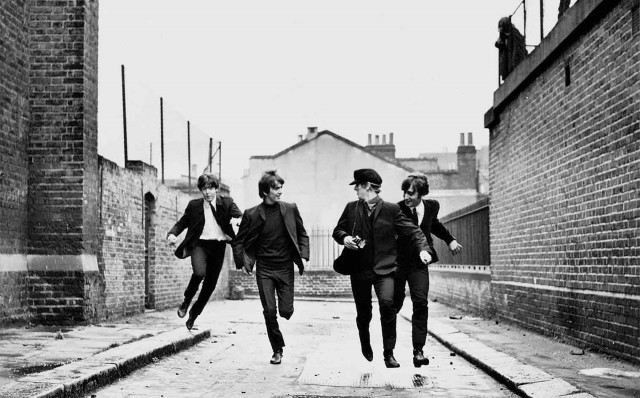
A HARD DAY’S NIGHT

A HARD DAY’S NIGHT

Fiftieth anniversary restoration of A HARD DAY’S NIGHT is playing July 4-17 at Film Forum

A HARD DAY’S NIGHT (Richard Lester, 1964)
Film Forum
209 West Houston St.
Opens July 4, 12:45, 3:00, 5:10, 7:30, 9:45
212-727-8110
www.filmforum.org
www.thebeatles.com

The Beatles are invading America again with the fiftieth anniversary restoration of their debut film, the deliriously funny anarchic comedy A Hard Day’s Night. Initially released on July 6, 1964, in the UK, AHDN turned out to be much more than just a promotional piece advertising the Fab Four and their music. Instead, it quickly became a huge critical and popular success, a highly influential work that presaged Monty Python and MTV while also honoring the Marx Brothers, Buster Keaton, Jacques Tati, and the French New Wave. Directed by Richard Lester, who had previously made the eleven-minute The Running Jumping & Standing Still Film with Peter Sellers and would go on to make A Funny Thing Happened on the Way to the Forum, Petulia, and The Three Musketeers, the madcap romp opens with the first chord of the title track as John Lennon, Paul McCartney, George Harrison, and Ringo Starr are running down a narrow street, being chased by rabid fans, but they’re coming toward the camera, welcoming viewers into their crazy world. (George’s fall was unscripted but left in the scene.) As the song blasts over the soundtrack, Lester introduces the major characters: the four moptops, who are clearly having a ball, led by John’s infectious smile, in addition to Paul’s “very clean” grandfather (Wilfrid Brambell, who played a dirty old man in the British series Steptoe and Son, the inspiration for Sanford and Son) and the band’s much-put-upon manager, Norm (Norman Rossington). Lester and cinematographer Gilbert Taylor (Dr. Strangelove or: How I Learned to Stop Worrying and Love the Bomb, Repulsion, Star Wars) also establish the pace and look of the film, a frantic black-and-white frolic shot in a cinema-vérité style that is like a mockumentary taking off from where François Truffaut’s 400 Blows ends.

The boys eventually make it onto a train, which is taking them back to their hometown of Liverpool, where they are scheduled to appear on a television show helmed by a hapless director (Victor Spinetti, who would star in Help as well) who essentially represents all those people who are dubious about the Beatles and the sea change going on in the music industry. Norm and road manager Shake (John Junkin) have the virtually impossible task of ensuring that John, Paul, George, and Ringo make it to the show on time, but there is no containing the energetic enthusiasm and contagious curiosity the quartet has for experiencing everything their success has to offer — while also sticking their tongues out at class structure, societal trends, and the culture of celebrity itself. Lester and Oscar-nominated screenwriter Alun Owen develop each individual Beatle’s unique character through press interviews, solo sojourns (the underappreciated Ringo goes off on a kind of vision quest; George is mistaken by a fashion fop for a model), and an endless stream of spoken and visual one-liners. (John sniffs a Coke bottle; a reporter asks George, “What do you call your hairstyle?” to which the Quiet One replies, “Arthur.”) Oh, the music is rather good too, featuring such songs as “I Should Have Known Better,” “All My Loving,” “If I Fell,” “Can’t Buy Me Love,” “I’m Happy Just to Dance with You,” “This Boy,” and “She Loves You.” The working name for the film was Beatlemania, but it was eventually changed to A Hard Day’s Night, based on a Ringo malapropism, forcing John and Paul to quickly write the title track. No mere exploitation flick, A Hard Day’s Night is one of the funniest, most influential films ever made, capturing a critical moment in pop-culture history and unleashing four extraordinary gentlemen on an unsuspecting world. The fiftieth-anniversary restoration, courtesy of Janus Films, is screening July 4-17 at Film Forum; don’t you dare miss this glorious eighty-five-minute explosion of sheer, unadulterated joy.

INDEPENDENCE DAY WEEKEND AT NITEHAWK — TEAM AMERICA: WORLD POLICE

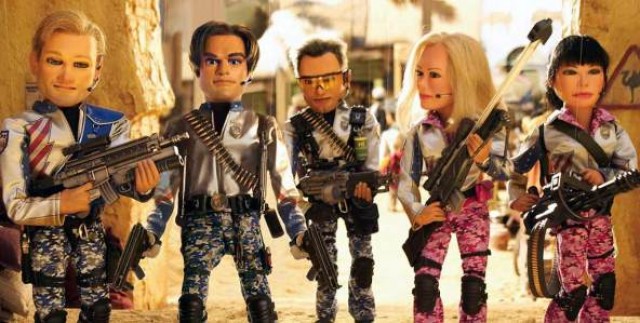
South Park dudes Trey Parker and Matt Stone employ puppets to lay waste to international terrorism in TEAM AMERICA

MIDNITE SCREENINGS — TEAM AMERICA: WORLD POLICE (Trey Parker, 2004)
Nitehawk Cinema
136 Metropolitan Ave. between Berry St. & Wythe Ave.
Friday, July 4, and Saturday, July 5, 12:05 am
718-384-3980
www.nitehawkcinema.com
www.teamamericamovie.com

Nothing is off limits for South Park dudes Trey Parker and Matt Stone in this marionette musical actioner that mixes Top Gun, Mission: Impossible, and The Matrix with that old classic television puppet show Thunderbirds. Kim Jong Il is determined to unleash his weapons of mass destruction on an unsuspecting world, and it is up to Team America and its newest member, actor Gary Johnston, formerly of the hit musical Lease, to stop the North Korean leader’s heinous plan. But Team America is a reckless bunch that has a tendency to destroy major cities and landmarks (the Eiffel Tower, the Sphinx) as it attempts to take out terrorists. Meanwhile, love threatens to complicate the success of their mission. Parker and Stone skewer international politics, the military, celebrity, and the media in this very dirty, very funny flick; among their victims are Alec Baldwin, Susan Sarandon, Sean Penn, Peter Jennings, Hans Blix, George Clooney, and, mercilessly, Matt Damon and Ben Affleck. There’s lots of blood and gore, a very hot puppet sex scene, and the best description ever about the three kinds of people in the world. Although it often misses its target or goes way too far — it could have been a classic like South Park: Bigger Longer & Uncut — it’s still a good way to spend a late night out at the movies, especially while honoring America during the July Fourth holiday. Team America: World Police is screening at 12:05 am on Friday and Saturday night as part of Nitehawk Cinema’s Independence Day Weekend, which also includes Steven Spielberg’s Jaws and Tim Burton’s Mars Attacks!
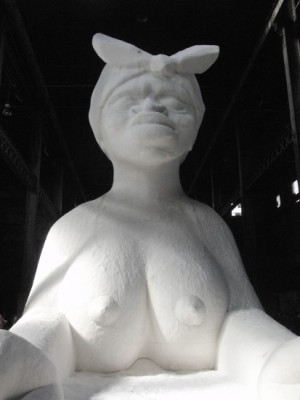
KARA WALKER AT DOMINO: A SUBTLETY

(photo by twi-ny/mdr)

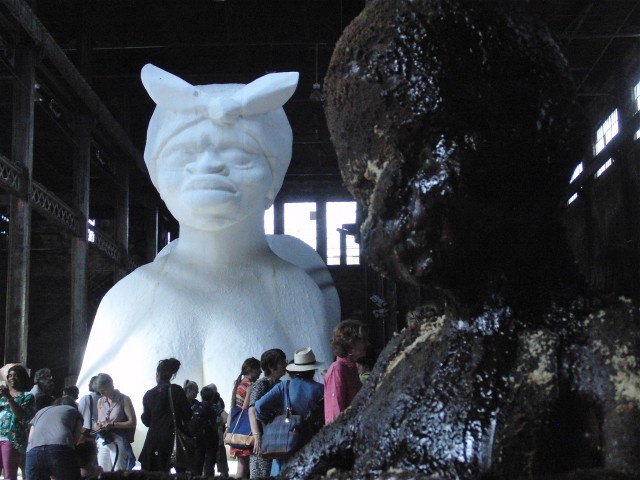
Kara Walker’s massive public art project features a sphinxlike mammy figure and life-size child slaves (photo by twi-ny/mdr)

KARA WALKER — A SUBTLETY OR THE MARVELOUS SUGAR BABY: AN HOMAGE TO THE UNPAID AND OVERWORKED ARTISANS WHO HAVE REFINED OUR SWEET TASTES FROM THE CANE FIELDS TO THE KITCHENS OF THE NEW WORLD ON THE OCCASION OF THE DEMOLITION OF THE DOMINO SUGAR REFINING PLANT
Domino Sugar Factory
South First St. at Kent Ave.
Saturday, July 5, and Sunday, July 6, free, 11:00 am – 7:00 pm
www.creativetime.org
kara walker at domino slideshow

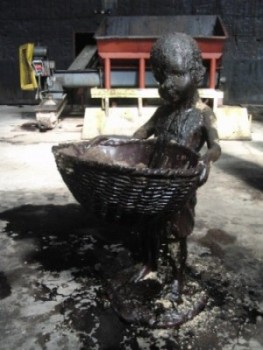
For more than 150 years, the Domino Sugar Factory has stood tall on the Williamsburg waterfront, the first sugar refinery in Brooklyn and at one time the largest in the world. The pre-Civil War structure was rebuilt in 1882 after a fire, it closed shop in 2004, and the 30,000-square-foot location is slated for demolition in a few months, giving way to luxury housing and commercial space. But it is getting quite a send-off, temporarily home to a spectacular, multilayered public art project that will have people talking for a long time. Forty-four-year-old California-born MacArthur “Genius” Kara Walker, best known for creating black silhouettes that boldly depict the horrors of slavery (“My Complement, My Enemy, My Oppressor, My Love,” “Gone: An Historical Romance of a Civil War as It Occurred between the Dusky Thighs of One Young Negress and Her Heart”), has installed “A Subtlety or the Marvelous Sugar Baby: an Homage to the unpaid and overworked Artisans who have refined our Sweet tastes from the cane fields to the Kitchens of the New World on the Occasion of the demolition of the Domino Sugar Refining Plant,” which remains on view through July 6. Upon entering the vast, open space, visitors are greeted by more than a dozen “Sugar Babies,” life-size sculptures in resin and molasses of slave children carrying baskets or bananas; some of the figures have melted, turning into what looks like a bloody mess on the floor, as if beaten to death, while also recalling tar. The objects in the baskets are parts of their bodies that essentially dissolved and fell off, as if their true selves have been eviscerated. Meanwhile, the air is filled with an acrid, rotting smell that falls right in line with the bittersweet nature of the installation.

“Sugar Babies” carry remnants of themselves in baskets at the Domino Sugar Factory (photo by twi-ny/mdr)

Melting “Sugar Babies” carry remnants of themselves in baskets at the Domino Sugar Factory (photo by twi-ny/mdr)

Glistening at the end of the large hall is an enormous white sphinx, made of foam and refined white sugar, sitting proudly, a highly sexualized mammy figure that evokes Aunt Jemima, serving as an oracle to the past, present, and future of a culture still dominated by racial tension, discrimination, and violence. A kerchief tied around her head, she stares out, her powerful fists outstretched (one in a gesture that alternately means “good luck” and “fuck you” in different countries), her large breasts both taunting and threatening. The curves of her body lead to giant buttocks and an exposed vulva that both shock and delight, laden in contradiction. The sculpture is yellowing at some points, the sugar crystalizing in the summer heat. When the exhibit ends, some of the slave babies will be able to be shown again, but the sphinx will be destroyed, erased from the annals of history, like so many aspects of slavery — but its memory will live on, a reminder of, among other things, that slavery took place right here in New York City. The controversial piece, totem and caricature, paradox and paradigm, uses stereotypes and racist imagery in referencing the refining of brown sugar into a white substance, the association of sugar with luxury desserts for the wealthy (the word “subtlety” refers to sweet banquet desserts), colonialism, and the exploitation of workers (including child labor, once again an issue on family-owned tobacco farms in America and sugar refineries in the Dominican Republic) in a society dominated by commercialism and corporations, offering an unspoken riddle with no answers. In her preliminary sketches, Walker used such phrases as “Sugar Rules the World,” “Natural processes fueled by industry,” “Production, not-consumption,” and “Refining to achieve desired whiteness which is equated in the modern mind — with purity,” lending crucial insight to her thinking. However, Walker has chosen to give no official artist’s statement about her first large-scale public art installation, preferring that people experience it for themselves, although project sponsor Creative Time has supplemented the work with five “Reports” that explore various aspects of “A Subtlety,” which can be found online: Edwidge Danticat’s “The Price of Sugar,” Tracy K. Smith’s “Photo of Sugar Cane Plantation Workers, Jamaica, 1891,” Jean-Euphèle Milcé’s “To Drink My Sweet Body,” Ricardo Cortés’s “The Act of Whitening,” and Shailja Patel’s “Unpour.”

Bittersweet Kara Walker installation is layered with meaning that is controversial, complex, and purposefully contradictory (photo by twi-ny/mdr)

Bittersweet Kara Walker installation is layered with meaning that is controversial, complex, and purposefully contradictory (photo by twi-ny/mdr)

Central to the work are viewers’ reactions. Some are in awe of its beauty and scope, while others pose in front of it for touristy photographs. Some consider the history and mystery that literally surround it, while others smile and pretend to put their arms around one of the slave babies as if they are friends or perform silly acts with the sphinx’s backside and genitalia. Many are so obsessed with taking pictures and video that they never pause, process, and contemplate what they are looking at. Yes, it’s spectacle, but it’s spectacle on a grand order, an unforgettable experience that places a powerful mirror on America’s four-hundred-year history, revealing telling elements that many still refuse to accept.

There are only two days left to see “A Subtlety,” which is open 11:00 am to 7:00 pm on Saturday and Sunday, July 5-6. Admission is free, but you can expect the lines to be a lot longer than the previous twenty minutes or so. After that, the piece, along with the Domino Sugar Factory itself, will meet its demise, though it will live on in the minds of those who had the opportunity to partake in its majesty.

NATHAN’S FAMOUS FOURTH OF JULY INTERNATIONAL HOT DOG EATING CONTEST 2014

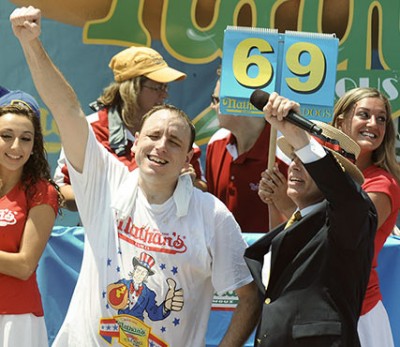
Joey Chestnut will defend his hot-dog-eating record on July 4 at Nathans (photo courtesy Nathans Famous)

Joey Chestnut will defend his hot-dog-eating record on July 4 at Nathan’s (photo courtesy Nathan’s Famous)

Sweikert Alley, Nathan’s Famous
1310 Surf Ave. at Stillwell Ave.
Friday, July 4, free, 10:00 am
212-627-5766
www.nathansfamous.com
www.ifoce.com

San Jose’s Joey Chestnut did it again last year, devouring a record sixty-nine hot dogs in ten minutes to win the Nathan’s Famous Fourth of July International Hot Dog Eating Contest for the seventh consecutive year. Sonya Thomas, the number five overall Major League Eater in the world — Chestnut is #1 — took home the women’s belt for the third straight year by consuming 36¾ dogs. Chestnut also currently holds the record for apple pie, asparagus, brain tacos, brats, chicken wings, chili, corned beef sandwiches, eggs, fish tacos, funnel cake, grilled cheese sandwiches, Krystal hamburgers, horseshoe sandwiches, short form ice cream, jalapeno poppers, Kolaches, pastrami, Philly cheesesteaks, Pizza Hut P’Zones, pork ribs, pulled pork, poutine, salt potatoes, shrimp cocktail, shrimp wontons, tacos, tamales, and Twinkies, while Thomas is tops in Armour Vienna sausage, long course baked beans, buffalo chicken tenders, cheesecake, cherrystone clams, chicken nuggets, chili cheese fries, crab cakes, crawfish, deep-fried okra, fruitcake, Big Daddy hamburgers, thickburgers, jambalaya, Maine lobster, meatballs, oysters, quesadillas, sweet potato casserole, toasted ravioli, turducken, and whole turkey. The event will also feature live music by the Brooklyn Community Choir, the Heavenly Chillbillies, the Skyriders, and former competitive eater turned rapper Eric “Badlands” Booker. To make it all a little more palatable, Nathan’s will donate one hundred thousand hot dogs to the Food Bank for New York City. For a different perspective on the event, with a special focus on the Takeru Kobayashi controversy, check out Jeff Cerulli and Barry Rothbart’s documentary Hungry.

PIER / PARTY: THE AVENGERS

THE AVENGERS

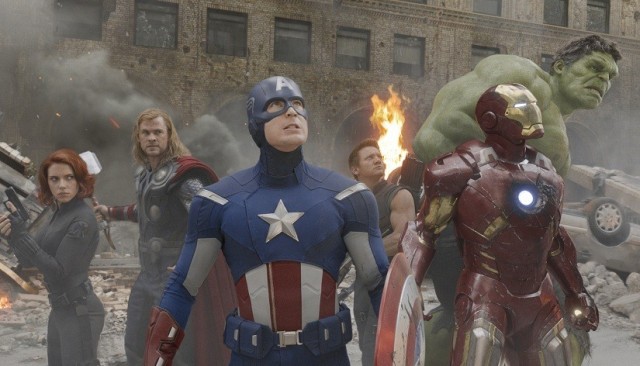
The Avengers face a powerful enemy in Joss Whedon’s action-adventure superhero blockbuster

THE AVENGERS (Joss Whedon, 2012)
South Street Seaport
Corner of Front & Fulton Sts.
Saturday, July 5, free, 8:00
www.southstreetseaport.com
www.marvel.com

After a spectacular energy device known as the Tesseract opens a wormhole that allows the evil Loki (Tom Hiddleston) to enter present-day Earth and ultimately steal the machine, turning Hawkeye (Jeremy Renner) and Dr. Erik Selvig (Stellan Skarsgård) into unwitting allies in the process, S.H.I.E.L.D. agent Phil Coulson (Clark Gregg) and director Nick Fury (Samuel L. Jackson) bring back the Avengers Initiative, reuniting Tony Stark / Iron Man (Robert Downey Jr.), Steve Rogers / Captain America (Chris Evans), Natasha Romanoff / Black Widow (Scarlett Johansson), and an extremely tentative Dr. Bruce Banner / Hulk (Mark Ruffalo), who are gathered together to regain the Tesseract and foil Loki’s evil plans to take over Earth. Also entering the fray is Thor (Chris Hemsworth), Loki’s brother, who needs to decide which side of the battle he is on. As egos get in the way and wisecracks fly by like so much machine-gun rattle, particularly from Stark, the Avengers realize they are facing a supremely powerful force, one that will require, well, superhuman effort to defeat. Writer-director Joss Whedon, the genius behind Buffy the Vampire Slayer, Angel, and Firefly, plays things a little loose in this comic-book blockbuster, not worrying too much about gaping plot holes that could have been created by the Tesseract itself and letting the superhero banter and tech-heavy set pieces take center stage. Downey goes over the top as the brash Stark, while Ruffalo, following in the failed footsteps of Edward Norton and Eric Bana (and, of course, the great Bill Bixby), is relegated to a whole lot of brooding. But there’s still lots of fun to be had as the characters team up to save the world. Be sure to stick around through the credits for a pair of bonus scenes. The Avengers is screening July 5 at 8:00, preceded by a Midtown Comics Fan Party at 4:00 in which costumed attendees can win prizes and drink specials, concluding the South Street Seaport’s free July 3-5 “Pier/Party,” which also includes live performances by the Hungry March Band, Dandy Wellington & His Band, Chris Bergson Blues, Mike Verge, Twin Forks ft. Chris Carrabba, and Sam Barnes Bluegrass Review. For a day-by-day listing of free summer movie screenings throughout New York City, go here.

MACY’S FOURTH OF JULY FIREWORKS: LIVE FROM THE BROOKLYN BRIDGE

macys fireworks

Televised live on NBC-TV beginning at 8:00 pm
Broadcast live on WINS 1010
Friday, July 4, free, 9:20 pm (approx.)
212-494-4495
www.macys.com

Macy’s July Fourth extravaganza is on the move again, this year heading downtown on the east side, with barges floating around the historic Brooklyn Bridge. The thirty-eighth annual event will again be hosted by Nick Cannon, with live performances by Lionel Richie, Ariana Grande, Enrique Iglesias, Miranda Lambert, and Hunter Hayes. There will also be two specially recorded songs, the Charlie Daniels Band’s “My Home” and Billy Porter singing “It’s a Patriotic Kind of Day,” in addition to a rousing version of “The Star-Spangled Banner” by Idina Menzel, backed by the DIVA Jazz Orchestra and Judith Clurman’s Essential Voices USA, in honor of the two-hundredth anniversary of the Francis Scott Key song that became America’s official national anthem in 1931. Among the best viewing points are along the elevated portions of the FDR Drive, with access at Montgomery & South Sts., the Brooklyn Bridge entry from St. James Pl., and Broad St. and/or Old Slip at Water St.; the ADA viewing area is at the Murray Bergtraum High School track-and-field facility. Across the river, you can watch the fireworks from Brooklyn Bridge Park and the Brooklyn Bridge Promenade; note that certain sections of Montague, Remsen, Old Fulton, Furman, and Hicks Sts. will be closed to vehicular traffic.

FIRST SATURDAYS: BROOKLYN SUMMER

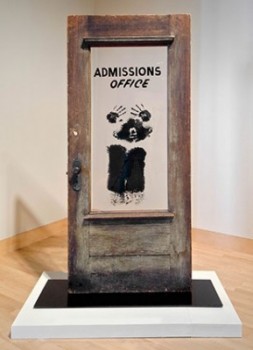
David Hammons, “The Door (Admissions Office),” wood, acrylic sheet, and pigment construction, 1969 (California African American Museum, Los Angeles, Collection of Friends, the Foundation of the California African American Museum / © David Hammons)

David Hammons, “The Door (Admissions Office),” wood, acrylic sheet, and pigment construction, 1969 (California African American Museum, Los Angeles, Collection of Friends, the Foundation of the California African American Museum / © David Hammons)

Brooklyn Museum
200 Eastern Parkway at Washington St.
Saturday, July 5, free, 5:00 – 11:00 ($10 discounted admission to “Ai Weiwei: According to What?”)
212-864-5400
www.brooklynmuseum.org

The Brooklyn Museum is throwing a summer party for its July free First Saturdays program, centered by a twenty-fifth-anniversary screening of Spike Lee’s Bed-Stuy classic, Do the Right Thing. In addition, there will be music from Matuto, Blitz the Ambassador, DJ Uhuru, and Nina Sky, a female comedy showcase hosted by Erica Watson, a talk and fashion show led by Afros: A Celebration of Natural Hair author Michael July, a sidewalk chalk drawing project organized by the City Kids, a hula hoop demonstration with Hula Nation, an art workshop in which participants will learn figure drawing with a live model, and an interactive talk with “Brooklyn in 3000 Stills” creators Paul Trillo and Landon Van Soest. In addition, you can check out the current quartet of exhibitions, all of which deal with activism through art: “Ai Weiwei: According to What?,” “Swoon: Submerged Motherlands,” “Chicago in L.A.: Judy Chicago’s Early Works, 1963–74,” and “Witness: Art and Civil Rights in the Sixties.”

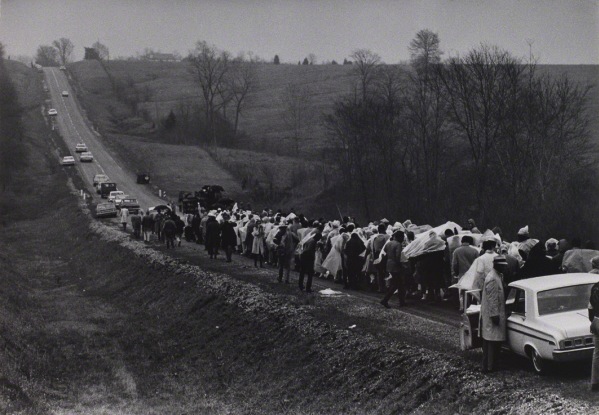
Moneta Sleet Jr., “Selma Marchers on road to Montgomery,” gelatin silver photograph, 1965 (courtesy Brooklyn Museum)

Moneta Sleet Jr., “Selma Marchers on road to Montgomery,” gelatin silver photograph, 1965 (courtesy Brooklyn Museum)

The powerful, wide-ranging “Witness,” which has just been extended through July 13 (the other three exhibits continue into August or September), is a traveling show being held in conjunction with the fiftieth anniversary of the passage of the Civil Rights Act of 1964. More than one hundred paintings, sculptures, photographs, and installations are on view, divided into eight thematic categories: “Integrate Educate,” “American Nightmare,” “Presenting Evidence,” “Politicizing Pop,” “Black Is Beautiful,” “Sisterhood,” “Global Liberation,” and “Beloved Community.” In Bruce Davidson’s “USA. Montgomery, Alabama. 1961,” a black Freedom Rider sits by a window on a bus being escorted by the National Guard. David Hammons’s “The Door (Admissions Office)” is not exactly a welcoming sight. Norman Rockwell’s “New Kids in the Neighborhood (Negro in the Suburbs)” depicts three white children and two black children stopped on a sidewalk, curiously looking at each other. Melvin Edwards’s “Chaino” evokes slavery and lynchings. A trio of cartoonish KKK members drive into town in Philip Guston’s “City Limits.” There are also works by Romare Bearden, Jacob Lawrence, Norman Lewis, Jack Whitten, Faith Ringgold, Ben Shahn, Betye Saar, Gordon Parks, Jim Dine, Yoko Ono, Barkley Hendricks, Robert Indiana, Richard Avedon, and others that examine the civil rights movement from multiple angles, displaying America’s continuing shame.