twi-ny recommended events

MOVIE MEDICINE — A FILM SERIES ABOUT THE HEALING FACTOR IN CINEMA: ZATOICHI

ZATOICHI

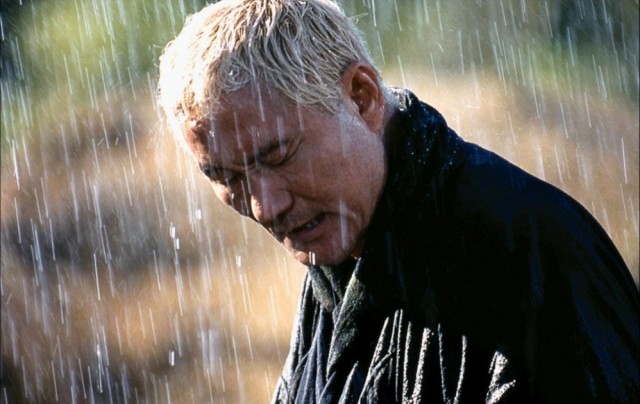
Takeshi Kitano stars in his own thrilling remake of popular Japanese serial ZATOICHI

CABARET CINEMA — THE BLIND SWORDSMAN: ZATOICHI (Takeshi Kitano, 2003)
Rubin Museum of Art
150 West 17th St. at Seventh Ave.
Friday, August 8, free with $10 K2 minimum, 9:30
212-620-5000
www.rubinmuseum.org
www.zatoichi.co.uk

Now we’re talking. Hardboiled action director and comic Takeshi Kitano takes on the Zatoichi legend that was a Japanese favorite from 1962 to 1989 (starring Shintaro Katsu), updating the story of the blind swordsman, gambler, and masseuse magnificently, adding a lot of blood while staying true to the heart of this classic tale. Beat Takeshi, the name Kitano uses as an actor, stars as the unlikely platinum blonde superhero who shuffles across the countryside battling the bad guys and rescuing damsels in distress. This is the first period film of Kitano’s career, which has included such bloodfests as Violent Cop, Brother, and Boiling Point and such moving dramas as Sonatine and Kikijuro. He has combined all the elements of his previous work to create this unforgettable masterpiece, a thrilling, beautifully shot, and wonderfully realized cinematic achievement that suffers only at the very end with a silly coda that is just way too out of place. Zatoichi is screening August 8 as part of the Rubin Museum Cabaret Cinema series “Movie Medicine: A Film Series about the Healing Factor in Cinema,” being held in conjunction with the “Bodies in Balance: The Art of Tibetan Medicine” exhibition, and will be introduced by Stephen Globus. The series continues August 15 with John Cromwell’s Of Human Bondage, introduced by psychiatrist and psychopharmacologist Harvey Roy Greenberg, and August 22 with Shohei Imamura’s Dr. Akagi, introduced by Gregory Hosho Abels.

RURAL ROUTE FILM FESTIVAL: SHADOWS OF FORGOTTEN ANCESTORS

SHADOWS

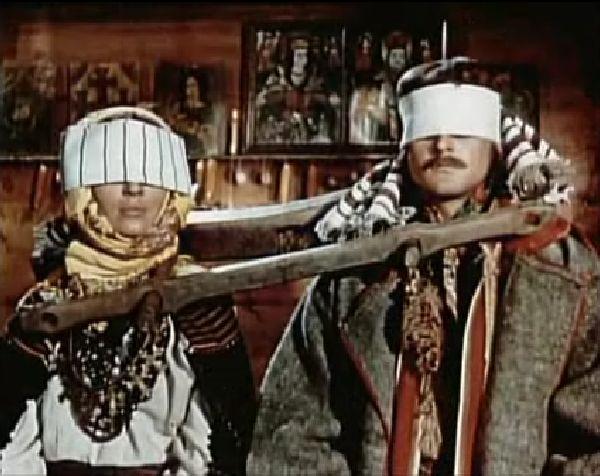
Unusual rituals are some of the many highlights of Sergei Parajanov’s SHADOWS OF FORGOTTEN ANCESTORS

SHADOWS OF FORGOTTEN ANCESTORS (TINI ZABUTYKH PREDKIV) (Sergei Parajanov, 1964)
Museum of the Moving Image
35th Ave. at 36th St., Astoria
Friday, August 8, $10, 7:00
Series runs August 8-10
718-777-6800
www.movingimage.us
www.ruralroutefilms.com

For a decade, the Rural Route Film Festival has been taking viewers to unique places around the world, far off the beaten track and away from urban centers, instead showing works “that take the road less traveled.” The festival is kicking off its tenth anniversary in a big way, with a fiftieth anniversary screening of Sergei Parajanov’s seminal Shadows of Forgotten Ancestors. Parajanov’s reimagining of Shakespeare’s Romeo and Juliet announces exactly what it is in the opening credits: “A tale of times past, of the great love of Ivan and Marichka. . . . The folk tales and customs of the Carpathian region.” Made in 1964 in honor of the centennial of the birth of Ukrainian author Mykhailo Kotsiubynsky, whose source novel was published in 1913, Shadows follows the friendship and romance of Ivan (Ivan Mikolajchuk) and Marichka (Larysa Kadochnikova), from childhood, when they are kids splashing water on each other, through marriage, war, and tragedy. In fact, there is a lot of tragedy throughout the film, even before Ivan’s family is cursed by a witchlike woman in their Hutsul village.


SHADOWS

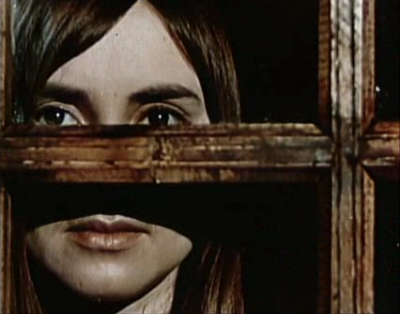
Restored Parajanov film opens the tenth annual Rural Route Film Festival at the Museum of the Moving Image

Shadows of Forgotten Ancestors is filled with fascinating scenes of Ukrainian rituals featuring extravagant costumes and marvelous masks that would make Margaret Mead proud. In one of the film’s most haunting scenes, Parajanov (The Color of Pomegranates, Ashik Kerib), moving between color and black-and-white, superimposes moments of Ivan’s past over religious imagery that sets up the second half of the story, in which things go from bad to worse. The film did not fit within the Soviet regime’s preferred social realism and ideology but it was an international success, although the director was soon blacklisted and arrested and much of his work was banned. A new fiftieth-anniversary 35mm restoration of Shadows of Forgotten Ancestors is screening at the Museum of the Moving Image on August 8 at 7:00, preceded by Sashko Danylenko’s five-minute animated “Carpathian Rap” video for the Ukrainian band Dakha Brakha and followed by a vodka reception; the Rural Route Film Festival runs August 8-10 and includes such other films as Robin Hardy’s The Wicker Man, Daniel Peddle’s Sunset Edge, and Alexsei Fedorchenko’s Celestial Wives of the Meadow Mari.

THE LOT LIC: CHOP SHOP

CHOP SHOP

Ale (Alejandro Polanco) does what he needs to do to get by in Queens-set CHOP SHOP

CHOP SHOP (Ramin Bahrani, 2007)
The Lot LIC
43-29 Crescent St., Long Island City
Thursday, August 7,
Series continues through September 20
www.thelotlic.com

Set amid the junkyards and auto-body shops in the shadow of Shea Stadium, Ramin Bahrani’s follow-up to his indie hit Man Push Cart is a gritty, realistic drama of family and community. Filmed in thirty days in the Iron Triangle neighborhood of Willets Point, Queens, Chop Shop stars Alejandro Polanco as Ale, a street-smart twelve-year-old boy who works for Rob (Rob Sowulski), calling cars into the repair shop, stealing spare parts, and learning virtually every aspect of the trade, legal and not. Ale lives in a small upstairs room in the garage with his sister, sixteen-year-old Isamar (Isamar Gonzalez), who by day works in a food van and at night makes extra cash by getting into cars and trucks with strange men. Neither Ale nor Izzy goes to school; instead, they’re working hard, saving up money to buy a food van and start their own business, but their life is fraught with danger and difficulty nearly every step of the way. Written by Bahrani (Goodbye Solo, At Any PriceChop Shop is an honest, frightening, yet sweet slice of life that takes place not far from a sign at Shea that announces, “Where Dreams Happen.”
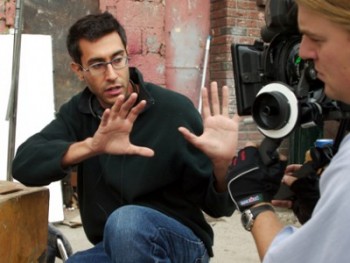
Director Ramin Bahrani frames a shot on the Willets Point set of CHOP SHOP

Director Ramin Bahrani frames a shot on the Willets Point set of CHOP SHOP

Polanco gives a remarkable performance as Ale, a rough yet vulnerable kid who has been dealt a tough hand but just forges ahead, attempting to make the most out of his meager life, trying to find his own piece of the American dream. Whether hanging out with his best friend, Carlos (Carlos Zapata), looking after his sister, doing a special job for Ahmad (Man Push Cart’s Ahmad Razvi), or counting his pay in front of his boss – Sowulski really does own the garage where most of the movie is filmed – Ale is an extraordinary character, played by an extraordinary young boy in his very first film. Chop Shop is a subtle, unforgettable experience. Chop Shop is screening August 7 in Long Island City as part of the free LOT LIC Music & Film Series, which consists of concerts (Taylor McFerrin, Widowspeak, Naomi Shelton and the Gospel Queens) on Saturdays from 3:00 to 9:00 and movie screenings (Polyester, Strictly Ballroom, The Triplets of Belleville) and DJs on Thursday nights beginning at 6:00. (For a day-by-day listing of free summer movie screenings throughout New York City, go here.)

BLADE: KING OF GRAFFITI

blade

Museum of the City of New York
1220 Fifth Avenue at 103rd St.
Friday, August 8, $10 ($40 with book), 6:30
212-534-1672
www.mcny.org
www.bladekingofgraf.com

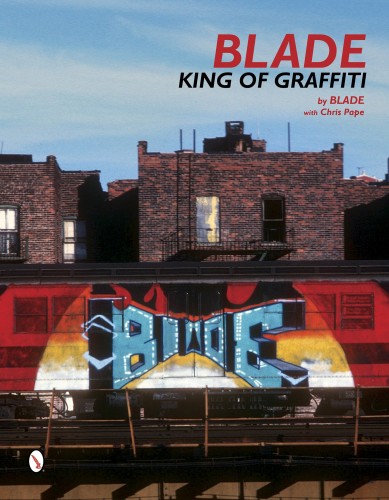
During the 1970s, Bronx native Steven Ogburn began turning subway trains into his canvas. Taking the street name BLADE, he went on to tag more than five thousand cars between 1972 and 1984. The man also known as the King of Graffiti and the King of Trains is now coming to the Museum of the City of New York in conjunction with the exhibit “City as Canvas: Graffiti Art from the Martin Wong Collection.” On August 8, BLADE will sit down for an intimate conversation, accompanied by a slideshow, with Chris Pape, his cowriter on the new book Blade: King of Graffiti (Schiffer, June 2014, $39.99). “I was just developing my moral compass at the time,” BLADE writes near the beginning of the book, “and if there’s one thing I learned it’s that everyone drew the line in the sand somewhere.” BLADE will talk about the line and more as he examines his life and career; the discussion will be followed by a book signing. “City as Canvas” continues at MCNY through September 21.

DR. LUCKY’S SURREALIST BURLESQUE PRESENTS FLAMING CREATURES

flaming creatures

Coney Island USA Sideshows by the Seashore
1208 Surf Ave.
Friday, August 8, $15, 10:00
www.coneyisland.com

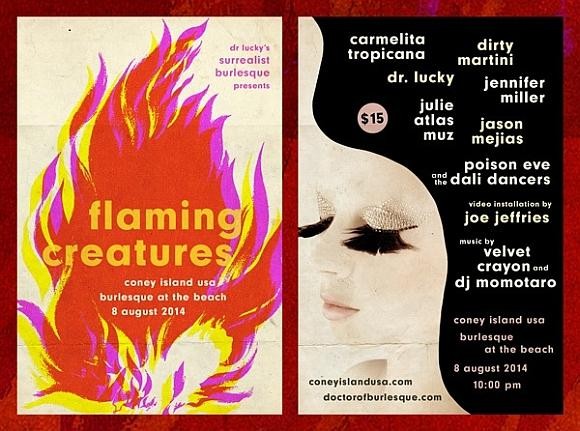
In 1964, experimental filmmaker Jack Smith’s forty-three-minute Flaming Creatures was shown at the Gramercy Arts Theatre to underground acclaim and governmental obscenity charges. Jonas Mekas called it “the most luxurious outpouring of imagination, of imagery, of poetry, of movie artistry,” while Smith himself considered it “a comedy set in a haunted music studio.” (You can watch the crazy, most definitely NSFW film here or catch it at the Museum of the Moving Image on August 10 along with Barbara Rubin’s Christmas on Earth.) So it is more than appropriate that Dr. Lucky’s Surrealist Burlesque will be paying tribute to Smith and his film at Coney Island’s Sideshows by the Seashore on August 8 with an evening of live performances by an impressive group of underground artists: Carmelita Tropicana, Dirty Martini, Jennifer Miller, Jason Mejias, Julie Atlas Muz, Peekaboo Pointe, Poison Eve, and Dr. Lucky himself. In previous years, Surreal Burlesque has adapted Guy Debord’s Society of the Spectacle, the Dada Manifesto, George Orwell’s Animal Farm, and Salvador Dali’s “Dream of Venus” as only it can. For this sixth annual presentation, Dr. Lucky has chosen another great subject, so expect the unexpected during what should be a wild and unpredictable event.

SOUND + VISION / ROOFTOP FILMS — PULP: A FILM ABOUT LIFE, DEATH & SUPERMARKETS

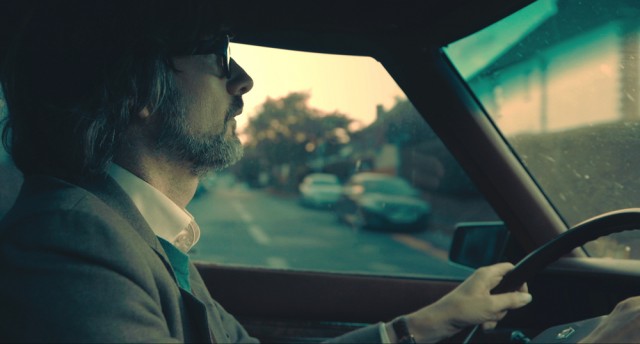
Jarvis Cocker takes a ride through his hometown of Sheffield as he prepares for Pulp farewell concert

Jarvis Cocker takes a ride through his hometown of Sheffield as he prepares for Pulp farewell concert

PULP: A FILM ABOUT LIFE, DEATH & SUPERMARKETS (Florian Habicht, 2013)
SOUND + VISION
Film Society of Lincoln Center, Walter Reade Theater
144 West 65th St. between Broadway & Amsterdam Ave.
Wednesday, August 6, 8:30
212-875-5600
www.filmlinc.com

ROOFTOP FILMS
Industry City roof and courtyard
220 36th St., Sunset Park
Thursday, August 7, live music 8:30, film screening 9:00
www.rooftopfilms.com
www.pulpthefilm.com

Florian Habicht’s Pulp: A Film About Life, Death & Supermarkets is a brilliant inside look at the long-lasting relationship between a band and its hometown. In December 2012, British alternative band Pulp returned to the place of its birth, the rugged, working-class city of Sheffield in the north of England, for what was being billed as its last-ever concert on dry land. Pulp frontman Jarvis Cocker hooked up with Habicht (Love Story, Woodenhead), conceiving a project in which the time and place, along with the fans, would be just as important as the band and its music, if not more so. In the nonchronological film, Habicht cuts between archival footage of Pulp, clips from the final concert, interviews on the street with old and young fans, and brief chats with Pulp tour manager Liam Rippon and the other band members: guitarist Mark Webber, keyboardist Candida Doyle, bassist Steve Mackey, and drummer Nick Banks, who are pretty much taking it all in stride. But at the center of it all is the soft-spoken, enigmatic Cocker, who founded Pulp back in 1978 when he was fifteen years old.

Habicht shows Cocker biking and driving through Sheffield, discussing his first job working for a fishmonger in a mall, and, most thrillingly, fixing a flat tire on his less-than-fancy car. The theme song of the documentary is Pulp’s “Common People,” in which a woman tells Cocker, “I want to live like common people / I want to do whatever common people do / I want to sleep with common people / I want to sleep with common people like you.” Is it possible for a rock star to be “common people”? It doesn’t really matter as Cocker reestablishes his connection to Sheffield. “We stopped playing in 2001 or 2002 or whatever it was, and I did feel that the way it finished was kind of a bit, I don’t know, not right,” he says in the film. “It didn’t feel like a good ending. . . . So I know that tidying up isn’t the greatest rock-and-roll motivation, but I did want to kind of tidy things up and give the story a happy ending.” It is all very happy indeed, as Habicht also delves into such Pulp favorites as “This Is Hardcore” and “Help the Aged” as well as “Disco 2000,” “Underwear,” and “Sheffield: Sex City.” The band, which released seven studio albums during its career, from 1983’s It through 2001’s We Love Life, has no arguments or complaints, just positive attitudes that make Pulp a thoroughly exhilarating experience. The film opens in November but is having two special screenings this week, first as the closing-night selection of the “Sound + Vision” festival at Lincoln Center on August 6, followed by a Q&A with Habicht, then the next night at Industry City in Sunset Park as part of the annual summer Rooftop Films series, preceded by a live set by Mondo and followed by a Q&A with Cocker and Habicht and a Pulp karaoke contest that the two men will judge at the after-party.

AN AUTEURIST HISTORY OF FILM: DAYS OF HEAVEN

DAYS OF HEAVEN

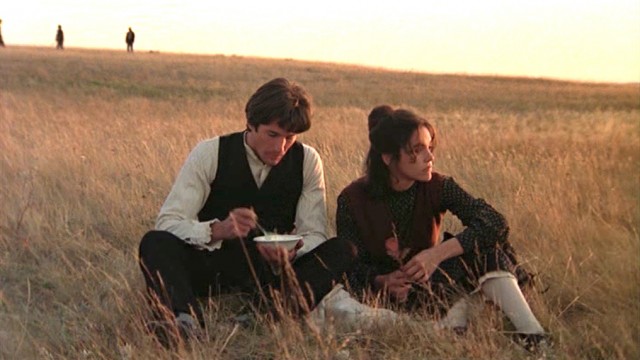
Bill (Richard Gere) and Abby (Brooke Adams) try to get by in tough times in Terrence Malick’s DAYS OF HEAVEN

DAYS OF HEAVEN (Terrence Malick, 1978)
MoMA Film, Museum of Modern Art
The Lewis B. and Dorothy Cullman Education and Research Building
4 West 54th St. between Fifth & Sixth Aves.
August 6-8, 1:30
Tickets: $12, in person only, may be applied to museum admission within thirty days, same-day screenings free with museum admission, available at Film and Media Desk beginning at 9:30 am
212-708-9400
www.moma.org

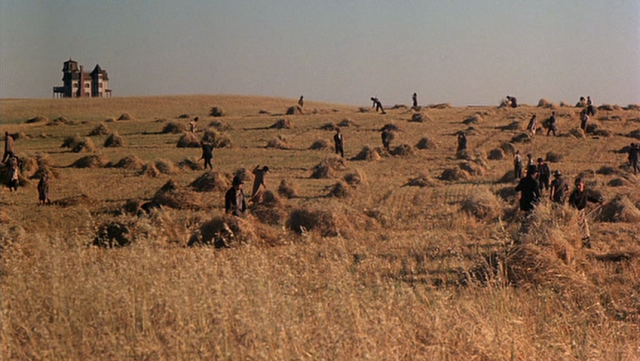
Justifiably recognized as one of the most beautiful films ever made, writer-director Terrence Malick’s sophomore effort, Days of Heaven, is a visually breathtaking tale of love, desperation, and survival in WWI-era America. After accidentally killing his boss (Stuart Margolin) in a Chicago steel mill, Bill (Richard Gere) immediately flees to the Texas Panhandle with his girlfriend, Abby (Brooke Adams), and his much younger sister, Linda (Linda Manz). Because they are unmarried, Bill and Abby pretend to be brother and sister — evoking the biblical story of Abraham introducing his wife Sarah as his sibling — and get a job working in the wheat fields owned by a reserved, possibly ill farmer (Sam Shepard) who is instantly smitten with Abby. Soon a complex love triangle develops in which money, class, and power play a key role. As beautiful as the main characters are — Gere and Shepard particularly are shot in ways that emphasize their tender but rugged good looks — they are outshone by the gorgeous landscapes and sunsets photographed by Nestor Almendros (who won an Oscar for Best Cinematography) and Haskell Wexler, as well as Jack Fisk’s stunning art direction, all of which were directly inspired by Edward Hopper’s “House by the Railroad” and Andrew Wyeth’s “Christina’s World,” among other paintings. Like Stanley Kubrick’s Barry Lyndon, freezing nearly any frame will produce an image that could hang in a museum.

DAYS OF HEAVEN

The award-winning DAYS OF HEAVEN is one of the most beautiful-looking movies ever made

The soundtrack is epic as well, composed by Ennio Morricone along with songs by Leo Kottke and Doug Kershaw (who plays the fiddler). It took two years for Malick and editor Bill Weber to assemble the vast amount of footage they shot into a comprehensible story, helped by the late addition of Manz’s character’s voice-over narration, but the results were well worth all of the time and effort. Days of Heaven came five years after Malick’s breakthrough debut, Badlands, and it would be another twenty years before his next film, The Big Red One, then seven more until 2005’s The New World. Finally, this master auteur is on a roll, already in the midst of his fifth feature project this decade. Days of Heaven is screening August 6-8 at 1:30 as part of MoMA’s ongoing series “An Auteurist History of Film,” which continues August 13-15 with Francis Ford Coppola’s Apocalypse Now Redux and August 20-22 with Martin Scorsese’s Raging Bull.