twi-ny recommended events

CARAX: HOLY MOTORS

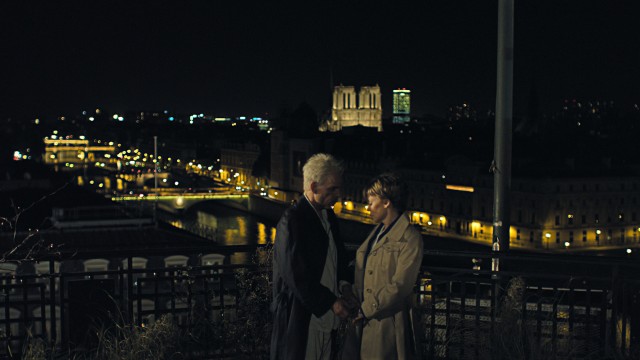
Léos Carax’s HOLY MOTORS is a dazzling tribute to Paris, cinema, and the art of storytelling

Léos Carax’s HOLY MOTORS is a dazzling tribute to Paris, cinema, and the art of storytelling

HOLY MOTORS (Léos Carax, 2012)
Film Forum
209 West Houston St.
August 15, 18, 21
Series runs August 15-21
212-727-8110
www.filmforum.org
www.holymotorsfilm.com

French writer-director Léos Carax (Boy Meets Girl, Mauvais Sang) has made only five feature films in his thirty-plus-year career, a sadly low output for such an innovative, talented director, but in 2012 he gave birth to his masterpiece, the endlessly intriguing, confusing, and exhilarating Holy Motors. His first film since 1999’s POLA X, the new work is a surreal tale of character and identity, spreading across multiple genres in a series of bizarre, entertaining, and often indecipherable set pieces. Holy Motors opens with Carax himself playing le Dormeur, a man who wakes up and walks through a hidden door in his room and into a movie theater where a packed house, watching King Vidor’s The Crowd, is fast asleep. The focus soon shifts to Carax alter ego Denis Lavant as Monsieur Oscar, a curious character who is being chauffeured around Paris in a white stretch limo driven by the elegant Céline (Édith Scob). Oscar has a list of assignments for the day that involve his putting on elaborate costumes — including revisiting his sewer character from Merde, Carax’s contribution to the 2009 omnibus Tokyo! that also included shorts by Michel Gondry and Bon Joon-ho — and becoming immersed in scenes that might or might not be staged, blurring the lines between fiction and reality within, of course, a completely fictional world to begin with. It is as if each scene is a separate little movie, and indeed, Carax, whose middle name is Oscar, has said that he made Holy Motors after several other projects fell through, so perhaps he has melded many of those ideas into this fabulously abstruse tale that constantly reinvents itself. The film is also a loving tribute to Paris, the cinema, and the art of storytelling, with direct and indirect references to Franz Kafka, E. T. A. Hoffman, Charlie Chaplin, Lon Chaney, Eadweard Muybridge, Georges Franju, and others. (Scob, who starred in Franju’s Eyes Without a Face, at one point even pulls out a mask similar to the one she wore in that classic thriller.) The outstanding cast also features Kylie Minogue, who does indeed get to sing; Eva Mendes as a robotic model; and Michel Piccoli as the mysterious Man with the Birthmark. Holy Motors is screening August 15, 18, and 21 at Film Forum in conjunction with the U.S. theatrical release of Tessa Louise-Salomé’s 2014 documentary, Mr. X: A Vision of Leos Carax; the week-long tribute to Carax includes the documentary as well as Carax’s other feature films, Pola X, Les Amants du Pont Neuf, and Mauvais Sang. (A restored version of Boy Meets Girl played Film Forum August 8-14.)
ROBERT GORDON RECORD RELEASE PARTY: I’M COMING HOME

Robert Gordon

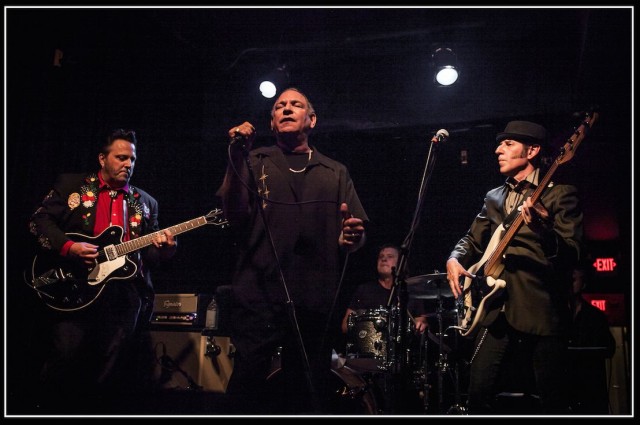
Rockabilly great Robert Gordon will be right at home with record release party August 15 at Bowery Electric

The Bowery Electric
327 Bowery at Second St.
Friday, August 15, $20, 7:30
www.theboweryelectric.com

Back in 1991, rockabilly legend Robert Gordon released the live album Greetings from New York City. On August 15, the former Tuff Darts lead vocalist, best known for his versions of Marshall Crenshaw’s “Someday Someway,” Bruce Springsteen’s “Fire,” Johnny Burnette’s “Rockabilly Boogie,” and Billy Lee Riley’s “Red Hot” (“My gal is red hot / Your gal ain’t doodley squat!”), will be celebrating the release of his latest album, the aptly titled I’m Coming Home (Lanark, June 2014), with a show at the Bowery Electric right here in his hometown. The record, his first in seven years, is pure Gordon, a dozen covers and originals, flying by in less than a half hour, that meld punk, blues, country, R&B, and rock ‘n’ roll in his unique style, anchored by his deep-throated baritone. The album opens with a trio of defiant tunes, Johnny Horton’s title track (one of several songs on which Gordon’s vocals evoke Johnny Cash), Crenshaw’s “Walk Hard” (with longtime friend Crenshaw on six-string), and Horton’s “Honky Tonk Man,” quickly establishing that Gordon is back indeed. He and his band — coproducer Quentin Jones on guitar, Rob Stoner on bass, and Dave Ferrara on drums — also take on Dorsey Burnette’s “It’s Late,” Harold Dorman’s “Mountain of Love,” Buck Owens’s “Under Your Spell Again,” and Little Richard’s “Lucille,” offering fun twists and turns along the way. The original, rollicking “It’s Only Love” (written by labelmate Barry Ryan of the Rockats and also featuring Crenshaw) sounds like a lost Buddy Holly gem, while Gordon proclaims in “Quit This Big Ole Town” (written by the Rockats’ Dibbs Preston), “You know I’m coming on back / Yeah, I’m coming on back / Well, I got my boots on my feet / shirt on my back / I’m a long tall daddy walking down the track.” For the Bowery Electric show, this long tall daddy will be joined by guitarist Jones, bassist Stoner, and drummer David Uosikkinen, with no intention of quitting this big ole town quite yet; Jeremy & the Harlequins open.

SHAKESPEARE IN THE PARK: KING LEAR

(photo by Joan Marcus)

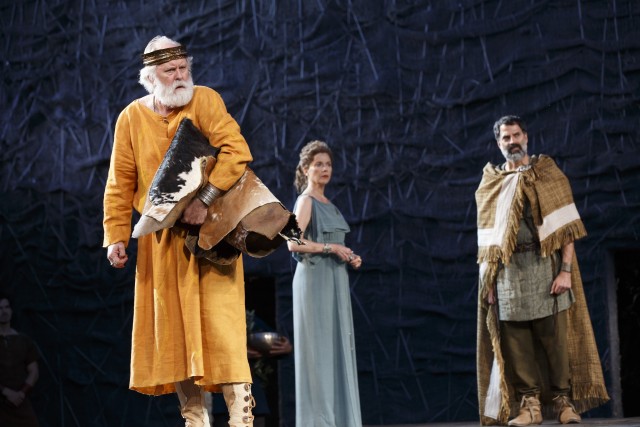
John Lithgow stars as an emotional King Lear in Shakespeare in the Park production that also features Annette Bening as Goneril and Christopher Innvar as Albany (photo by Joan Marcus)

Central Park
Delacorte Theater
Tuesday – Sunday through August 17, free, 8:00
shakespeareinthepark.org

Fut! Another day, another Lear. Over the last several years, New York City has been inundated with major productions of Shakespeare’s greatest tragedy. There’s been Michael Pennington at Theatre for a New Audience, Sir Ian McKellen, Sir Derek Jacobi, and Frank Langella at BAM, and Kevin Kline and Sam Waterston at the Public. And now Rochester native John Lithgow, at the age of sixty-eight, has taken on the role of the king and father descending into madness. First performed at Shakespeare in the Park in the Delacorte’s inaugural season, 1962, with Frank Silvera and last seen there in 1973 with James Earl Jones, this latest Public Theater presentation of King Lear features two-time Tony winner Lithgow (The Changing Room, Sweet Smell of Success) as an emotional Lear as he deals with the betrayal of his two conniving older daughters, Goneril (Annette Bening) and Regan (Jessica Hecht), after casting aside his beloved youngest, Cordelia (Jessica Collins). He also exiles his loyal friend, the Earl of Kent (Jay O. Sanders), who reappears in disguise as Caius to protect his lord, the fading king. Meanwhile, the Earl of Gloucester (Clarke Peters) is misled by his bastard son, Edmund (Eric Sheffer Stevens), into believing his first-born, Edgar (Chukwudi Iwuji), is plotting patricide.

(photo by Joan Marcus)

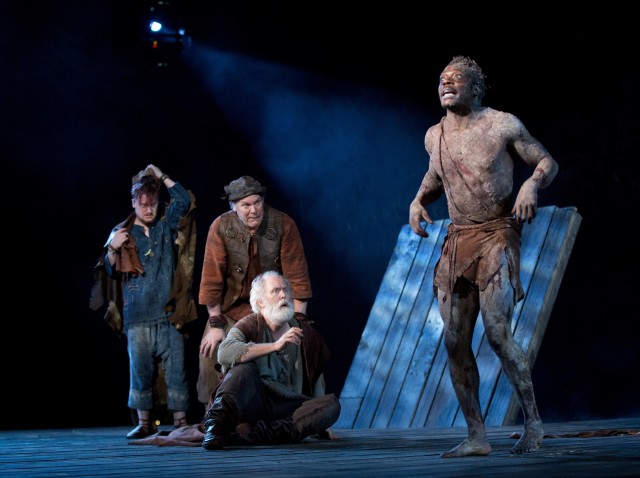
The Fool (Steven Boyer), Caius (Jay O. Sanders), and Lear (John Lithgow) are surprised by Poor Tom (Chukwudi Iwuji) in Public Theater presentation in the park (photo by Joan Marcus)

One of the most fascinating things about King Lear is how adaptable it is, that even when the same dialogue is being used, focus can shift dramatically from one character to another in different productions. In this case, veteran Shakespeare in the Park director Daniel Sullivan (The Comedy of Errors, The Merchant of Venice) highlights Goneril and Regan, but Bening, in her return to the New York stage for the first time in a quarter-century, is too stolid as the former, and Hecht (The Assembled Parties, A View from the Bridge) adds too much ironic humor as the latter. Jeremy Bobb’s laconic Oswald is stronger than Stevens’s fanciful Edmund, which is usually the other way around, while Iwuji transforms from carefree Edgar to the pathetic Poor Tom very well. Lithgow is a sad, heart-rending Lear, but Sullivan too often leaves him virtually alone on John Lee Beatty’s set, a large wooden platform backed with a tall screen covered with metallic rods that are like sharp sticks; Lear loses his grandeur too quickly, his minions peeling away as his mind goes. Shakespeare in the Park mainstay Sanders nearly steals the show as Kent/Caius, the only one who truly stands by his king. Steven Boyer is a fine Fool, but there’s not enough of him. The blinding scene is disappointingly tame, but Tal Yarden’s video projections enhance the storm, there’s an exciting sword fight near the end that draws gasps, and percussion played by two men on either side of the stage intensifies the overall ominous mood, resulting in a worthwhile, if not stellar, version of an oft-seen play that, amazingly, rarely bores even after repeated viewings. However, just when it seemed safe to put Lear to bed for at least a little while, it’s been announced that English actor Joseph Marcell will be starring in a production at the NYU Skirball Center this fall by Shakespeare’s Globe, the company that just performed Twelfth Night and Richard III on Broadway to such great acclaim. Fut! indeed. . . .

(In addition to waiting on line at the Delacorte, the Queens Museum, Snug Harbor Cultural Center, Lehman College, the Brooklyn Children’s Museum, and the Public Theater to get free tickets, you can also enter the daily virtual ticketing lottery online here.)

ESSENTIAL CINEMA: ZORNS LEMMA AND HAPAX LEGOMENA I: (nostalgia)

ZORNS LEMMA

Hollis Frampton breaks down cinema into its essential audio and visual forms in experimental masterpiece ZORNS LEMMA

ZORNS LEMMA (Hollis Frampton, 1970)
HAPAX LEGOMENA I: (nostalgia) (Hollis Frampton, 1971)
Anthology Film Archives
32 Second Ave. at Second St.
Thursday, August 14, 7:30
212-505-5181
www.anthologyfilmarchives.org
www.hollisframpton.org.uk

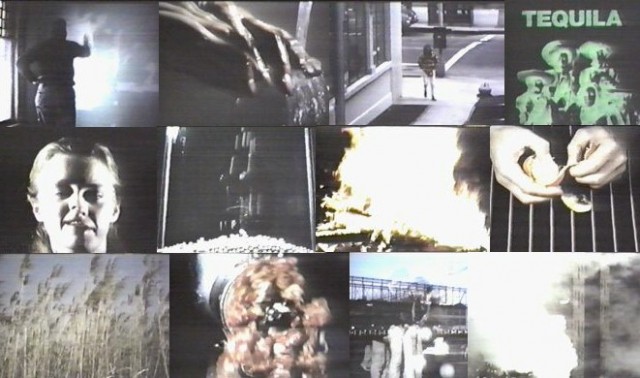
A poet and photographer before turning to film, Ohio-born avant-garde visual artist Hollis Frampton created a unique cinema that deconstructed and reconstructed sound and image as basic structural elements, developing narratives that were more often about time, space, and memory than traditional storytelling. On August 14 at 7:30, Anthology Film Archives is screening two of his most famous works as part of its continuing Essential Cinema series. In the hour-long Zorns Lemma, which he described as a “kind of cryptic autobiography,” Frampton makes a triptych about learning the language of life and film, about how we process what we see and hear as we mature. In the first section, Canadian filmmaker Joyce Wieland reads twenty-four rhyming sentences from the eighteenth-century Puritan children’s book The Bay State Primer, each one centering on a word starting with the next letter of the ancient Greek alphabet, which does not include “J” and “V”; the accompanying visual is just the black filmstrip itself, with tics and scratches evident. In the second section, which lasts forty-five minutes, Frampton zeroes in on individual words from signs, billboards, posters, and other places around New York City, displaying them alphabetically one per second, each twenty-four-second trip from A to Z evoking the very essence of cinema, which is projected at twenty-four frames per second. As the words continue to cycle silently through, sometimes completely random, sometimes combining into intentional combinations, they are eventually replaced by moving images, roughly in reverse order of how often they are used in the English language. Thus, W-X-Y-Z become passing by city lights in the dark, a raging fire, cattails swirling in the wind, and waves going backward into the ocean. After each letter has ultimately been replaced, the third section begins, both sound and image; as a man, woman, and dog slowly make their way across a snowy landscape, the soundtrack consists of six women reading excerpts from medieval bishop Robert Grosseteste’s On Light, or the Ingression of Forms, at one word per second, accompanied by a ticking metronome. Perhaps Frampton chose six readers to evoke another of Grosseteste’s works, On the Six Days of Creation, as Zorns Lemma, named for an actual mathematical theory, is, at its very heart and soul, about the creation of cinema. It is also about duration, expectation, completion, experience, and satisfaction, and it is surprisingly gripping, even if it can occasionally get monotonous. But of course, that’s part of its charm.

Hollis Frampton burns a photograph of himself in experimental film

Hollis Frampton burns a photograph of himself in seminal experimental film

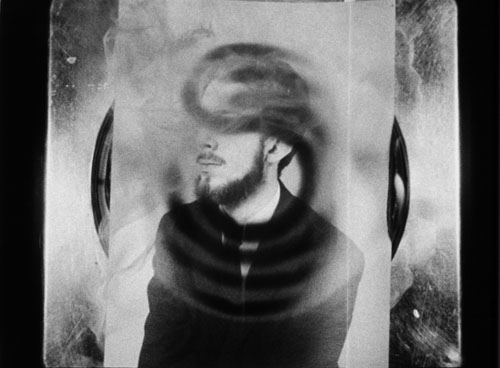
Zorns Lemma will be screening with another masterful work by Frampton, 1971’s (nostalgia). Over the course of nearly forty minutes, Frampton displays a dozen photographs one at a time, placed on a coiled electric burner that ignites the picture, eventually reducing it to ash as the camera remains static. Meanwhile, Michael Snow (Wavelength) narrates Frampton’s first-person words in a deadpan voice over each photograph, discussing how he (Frampton) came to took it, sharing details about his life as well as his thoughts on art, name-dropping such friends, classmates, and colleagues as onetime roommate Carl Andre, Frank Stella, Larry Poons, and Snow himself. However, Frampton is actually talking about the next photograph in the sequence, not the one that is currently disintegrating on the screen. Thus, as we see a self-portrait, he is analyzing a photograph of a cabinetmaker’s shop, which will be shown next; the self-portrait was discussed over the previous photograph, a shot of Andre in a picture frame, with a metronome. As he did with Zorns Lemma, Frampton plays with, and preys on, the viewer’s relationship with cinema, busting open the boundaries that are part of the intrinsic nature of film, becoming a treatise on time and the fallibility of memory. It is also about the impermanence of both life and art; as each photograph crumbles, he leaves the camera on it as it morphs into a kind of black ash sculpture, each one unique and original. “Language and image, each trespassing in the other’s house, secrete disquieting disjunctions, conundrums, circularities,” Frampton explained in 1979. “We are accustomed to the poetic strategy, within language, of bracketing a noun within the genus of yet another noun, which may come from an alien phylum, a foreign kingdom. Translation of that strategy into the economy of images yields artifacts . . . savagely grotesque, arch, silly . . . that seem to flee the rigors of self-reference; contradictory images, far from coalescing in a dialectical encounter, annihilate one another in a gesture that sweeps language clean of specification and seems on the point of suggesting a raw map of the preconscious work — the material ACTION — of language.” In Zorns Lemma and (nostalgia) , Frampton, who died in 1984 at the age of forty-eight, still in the midst of his epic Magellan cycle, poetically deals with “disquieting disjunctions, conundrums, [and] circularities,” resulting in a pair of captivating, disorienting, and entertainingly philosophical self-referential works that will continue to project themselves into the time and space of your own memories long after they are over.

INTREPID SUMMER MOVIE SERIES / RIVERFLICKS — BIG HIT WEDNESDAYS: CAPTAIN PHILLIPS

Tom Hanks

Tom Hanks fights for his crew and his ship in another tense thriller from expert director Paul Greengrass

CAPTAIN PHILLIPS (Paul Greengrass, 2013)
Intrepid Summer Movie Series
Thursday, August 14, Intrepid Sea, Air & Space Museum, Pier 86, 12th Ave. & 46th St., free, dusk
RiverFlicks: Big Hit Wednesdays
Wednesday, August 20, Hudson River Park, Pier 63 lawn at 23rd St., free, dusk
www.captainphillipsmovie.com

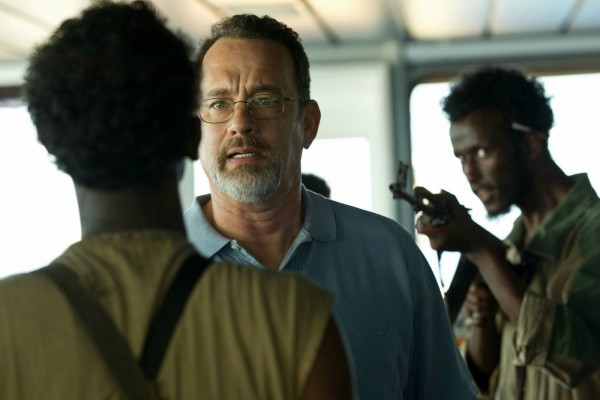
Based on the true story of Somali pirates hijacking a Maersk container ship in the spring of 2009, Paul Greengrass’s Captain Phillips is a nonstop action thriller, a gripping film that is solidly one of the best of the year. Tom Hanks gives a riveting performance as Captain Richard Phillips, a merchant marine guiding the MV Maersk Alabama on its mission to deliver relief supplies to Somalia, Uganda, and Kenya, in addition to more standard cargo. A family man, he kisses his wife, Andrea (Catherine Keener), goodbye, then heads out on his journey, paying close attention to a memo warning of possible pirate activity. When small motorboats do indeed start approaching, Phillips tries diversionary tactics — the ship and crew were not permitted to carry any weaponry whatsoever back then — but he knows that it’s only a matter of time before they come back, and indeed the Alabama is soon boarded by four armed pirates led by Abduwali Muse (Barkhad Abdi), who capture Phillips and take over the ship. But things don’t go quite as planned for Phillips or the pirates, leading to a marvelously staged showdown finale. Greengrass, who has made such previous expert thrillers as Bloody Sunday, The Bourne Supremacy, and United 93, once again builds unrelenting tension every step of the way, even for those in the audience who might already know the outcome. The film centers on the complex relationship between the relatively easygoing Phillips and the desperate Muse, their eyes constantly meeting in penetrating gazes as they play an intense psychological game of cat and mouse. Hanks is a marvel as Phillips, giving brilliant nuance and texture to what could have been a one-note role but instead ends up being one of the finest of his outstanding career. All along the way, Greengrass keeps upping the ante, whether in a chase on the high seas or a claustrophobic battle of wills inside a lifeboat. There has been some controversy over the factual accuracy of the film, which is based on Phillips’s bestselling A Captain’s Duty: Somali Pirates, Navy SEALs, and Dangerous Days at Sea (written with Stephan Talty), but that doesn’t take anything away from what is a breathtaking cinematic experience. Nominated for six Academy Awards, Captain Phillips is screening August 14 at the Intrepid Summer Movie Series and August 20 at Hudson River Park’s Pier 63, concluding the free RiverFlicks: Big Hit Wednesdays series. (For a day-by-day listing of free summer movie screenings throughout New York City, go here.)

OUTDOOR CINEMA: 13 ASSASSINS

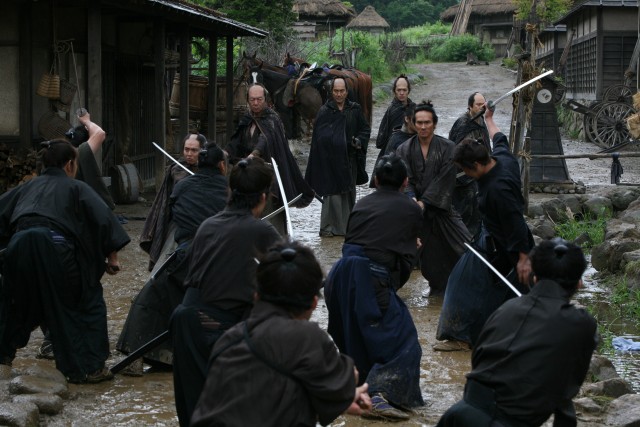
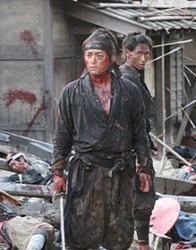
A small group of samurai sets out to end a brutal madman’s tyranny in Takashi Miike’s brilliant 13 ASSASSINS

A small group of samurai sets out to end a brutal madman’s tyranny in Takashi Miike’s brilliant 13 ASSASSINS

13 ASSASSINS (JÛSAN-NIN NO SHIKAKU) (Takashi Miike, 2010)
Socrates Sculpture Park
32-01 Vernon Blvd.
Wednesday, August 13, free, 7:00
718-956-1819
www.socratessculpturepark.org
www.13assassins.com

Japanese director Takashi Miike’s first foray into the samurai epic is a nearly flawless film, perhaps his most accomplished work. Evoking such classics as Kurosawa’s Seven Samurai, Mizoguchi’s 47 Ronin, Aldrich’s The Dirty Dozen, and Eastwood’s High Plains Drifter, 13 Assassins is a thrilling tale of honor and revenge, inspired by a true story. In mid-nineteenth-century feudal Japan, during a time of peace just prior to the Meiji Restoration, Lord Naritsugu (Gorô Inagaki), the son of the former shogun and half-brother to the current one, is abusing his power, raping and killing at will, even using his servants and their families as target practice with a bow and arrow. Because of his connections, he is officially untouchable, but Sir Doi (Mikijiro Hira) secretly hires Shinzaemon Shimada (Kôji Yakusho) to gather a small team and put an end to Naritsugu’s brutal tyranny. But the lord’s protector, Hanbei (Masachika Ichimura), a former nemesis of Shinzaemon’s, has vowed to defend his master to the death, even though he despises Naritsugu’s actions. As the thirteen samurai make a plan to get to Naritsugu, they are eager to finally break out their long-unused swords and do what they were born to do.
It’s an intense battle to the bitter end in modern classic

It’s an intense battle to the bitter end in modern classic

“He who values his life dies a dog’s death,” Shinzaemon proclaims, knowing that the task is virtually impossible but willing to die for a just cause. Although there are occasional flashes of extreme gore in the first part of the film, Miike keeps the audience waiting until he unleashes the gripping battle, an extended scene of blood and violence that highlights death before dishonor. Selected for the 2009 Cannes Film Festival and nominated for the Silver Lion at the 2010 Venice Film Festival, 13 Assassins is one of Miike’s best-crafted tales; nominated for ten Japanese Academy Prizes, including Best Picture, Best Director, Best Screenplay (Daisuke Tengan), Best Editing (Kenji Yamashita), Best Original Score (Koji Endo), and Best Actor (Yakusho), it won awards for cinematography (Nobuyasu Kita), lighting direction (Yoshiya Watanabe), art direction (Yuji Hayashida), and sound recording (Jun Nakamura). 13 Assassins is screening August 13 in Long Island City as part of Socrates Sculpture Park’s free summer Outdoor Cinema series and will be preceded by a live performance, with Japanese food available for purchase as well. The sixteenth annual series continues August 20 with Claude Nuridsany and Marie Pérennou’s Microcosmos and concludes August 27 with a double feature of Maxim Pozdorovkin and Mike Lerner’s Pussy Riot: A Punk Prayer and Vittorio De Sica’s Umberto D., both of which were rained out earlier this summer.

BETWEEN RIVERSIDE AND CRAZY

(photo by Kevin Thomas Garcia)

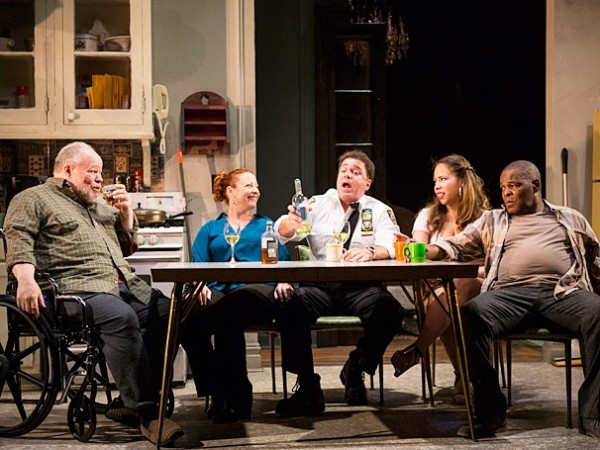
BETWEEN RIVERSIDE AND CRAZY features a stellar cast led by the wonderful Stephen McKinley Henderson (photo by Kevin Thomas Garcia)

Atlantic Theater Company
Linda Gross Theater
336 West 20th St. between Eighth & Ninth Aves.
Monday – Saturday through August 23, $20-$65
866-811-4111
www.atlantictheater.org

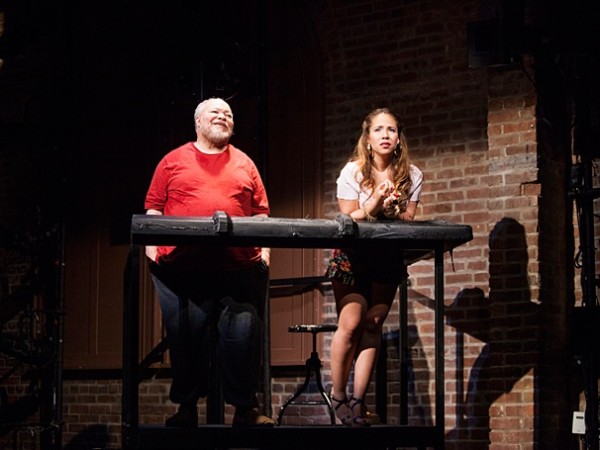
Longtime character actor Stephen McKinley Henderson, a staple in the work of August Wilson, finally gets the big-time starring role he deserves in Stephen Adly Guirgis’s Between Riverside and Crazy. In the Atlantic Theater Company production, which has been extended through August 23, Henderson, who was nominated for a supporting actor Tony in 2012 for his role as Bono in Fences and more recently played Bobo in the Tony-nominated revival of A Raisin in the Sun, both opposite Denzel Washington, stars as Walter “Pops” Washington, a former beat cop whose career ended after a fellow police officer shot him multiple times. As the play opens, the portly Pops is sitting in a wheelchair at the kitchen table in his broken-down, rent-stabilized Riverside Drive railroad apartment. But it turns out that he can walk fine; the wheelchair belonged to his wife, who passed away just before Christmas. Meanwhile, the much-coveted apartment has been falling apart ever since his wife’s death, as evidenced by a wobbly Christmas tree still in the living room. Pops lives with his grown son, the recently paroled Junior (Ray Anthony Thomas), who is secretive and argumentative; Oswaldo (Victor Almanzar), a tough-talking young man in recovery who Pops has taken in; and Lulu (Rosal Colón), Junior’s pregnant girlfriend. It’s been eight years since Pops was shot in a controversial off-duty incident that he claims was racially motivated; over that time, the city has made financial offers to settle the case, but Pops has rejected every one on principle. “An honorable man can’t be bought off,” he tells his son. “An honorable man doesn’t just settle a lawsuit ‘No Fault’ and lend his silence to hypocrisy and racism and the grievous violation of all our civil rights.” His former partner, Audrey (Guirgis regular Elizabeth Canavan), and her fiancée, Lieutenant Caro (The Sopranos’ and Nurse Jackie’s Michael Rispoli) come for dinner and try to persuade him to take the deal, but Pops is a stubborn, unpredictable man with a unique view of the world. Nevertheless, he sees a different light after a visit from the new church lady (Liza Colón-Zayas).

(photo by Kevin Thomas Garcia)

Pops (Stephen McKinley Henderson) and Lulu (Rosal Colón) share a moment in new Stephen Adly Guirgis play at the Atlantic (photo by Kevin Thomas Garcia)

Guirgis, who grew up on Riverside Drive, is the former co-artistic director of the LAByrinth Theater Company, for which he wrote five plays directed by Philip Seymour Hoffman (including Our Lady of 121st Street and Jesus Hopped the “A” Train), followed by his Broadway debut, The Motherf**ker with the Hat. Between Riverside and Crazy again demonstrates his sharp ear for dialogue and his keen sense of characterization as he creates complex, realistic situations filled with surprise twists and turns. Henderson is fabulous as Pops, alternating between a sweet gentleness and a selfish anger, both populated with four-letter words that emerge poetically; the audience never knows what he’ll say or do next, making the play wonderfully uncomfortable. The supporting cast is excellent as well, as Guirgis and director Austin Pendleton (Gidion’s Knot, Orson’s Shadow) give each character his and her moment to shine on Walt Spangler’s rotating, somewhat ramshackle set. But best of all, everyone keeps the spotlight centered on Henderson as Pops, a lovable yet intensely frustrating individual played by an actor of tender and intelligent depth and charm.