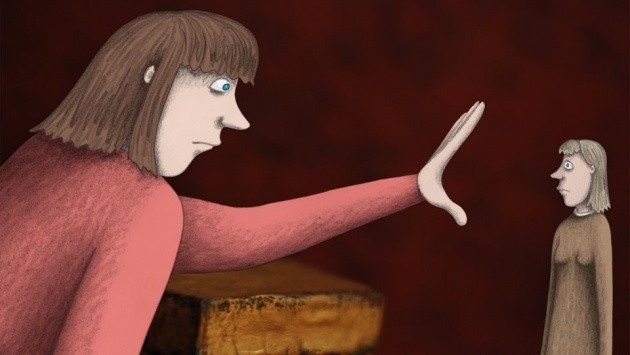
Signe Baumane examines her family history of suicide and depression in ROCKS IN MY POCKETS
ROCKS IN MY POCKETS: A CRAZY QUEST FOR SANITY (Signe Baumane, 2014)
IFC Center
323 Sixth Ave. at West Third St.
Opens Wednesday, September 3
212-924-7771
www.ifccenter.com
www.rocksinmypocketsmovie.com
 The recent suicide of Robin Williams shook the nation, once again pointing out that depression is no laughing matter. But Latvian-born, Brooklyn-based writer-director-producer-animator Signe Baumane takes a unique approach to depression and suicide in the darkly twisted animated film Rocks in My Pockets: A Crazy Quest for Sanity. Influenced by such animation giants as Jan Švankmajer and Bill Plympton in addition to Lithuanian-Polish illustrator Stasys Eidrigevicius and Russian animator Yuri Norstein, Baumane, a self-described “Master of Self Pity,” incorporates hand-drawn animation, papier-mâché constructions, and stop-motion animation in telling the story of her family’s long history of mental illness and suicide. Inspired by her own thoughts of ending it all, Baumane (Teat Beat of Sex), in her feature-length debut, divides the film into segments about her suicidal relatives. She narrates the tales of Indulis, an entrepreneur and failed counterfeiter with an “idea-generating brain”; Anna, a university graduate and secretary who falls in love with Indulis, her married boss; Miranda, who looks at the world as if everything were a work of art; Linda, a medical student with big dreams; Irbe, a lonely music teacher who hears voices in her head; and herself as they all experience various aspects of severe depression while facing the trials and tribulations of everyday life in a changing sociopolitical climate in Eastern Europe.
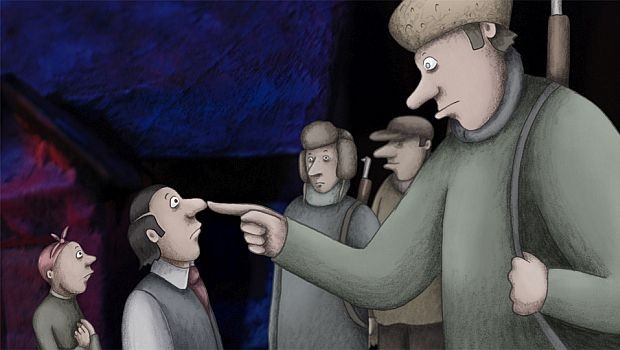
ROCKS IN MY POCKETS uses twisted humor to explore some very serious subjects
Despite the serious topics and events — and the regular appearance of nooses tempting the protagonists — Rocks in My Pockets is filled with clever jokes, imaginative visual puns, beautiful imagery, and a playful score by Kristian Sensini; Baumane refers to it as “a funny film about depression,” and that’s just what it is. The animated characters make their way through lush forests, across a real chess board, and past other colorful backgrounds as reality strikes them hard. The personal nature of the film is enhanced by Baumane’s own narration, in her thick Latvian accent. (Her mother attempted to talk her out of doing the narration, thinking it was a bad idea.) “I want to survive, but I don’t want to live,” Baumane says halfway through the film. “When my brain is idle, it starts eating itself.” Fearing that depression and suicide are part of her DNA, she’s unsure how she can get away from it — and prevent it from affecting future generations of her family. Winner of the International Critics (FIPRESCI) Prize at the 2014 Karlovy Vary Film Festival and financed in part by a Kickstarter campaign (where you can learn more about the making-of process), Rocks in My Pockets opens September 3 at the IFC Center, with Baumane taking part in Q&As following the 6:30 and 8:30 shows on Wednesday and Thursday, with more to be announced; in addition, original drawings from the film will be given away at select screenings.
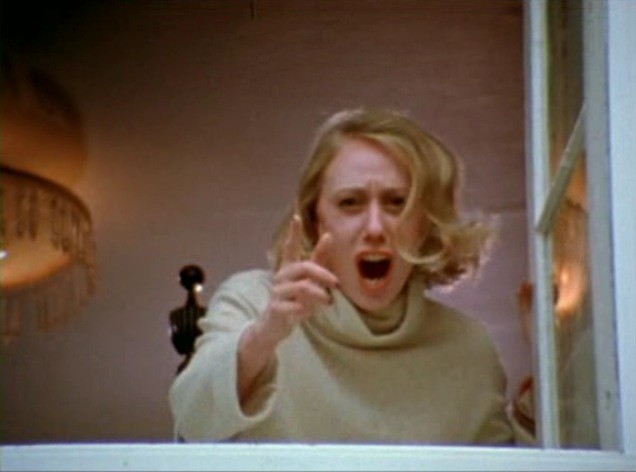
 A turning point in his career, John Waters’s Desperate Living is an off-the-charts bizarre, fetishistic fairy tale, the ultimate suburban nightmare. Mink Stole stars as Peggy Gravel, a wealthy housewife suffering yet another of her mental breakdowns. In the heat of the moment, she and the family maid, four-hundred-pound Grizelda Brown (Jean Hill), kill Peggy’s mild-mannered husband, Bosley (George Stover), and the two women end up finding refuge in one of the weirdest towns ever put on celluloid, Mortville, where MGM’s The Wizard of Oz and Babes in Toyland meet Russ Meyer’s Faster, Pussycat! Kill! Kill! (with some Kenneth Anger, Jack Smith, and Douglas Sirk thrown into the mix as well). “I ain’t your maid anymore, bitch! I’m your sister in crime!” Grizelda declares. Peggy and Grizelda move into the “guest house” of manly Mole McHenry (Susan Lowe) and her blonde bombshell lover, Muffy St. Jacques (Liz Renay). Mortville is run as a kind of fascist state by the cruel and unusual despot Queen Carlotta (Edith Massey), an evil shrew who enjoys being serviced by her men-in-leather attendants, issues psychotic proclamations, and is determined that her daughter, Princess Coo-Coo (Mary Vivian Pearce), stop dating her garbage-man boyfriend, Herbert (George Figgs). (Wait, Mortville has a sanitation department?) Camp and trash combine like nuclear fission as things get only crazier from there, devolving into gorgeous low-budget madness and completely over-the-top ridiculousness, a mélange of sex, violence, and impossible-to-describe lunacy that Waters himself claimed was a movie “for fucked-up children.”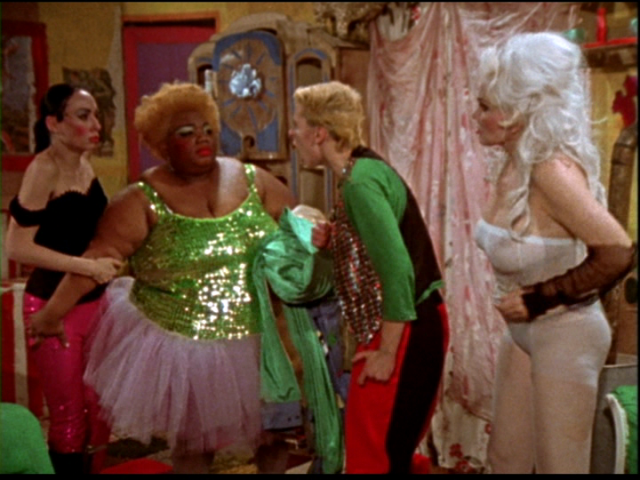



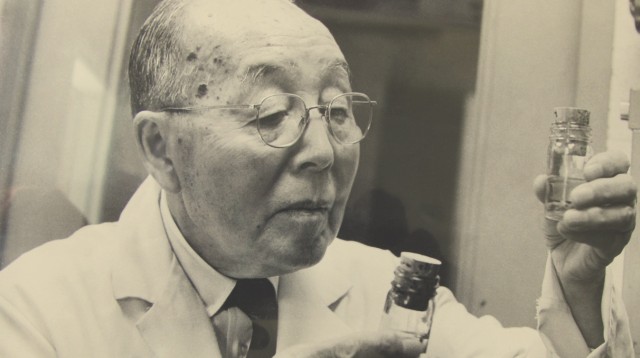
 At the beginning of Eric Merola’s Second Opinion: Laetrile at Sloan-Kettering, a 1970s news reporter says, “Dr. Robert Good, president of the Sloan Kettering Institute, one of the world’s biggest and richest cancer research centers, said Laetrile does not prevent cancer, nor cure cancer, nor stop cancer from spreading.” For the next seventy-five minutes, Ralph W. Moss, PhD, the public affairs science writer for the Memorial Sloan Kettering Cancer Center from 1974 to 1977, talks about what lay behind that statement and the furor that followed. He tells the captivating story of what went on behind the scenes as Laetrile, a form of amygdalin used in tumor treatment, was coveted by cancer patients but demonized by the medical establishment. The controversy over the drug, which was eventually banned in America, forced patients to go to Mexico in search of the palliative care medicine while the FDA, the National Cancer Institute, and several high-profile MSK doctors considered it to be quackery. MSK’s own top researcher, Dr. Kanematsu Sugiura, had exciting success treating mice with the drug, hopeful that the positive effects would be proven in humans as well. But when Dr. Good, MSK vice presidents Dr. Lloyd J. Old and Dr. Chester Stock, and MSKCC president Dr. Lewis Thomas decided that Laetrile was not the future of cancer treatment, despite what some of them had previously stated in public, Moss was confused and distressed. Others were as well; the documentary reveals that the political dimension of the debate eventually brought even the ultra-right-wing John Birch Society into the fray. Moss eventually became a whistleblower, writing numerous books on the subject, including The Cancer Industry, Cancer Therapy: The Independent Consumer’s Guide to Non-Toxic Treatment & Prevention, and the brand-new Doctored Results: The Suppression of Laetrile at Sloan-Kettering Institute for Cancer Research, which spurred the documentary.