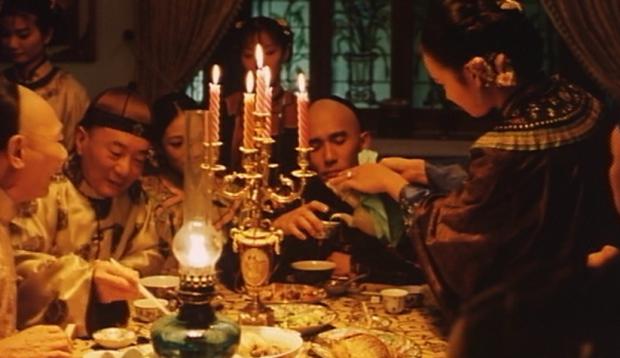
Hou Hsiao-hsien gem FLOWERS OF SHANGHAI explores complex relationships between wealthy patrons and courtesans
FLOWERS OF SHANGHAI (HAI SHANG HUA) (Hou Hsiao-hsien, 1998)
Museum of the Moving Image
35th Ave. at 36th St., Astoria
Friday, September 12, $12, 7:00
Series runs September 12 – October 17
718-777-6800
www.movingimage.us
 Taiwanese New Wave master Hou Hisao-hsien might be the best filmmaker whose work you’ve never seen. For more than thirty years, he has been telling intimate, meditative stories about life, family, and relationships with a gentle, deeply intuitive style, infused with gorgeous visuals and subtly beautiful soundtracks. The Museum of the Moving Image is honoring the sixty-seven-year-old auteur with “Also like Life: The Films of Hou Hsiao-hsien,” a five-week series that includes all of his feature films, some shorts, Olivier Assayas’s documentary about him, and other films that he either appeared in or cowrote. The festival, organized by Richard I. Suchenski in conjunction with the publication of a new book about Hou, begins with one of his most elegant works, Flowers of Shanghai. The film is set in brothels, known as flower houses, in 1884 in the British Concession, where men and women congregate for social interaction and develop long-term bonds and responsibilities to one another based on much more than just sex. The men play drinking games, smoke opium, and buy the women gifts. The story, told in a series of vignettes as Mark Lee Ping Bin’s camera slowly moves through dark, lush, reddish gas-lit interiors, focuses on Master Wang (Tony Leung Chiu-wai), who has promised to be the sole patron of Crimson (Michiko Hada) but who has also been secretly seeing the younger Jasmin (Vicky Wei) and lavishing her with presents. The elder Master Hong (Luo Tsai-erh) and Auntie Huang (Rebecca Pan), the madam, discuss the situation, bringing up issues of responsibility and honesty, attempting to come to some kind of understanding in an exchange that shows respect for both the men and women who are a far cry from the Western conception of johns and prostitutes.
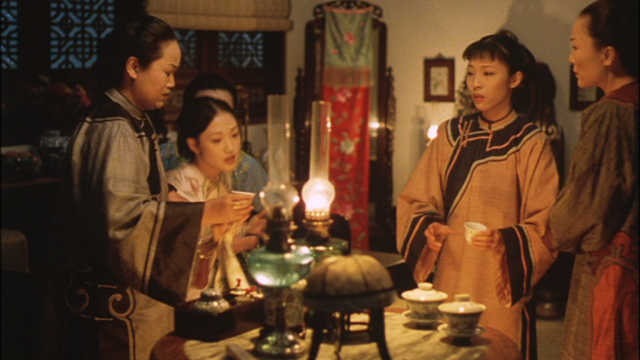
Women working in a brothel discuss their futures amid intimate lighting in Hou Hsiao-hsien’s gorgeous FLOWERS OF SHANGHAI
Most scenes end by fading quietly to black, then introducing the woman protagonist of the next section — Crimson, Jasmin, Pearl (Carina Lau), Jade (Shuan Fang), and Emerald (Michelle Reis) — as the women gossip and Crimson and Hong, and other pairs, try to figure out what they want out of life and from one another. In Flowers of Shanghai, Hou explores class differences, gender roles, the Asian notion of saving face, and intimacy with grace and sophistication. When the film fades out for the final time, viewers are left knowing they’ve just experienced something special, a stunning work that uses the technologies of cinema to delve into the very nature of humanity. Flowers of Shanghai is screening at the Museum of the Moving Image on September 12 at 7:00; it will be introduced by Suchenski and followed by a reception. The opening weekend of “Also like Life” also includes Hou’s debut feature, Cute Girl, Assayas’s HHH: A Portrait of Hou Hsiao-hsien, Hou’s masterpiece The Puppetmaster, the coming-of-age tale A Summer at Grandpa’s, 1981’s Cheerful Wind, and the love-story trilogy Three Times.

 Most prison documentaries are about drugs, violence, race, systemic abuse and corruption, politics, and social justice, focusing on frightening crime statistics. But first-time director John Lucas takes a different approach in the thoroughly engaging new film The Cooler Bandits. In 1991, Ohio teenagers Charlie Kelly, Donovan Harris, Richard “Poochie” Roderick, and Frankie Porter pulled off a string of restaurant robberies in which they locked employees in refrigeration rooms or freezers. Caught, tried, and convicted, the four friends got vastly different sentences; while Harris accepted a plea bargain and got 16 to 50 years, the others went to trial: Kelly and Roderick received sentences of 60 to 150 years and Porter 200 to 500 years. But Lucas, a longtime Ohio photojournalist, doesn’t concentrate on the men’s past, their fair or unfair treatment, or their experiences behind bars; instead, the film follows them from 2006 to 2013 as Harris adjusts to life outside and his release before the others, Kelly and Roderick prepare for possible parole, and Porter faces much more time in prison. Kelly and Roderick, in particular, speak openly and honestly about their plans for their future, thinking about education, careers, and family, fully accepting their punishment without any chips on their shoulders despite sentences that even the prosecutor agrees were far too harsh. They refuse to turn themselves into victims, making for a surprising and refreshing film. Lucas also speaks with their parents, siblings, aunts, uncles, and cousins, who are much more emotional than the four men; while standing by their family members, they recognize that the group committed serious crimes that deserved jail time, but they also want them to still be able to have a chance at a good life on the outside. The Cooler Bandits is screening September 11 at 7:00 at Aaron Davis Hall as part of the ninth annual Harlem International Film Festival; it will be preceded by Melanie Hibbert’s Coalition for Women Prisoners: Harlem NYC and Indrani Kopal’s The Game Changer and followed by a performance and Q&A with the filmmakers. Among the other films at the five-day fest, consisting of nearly one hundred shorts and features from more than two dozen countries, are Jason Paul Laxamana’s Magkakbaung (The Coffin Maker), Tim Wilkerson’s Oracles of Pennsylvania Ave., Joel Lamangan’s Kamkam (Greed), and Kevin Chu’s I See Love.