Who: Deer Tick
What: Six-night residency playing full cover albums and original songs in honor of band’s tenth anniversary
Where: Brooklyn Bowl, 61 Wythe Ave., 718-963-3369
When: December 26-31, $25
Why: 12/26 — NRBQ’s Tiddly Winks, DT’s War Elephant; 12/27 — Lou Reed’s Transformer, DT originals; 12/28 — the Beatles’ Meet the Beatles, DT originals; 12/29 — Devo’s Q: Are We Not Men? A: We Are Devo!, DT originals; 12/30 — Elvis Costello’s My Aim Is True, DT originals; 12/31 — fan-chosen set
twi-ny recommended events
UNBROKEN

Louie Zamperini (Jack O’Connell) gets ready to run for his life in UNBROKEN
UNBROKEN (Angelina Jolie, 2014)
Opens Thursday, December 25
www.unbrokenfilm.com
 Unbroken, Angelina Jolie’s second film as director (following In the Land of Blood and Honey), attempts to set itself apart from other real-life dramas right from the start; while other movies claim to be “based on a true story” or “inspired by actual events,” Unbroken boldly, and very clearly, declares itself to be “a true story.” The old-fashioned WWII movie tells the story of Louis “Louie” Zamperini, a troubled kid (first C. J. Valleroy, then Jack O’Connell) who drinks, smokes, and gets in trouble with the law until his life turns around when his brother, Pete (first John D’Leo, then Alex Russell), helps train him to become an Olympic runner. But duty calls, and Louie enlists in the air force. His plane is shot down over the Pacific Ocean, leaving him, Russell “Phil” Phillips (Anna Karenina’s Domhnall Gleeson), and Francis “Mac” McNamara (American Horror Story’s Finn Wittrock) adrift on a pair of life rafts, surrounded by sharks. Later, Zamperini is captured and taken to a POW camp run by the sadistic Mutsuhiro “the Bird” Watanabe (Japanese rock star Miyavi), who decides to make the Olympian his personal punching bag, brutalizing him every chance he gets, daring him to give up, but Zamperini isn’t about to give him the satisfaction.

Louie Zamperini (Jack O’Connell) goes through hell and back in Angelina Jolie’s WWII drama
A gripping, if overly straightforward, good vs. evil story, Unbroken is based on Laura Hillenbrand’s 2010 book, Unbroken: A World War II Story of Survival, Resilience, and Redemption, and both Hillenbrand and Zamperini, who died earlier this year at the age of ninety-seven, served as consultants on the film. The screenplay, which leaves little room for nuance, was written by Joel and Ethan Coen, along with William Nicholson (Shadowlands, Sarafina!) and Richard LaGravenese (The Fisher King, Beautiful Creatures). English actor O’Connell (Starred Up, This Is England) gives a courageous, physically harrowing performance as Zamperini, while the baby-faced Miyavi is frightening in his movie debut. Their relationship recalls elements of such films as The Hill, Papillon, The Deer Hunter, and even The Bridge on the River Kwai, although Jolie ultimately relies too much on the hero vs. villain black-and-white aspects of the story. There also might be unintended reactions to Unbroken, especially coming on the heels of the Senate’s recent release of the CIA Torture Report; while the film is a distinctly American tale of the indomitability of the human spirit and the sheer will to survive against all odds, it deals with the controversial issue of wartime torture, and near the end of the film, the man sitting next to us muttered that what the Bird did to Zamperini was much worse than anything the U.S. has ever done to any of its enemies.
CHUCK JONES MATINEES: FOR SCENT-MENTAL REASONS AND OTHER CARTOONS

Love, among other things, is in the air in Chuck Jones classic FOR SCENT-IMENTAL REASONS
Museum of the Moving Image
35th Ave. at 36th St., Astoria
Friday, December 26, and December 29 – January 2, free with museum admission, 1:00
718-777-6800
www.movingimage.us
 The Museum of the Moving Image’s celebration of all things Chuck Jones continues with a matinee of eight more of his classic Warner Bros. cartoons, held in conjunction with the endlessly fun exhibit “What’s Up, Doc? The Animation Art of Chuck Jones.” The festivities begin with 1946’s Hair-Raising Hare, in which Bugs Bunny thinks that monsters must lead such interesting lives. In 1949’s For Scent-imental Reasons, Pepè Le Pew thinks he has found true love. Daffy heads into the future and battles Marvin the Martian in 1953’s Duck Dodgers in the 24 1/2th Century. Daydreaming eight-year-old Ralph Phillips is introduced in 1954’s From A to Z-Z-Z-Z. Witch Hazel has some dastardly plans for Halloween trick-or-treaters in 1956’s Broom-Stick Bunny. Daffy and Bugs fight over a vast treasure in 1957’s Ali Baba Bunny. Daffy attempts to steal from the poor and give to the rich in 1958’s Robin Hood Daffy. And Wile E. Coyote (as Batman!) and the Delicius-Delicius Road Runner go at it yet again in 1956’s Gee Whiz-z-z. The exhibit runs through January 19; the matinees continue with “Baton Bunny and Other Cartoons” on January 4, “The Rabbit of Seville and Other Cartoons” January 10-11, and “Duck Amuck and Other Cartoons” January 17-18.
VIDEO OF THE DAY: “AFRAID” BY AMEL LARRIEUX
Who: Amel Larrieux
What: Amel Larrieux: A Blissful Holiday
Where: City Winery, 155 Varick St., 212-608-0555
When: Friday, December 26, $24-$45, 8:00
Why: An activist, a self-described “urban chanteuse by birth,” and cofounder of Groove Theory, Amel Larrieux has released such solo records as Infinite Possibilities, Morning, and Ice Cream Everyday; “when i wrote ‘Danger’ for my latest project,” she recently blogged, “i truly did not expect i would be dedicating it to anyone so soon….”
THE SHOP AROUND THE CORNER
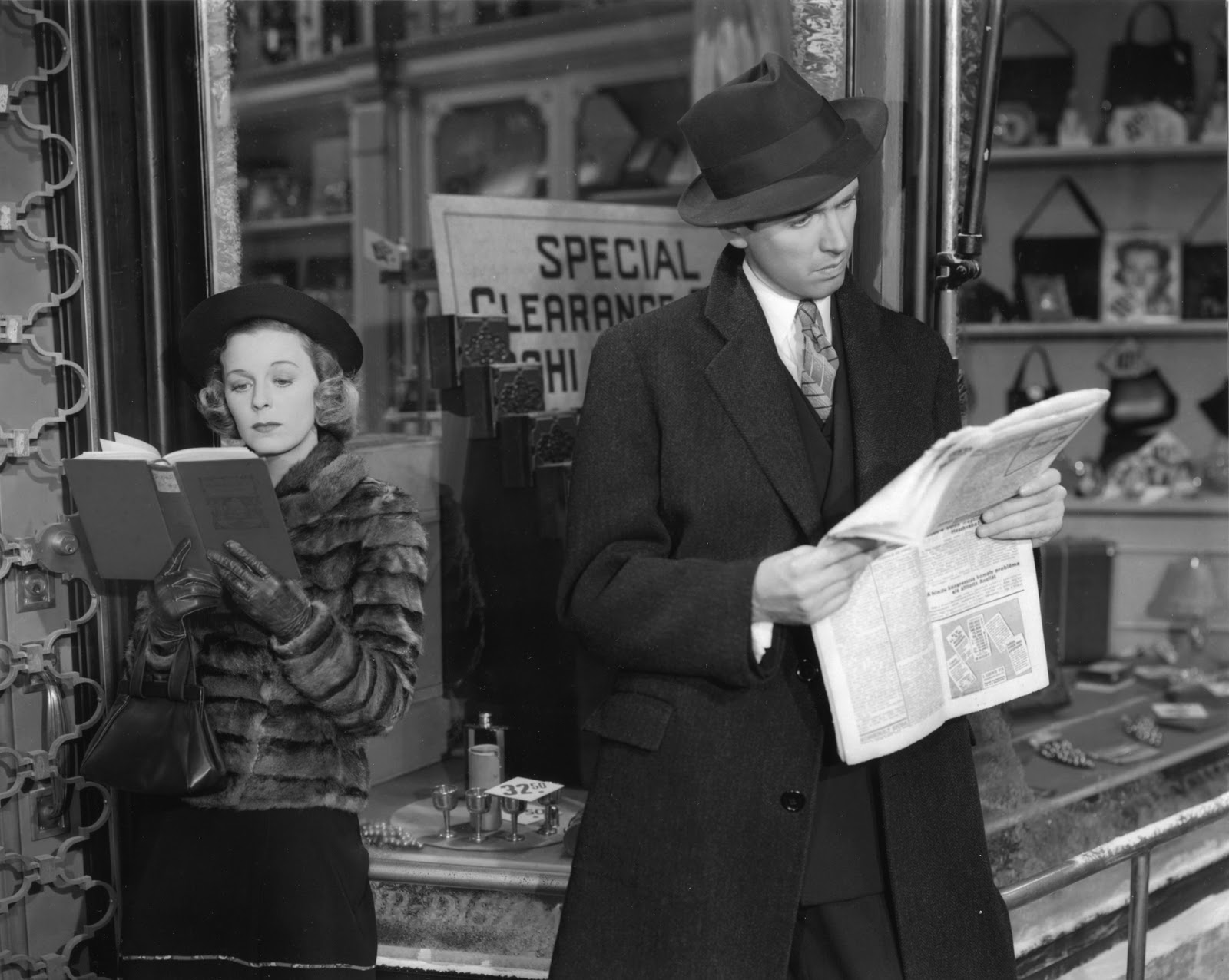
Klara Novak (Margaret Sullavan) and Alfred Kralik (James Stewart) have little time for each other in Ernst Lubitsch’s THE SHOP AROUND THE CORNER
THE SHOP AROUND THE CORNER (Ernst Lubitsch, 1940)
Film Forum
209 West Houston St.
December 25-31
212-727-8110
www.filmforum.org
Jimmy Stewart’s most famous Christmas movie might be It’s a Wonderful Life, but that doesn’t mean it’s his best. That distinction belongs to the 1940 Ernst Lubitsch black-and-white romantic comedy The Shop Around the Corner, which is having a special holiday run December 25-31 at Film Forum. Stewart stars as Alfred Kralik, a serious-minded longtime clerk at the Budapest gift shop Matuschek & Co., serving as the right-hand man to owner Hugo Matuschek (The Wizard of Oz’s Frank Morgan), who relies on his star employee’s honesty and expertise. Also working at the store is Pirovitch (Felix Bressart), a timid family man who hides every time Mr. Matuschek asks for an opinion; the shy Flora Kaczek (Sara Haden); the brash, ambitious delivery boy Pepi Katona (William Tracy); and the self-involved would-be bon vivant Ferencz Vadas (Joseph Schildkraut). When Klara Novak (Margaret Sullavan) shows up looking for a job, Kralik tries to quickly dismiss her, but she ends up charming Mr. Matuschek and getting hired. She and Kralik, her direct superior, bicker constantly, each one hoping that a romantic pen pal will make their dreary lives much brighter, especially as Christmas approaches. But little do they know the love letters that they are so carefully crafting are actually to each other, their secretive literary relationship a far cry from their actual daily one.
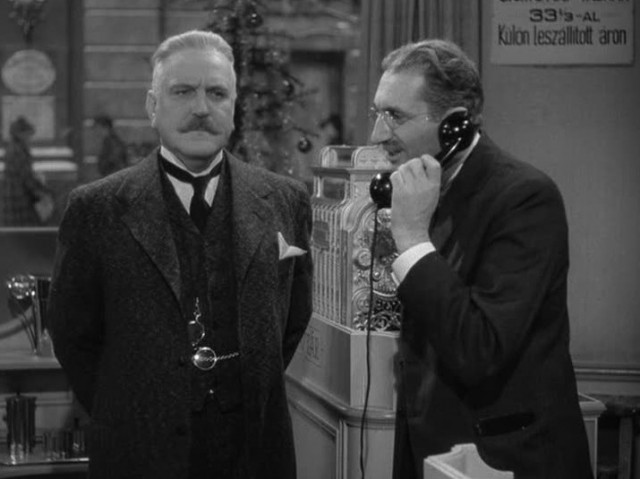
Mr. Matuschek (Frank Morgan) and Pirovitch (Felix Bressart) prepare for Christmas in THE SHOP AROUND THE CORNER
The Shop Around the Corner is based on Miklós László’s 1937 play, Parfumerie, and it very much has a claustrophobic feel, as events occur primarily in the small store. Stewart and Sullavan channel some of that Cary Grant / Irene Dunne magic as they go about their private and professional business, even if they don’t even make attempts at Hungarian accents. (Neither does Morgan, who gives one of his finest performances.) “There might be a lot we don’t know about each other. You know, people seldom go to the trouble of scratching the surface of things to find the inner truth,” Mr. Kralik says to Miss Novak, who replies, “Well, I really wouldn’t care to scratch your surface, Mr. Kralik, because I know exactly what I’d find. Instead of a heart, a handbag. Instead of a soul, a suitcase. And instead of an intellect, a cigarette lighter . . . which doesn’t work.” The central object in the shop is a cigarette box that plays the Eastern European folk song “Ochi Tchornya” every time it is opened; while Mr. Kralik thinks that smokers will tire of hearing the same tune over and over, Miss Novak convinces a customer that it is a candy box and that the repetition of the song will turn her away from opening the box again and again to eat more; meanwhile, Mr. Matuschek just wants to sell the darn things, delineating the three characters’ approach to life in general. Written by Samson Raphaelson, who adapted other plays and novels for Lubitsch, including The Smiling Lieutenant, Trouble in Paradise, and Heaven Can Wait, The Shop Around the Corner is a sweetly innocent film with just the right amount of edginess, a fun frolic through human nature and love, a fanciful confection set in the rococo interior of a shop selling little luxuries in a now-lost Hungary between the world wars. The story was also turned into the 1949 musical In the Good Old Summertime with Van Johnson and Judy Garland (Johnson also appeared in a 1945 radio version with Phyllis Thaxter) and Nora Ephron’s popular 1998 romantic comedy You’ve Got Mail, starring Tom Hanks and Meg Ryan, the latter playing a woman who runs a New York City bookstore called the Shop Around the Corner. (On New Year’s Eve, Film Forum will be pouring free champagne for the 7:00 and 9:15 shows.)
VIDEO OF THE DAY: “LEKHA DODI” BY JOSHUA NELSON AND THE KOSHER GOSPEL CHOIR
Who: Joshua Nelson and the Kosher Gospel Choir
What: Christmas Day concert melding Jewish lyrics with gospel music
Where: Museum of Jewish Heritage, 36 Battery Pl., 646-437-4202
When: Thursday, December 25, $35, 1:00 & 3:30
Why: Joshua Nelson is the Prince of Kosher Gospel, having recorded unique versions of “Adon Olam,” “Hine Ma Tov,” and “Lekha Dodi,” among other favorites; in addition, the museum is open, featuring such exhibits as “Against the Odds: American Jews and the Rescue of Europe’s Refugees, 1933-1945” and “A Town Known as Auschwitz: The Life and Death of a Jewish Community”
THE ELEPHANT MAN
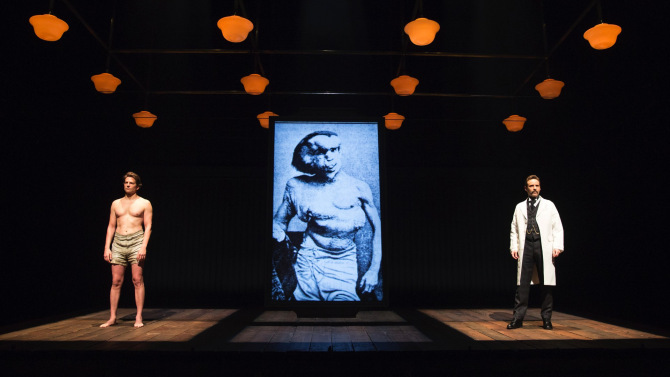
Bradley Cooper contorts himself into character as Dr. Frederick Treves (Alessandro Nivola) explains the physical deformations of the real John Merrick (photo by T. Charles Erickson)
Booth Theatre
222 West 45th St. between Broadway & Eighth Ave.
Through February 22, $79 – $169
www.elephantmanbroadway.com
www.shubert.nyc
The first time we see Bradley Cooper in director Scott Ellis’s strong revival of Bernard Pomerance’s 1977 Tony-winning hit, The Elephant Man, he is whole, perfectly formed, standing on the left side of the stage, wearing only a pair of shorts, a specimen on display for the audience. (There might be no applause at his initial appearance, but there is an audible gasp from appreciators of a fine male physique.) At stage right, Dr. Frederick Treves (Alessandro Nivola) is explaining the deformations that Cooper’s character, John Merrick, suffers from, pointing at enlarged photographs of the real Merrick, a nineteenth-century British resident of London. As Treves mentions each body part, Cooper contorts his shape, curling a hand, tightening a foot, twisting his mouth. Without makeup, he has turned himself into the sideshow spectacle known as the Elephant Man, and the transformation becomes complete when he speaks, grunts that soon flow into more eloquent language emerging from his misshapen mouth. In David Lynch’s 1980 film, an Oscar-nominated John Hurt played Merrick in full, disturbing makeup, but in the play Cooper — like such previous Merrick stage portrayers as the Tony-nominated Philip Anglim in the 1979 original, David Bowie as one of his replacements, and the Tony-nominated Billy Crudup in the 2002 Broadway revival — turns Merrick into a grotesque yet elegant and graceful character, a man whose inner beauty shines through as he goes from circus freak to a respected human being. But even as Merrick is accepted by high society, the medical community, and royalty, he still can’t escape being an attraction, eliciting a strange combination of revulsion and attraction, as Ellis (You Can’t Take It with You, The Mystery of Edwin Drood) cleverly uses the most basic theatricality to investigate what is revealed and what is hidden, changing scenes merely with curtains pulled across the stage by various minor characters.
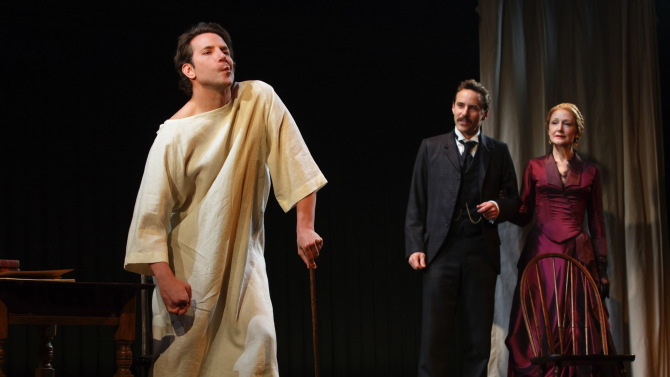
Dr. Frederick Treves (Alessandro Nivola) and Mrs. Kendal (Patricia Clarkson) befriend John Merrick (Bradley Cooper) in powerful Broadway revival (photo by T. Charles Erickson)
Despite a few treacly moments of oversentimentality, Pomerance’s play is a profound exploration of what makes us all different — as well as what makes us very much the same. Two-time Oscar nominee Cooper (American Hustle, Silver Linings Playbook) is extraordinary as Merrick (whose real first name was Joseph), a severely disfigured man who just wants to be “normal.” Nivola (The Winslow Boy, A Month in the Country) is outstanding as Treves, a doctor who sees Merrick as more than just a difficult case, becoming a kind of proud yet seriously overprotective parent. And Patricia Clarkson (The House of Blue Leaves, Eastern Standard) is lovely and charming as the lovely and charming Mrs. Kendal, a popular actress who is more than a little intrigued by Merrick, ready to reveal herself in unexpected ways. The excellent cast also includes two-time Tony nominee Anthony Heald (Anything Goes, Love! Valour! Compassion!) as Bishop Walsham How, who wants to make sure that Merrick receives the proper religious education; Henry Stram (Inherit the Wind, Titanic) as hospital head Carr Gomm, who realizes that taking care of Merrick can be good for business; and Tony nominee Kathryn Meisle (Tartuffe, Outside Mullingar) as both Princess Alexandra, who takes an interest in the oddity that is the Elephant Man, and Miss Sandwich, a caretaker who is horrified by Merrick. Timothy R. Mackabee’s set is suitably spare, consisting of just a table at one time, a bathtub at another, matching Cooper’s courageous soul- and body-baring performance. Once upon a time, people flocked to see the Elephant Man for all the wrong reasons; now they are flocking to see The Elephant Man for all the right ones.