twi-ny recommended events

TALKING BAND: EXISTENTIALISM

Husband-and-wife Ellen Maddow and Paul Zimet portray a married couple in Existentialism (photo by Maria Baranova)

EXISTENTIALISM
La MaMa Experimental Theatre Club
The Ellen Stewart Theatre
66 East Fourth St. between Second Ave. & Bowery
Wednesday – Sunday through March 10, $35-$40
212-475-7710
www.lamama.org
talkingband.org

Early on in Talking Band’s gorgeously poetic two-character play Existentialism, the man says, “Choice is possible. / What is impossible is not to choose. / If I decide not to choose, / That still constitutes a choice.”

It would be a mistake not to choose to see one of the best shows of the year.

Existentialism is created and directed by former SITI Company head Anne Bogart specifically for Ellen Maddow and Paul Zimet in celebration of the fiftieth anniversary of Talking Band, the troupe Maddow and Zimet cofounded with Tina Shepard in 1974. The duo, who have been married since 1986, portray an unnamed woman and man living in a home on the beach. Anna Kiraly’s set features a pair of house-shaped structures, open in the front, each with the same overhead lamp and a small table with a backless chair and typewriter. Short walkways lead out of and around the rooms, with a small planting bed on the woman’s side. Brian Scott’s lighting casts warm red, yellow, orange, blue, and green glows on the structures, while Darron L West’s sound ranges from loud music to soft nature elements to the actors’ crystal-clear enunciations. Kiraly’s projections of waves on the shore and birds flying freely come and go on a large screen in the back.

The woman waters her plants with panache, raising the watering can high above her as the liquid drips out. She does the shopping and is agonized by a speck of dirt she cannot get clean on the path. The two sit at their respective desks on opposite sides of a wall and type in unison.

He saunters to the front of the stage and speaks directly to the audience: “There is a wall between us, but it is a wall we build together. Each of us puts a stone in the gap left by the other. / I’m going to smile, and my smile will sink down into your pupils, and heaven knows what it will become,” he says, sharing an intimate, funny smile. “I am no longer sure of anything. / Something has to snap. / Words are loaded pistols. / There may be more beautiful times, but this one is ours.” Throughout the show’s seventy minutes, we all fill the gaps with figurative stones (and smiles) of our own.

The dialogue is based on the writings of life partners Simone de Beauvoir and Jean-Paul Sartre in addition to Albert Camus, Martin Heidegger, Maurice Merleau-Ponty, Sarah Bakewell, Maggie Nelson, Octavia Butler, bell hooks, and Betty Friedan. The words form an enticing and gentle meditation on gender and aging, delivered in a soft, plain-spoken, but not dispassionate style. The text is all the more compelling because Maddow is seventy-five and Zimet eighty-one; however, they are imbued with an infectious youthfulness.

“My life is set within a given space of time: / It has a beginning and an end, / It evolves in given places, / Always retaining the same roots, / It spins an unchangeable past, / Its future is limited,” the woman says. “No one else is as old as I am. / How young everyone is!”

The man says, “I was young once.”

The man turns on the radio and listens to Dave Brubeck’s “Broadway Bossa Nova” and Beethoven’s “Moonlight Sonata.” The duo dances to the Jim Carroll Band’s punk anthem “People Who Died” blasting out of the speakers, a furious song about how more than a dozen men and women meet untimely ends. “They were all my friends and they died,” Carroll belts out. A New York City native, Carroll himself died of a heart attack in 2009 at the age of sixty; his most well known works include the novel The Basketball Diaries and the LP Catholic Boy.

Time moves on, but the man and the woman continue their daily existence, discussing life in abstract terms.

“No one will ever make sense of this mystery,” she says.

Paul Zimet and Ellen Maddow take a spin in Existentialism (photo by Maria Baranova)

Last month Maddow and Zimet appeared in The Following Evening at PAC NYC, a show written and directed specifically for them by Abigail Browde and Michael Silverstone of 600 Highwaymen, two married creators in their early forties paying tribute to the older couple and what they have accomplished both personally and professionally.

With Existentialism, Bogart is also celebrating Maddow and Zimet. Bogart last worked with Talking Band in 1988, winning the first of her three Obies for directing No Plays No Poetry but Philosophical Reflections Practical Instructions Provocative Prescriptions Opinions and Pointers from a Noted Critic and Playwright, incorporating the writings of Bertolt Brecht; Maddow and Zimet were part of an ensemble cast that also included Louise Smith and Shepard. Bogart has said that when Maddow and Zimet suggested they work together again, she instantly knew it would be called Existentialism; it’s a fitting title for the show, which has its own built-in meta.

Maddow and Zimet are utterly charming in this new piece, which continues at La MaMa through March 10. Although not much is revealed about their characters, you can’t help but fall in love with their relationship. They know they are in the sunset of their lives, but that isn’t stopping them from enjoying every moment. “Do you think that I count the days? There is only one day left, always starting over. It is given to us at dawn and taken away from us at dusk,” he says.

Bogart captures the essence of long-term love, with all its bumps and bruises. When the woman hides behind the wall, listening intently to the man typing away, you can feel how much they adore and need each other. It’s a tender moment that I won’t soon forget.

But right in front of the houses is a rectangular gap in the walkway, a small but constant threat, reminding us how easy it is to fall off one’s path, something Bogart, Maddow, and Zimet don’t have to worry about with this wonderful collaboration.

“Why do we even exist? Hahaha . . . ,” the woman asks. One reasonable answer could be so we could experience such shows as Existentialism.

[Mark Rifkin is a Brooklyn-born, Manhattan-based writer and editor; you can follow him on Substack here.]
I LOVE YOU SO MUCH I COULD DIE

Mona Pirnot sits with her back to the audience throughout I Love You So Much I Could Die (photo by Jenny Anderson)

I LOVE YOU SO MUCH I COULD DIE
New York Theatre Workshop
79 East Fourth St. between Second & Third Aves.
Monday – Saturday through March 9, $65-$75
www.nytw.org

Almost forty years ago, I composed a eulogy for my father’s funeral but was unable to read it because I was too distraught; instead, one of my best friends read it for me. So I understand why Mona Pirnot performs her solo show, I Love You So Much I Could Die, about a family tragedy with her back to the audience and has a Microsoft text-to-speech tool read her story, interspersed with five songs she sings with an acoustic guitar without turning around. However, I’m not convinced that it’s the best way to share this specific narrative, which doesn’t live up to the technical aspects of the production.

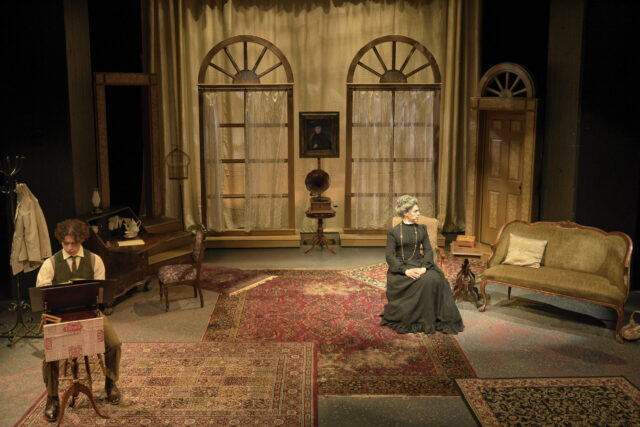
The play starts with Pirnot walking down one of the aisles and onto Mimi Lien’s spare set, where she takes a seat on a ladderback chair at a folding table with a laptop, a water bottle, a microphone, and a lamp; a floor speaker and monitor are nearby. She opens the computer and pushes the space bar; a disconcerting, disembodied male AI voice begins, “I’ve been trying out different support groups. It has not been going well. I can’t seem to find the right group for me. And everything is on zoom. Which makes everything sadder than it already was. And everything was already sad.” The voice adds a moment later, “[The leader] asked if I wanted to share first. I did not. But I said okay. I shared my story and when I was done, the guy was like, oh my god that’s awful. And I was like, yep. And he was like, oh my god. And I was like . . . yeah.”

As the voice recites the text, audience members with sharp eyesight can follow along as each word is highlighted on the screen as it’s spoken, reminiscent of karaoke, especially when the amateur warbler might be a bit tipsy and/or tone deaf. The delivery is bumpy, with unexpected pauses and mispronunciations, particularly involving the name Shia LaBeouf.

Pirnot, wearing a comfortable jumpsuit (the costume is by Enver Chakartash), stops the program five times to perform melancholic songs, including “happy birthday whatever who cares,” “good time girl,” and “Home to You.” The tunes are slow, mournful, and self-deprecating; she introduces “good time girl” by explaining it is much better with a hardcore electric guitar solo, which she instead will perform with her mouth, and proceeds to sing, “I fell back into that hole I forgot was there / My ride drove off and left me in the middle of nowhere / mmm I’m gone / Don’t even know where I went.”

The story also goes back ten years, when Pirnot first met a playwright who “would later become quite famous. As famous as a playwright can get ha ha if playwrights can ever really get famous.” Although she never mentions him by name, it is the man she would eventually marry, Lucas Hnath, who has written such plays as Red Speedo, The Christians, A Doll’s House Part 2, and The Thin Place. Hnath is the director of I Love You So Much I Could Die and has noted in interviews that one of the reasons he opted for Pirnot to sit with her back to the audience because that is how he saw her when she was writing the piece. For added intimacy, the lamp on the table is from their home.

I Love You So Much I Could Die is part of an unofficial trilogy (with maybe more to come?) in which Hnath explores unique methods to tell stories using old and new sound technology in one-person shows. In Dana H., Deirdre O’Connell won a Tony without speaking a word, instead lip-synching to an interview Hnath’s mother gave about her abduction by a member of the Aryan Brotherhood. In A Simulacram, actor, magician, and illusion designer Steve Cuiffo discusses his life and career by using an in-ear device to communicate live with a cassette recording of Hnath, re-creating exact conversations they had over the course of more than fifty hours of workshopping.

Dana H. and A Simulacram were both fascinating plays with compelling, entertaining stories to tell; unfortunately, I Love You So Much I Could Die falls short in that respect. Perhaps Hnath is too close to this one; the play might be a great way for Pirnot (Private, the world is full on) to deal with her personal situation, but it’s not an unusual one, even though she does not give specific details of what happened. In addition, the final section feels manipulative, tossed in to elicit a last surge of emotional melodrama.

While the AI’s voice is clear and crisp, it is often difficult to make out everything Pirnot is singing in her slow, eerily quiet tunes. (The sound design is by Mikhail Fiksel, with music direction by Will Butler.) Throughout the play’s sixty-five minutes, Oona Curley’s lighting dims nearly imperceptibly throughout the theater, ending in complete darkness.

I was hoping that at the conclusion, Pirnot would get off the chair and make her way to the door at the back left of the theater, never showing herself to the audience, but instead she turned around and smiled as she bowed. It’s not that didn’t deserve applause, but I thought it was a lost opportunity to add a special coda to this very private play.

[Mark Rifkin is a Brooklyn-born, Manhattan-based writer and editor; you can follow him on Substack here.]
PUBLIC OBSCENITIES

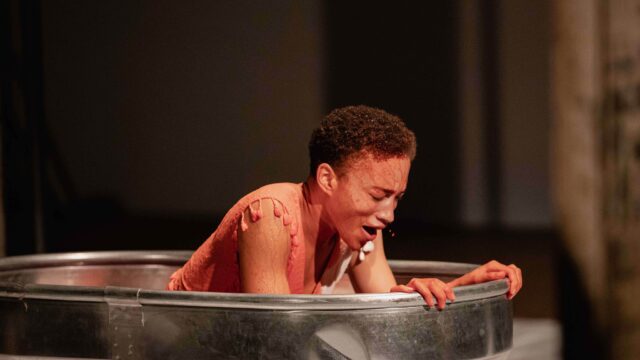
Jakeem Dante Powell (Raheem) and Abrar Haque (Choton) uncover a family secret in Shayok Misha Chowdhury’s Public Obscenities (photo by Hollis King)

PUBLIC OBSCENITIES
Theatre for a New Audience, Polonsky Shakespeare Center
262 Ashland Pl. between Lafayette Ave. & Fulton St.
Tuesday – Sunday through February 25, $97-$132
866-811-4111
www.tfana.org

Shayok Misha Chowdhury’s bilingual Public Obscenities is the surprise hit of the season. Following its sold-out run at Soho Rep, it moved to Theatre for a New Audience’s Polonsky Shakespeare Center, where it’s been extended through February 25.

Writer-director Chowdhury immerses the audience in Indian culture from the very beginning, as commercials for Indian products are projected onto a large screen like ads before a movie. Behind the screen is Peiyi Wong’s set, the interior of a house in South Kolkata with a mattress on the floor to the left, a refrigerator in the back, a table and chairs at the right, and a curtained-off kitchen (one character calls it “a mausoleum”); you can almost smell the Indian spices simmering throughout the family drama.

Choton (Abrar Haque), a Bengali American PhD student, has returned to South Kolkata with his boyfriend, Raheem (Jakeem Dante Powell), a Black cinematographer from America. They are staying with Choton’s aunt Pishimoni (Gargi Muhkerjee) and uncle Pishe (Debashis Roy Chowdhury), who are caring for Choton’s ailing, bedridden paternal grandmother, Thammi; Jitesh (Golam Sarwar Harun) runs the household and cares for Thammi. Looming over everything is a stern-looking portrait of Choton’s late grandfather, Dadu.

Choton is in Kolkata because he is applying for a dissertation fellowship at the University of Chicago. He’s working on a queer archiving project, planning to interview people he finds over Grindr, eventually meeting with Tashnuva Anan (Shou), who is kothi, and Sebanti (NaFis), who is hijra, two types of nonbinary and/or transgender identities in India. Meanwhile, Pishe is secretly chatting with a much younger single mother who lives in Minnesota.

Acknowledging Raheem’s interest in photography, Pishimoni asks Jitesh to show Raheem an old Rolleicord camera owned by Dadu. Raheem notices that there is still film in the camera, and when they examine it, they make a shocking discovery.

Pishimoni (Gargi Muhkerjee) makes a point to Raheem (Jakeem Dante Powell) in Public Obscenities (photo by Hollis King)

The Soho Rep and NAATCO National Partnership Project’s production of Public Obscenities, copresented by TFANA and Woolly Mammoth, might be three hours long (including intermission), but it flies by; Chowdhury makes the audience feel like it’s part of the family, even when the Hindi is not translated into English.

The intergenerational drama not only smartly explores gender identity and sexual orientation but uses technology to advance the plot and define the characters. Choton has trouble operating Raheem’s camera on his own. Raheem uses the sixty-year-old Rolleicord to show us Thammi, while we see Choton’s father only over FaceTime. Old printed-out photos reveal another side of Dadu. Meanwhile, Johnny Moreno’s cinematic projections move the action from the house to a riverbank, and one scene plays out as a prerecorded film.

The ensemble is terrific, led by Haque in his impressive New York City debut, Muhkerjee (Women on Fire: Stories from the Frontlines, The Namesake) as the inquisitive Pishimoni, Harun (Marat-Sade, Mrichchakatikam) providing occasional comedy as Jitesh, and Anan, who is a revelation as Shou. Enver Chakartash’s costumes, Barbara Samuels’s lighting, and Tei Blow’s sound, which includes outdoor nature tones echoing through the theater, further immerses the audience into Indian culture.

Public Obscenities moved from Soho Rep to TFANA as part of the Under the Radar festival, but the secret is out; the show is no longer flying under the radar.

[Mark Rifkin is a Brooklyn-born, Manhattan-based writer and editor; you can follow him on Substack here.]
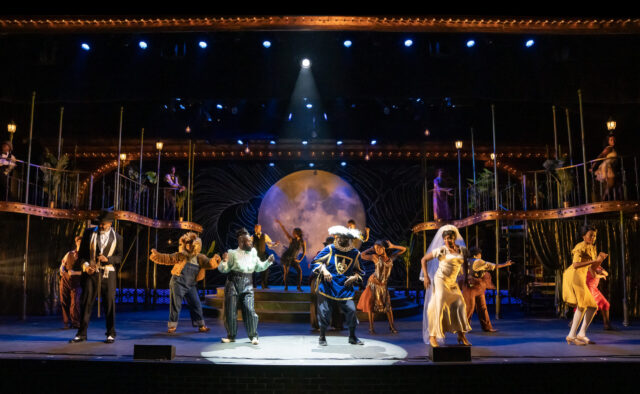
2024 MOVEMENT RESEARCH FESTIVAL

Salma AbdelSalam and Noura Seif Hassanein (nasa4nasa) are part of 2024 Movement Research Festival (photo by Rachel Keane)

MOVEMENT RESEARCH FESTIVAL: PRACTICES OF EMBODIED SOLIDARITY IN MOVEMENT(S)
122CC, 150 First Ave.
Judson Church, 55 Washington Square South
Danspace Project, 131 East Tenth St.
February 28 – March 9, free with advance RSVP
movementresearch.org

The theme of the 2024 Movement Research Festival is “Practices of Embodied Solidarity in Movement(s),” consisting of nine days of live performances, workshops, and talks at three downtown locations: 122CC, Judson Church, and Danspace Project. Curated by Marýa Wethers, director of the GPS/Global Practice Sharing Program at Movement Research, the program features dance artists who are part of GPS MENA, the Middle East and North Africa Exchange Program: Salma AbdelSalam and Noura Seif Hassanein (nasa4nasa) from Egypt, Sahar Damoni from Palestine, Lori Kharpoutlian and Charlie Prince from Lebanon, and F. M. Sayna from Iran; the festival will explore sociopolitical issues that reflect the state of the world today.

Below is the full schedule; all events are free with advance RSVP.

Wednesday, February 28, 6:30 pm
“GPS Chats: Solidarity, Displacement, and Inverted Process in Contemporary Practice,” with F. M. Sayna, Lori Kharpoutlian, and Charlie Prince, 122CC

Thursday, February 29, 10:00 am
“Workshop: back2back,” with nasa4nasa (Salma AbdelSalam and Noura Seif Hassanein), 122CC

Friday, March 1, 10:00 am
“Workshop: the body symphonic,” with Charlie Prince, 122CC

Saturday, March 2, 10:00 am
“Workshop: Lemon Water ma’a Nana (Moving in your own space, and out of it),” with Sahar Damoni, 122CC

Monday, March 4, 7:00 pm
“Performance: Movement Research at the Judson Church,” with solos and group improvisation by Lori Kharpoutlian, F. M. Sayna, Sahar Damoni, and Charlie Prince, Judson Church

Wednesday, March 6, 7:00 pm
“Studies Project: The Political Body in Solo and Collaborative Performance,” with Salma AbdelSalam, Sahar Damoni, and Noura Seif Hassanein, 122CC

Thursday, March 7, 7:30 pm
No Mercy, by nasa4nasa (Salma AbdelSalam and Noura Seif Hassanein), Danspace Project

Friday, March 8, 7:30 pm
Eat Banana and Drink Pills, by Sahar Damoni, Danspace Project

Saturday, March 9, 7:30 pm
Cosmic A*, by Charlie Prince, Danspace Project

SUNSET BABY

Nina (Moses Ingram) and her father, Kenyatta (Russell Hornsby), meet for the first time in years in Sunset Baby (photo by Marc J. Franklin)

SUNSET BABY
The Pershing Square Signature Center
The Romulus Linney Courtyard Theatre
480 West 42nd St. between Tenth & Eleventh Aves.
Tuesday – Sunday through March 10, $49-$119
212-244-7529
signaturetheatre.org

“History is bullshit. Only thing matters is the present. The past don’t do a damn thing but keep you chokin’ on bad memories,” Damon (J. Alphonse Nicholson) says in Steve H. Broadnax III’s blistering revival of Dominique Morisseau’s Sunset Baby at the Signature.

Family legacy is at the heart of the play, which debuted in 2013 from the LAByrinth Theater Company. It’s the early 2000s in East New York, where Nina (Moses Ingram), teaming up with Damon, dresses up like a street hooker to sell drugs and steal from people. Nina’s mother, 1960s radical civil rights activist Ashanti X, has died, leaving behind a stack of love letters she wrote but never sent to Nina’s father, Kenyatta Shakur (Russell Hornsby), while he was in prison. Academics, publishing companies, and the press are after the letters and are willing to pay good money for them, but then Kenyatta shows up at his daughter’s doorstep, claiming he just wants to read them.

Nina, who was named after singer, composer, and activist Nina Simone, doesn’t trust this man, whom she considers a stranger; they haven’t seen each other in decades since he left. But Damon, always on the lookout for a deal, is interested in hearing what Kenyatta has to offer.

Several times during the play, Kenyatta stands alone, making a camcorder video that is projected on three screens. (The stark projections are by Katherine Freer.) In the first one, he essentially introduces the topics that the story will touch on. He says, “Fatherhood. Complex. Complicated. An abstract concept. Not clearly definable. Stages. For sure there are stages. Levels of its affectiveness. Affectionless. Manhood. Confusion. Preparedness. Lack of preparation. Funding. Resources. Instructions. No instructions. Child support. Life being run by child support. Drama. Suffocation. Lots of suffocation. Guilt. Lots of guilt. Incompetency. Freedom. Freedom lost. Freedom never acquired. Fear. Lots of fear. Decades and decades of fear. Lifetime of fear. Lifetime of fear. Fear. Fear.”

Damon praises Kenyatta’s activist past and sees the two of them as somewhat similar, telling him, “The fuck-the-government, disrupt capitalism, develop-our-own-economy type shit. I’m with it. Believe in that cause myself. My line of work is a little different, but same principles.”

Damon has a son of his own with another woman; the relationship is one of potential abandonment, echoing Kenyatta’s abandonment of Nina. “When a man wants to spend time with his child, shouldn’t be not a goddamn thing that gets in his way,” she tells Damon. She dreams of saving enough money to leave New York City for Europe, and Damon seems ready to go anywhere with her, thinking they are an inseparable Bonnie and Clyde. But nothing for Nina has ever been easy.

Nina (Moses Ingram) and Damon (J. Alphonse Nicholson) make plans for a better life in Signature revival (photo by Marc J. Franklin)

Sunset Baby recalls Suzan-Lori Parks’s 2001 Pulitzer Prize–winning Topdog/Underdog, in which two brothers contemplate their fate in their cramped, tiny apartment in a rooming house, one a petty thief, the other a bluesman portraying Abraham Lincoln at an arcade, both holding on to a small inheritance their mother left them. Nina lives in a tiny, cluttered studio apartment with decaying walls and the bathroom down the hall; however, where Arnulfo Maldonado’s set for the recent Broadway revival of Topdog/Underdog was claustrophobic, penning the characters in like a kind of prison, Wilson Chin’s set for Sunset Baby is more open, suggesting that Nina may be able to escape and seize the freedom she so desires. Emilio Sosa’s costumes delineate Nina from the two men in her life; Kenyatta and Damon wear ordinary, everyday jeans, shirts, and jackets, while Nina puts on glittery and shiny red and blue tight-fitting outfits, fancy boots, and any of a number of long wigs, only occasionally relaxing on her couch without all the glitz of the street.

Songs by Simone, who died in 2003 at the age of seventy, are scattered throughout the show, including “Love Me or Leave Me” (“My baby don’t care for shows / My baby don’t care for clothes / My baby just cares for me”), “Don’t Let Me Be Misunderstood” (“I’m just a soul whose intentions are good / Oh, Lord, please, don’t let me be misunderstood”), and “Feeling Good” (“Stars when you shine, you know how I feel / Scent of the pine, you know how I feel / Oh, freedom is mine / And I know how I feel”), the tunes moving from the background to the foreground, lifting through the theater, courtesy of co–sound designers Curtis Craig and Jimmy “J. Keys” Keys.

Kenyatta (Russell Hornsby) tries to explain himself in a series of videos in Dominique Morisseau revival (photo by Marc J. Franklin)

Broadnax III (Thoughts of a Colored Man, The Hot Wing King) lets Morisseau’s (Skeleton Crew, Confederates) rhythmic, potent dialogue sing; words flow out of Nicholson (Paradise Blue, A Soldier’s Play) like music. Hornsby (King Hedley II, Fences) is convincing as the complicated Kenyatta, who always seems to be holding something back. And Emmy nominee Ingram (The Queen’s Gambit, The Tragedy of Macbeth), in her off-Broadway debut, is a powerhouse as Nina, a woman desperate to break free of the legacy that weighs her down.

In a program note, the Detroit-born Morisseau writes that when Sunset Baby debuted at the LAByrinth, it was only her second professionally produced play in New York City, her father was still alive, and she was “not yet a mother. Only a daughter.” But this revival has given her new insight into herself and activist movements, “that they are complex and most people can only understand the trauma from the side they are on, never from the assumed opposition.” She also points out, “My father believed in revolution so much that he espoused it on a daily. Our answering machine message would end with ‘long live the revolution.’ It took many years for me to understand what that meant to him. And then what it meant to me.”

That explanation lends underlying meaning to the relationship between parents and children when Nina declares to Damon, “I don’t need to be part of a revolution. I don’t want a movement or a cause. I don’t want a hustle or no fast money. I want a home. I want somewhere I can walk into my space and not have to look over my shoulder or hold my breath. I want some kids of my own. . . . I wanna sit in the horizon somewhere and watch the sun rise and set. I never even saw a fuckin’ sunset! I am not alive here. I am not alive in this chaos — you hear me? I do not want this shit no more.”

Nina just wants to be understood in a world that insists on defining her, but in Sunset Baby, Morisseau gives her voice and has it rise to the rafters and beyond.

[Mark Rifkin is a Brooklyn-born, Manhattan-based writer and editor; you can follow him on Substack here.]
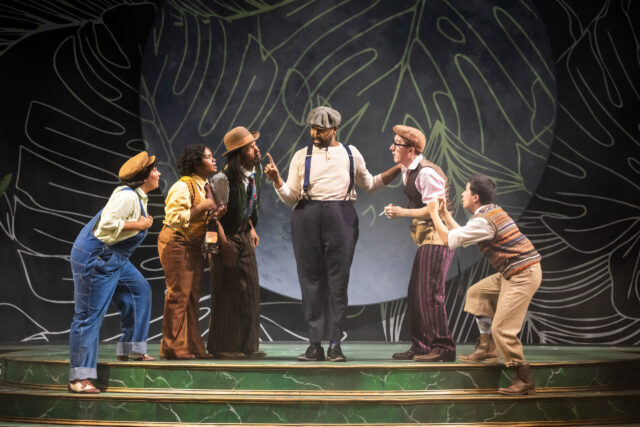
DAEL ORLANDERSMITH: SPIRITUS/VIRGIL’S DANCE

Dael Orlandersmith’s Spiritus/Virgil’s Dance is a multimedia journey into fate and destiny (photo © HanJie Chow)

SPIRITUS/VIRGIL’S DANCE
Rattlestick Playwrights Theater
224 Waverly Pl.
Through March 9, $50, 7:00
www.rattlestick.org

In Dante Alighieri’s fourteenth-century epic The Divine Comedy, Publius Virgilius Maro, better known simply as Virgil, shepherds the Italian poet through the “Inferno” and “Purgatory,” two of the three realms of the dead. “Thou follow me, and I will be thy guide, / And lead thee hence through the eternal place, / Where thou shalt hear the desperate lamentations, / Shalt see the ancient spirits disconsolate, / Who cry out each one for the second death,” Virgil, who represents human reason, says to Dante. Virgil (70–19 BCE) was the author of The Aeneid, which tells the story of Trojan War hero and refugee Aeneas’s journey toward his fate and destiny.

In Spiritus/Virgil’s Dance, solo show master Dael Orlandersmith portrays a fictional character named Virgil who takes the audience at the Rattlestick Theater on a sixty-minute multimedia odyssey into death and destiny, fate and fulfillment.

The mood is set early, with such songs as Johnny Cash’s Nine Inch Nails cover “Hurt” and Mavis Staples’s “See That My Grave Is Kept Clean” playing as the crowd enters the space, giving it a holy feel. Takeshi Kata’s set features six floor-to-ceiling string-curtained cylinders containing furniture: a chair, a table, a lamp on a stand. We soon learn that each one symbolizes a chapter in Virgil’s own epic narrative as they try to find their place in a world complicated by loss and loneliness.

“Have I done it right?” Virgil asks. “Have I used time — my time — right?” Have any of us?

Virgil wanders from cylinder to cylinder, sharing moments from their past. They grew up in the Bronx, hanging out at Woodlawn Cemetery and going to St. Barnabas. Their parents’ love of music led Virgil to become a deejay at a pirate radio station in the East Village. As the years pass, Virgil realizes they need something more. “I make a decision to make more money / Move to another part of downtown / Because / That must be the answer / Me / Thinking the money / Another place / Has got to be the answer,” they explain, but it takes their mother’s unexpected death and their father’s sudden illness for Virgil to take a long look at their life, significantly influenced by their friendship with funeral director Jimmy McHugh and hospice nurse Peggy Callahan.

Dael Orlandersmith looks at her past and future in beautiful one-person show at Rattlestick (photo © HanJie Chow)

Born in East Harlem, Orlandersmith has been staging one-person dramas, some semiautobiographical, most featuring the playwright performing multiple characters, since 1995’s Beauty’s Daughter, which earned her an Obie. She won the prestigious Susan Smith Blackburn Prize in 2003 for Yellowman. More recently, Forever was a deeply intimate show about the severely dysfunctional relationship between a daughter and her alcoholic mother, while Until the Flood explored the tragic story of the killing of Michael Brown at the hands of police officer Darren Wilson in Ferguson, Missouri, on August 9, 2014.

Orlandersmith is masterful in Spiritus/Virgil’s Dance, a beautifully rendered production lovingly directed by Neel Keller, who has been working with Orlandersmith for four decades. As Orlandersmith says at one point in the play, it’s a “celebration of life and death.” She doesn’t make major shifts in tone or body as she switches among the characters, always wearing the same all-black outfit (the costume is by Kaye Voyce) as she walks slowly around the cylinders, which have a heavenly glow (the sensitive lighting is by Mary Louise Geiger), the people they represent prepared for the great beyond. Nicholas Hussong’s projections include leaves blowing in the wind and the subway speeding by, accompanied by Lindsay Jones’s tender original music and sound.

As Virgil discovers their true vocation, it’s like they have been given a giant hug from the universe, something we all seek — and something we all receive from Orlandersmith in this gently, enveloping experience. You’ll leave the theater thinking of the words Peggy shared with Virgil: “Live your life / Live it fully / Do not leave here regretfully.”

Spiritus/Virgil’s Dance continues at Rattlestick through March 9; the March 6 performance will be followed by the discussion “Music Lives On” with Javier Arau, Felice Rosser, Elliot Sharp, and Matt Stapleton.

[Mark Rifkin is a Brooklyn-born, Manhattan-based writer and editor; you can follow him on Substack here.]
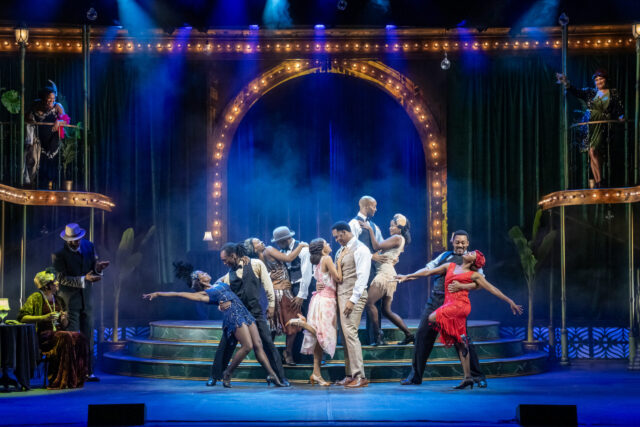
VESELKA: THE RAINBOW ON THE CORNER AT THE CENTER OF THE WORLD

Documentary traces multigenerational history of Veselka, including father and son Tom and Jason Birchard

VESELKA: THE RAINBOW ON THE CORNER AT THE CENTER OF THE WORLD (Michael Fiore, 2023)
Village East by Angelika
181-189 Second Ave. at 12th St.
Opens Friday, February 23
veselka.com
www.angelikafilmcenter.com/villageeast

Watching Veselka: The Rainbow on the Corner at the Center of the World is like having two meals, the first a solid lunch, the second a complex, emotional dinner.

Michael Fiore wrote, directed, produced, and edited the film, which starts by telling the fascinating history of the beloved restaurant, opened by Ukraine immigrants Wolodymyr and Olha Darmochwal as a candy store on the southeast corner of Second Ave. and Ninth St. in 1954. It expanded over the years to a full-service restaurant as it was handed down to Wolodymyr’s son-in-law, Tom Birchard, and then Tom’s son, Jason. Cinematographer Bill Winters follows Jason and his employees greeting customers and working in the back office and kitchen, where they make five thousand varenyky (pierogi) a day, three thousand latkes (potato pancakes) a week, and fifty-two hundred gallons of borscht a year.

“Jason Birchard has a hunger to feed people like his father and grandfather before him,” narrator David Duchovny explains. “But the feeding goes beyond food itself. Food should unite us, and it can transport us.” Duchovny grew up in the area; his paternal grandfather was from Ukraine, his paternal grandmother from Poland.

Jason initially was not interested in following in his father’s footsteps, but stuff happened. “I’ve worn many hats here as the proprietor of Veselka,” Jason, who has worked at the eatery since he was thirteen, says. “I never really envisioned a long-term future here in the business. And with the onset of the war, some days I need to give a little extra love to my Ukrainian staff, who have been unsure of what the future holds.”

In the first half of the film, we are introduced to Mrs. Slava, who fries the latkes; grillmen Dima Prach and Ivan; Jason’s nephew Justin, who oversees business development; pastry chef Lisa; potager chef Arturo; short order cook Max; operations manager Vitalii Desiatnychenko; muralist Arnie Charnick; and the pierogi ladies. Everyone is considered family at Veselka, from the employees to the customers. “The way that they treat people personally is a direct reflection about what makes this place so special,” Lisa says.

During the pandemic, Veselka, which means “rainbow” in Ukrainian, turned to outdoor dining; in one poignant scene, Jason and Ukrainian consul general to New York Oleksii Holubov can only shrug as Mayor Adams, eating borscht, pays more attention to the cameras outside than to Jason’s pleas for Hizzoner to support the restaurant industry.

But everything got more complicated on February 24, 2022, when Russia invaded Ukraine; the second half of the film focuses on Jason’s efforts to help his staff, most of whom have relatives in Ukraine, some of whom are determined to stay, others considering coming to America. Several male employees feel guilty for not returning to Ukraine to join the fight. For every person who shares their personal story, another chooses not to because it’s too painful. Veselka collects donations of clothing and other goods and raises money through borscht sales and its World Central Kitchen Ukraine Bowl.

Dima wants to bring his mother and aunt, who are twins, and his father and uncle to the United States. Vitalii is trying to get his mother out of Ukraine but agonizes when he cannot get in touch with her for days. The Ukrainian national baseball team comes to Coney Island to play charity games against the NYPD and FDNY. Charnick designs a new mural celebrating Ukrainian strength. Jason puts off expansion plans in order to help the community. Employees gather to watch news reports and speeches by Ukraine president Volodymyr Zelenskyy. New York governor Kathy Hochul stops by to find out what she can do.

Veselka began life as a neighborhood candy store opened by Ukrainian immigrants

Veselka: The Rainbow on the Corner at the Center of the World is a testament to the human spirit, a vivid depiction of a community in action, showing how individuals can make a difference in difficult times. Jason is an inspiration, a mensch who doesn’t believe in the word no; he has an inner drive to do what’s right for others. He feeds people’s souls and their stomachs.

Ryan Shore’s score can get treacly, but David Sanborn’s sax solos lift the music. Fiore (Floyd Norman: An Animated Life) captures the essence of Veselka, which is the heart of the Ukrainian community in New York City and a vital part of the East Village. The film is especially poignant as the war enters its second year and the US Congress is taking its time deciding whether to send more funding to Ukraine.

Veselka: The Rainbow on the Corner at the Center of the World opens February 23 at Village East, just a few blocks from the restaurant, making your choice of where to eat before or after the movie that much easier. The 7:05 screenings on Friday and Saturday will be followed by Q&As with Fiore and Tom and Jason Birchard.

[Mark Rifkin is a Brooklyn-born, Manhattan-based writer and editor; you can follow him on Substack here.]