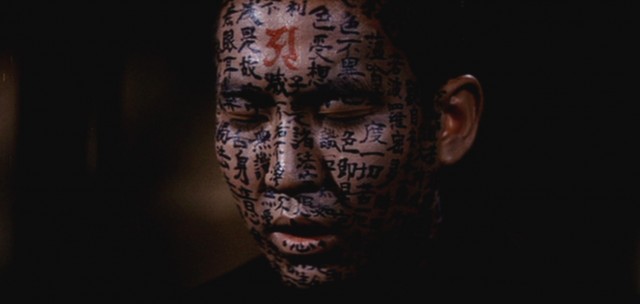
Masaki Kobayashi paints four chilling, ghostly portraits in KWAIDAN, including “Hoichi, the Earless”
KWAIDAN (Masaki Kobayashi, 1964)
Museum of the Moving Image
35th Ave. at 36th St., Astoria
Sunday, May 24, $12, 6:00
Series runs through May 24
718-777-6800 www.movingimage.us
The Museum of the Moving Image series “Portraying the Human Condition: The Films of Masaki Kobayashi and Tatsuya Nakadai” comes to a sensational conclusion on May 24 with a 2:00 screening of Harakiri, with the eighty-two-year-old Nakadai on hand to discuss the work, and then, at 6:00, a presentation of the mesmerizing Kwaidan. In the latter film, based on folkloric tales by Lafcadio Hearn, aka Koizumi Yakumo, Kobayashi (The Human Condition, Samurai Rebellion) paints four marvelous ghost stories, each one with a unique look and feel. In “The Black Hair,” a samurai (Rentaro Mikuni) regrets his choice of leaving his true love for societal advancement. Yuki (Keiko Kishi) is a harbinger of doom for a woodcutter (Nakadai) in “The Woman of the Snow.” Hoichi (Katsuo Nakamura) must have his entire body covered in prayer in “Hoichi, the Earless.” And Kannai (Kanemon Nakamura) finds a creepy face staring back at him in “In a Cup of Tea.” The four films subtly, and not so subtly, explore such concepts as greed and envy, love and loss, and the art of storytelling itself. Winner of the Special Jury Prize at Cannes, Kwaidan is one of the greatest ghost story films ever made, a quartet of chilling existential tales that will get under your skin and into your brain. The score was composed by Tōru Takemitsu, who said of the film, “I wanted to create an atmosphere of terror.” He succeeded.
Who: Honorees Michelle Coffey, Icema Gibbs, Paul Januszewski, Juliana May, Cathy Nolan, Martha Sherman, Rebecca Trent, Jimmy Van Bramer, and Mac Wellman What: Tenth annual Taste of LIC, presented by the Chocolate Factory Where:Gantry Plaza State Park, 49th Ave. at the East River When: Tuesday, June 2, $65-$400, 6:30 Why: Taste of LIC celebrates the growth of the Long Island Community, and for its tenth year it will be honoring ten leaders (one posthumously) in Gantry Plaza State Park, where more than fifty restaurants will be providing food and drink, including Alewife NYC, Alobar, Antidote Chocolate, Astor Bake Shop, Bear Bar & Restaurant, Beija Flor, Bella Via Restaurant, Casa Enrique, the Creek & the Cave, Crescent Grill, Dominie’s Hoek, M. Wells, Manducatis Rustica, Manetta’s Ristorante, the Pie Lady, Sage General Store, Skinny’s Cantina, Southern Wheels Eats, Sweetleaf, Tournesol, and Zenon Taverna. There will also be raffle prizes from more than one hundred LIC businesses, with proceeds benefiting the Chocolate Factory, as well as a live performance by Jon Kinzel, with New York City Council majority leader Jimmy Van Bramer serving as master of ceremonies.
Sardinian brothers Michele (Michele Cossu) and Peppeddu (Peppeddu Cuccu) are on the run from the law in Vittorio De Seta’s BANDITI A ORGOSOLO
BANDITI A ORGOSOLO (BANDITS OF ORGOSOLO) (Vittorio De Seta, 1961)
Film Society of Lincoln Center, Walter Reade Theater
144 West 65th St. between Eighth Ave. & Broadway
Saturday, May 23, 7:00
Festival runs May 22-31
212-875-5050 www.filmlinc.com
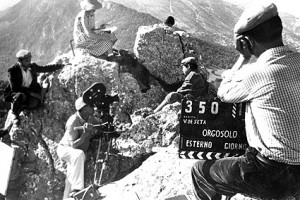
“The souls of these men are still primitive. What is right according to their law is not right according to that of the modern world,” an unseen narrator explains at the beginning of Vittorio De Seta’s sadly overlooked debut feature, Banditi a Orgosolo, about shepherds scraping to get by in a vast mountainous region of Sardinia. In the black-and-white post-neorealist film, Michele (Michele Cossu) and his young brother, Peppeddu (Peppeddu Cuccu), tend to their flock of sheep, for which Michele still owes money. After a trio of former shepherds turned bandits shows up, Michele is visited by the police; not wanting to get involved, he lies to the carbinieri, insisting he has not seen anyone else. A firefight ensues between the police and the bandits, leaving one cop dead, and Michele and Peppeddu are on the lam, hunted by the police while desperately trying to hold on to their flock as they make their way through what Michele refers to as “bad places.” Winner of the New Cinema Award at the 1961 Venice Film Festival, Banditi a Orgosolo is a dark, bleak tale, shot by De Seta in nearly infinite gradations of black and white, Valentino Bucchi’s ominous score lurking in the background. Cossu, a nonprofessional actor from the region, portrays Michele with a stark earnestness and a clear understanding of the futility of his character’s situation. A former documentarian, De Seta (The Uninvited, Lettere dal Sahara), who wrote the screenplay with Vera Gherarducci, doesn’t make any epic proclamations about society’s ills, instead letting the story about changing times and abject poverty in Sardinia unfold at an often agonizing snail’s pace. The shepherds and their small villages, representative of the old ways, are being left behind, even as the state takes the place of centuries-old oppressors, doing what it can to keep them down and destitute.
BANDITI A ORGOSOLO is set in the mountainous region of Sardinia
Banditi a Orgosolo is getting a rare screening on May 23 at 7:00 as part of the Film Society of Lincoln Center series “Titanus: A Family Chronicle of Italian Cinema,” a ten-day, twenty-three-film retrospective honoring the Italian production company founded by Gustavo Lombardo in 1904 and later run by his son, Goffredo, and grandson, Guido, that remained active until 1964 (although it continues to occasionally release work). The festival displays the wide range of Titanus’s output, including Michelangelo Antonioni’s Le Amiche, Dario Argento’s The Bird with Crystal Plumage, Ermanno Olmi’s The Fiancés, Francesco Rosi’s The Magliari, Elio Petri’s Numbered Days, Federico Fellini’s The Swindle, Steno’s Totò Diabolicus, and Vittorio De Sica’s Two Women, but not Luchino Visconti’s The Leopard; the tremendous cost of filming Giuseppe di Lampedusa’s epochal novel played a major role in the company’s downward fortune.
Who:Rangers alumni and fans What: Outdoor viewing party Where:Bryant Park, between Fifth & Sixth Aves. and 40th & 42nd Sts. When: Wednesday, May 20, free, 4:00 Why:Rangerstown moves to Bryant Park for all-important Game 3 of the NHL conference finals between the Broadway Blueshirts and the Tampa Bay Lightning. Starting at 4:00, fans can take part in hockey clinics, ice-skate, meet Rangers alums, get their face painted in True Blue, and win prizes. At 8:00, the game will be broadcast on the big screen, as the Rangers try to recover from their disappointing outing in Game 2. They’ll have to step up their game, particularly Martin St. Louis and Rick Nash, crash the net, use their speed, and stay out of the penalty box if they want to get the lead back in the series. Of course, these are the Rangers, where nothing comes easy.
The Godlight Theatre Company follows up its spare, Drama Desk–nominated staging of James Dickey’s Deliverance with another testosterone-fueled tale, Donn Pearce’s Cool Hand Luke. As with all of Godlight’s productions — which also include One Flew Over the Cuckoo’s Nest, In the Heat of the Night, Slaughterhouse-Five, Fahrenheit 451, and The Third Man — this latest work is based on the original novel, not the popular film, in this case Pearce’s 1965 book rather than Stuart Rosenberg’s 1967 movie, which starred Paul Newman and an all-star ensemble and earned four Oscar nominations. (Warning: The classic line “What we’ve got here is failure to communicate” is from the movie, so it is not in the play.) Lawrence Jansen stars as Luke Jackson, a smartass war hero with what would now be called PTSD who is serving time for having cut the heads off of parking meters. “Luke had the devil in him,” fellow inmate Dragline (Mike Jansen) explains in a short prologue. “Luke done some kinda deal somewheres along the line. Don’t know what. Thar’s no telling. But Luke was jes’ natcherly mad at God.” Luke becomes part of a roadside chain gang with Dragline, Curly (Lars Drew), Society Red (Brett Warnke), and Rabbit (Jarrod Zayas), who are closely watched by Boss Kean (Jason Bragg Stanley), collaborator Carr (Ken King), and the evil Boss Godfrey (Nick Paglino), who has it in for Luke from the start. But through it all, Luke keeps on smiling, as he faces off against Boss Godfrey, tries to eat fifty hard-boiled eggs in one hour, and won’t take the advice of his mother (Kristina Doelling) to put his faith in the lord. “Ain’t you scared a’ dyin’ and goin’ to hell?” Dragline asks him. “Dyin’? It’s livin’ I’m scared of,” Luke responds.
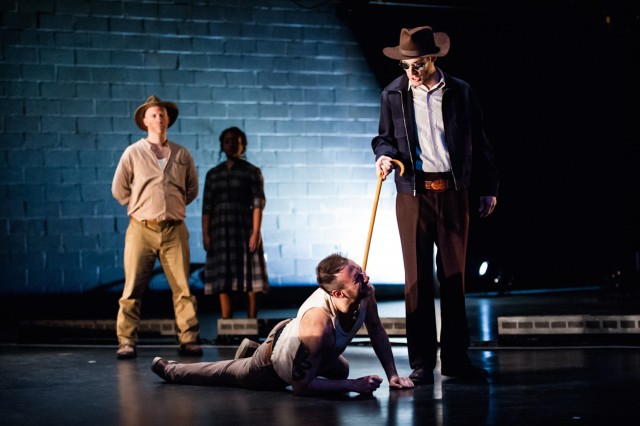
Lawrence Jansen plays a Jesus-like prisoner in Godlight Theatre adaptation of COOL HAND LUKE (photo by Jason Woodruff)
Once again, the staging is the star in this Godlight production. The story, adapted by Emma Reeves (Anne of Green Gables, Little Women), unfolds with no props or scenery in a tiny black box at 59E59, where the characters are cordoned off on the right and left by an angled row of lights on the floor, with Luke and Boss Godfrey almost always in the center, Luke in the front, Godfrey in the back, the latter watching everything from behind his dark sunglasses. Director Joe Tantalo (A Clockwork Orange, 1984), the artistic director of Godlight for more than twenty years, announces scene changes with sharp flashes of light, courtesy of set and lighting designer Maruti Evans, accompanied by the crack of a rifle loading. (The sound design is by Ien Denio.) Cool Hand Luke is filled with religious imagery, with Luke envisioned as a Christ-like figure and a saint, Boss Godfrey as the devil, the other prisoners potential disciples. In a scene from Luke’s past, he seeks help from a woman named Mary (Julia Torres, who also curiously sings a spiritual at the beginning and end of the play), while Doelling portrays a prostitute in addition to Luke’s mother, furthering biblical references. The show lacks the dramatic conflict inherent in previous Godlight shows; it is significantly more slight, a series of episodes in search of a fluent narrative as a whole. But the strong acting and expert, unique staging will keep you chained to your seats.
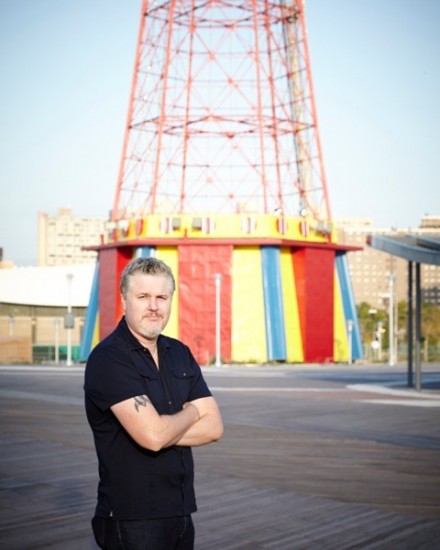
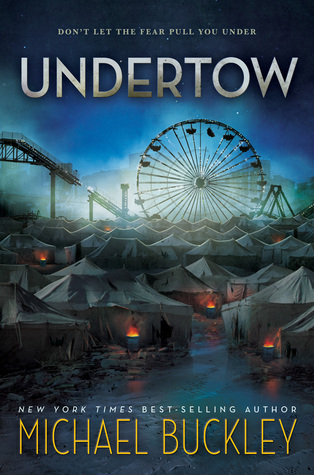
Brooklyn-based author Michael Buckley has gone from writing advertising copy to the text for Macy’s holiday window display to a pair of New York Times bestselling series for middle-grade readers, the Sisters Grimm and N.E.R.D.S. He has now made the leap to YA with Undertow (Houghton Mifflin, May 5, $18.99), the first in a trilogy about an alien race, known as the Alpha, in Coney Island. A tall, gregarious fellow, Buckley, who was born and raised in Ohio, was a stand-up comic, and it shows in his wickedly wry and playful sense of humor. He’s just finishing up a nine-city book tour that took him to Seattle, Portland, San Francisco, Los Angeles, Salk Lake City, Minneapolis, St. Paul, and Rochester, concluding May 19 in Brooklyn, where he lives with his wife and young son. (He will also be signing at BookCon at booth #2541 at the Javits Center on May 31 at 2:00.) I’ve known Buckley for more than ten years now — his wife and my wife are partners at Stonesong, his literary agency — and it’s been exciting watching his career skyrocket. Just as he returned home from the tour, we discussed Coney Island, migraines, immigration, China, and imaginary friends.
twi-ny: On your blog, you recently wrote, “Undertow is the culmination of a lot of hard work and a whole lot of wishing and risk taking — not only by me but a whole lot of other people.” What were some of those risks?
Michael Buckley: Anytime a writer tries to do something new there’s a risk that their audience is not going to embrace it. For some, a fear of losing their fans can get in the way of growth as an artist, but I don’t do anything because it’s the safe thing to do. I want to try new stories and ways of telling them. I’m blessed to have editors and publishers who are supportive, because it’s not easy on them either. Every time I try something new, it takes a lot of energy by lots of folks to get the word out about it, to find ways to get my readers to give it a chance, and to make sure booksellers get excited about it as well. That’s a lot of long hours at work for everyone. I try not to lose sight of the fact that every risk I take is one I am not taking alone.
twi-ny: In the book, you write very candidly about migraines, which the protagonist, Lyric, suffers from and grades on a scale. Are you writing from personal experience?
MB: Actually, I rarely get headaches at all, but I have friends who get them and from what I understand they can be destructive. I asked a few what it felt like and how they handled it and most of them had different experiences and different strategies that helped them cope. Some have little tricks they do that can fend off a migraine, while others know the stimuli that cause the pain so they can avoid them. I have the utmost sympathy for these people, but I’m also in awe of them, too. There is an incredible amount of bravery and personal strength in people who suffer from migraines. They’re tough people, far tougher than me.
twi-ny: Undertow is set in Coney Island. Prior to writing the book, what was your opinion of Coney Island? Were you a regular visitor?
MB: I’ve been drawn to Coney Island since I moved to NYC in ’96 and have spent many a summer day in Rudy’s Bar or walking on the boardwalk. It’s grungy in the best possible ways — a real people’s amusement park, filled with faces from every corner of the world. I also worked in documentary films earlier in my life and researched Coney Island’s glorious history. It was once the biggest tourist attraction in the world until the original park burned to the ground in 1911.
twi-ny: What do you think about the changes going on there these past few years?
MB: I like some of the things that are happening down there now — the Cyclones’ ballpark is spectacular, and some of the new rides are fun, but it’s important to me that the park stays affordable. It’s getting a bit too expensive in my opinion, especially for the people who live in that neighborhood. I hope the city and the investors are considering the community.
twi-ny: The story in Undertow is an apt metaphor for the current heated debate over immigration in America. Where do you stand on that issue? I gather you’re not hiding much by giving the female politician most against the Alpha the last name Bachmann. Then again, you also give an ultra-right-wing conservative pundit the last name Rifkin.
MB: America is an amazing place to live, so no one should be surprised when people want to come here. We’ve also got a giant statue in New York Harbor that asks the world to send us “your huddled masses yearning to be free.” I mean, if we’re not going to welcome the world to this country, then let’s take the statue down — it’s false advertising. I think it’s hypocritical — we’re either welcoming them with open arms or we’re not. It’s not like we don’t have the room. There are plenty of places to live in the US. Have you ever been to North Dakota? Fifteen people live there! As for the Bachmann name, that could be purely coincidental. I mean . . . the character in my book is clearly insane and manipulative. She’s also a moron. Who could that be? [As far as that other name,] I’m not sure whom you’re referring to . . . ahem.
twi-ny: Undertow has elements of a number of science-fiction movies, from Alien Nation to Close Encounters of the Third Kind. Did any specific films or books either influence or inspire Undertow?
MB: I was wildly inspired by District 9. That movie blew me away — not because it was a film about aliens, but rather that it felt real to me. I have no doubt that if an alien species crash-landed here and could not fly away, we would put them in a camp with a big fence around it. I was inspired by books as well. The Outsiders was a huge influence.
twi-ny: Your previous series, the Sisters Grimm and N.E.R.D.S., were for middle-grade readers. With Undertow, did you consciously set out to write a YA trilogy, or did it just happen that way?
MB:Undertow is the first young adult novel I have written and it was daunting. I wasn’t sure I could pull it off. First, the themes and ideas in a YA book are far more complicated than in middle-grade books. You can explore ideas and feelings in a way that you can’t when writing for a younger audience, and I had never really had the opportunity to try it. To prepare, I gave myself a sort of master’s in young adult literature, reading everything I could get my hands on, then interviewing some of the authors behind the books I loved the most to find out what they thought was important for the readers, how to write a teenage girl, how far to go with adult themes — they were true friends and mentors to me. When I felt like I understood YA, and more importantly, when I realized I loved YA, that’s when I knew it was time to give it a try.
twi-ny: You’ll be at BookCourt on May 19 in Brooklyn, where you live. Is it exciting to come home, or is a book tour all just a big blur?
MB: Book tours can be both exhilarating and exhausting at the same time. I get to meet fans and booksellers and teachers and librarians and occasionally other authors, so that part is always fun, but getting up early and racing to airports and forgetting what your rental car looks like — well, there’s a million stories there. I’m excited to finally have an event here in Brooklyn. BookCourt has always been a great supporter of what I do and it’s a fantastic indie shop that really knows what people like to read.
twi-ny: Do you have anything special planned for the event?
MB: We’re going to throw a little shindig with some mermaid cupcakes and a little wine for the grown-ups. I’m hoping to see a lot of faces both familiar and new.
twi-ny: You’ve also contributed the story “Mr. Shocky” to Jon Scieszka’s sixth Guys Read volume, Terrifying Tales, and you’ll be signing copies of the book later this month at BEA. How did that come about?
MB: Jon is one of the leaders in getting boys to read, which is sometimes a complicated endeavor. He’s done a few of these Guys Read books in the past, but this was the first one in which I was able to contribute. I was thrilled to be able to write something scary — another new thing I’d never tried. I’m very excited to see how people react to it. Everyone involved has said my story is one of the scariest they’ve read.
twi-ny: I agree; it’s tremendously scary. It deals with a boy and his imaginary friend; did you ever have an imaginary friend growing up?
MB: I had an imaginary friend, but then he met another imaginary friend, and they both stopped hanging out with me. That’s sad. Wait, that could be a great story!
twi-ny: You recently got back from a trip to China with your wife and son. What was that experience like?
MB: China is nothing like I expected. Growing up in the ’70s and ’80s, during the Cold War, we were taught to fear all things Communism, and I had heard a lot of stories about China that turned out to be nonsense. What I saw was a vibrant, exciting country filled with amazing architecture and food and art. The people were friendly and kind and there was very little of the “police state” I was led to believe existed. In fact, if you ask me, they could use more police. Everyone drives like a maniac there! I can’t wait to go back.
twi-ny: Do people ever confuse you with so-called “Internet Celebrity” Michael Buckley of The What the Buck Show?
MB: I do get confused with him all the time and even get some of his fan mail. We connected on twitter awhile back. He gets some of my fan mail, too. I’ve become a fan of his — he’s hilarious, but every once in a while someone puts a picture up of him when they should have put a picture of me. Then, it’s not so funny — lol.
Dylan Crossman and Kimberly Bartosik will present world premieres in Travelogues series at Abrons Arts Center
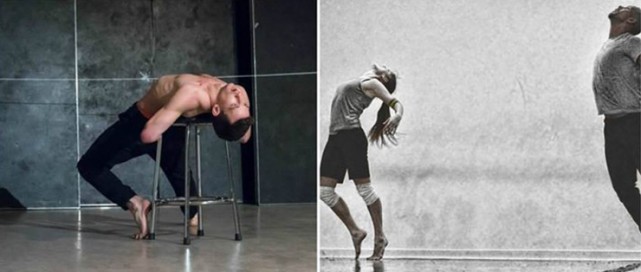
Who:Kimberly Bartosik and Dylan Crossman What:Travelogues Where:Abrons Arts Center Experimental Theater, 466 Grand St. at Pitt St. When: May 20-23, $20, 8:00 Why: Abrons Arts Center’s new Travelogues series, which debuted earlier this year with a presentation by Daniel Léveillé Danse, continues May 20-23 with a shared program featuring the world premieres of Kimberly Bartosik’s Ecsteriority4 (Part 2) and Dylan Crossman’s Bound. Both works, by former Merce Cunningham dancers, are constructed around borders and boundaries; the former is a trio for Marc Mann, Melissa Toogood, and Crossman in which a wall plays a key component, while the latter is a solo by Crossman, performed while tied to rope, limiting his movement. (The two parts of Ecsteriority4 will come together at the Chocolate Factory in September 2016.) The Travelogues series, which is curated by Laurie Uprichard, continues in the fall with ponydance’s Anybody Waitin’? and Lionel Popkin’s Ruth Doesn’t Live Here Anymore.
 The Museum of the Moving Image series “Portraying the Human Condition: The Films of Masaki Kobayashi and Tatsuya Nakadai” comes to a sensational conclusion on May 24 with a 2:00 screening of Harakiri, with the eighty-two-year-old Nakadai on hand to discuss the work, and then, at 6:00, a presentation of the mesmerizing Kwaidan. In the latter film, based on folkloric tales by Lafcadio Hearn, aka Koizumi Yakumo, Kobayashi (The Human Condition, Samurai Rebellion) paints four marvelous ghost stories, each one with a unique look and feel. In “The Black Hair,” a samurai (Rentaro Mikuni) regrets his choice of leaving his true love for societal advancement. Yuki (Keiko Kishi) is a harbinger of doom for a woodcutter (Nakadai) in “The Woman of the Snow.” Hoichi (Katsuo Nakamura) must have his entire body covered in prayer in “Hoichi, the Earless.” And Kannai (Kanemon Nakamura) finds a creepy face staring back at him in “In a Cup of Tea.” The four films subtly, and not so subtly, explore such concepts as greed and envy, love and loss, and the art of storytelling itself. Winner of the Special Jury Prize at Cannes, Kwaidan is one of the greatest ghost story films ever made, a quartet of chilling existential tales that will get under your skin and into your brain. The score was composed by Tōru Takemitsu, who said of the film, “I wanted to create an atmosphere of terror.” He succeeded.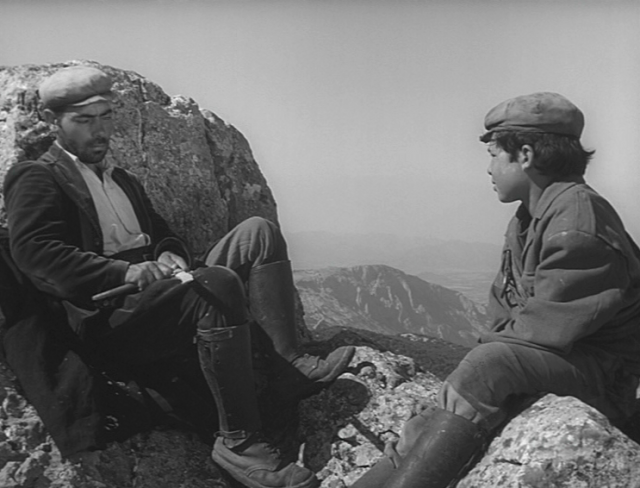
 “The souls of these men are still primitive. What is right according to their law is not right according to that of the modern world,” an unseen narrator explains at the beginning of Vittorio De Seta’s sadly overlooked debut feature, Banditi a Orgosolo, about shepherds scraping to get by in a vast mountainous region of Sardinia. In the black-and-white post-neorealist film, Michele (Michele Cossu) and his young brother, Peppeddu (Peppeddu Cuccu), tend to their flock of sheep, for which Michele still owes money. After a trio of former shepherds turned bandits shows up, Michele is visited by the police; not wanting to get involved, he lies to the carbinieri, insisting he has not seen anyone else. A firefight ensues between the police and the bandits, leaving one cop dead, and Michele and Peppeddu are on the lam, hunted by the police while desperately trying to hold on to their flock as they make their way through what Michele refers to as “bad places.” Winner of the New Cinema Award at the 1961 Venice Film Festival, Banditi a Orgosolo is a dark, bleak tale, shot by De Seta in nearly infinite gradations of black and white, Valentino Bucchi’s ominous score lurking in the background. Cossu, a nonprofessional actor from the region, portrays Michele with a stark earnestness and a clear understanding of the futility of his character’s situation. A former documentarian, De Seta (The Uninvited, Lettere dal Sahara), who wrote the screenplay with Vera Gherarducci, doesn’t make any epic proclamations about society’s ills, instead letting the story about changing times and abject poverty in Sardinia unfold at an often agonizing snail’s pace. The shepherds and their small villages, representative of the old ways, are being left behind, even as the state takes the place of centuries-old oppressors, doing what it can to keep them down and destitute.