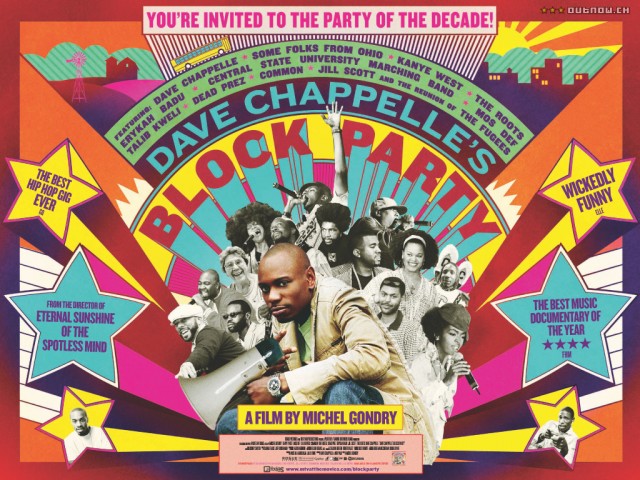
DAVE CHAPPELLE’S BLOCK PARTY (Michel Gondry, 2006)
BAMcinématek at Putnam Triangle Plaza
22 Putnam Ave. at Fulton St. & Grand Ave.
Tuesday, June 9, free, 8:00
718-636-4100
www.bam.org
www.chappellesblockparty.com
 In September 2004, comedian Dave Chappelle put on a surprise block party in Bedford-Stuyvesant, sort of a mini-Brooklyn version of Wattstax, Mel Stuart’s seminal L.A. concert film in which Richard Pryor teamed up with a host of black musicians, including Isaac Hayes, Albert King, the Staples Singers and Carla and Rufus Thomas. Directed by Michel Gondry (Eternal Sunshine of the Spotless Mind, The Science of Sleep) and photographed by Ellen Kuras (Neil Young: Heart of Gold, Blow) Block Party is Chappelle’s Wattstax for the twenty-first century. Gondry and Chappelle take viewers on a very funny trip as the comedian wanders around his hometown of Dayton, Ohio, handing out golden tickets like a black Willy Wonka, offering everyone free transportation to Brooklyn, loading buses up with a fascinating mix of people of all races. When he bumps into a college marching band, he invites them to play at the party, joining such big names as Kanye West, the reunited Fugees, Big Daddy Kane, Common, John Legend, the Roots, and Dead Prez. Gondry cuts between the preparation for the block party and the actual festivities, an infectious blend of music and comedy that makes you feel like you’re right in the middle of it all. Musical highlights include West performing “Jesus Walks” with Legend and Common, Jill Scott and Erykah Badu backing the Roots on “You Got Me,” and Talib Kweli, Common, and Fred Hampton Jr. rapping with Mos Def on “Umi Says.”
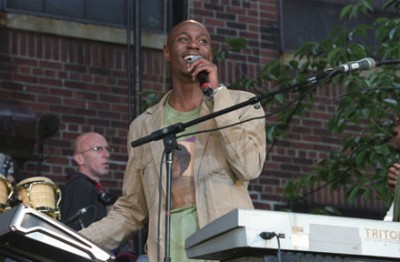
Dave Chappelle invites everyone to his Bed-Stuy block party
Unfortunately, the songs are not seen in their entirety, one of the film’s only drawbacks. Behind the scenes, Chappelle tickles the ivories to “Misty” and “Round Midnight,” hangs out with the bizarre white couple who live in the Broken Angel house across the street, and jokes around with Mos Def. The film avoids any overt political messages, although some of the songs deal with controversial topics. One of the sweetest moments is when Wyclef Jean plays “President” for the marching band, letting the members know they can be anything they want to be. Block Party is a shining, defining moment for Chappelle, who shortly after walked away from a $50 million Comedy Central contract, succumbing to the pressure of fame and expectation. Dave Chappelle’s Block Party is screening June 9 at 8:00 at Putnam Plaza Triangle as part of BAMcinématek’s free “FAB Flicks” series, which began June 2 with Jeffrey Levy-Hinte’s Soul Power and concludes June 16 with D. A. Pennebaker’s Shake! Otis at Monterey and Chris Hegedus and Pennebaker’s Jimi Plays Monterey. Each evening also features a DJ and food from local restaurants.
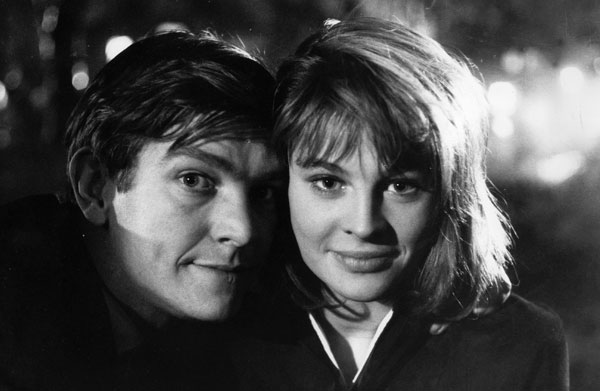
 Based on the novel by Keith Waterhouse (which he also adapted into a play with Willis Hall and which later became a musical), John Schlesinger’s Billy Liar is a prime example of the British New Wave of the 1950s and 1960s, which features work by such directors as Lindsay Anderson, Joseph Losey, Ken Russell, Nicolas Roeg, and Karel Reisz. Tom Courtenay stars as William Fisher, a ne’er-do-well ladies’ man who drudges away in a funeral home and dates (and lies to) multiple women, all the while daydreaming of being the president of the fictional country of Ambrosia. Billy lives in his own fantasy world where he can suddenly fire machine guns at people who bother him and be cheered by adoring crowds as he leads a marching band. Reminiscent of the 1947 American comedy The Secret Life of Walter Mitty, in which Danny Kaye dreams of other lives to lift him out of the doldrums, Billy Liar is also rooted in the reality of post-WWII England, represented by Billy’s father (Wilfred Pickles), who thinks his son is a no-good lazy bum. Shot in black-and-white by Denys Coop (This Sporting Life, Bunny Lake Is Missing), the film glows every time Julie Christie appears playing Liz, a modern woman who takes a rather fond liking to Billy. The film made Christie a star; Schlesinger next cast her in Darling, for which she won the Oscar for Best Actress. Billy Liar is screening on June 7 in the BAMcinématek series “Black & White ’Scope: International Cinema,” an eighteen-day, twenty-eight-film festival featuring 1950s and ’60s black-and-white films shot in CinemaScope. The series includes such other fab works as Andrzej Wajda’s Siberian Lady Macbeth, Frantisek Vlacil’s Valley of the Bees, Kaneto Shindo’s Onibaba, Jack Clayton’s The Innocents, and Masaki Kobayashi’s Samurai Rebellion.