Hiroshi Teshigahara examines identity and more in THE FACE OF ANOTHER
CABARET CINEMA: THE FACE OF ANOTHER (TANIN NO KAO) (Hiroshi Teshigahara, 1966)
Rubin Museum of Art
150 West 17th St. at Seventh Ave.
Friday, August 7, $10, 9:30
212-620-5000
rubinmuseum.org
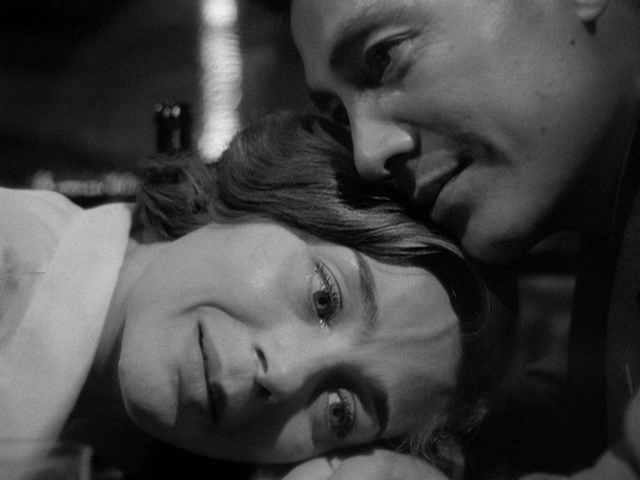
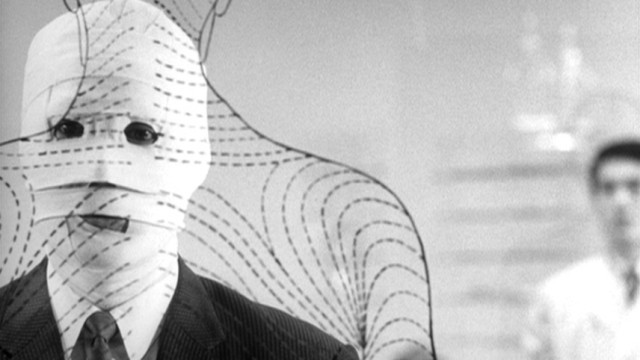
 Kôbô Abe and director Hiroshi Teshigahara collaborated on five films together, including the marvelously existential Woman of the Dunes in 1964 and The Face of Another two years later. In the latter, Tatsuya Nakadai (The Human Condition, Kill!) stars as Okuyama, a man whose face has virtually disintegrated in a laboratory accident. He spends the first part of the film with his head wrapped in bandages, a la the Invisible Man, as he talks about identity, self-worth, and monsters with his wife (Machiko Kyo), who seems to be growing more and more disinterested in him. Then Okuyama visits a psychiatrist (Mikijirô Hira) who is able to create a new face for him, one that would allow him to go out in public and just become part of the madding crowd again. But his doctor begins to wonder, as does Okuyama, whether the mask has actually taken control of his life, making him as helpless as he was before. Abe’s remarkable novel is one long letter from Okuyama to his wife, filled with utterly brilliant, spectacularly detailed examinations of what defines a person and his or her value in society. Abe wrote the film’s screenplay, which tinkers with the time line and creates more situations in which Okuyama interacts with people; although that makes sense cinematically, much of Okuyama’s interior narrative, the building turmoil inside him, gets lost. Teshigahara once again uses black and white, incorporating odd cuts, zooms, and freeze frames, amid some truly groovy sets, particularly the doctor’s trippy office, and Tōru Takemitsu’s score is ominously groovy as well. As a counterpart to Okuyama, the film also follows a young woman (Miki Irie) with one side of her face severely scarred; she covers it with her hair and is not afraid to be seen in public, while Okuyama must hide behind a mask. But as Abe points out in both the book and the film, everyone hides behind a mask of one kind or another. The Face of Another is screening August 7 as part of the Rubin Museum Cabaret Cinema series “Movie Masks,” being held in conjunction with the excellent exhibition “Becoming Another: The Power of Masks,” and will be introduced by RISK! podcast host Kevin Allison. The film series continues through August 28 with such other mask-related works as Mario Bava’s Black Sunday, Billy Wilder’s Witness for the Prosecution, and Alfred Hitchcock’s To Catch a Thief.
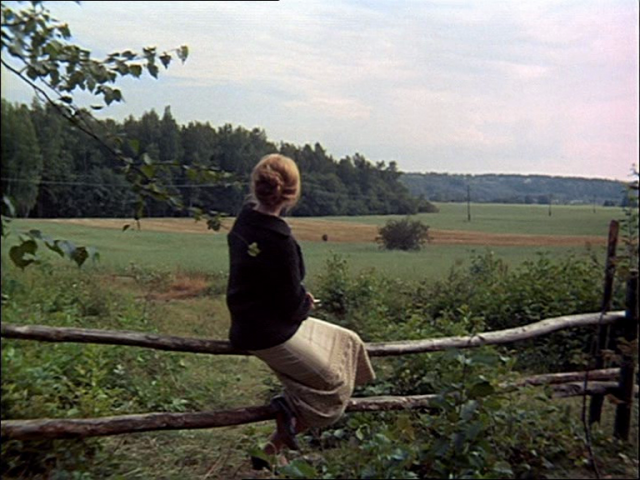
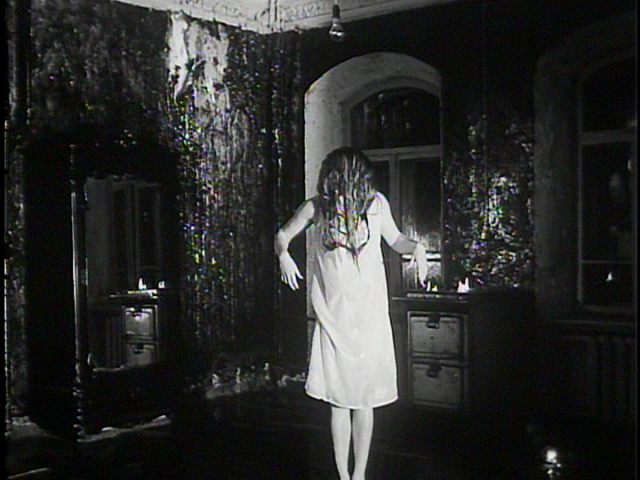
 “Words can’t really express a person’s emotions. They’re too inert.” So explains Andrei Tarkovsky in his 1975 semiautobiographical masterpiece, The Mirror, in which the Soviet auteur takes a literal and figurative looking glass to reflect on his life, particularly his childhood, in twentieth-century Russia. The nonlinear film, which features long, beautifully composed scenes with little or no dialogue, alternates between color and black-and-white as Tarkovsky maneuvers between three time periods, telling the fragmented and disjointed story of forty-year-old Alexei, who is never onscreen as an adult (he is only heard offscreen in voiceover by Innokenty Smoktunovsky) but is shown as a young boy (Filipp Yankovsky) and an adolescent (Ignat Daniltsev, who also plays Alexei’s son, Ignat). Margarita Terekhova portrays Alexei’s ex-wife, Natalia, as well as his mother, Maria; Tarkovsky’s own mother, Maria Vishnyakova, plays the elderly Maria (who is also called Masha and Marusya), and his father, Arseny Tarkovsky, a successful poet, reads several of his works over the gorgeous imagery that is composed, in many cases, like paintings. Incorporating archival footage of WWII, the Spanish Civil War, and the Sino-Soviet split, Tarkovsky explores family relationships as seen through the eyes of the young Alexei and Ignat, adding mystery and magic, including levitation and slow motion, to the personal, poignant tale. As with Andrei Rublev, the film begins with an odd prologue in which Ignat turns on a sepia-toned television show in which a woman uses a type of hypnosis, concentrating on the hands, to help a student speak without a stutter, as if Tarkovsky is warning the viewer about what is to follow, a deeply hypnotic film that speaks in unusual ways.