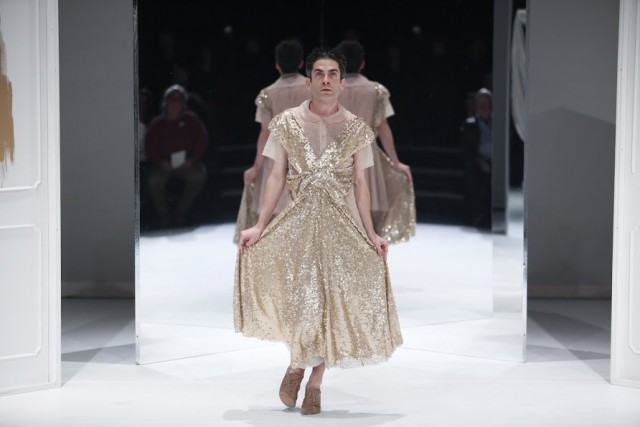
Jack Ferver and Marc Swanson will present the glittering CHAMBRE as part of FIAF’s annual Crossing the Line festival (photo by Julieta Cervantes)
French Institute Alliance Française and other locations
Florence Gould Hall, 55 East 59th St. between Madison & Park Aves.
FIAF Gallery, 22 East 60th St. between Madison & Park Aves.
September 10 – October 4, free – $35
212-355-6160 www.fiaf.org
Tickets are now available for FIAF’s ninth annual late summer/early fall multidisciplinary arts festival, and you better act fast if you want to see some of this year’s most intriguing programs. For us, the highlight is Jack Ferver and Marc Swanson’s Chambre, an installation and performance piece at the New Museum inspired by Jean Genet’s The Maids and pop-culture elements, with extravagant costumes by Reid Bartelme and experimental sound and music by twi-ny fave Roarke Menzies. British artist Ant Hampton’s Autoteatro series continues with The Extra People, in which participants will go on an individual adventure through FIAF’s Florence Gould Theater. The U.S. premiere of Brazilian artist Gustavo Ciriaco and Austrian artist Andrea Sonnberger’s Here whilst we walk will take small groups, bound by a giant rubber band, on a silent trip through Red Hook. Elana Langer’s free What I Live By will pop up at three locations, examining brand identification and personal values. Iranian artist Ali Moini searches for freedom in the multimedia dance work Lives at New York Live Arts (NYLA). Miguel Gutierrez will present the New York City premiere of all three parts of his Age & Beauty series, Mid-Career Artist/Suicide Note or &:-/; Asian Beauty @ the Werq Meeting or The Choreographer & Her Muse or &:@&; and Dancer or You can make whatever the fuck you want but you’ll only tour solos or The Powerful People or We are strong/We are powerful/We are beautiful/We are divine or &:’////, at NYLA, featuring such collaborators as Mickey Mahar, Michelle Boulé, Jen Rosenblit, Ishmael Houston-Jones, and Alex Rodabaugh. Italian artist Alessandro Sciarroni asks Folk-s, will you still love me tomorrow? in his unique interpretation of Bavarian folk dance at NYLA. French director Joris Lacoste investigates multiple languages and human spoken expression in Suite n°2 in Florence Gould Hall. Also on the bill are Shezad Dawood’s “It was a time that was a time” exhibition at Pioneer Works, a photography show by Mazaccio & Drowilal in the FIAF Gallery, Olivia Bransbourg’s ICONOfly magazine, and Adrian Heathfield and André Lepecki’s three-day symposium, “Afterlives: The Persistence of Performance,” at FIAF and MoMA.
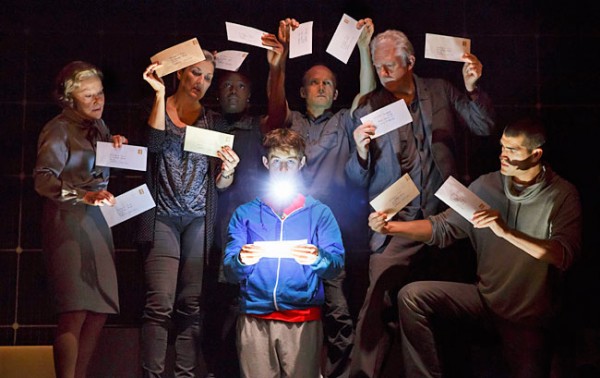
THE CURIOUS INCIDENT OF THE DOG IN THE NIGHT-TIME is among nearly two dozen Broadway shows offering half-price tickets September 7-20 (photo by Joan Marcus)
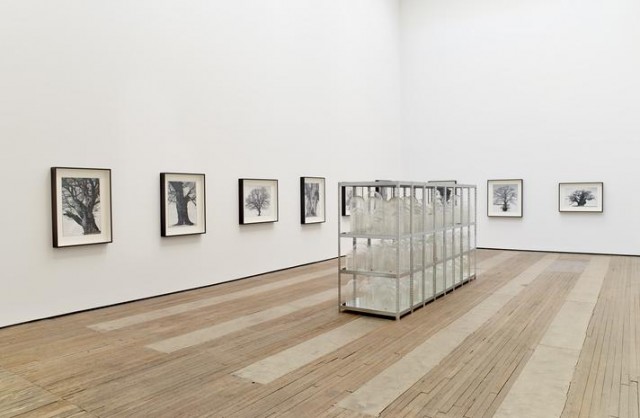
Patrick Van Caeckenbergh creates a kind of alternate Garden of Eden in his first exhibition at Lehmann Maupin (photo courtesy Lehmann Maupin)
Lehmann Maupin
201 Chrystie St. between Stanton & Rivington Sts.
Through August 21, free, 10:00 am – 6:00 pm
212-254-0054 www.lehmannmaupin.com
Flanders-based Belgian artist Patrick Van Caeckenbergh has transformed Lehmann Maupin’s Lower East Side space into a forest of wonder, using his memory and his imagination, combining dazzling drawings of trees with a curious sculptural installation. A compulsive, and by some accounts reclusive, collector, cataloger, and tinkerer, Van Caeckenbergh spent seven years making graphite drawings of trees inspired by those in his garden, as well as other parts of Belgium, each one a unique Tree of Life or Tree of Knowledge. The black-and-white framed works in “Drawings of Old Trees during the wintry days 2007-2014” at first appear to be photographs but upon closer inspection are revealed to be obsessively intricate pencil and paint depictions of trees with thick trunks and endless leafless branches, enhanced by such fairy-tale elements as windows, doors, bells, and faces. In the center of the gallery is “THE PICTURESQUE HISTORY OF EMPTINESS, Les Oubliettes – The Oblivions – De Vergeetputten,” mirrored metal shelves that hold nearly three hundred dust-covered glass bell jars that once contained statues of saints but became so much detritus with a downturn in religious belief in Flanders. The vast emptiness seems to go on ad infinitum in the mirrors at the top and bottom, almost as if the Garden of Eden is now devoid of Adam and Eve, or anyone at all. Van Caeckenbergh, a collagist and amateur genealogist who has extensively investigated the digestive system of both animals and humans and, in “The Grave” (1986), paid tribute to six of his major influences — Joseph Beuys, Constantin Brancusi, Marcel Duchamp, Marcel Broodthaers, René Magritte, and Andy Warhol — includes a playful interactive bonus with “Het Muziekbos — The Musical Forest,” which he also calls “the nature guide to the Bialowieza primeval forest” in Poland, an antique table featuring a vaguely antique-looking hinged wooden box holding sixty-three small reproductions of his tree drawings on heavy card stock. People are invited to browse them, then curate their own mini-exhibition by choosing any two to place display stands on either side of the box.
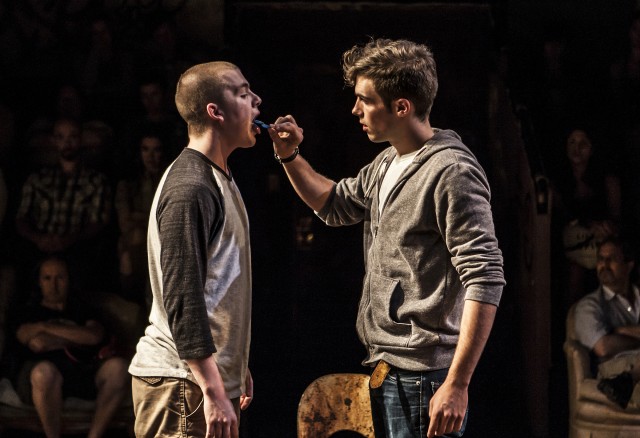
Brothers Darren (Jack DiFalco) and Elliot (Zane Pais) are caught up in some shady dealings in Philip Ridley’s MERCURY FUR (photo by Monique Carboni)
The New Group at the Pershing Square Signature Center
The Romulus Linney Courtyard Theatre
480 West 42nd St. between between Ninth & Tenth Aves.
Tuesday – Sunday through September 27, $25-$75 www.thenewgroup.org www.signaturetheatre.org
British playwright Philip Ridley — who also writes children’s books, pens screenplays, song lyrics, and poetry, directs films, is an experienced photographer, and has staged multimedia installations and performance art projects — has a special relationship with his audience. In Tender Napalm, which enjoyed a limited run at 59E59 in 2012, the audience sat in two rows across a narrow, horizontal space between which two actors shared their dreams and fantasies in abstract soliloquies. If a patron had to use the rest room (there was no intermission), he or she would have to walk right through the action, and would not be allowed back in. There’s a similar conceit in Mercury Fur, Ridley’s confrontational 2005 work being revived by the New Group at the Signature’s Linney theater, which has been transformed by Derek McLane into a dilapidated room in an abandoned New York City housing project, strewn with debris, the windows boarded up. On two facing sides, the audience sits in folding chairs, ratty couches, or decaying love seats; on the other two sides, people sit high atop walls that offer occasionally limited views of what is happening below. Once again, there is no intermission, so getting up to use the facilities would be rather noticeable, and reentry is only at the discretion of management. Then again, Mercury Fur has been known to cause audience members to leave and not want to come back; in fact, Ridley’s publisher rejected it, refusing to release a printed edition. (Ridley defiantly took the play, and his backlist, to a different company.) Which is all rather beside the point, as the two-hour Mercury Fur is a bold, engrossing work that is not afraid to challenge audiences as it digs deeply into the dark part of the soul, revealing the lengths to which humans will go when faced with imminent disaster. As the David Leavitt epigraph in the published play states, “Sometimes brutality is the only antidote to sorrow.”
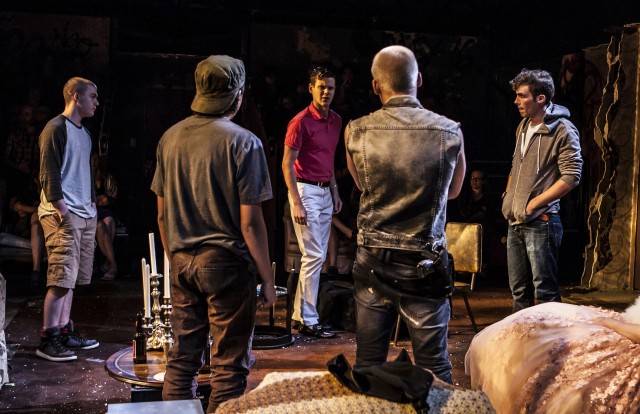
Things don’t go so well at a bizarre party in the New Group revival of MERCURY FUR (photo by Monique Carboni)
As the play opens, nineteen-year-old Elliot (Zane Pais) and his younger brother, sixteen-year-old Darren (Jack DiFalco), are cleaning up a ramshackle apartment, preparing it for a special party. Elliot is by far the stronger of the two, telling his not-too-swift sibling, “You know what you’re like? A fucking anvil round my neck. The lifeboat’s sinking and I’m bailing it out like a good egg but I’ve got this fucking anvil getting heavier and heavier dragging the whole thing down.” The brothers, who soon touch each other’s hearts in a sweetly innocent moment, are working for Spinx (Sea McHale), a dangerous tough guy who throws parties for wealthy people in which they can do any degraded thing they want, for a price. Afterward, the entire building will be burned down, leaving no evidence of the depravity that occurred there. In this case, with WWIII on the horizon, a Wall Streeter called Party Guest (Peter Mark Kendall) has very specific, and deviant, plans for the ten-year-old Party Piece (Bradley Fong), involving gold lamé, Elvis Presley style. Also on hand for the festivities are Lola (Paul Iacono), a scantily clad transgender makeup artist; Spinx’s date, the Duchess (Emily Cass McDonnell), who is brought along unexpectedly, complicating things for Elliot, who sells hallucinogenic butterflies, and Darren, who likes to eat those colorful treats; and Naz (Tony Revolori), a fifteen-year-old who is squatting in the building and wants to join in the fun, thinking it’s going to be a regular party. Oh, how wrong he is.
New Group artistic director Scott Elliott (Sticks and Bones, Hurlyburly) directs this Off-Broadway premiere with pre/post-apocalyptic punk flair, keeping the aggression level high while maintaining an intoxicating yet uncomfortable intimacy. You can’t look away, even when you know what’s going to happen, even though most of the ultraviolence takes place offstage. The play includes elements of Greek tragedy and Shakespeare, J. G. Ballard and Tennessee Williams, so you never know which direction it will turn. The brave, talented cast — which features several actors with little or no professional stage experience, including Revolori, who recently won accolades for his portrayal of Zero the lobby boy in Wes Anderson’s Oscar-nominated The Grand Budapest Hotel — holds nothing back as events spin out of control and an overwhelming sense of doom dominates the proceedings. The characters live in a frightening world, one that is even more terrifying because it doesn’t feel that much removed from our current situation, as if all of this is waiting for us, just around the corner. With Mercury Fur, the New Group, which staged Ridley’s The Fastest Clock in the Universe in 1998, takes a good look at the future, and it is not a happy prospect.
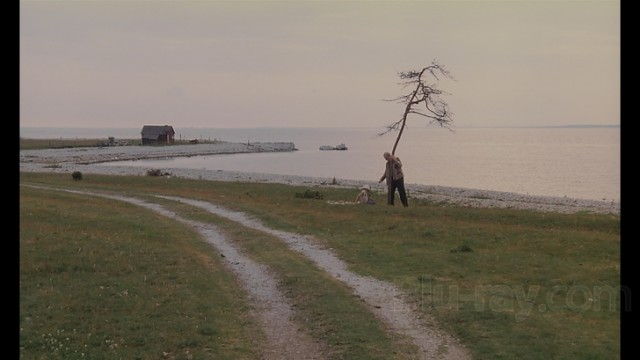
A man and his son plant a dead tree they hope will grow in Andrei Tarkovsky’s final film, THE SACRIFICE
THE SACRIFICE (OFFRET) (Andrei Tarkovsky, 1986)
Museum of Arts & Design
2 Columbus Circle at 58th St. & Eighth Ave.
Friday, August 21, $10, 7:00
Series continues Friday nights through August 28
212-299-7777 madmuseum.org
Andrei Tarkovsky’s final film, The Sacrifice, completed shortly before his death in 1986 of cancer at the age of fifty-four, serves as a glorious microcosm of his career, exploring art, faith, ritual, devotion, and humanity in uniquely cinematic ways. Made in Sweden, the film has many Bergmanesque qualities: Bergman’s longtime cinematographer, Sven Nykvist, shot the film; the production designer is Anna Asp, who won an Oscar for her work on Fanny and Alexander; Bergman’s son Daniel served as a camera assistant; and the star is Erland Josephson, who appeared in ten Bergman films as well as Tarkovsky’s previous feature, the Italy-set Nostalghia. Josephson plays Alexander, a retired professor and former actor living in the country with his wife, the cold Adelaide (Susan Fleetwood), his stepdaughter, Marta (Filippa Franzén), and young son, Little Man (Tommy Kjellqvist), who cannot speak after a recent throat operation. It is Alexander’s birthday, and the family doctor, Victor (Sven Wollter), has come to visit, along with the odd local postman, Otto (Allan Edwall), who explains, “I collect incidents. Things that are unexplainable but true.” Also on hand are the two maids, Maria (Guðrún Gísladóttir), who Otto believes is a witch, and Julia (Valérie Mairesse). Alexander states early on that he has no relationship with God, but when a nuclear holocaust threatens, he suddenly gets down on the floor and prays, offering to sacrifice whatever it takes in order for him to survive, leading to a chaotic conclusion that is part slapstick, part utter desperation.
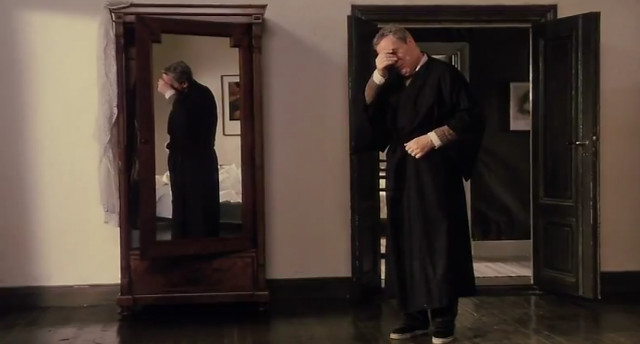
Alexander (Bergman regular Erland Josephson) is seeking redemption in THE SACRIFICE
Although it has a more focused, direct narrative than most of Tarkovsky’s other works, The Sacrifice is far from a conventional story. Tarkovsky has written that it “is a parable. The significant events it contains can be interpreted in more than one way. . . . A great many producers eschew auteur films because they see cinema not as art but as a means of making money: the celluloid strip becomes a commodity. In that sense The Sacrifice is, amongst other things, a repudiation of commercial cinema. My film is not intended to support or refute particular ideas, or to make a case for this or that way of life. What I wanted was to pose questions and demonstrate problems that go to the very heart of our lives, and thus to bring the audience back to the dormant, parched sources of our existence. Pictures, visual images, are far better able to achieve that end than any words.” The film is filled with gorgeous visual images, beautiful shots of vast landscapes, of open doorways in stark interiors, of mirrors and windows, of Alexander and Little Man planting a dead tree by the edge of the ocean, and spoken language is often kept to a minimum, saved for philosophical discussions of God, Nietzsche, and home. Several scenes are filmed in long, continuous shots, lasting from six minutes to more than nine, heightening both the reality and the surrealism of the tale, which includes black-and-white memories, floating characters, and actors staring directly into the camera. Although Christianity plays a key role in the film — Tarkovsky considered himself a religious man, and the opening credits are shown over a close-up of Leonardo da Vinci’s “Adoration of the Magi” — the redemption that Alexander is after is a profoundly spiritual and, critically, a most human one as he searches for truth and hope amid potential annihilation. Winner of three awards at the Cannes Film Festival (among many other honors), The Sacrifice is screening August 21 at 7:00 as part of the Museum of Arts & Design film series “Andrei Tarkovsky, Sculpting in Time,” which runs Friday nights through August 28 and includes all seven of Tarkovsky’s masterpieces (Solaris, Stalker, Ivan’s Childhood, Andrei Rublev, The Mirror, Nostalghia, The Sacrifice) before concluding with the behind-the-scenes documentary Directed by Andrei Tarkovsky, which lends fascinating insight to the making of The Sacrifice in particular.
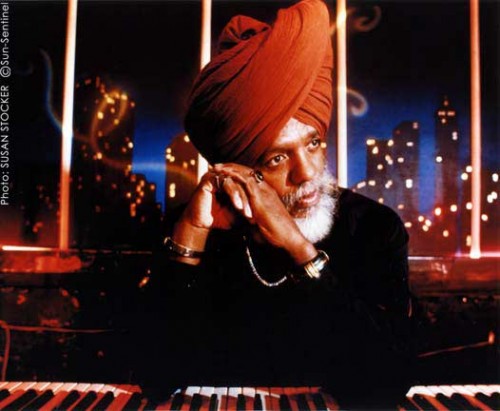
The annual Charlie Parker Jazz Festival is always a bittersweet affair. The sweet part is three days of free music this year, up from the usual two. The bitter part is that it always comes near the end of the summer season, with Labor Day and school right around the corner. But let’s not worry about that now and instead concentrate on the free concerts at the twenty-second edition, which is part of the CityParks Foundation SummerStage program and begins August 21 at 6:00 in Marcus Garvey Park with Oliver Lake Big Band performing a special commission, the King Solomon Hicks Trio, and Michela Taps: Bird Lives! (“[Parker] was such an innovator and a driving force in this music, as well as an important influence on tap,” tap-dance star Michela Marino Lerman said in a statement. “We hope to contribute, in some way, to his tremendous legacy.”) On Saturday starting at 3:00, Dr. Lonnie Smith, Andy Bey, Jeff “Tain” Watts, Camille Thurman, and Norma Miller will be in Marcus Garvey Park (preceded at 2:00 by a master class taught by Samuel Coleman). And on Sunday at 3:00, Charlie Parker’s lasting influence will be honored in Tompkins Square Park with Rudresh Mahanthappa: Bird Calls, Joe Lovano, Myra Melford: Snowy Egret, and Michael Mwenso.
Film Forum
209 West Houston St.
August 19-25
212-727-8110 filmforum.org
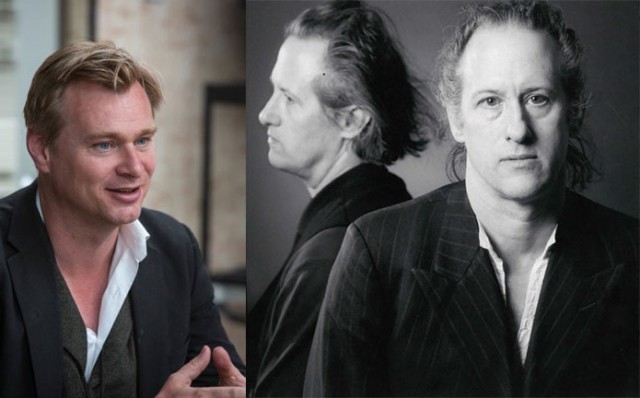
In such films as Memento, Inception, and Interstellar, British-American writer-director Christopher Nolan has shown a flair for unusual storytelling devices and complex narratives. “I decided to structure my story in such a way as to emphasize the audience’s incomplete understanding of each new scene as it is first presented,” he said about his debut feature, 1998’s Following, and a similar aesthetic can be applied to the works of the Quay Brothers. Pennsylvania-born, England-based twins Stephen and Timothy Quay have been making complex narratives for three dozen years, short films and feature-length tales that push the boundaries of storytelling conventions. In hypnotic films such as In Absentia, The Comb (From the Museums of Sleep), and their universally acclaimed masterpiece, Street of Crocodiles, they use fragile dolls and puppets, psychologically tantalizing Expressionistic imagery, and experimental music to draw viewers into their Gothic, industrial, dreamlike fantasy world. In fall 2009, their mind-blowing sets were on display in the exhibit “Dormitorium: Film Décors by the Quay Brothers” at Parsons the New School for Design, and the brothers were justly celebrated in the wide-ranging 2012-13 MoMA retrospective “Quay Brothers: On Deciphering the Pharmacist’s Prescription for Lip-Reading Puppets.” Now they have joined forces with Nolan for a special traveling program that debuts August 19-25 at Film Forum, consisting of the abovementioned three shorts, all restored in 35MM, and the world premiere of Nolan’s documentary about the brothers, simply titled Quay.
The meditative, mesmerizing In Absentia, dedicated to a woman “who lived and wrote to her husband from an asylum,” boasts a gorgeous minimalist score by Karlheinz Stockhausen. The Comb (From the Museums of Sleep) is a fabulously layered film that switches back and forth between color and black and white, live action and stop-motion animation, as a woman has a remarkable dream. And Street of Crocodiles is an award-winning adaptation of Bruno Schulz’s story told the Quay way, with eerie dolls and puppets, ominous screws, and various machine parts come to life. In the three works, light, shadow, and repetitive movement create a dark but compelling mood while providing no easy answers for what is actually occurring onscreen. “That’s the question nobody’s ever asked us: ‘What are you doing?!’ or ‘What are you doing to us?’” Stephen and Timothy told Senses of Cinema in a 2001 interview. Thus, it is no surprise that some of the their major influences are Franz Kafka, Jan Švankmajer, and Leoš Janáček. Nolan and the brothers, who look rather amazing at the age of sixty-eight, will be at Film Forum on August 19 for Q&As after the 7:00 & 9:30 screenings, and the Quays will be back August 20-22 to talk about their work at the 7:00 show each night. In addition to making astonishing, hallucinatory films, they are fun to listen to, so don’t miss this opportunity that we cannot recommend highly enough.
 Andrei Tarkovsky’s final film, The Sacrifice, completed shortly before his death in 1986 of cancer at the age of fifty-four, serves as a glorious microcosm of his career, exploring art, faith, ritual, devotion, and humanity in uniquely cinematic ways. Made in Sweden, the film has many Bergmanesque qualities: Bergman’s longtime cinematographer, Sven Nykvist, shot the film; the production designer is Anna Asp, who won an Oscar for her work on Fanny and Alexander; Bergman’s son Daniel served as a camera assistant; and the star is Erland Josephson, who appeared in ten Bergman films as well as Tarkovsky’s previous feature, the Italy-set Nostalghia. Josephson plays Alexander, a retired professor and former actor living in the country with his wife, the cold Adelaide (Susan Fleetwood), his stepdaughter, Marta (Filippa Franzén), and young son, Little Man (Tommy Kjellqvist), who cannot speak after a recent throat operation. It is Alexander’s birthday, and the family doctor, Victor (Sven Wollter), has come to visit, along with the odd local postman, Otto (Allan Edwall), who explains, “I collect incidents. Things that are unexplainable but true.” Also on hand are the two maids, Maria (Guðrún Gísladóttir), who Otto believes is a witch, and Julia (Valérie Mairesse). Alexander states early on that he has no relationship with God, but when a nuclear holocaust threatens, he suddenly gets down on the floor and prays, offering to sacrifice whatever it takes in order for him to survive, leading to a chaotic conclusion that is part slapstick, part utter desperation.