twi-ny recommended events

ANTIGONE

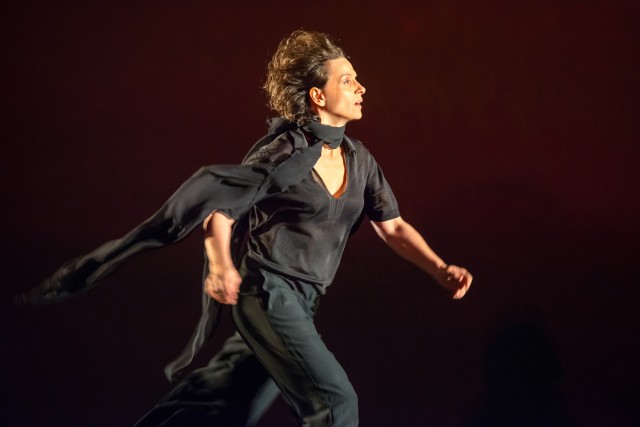
Juliette Binoche fights a chill wind in ANTIGONE (photo by Stephanie Berger)

Juliette Binoche fights a chill wind in ANTIGONE at BAM (photo by Stephanie Berger)

NEXT WAVE FESTIVAL
Brooklyn Academy of Music
BAM Harvey Theater
651 Fulton St. between Ashland & Rockwell Pl.
Through October 4, $30-$135
718-636-4100
www.bam.org

A chill runs through Belgian director Ivo van Hove’s adaptation of Sophokles’s classic tragedy Antigone, continuing through October 4 at BAM’s Harvey Theater. The sizzling-hot van Hove, who has dazzled audiences and critics alike with his recent, unusual presentations of Scenes from a Marriage, Angels in America, and Cries and Whispers, has stripped down the tale of power, family, loyalty, and responsibility in a new translation by Canadian poet Anne Carson (Agamemnon, Electra) that emphasizes the story’s relevance to today’s politics. As the play opens, Antigone (Juliette Binoche, who was last at BAM in 2009 in In-I), clad in black, is fighting off a brisk wind with her sister, Ismene (Kirsty Bushell). Their two brothers have killed each other in the Theban civil war fighting on opposite sides, Eteocles a hero, Polyneices a traitor. The new king, Kreon (Patrick O’Kane), has decreed that Polyneices’s body should be left outside to rot, but Antigone is determined to give her sibling a proper burial, although the punishment for doing so is death. Upon discovering that his niece and future daughter-in-law — Antigone’s father was Kreon’s brother, and she is engaged to marry Kreon’s son, Haimon (Samuel Edward-Cook) — has indeed buried Polyneices, Kreon shows no mercy, commanding Antigone’s execution, as well as that of anyone who supports her. Kreon’s chief adviser, Teiresias (Finbar Lynch), wants him to rethink his position, but Kreon is just as stubborn as Antigone, and it doesn’t take long for the bodies to start piling up.
(photo by Stephanie Berger)

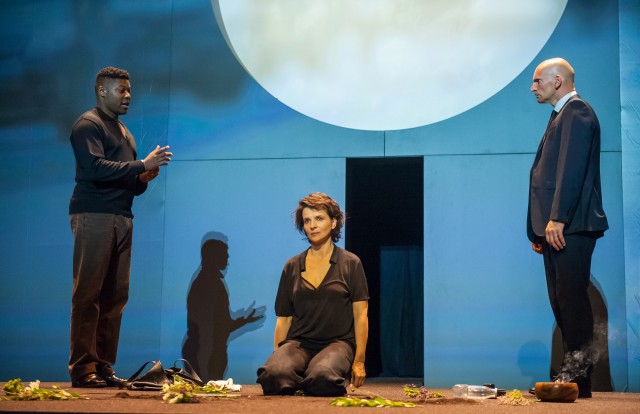
The guard (Obi Abili) and the king (Patrick O’Kane) look over Antigone (Juliette Binoche) at BAM (photo by Stephanie Berger)

Jan Versweyveld’s stage features a giant circle at the top of the back wall that rotates to reveal a projection of sky and clouds, as if the gods are looking down, judging the trials and tribulations of humanity. In the center of the floor is a rectangular platform that sinks to serve as a grave, lowering Polyneices and Antigone down toward hell and rising up again; it is perpendicular to a narrow walkway and opening used by Kreon, as if he is emerging from the lair of the gods. At the front of the stage is a leather couch, congruent with the costumes by An d’Huys — the men are mainly in suits and jackets as if attending a board meeting. Binoche and O’Kane make fine adversaries, though Antigone shouts too much, and Kreon changes moods a little too randomly. All of the actors except for O’Kane also double as the Greek chorus, who never speak as a unit. Carson’s script contains several contemporary phrases that elicit chuckles from the audience at inopportune moments, and Tal Yarden’s projections are hit-or-miss; the scenes of the vast desert work well, while video of ghostly figures making their way through a present-day city is confusing and feels out of place, though the last shot is effective. Meanwhile, the score weaves in and out of music by Morton Feldman, Arvo Pärt, Henryk Gorecki, and Dmitri Shostakovich before concluding with a sonic blast from longtime BAM favorite Lou Reed as van Hove attempts to relate this story of the state vs. the individual to the twenty-first century. Overall, he only partly succeeds, but by never quite providing the audience with an emotional connection to the characters or narrative, this Antigone will leave you feeling a little too cold. (The September 29 performance will be followed by a talk with Binoche and other members of the company, free for same-day ticket holders.)

FROM MINIMALISM TO ALGORITHM: SEPTEMBER SPRING

(photo by twi-ny/mdr)

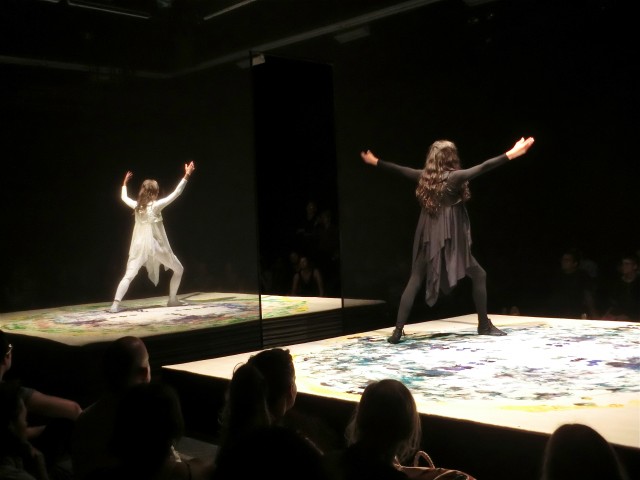
“September Spring” combines music, dance, painting, and installation at the Kitchen (photo by twi-ny/mdr)

The Kitchen
512 West 19th St. between Tenth & Eleventh Aves.
Installation open Tuesday – Saturday through October 10, free
Performances Tuesday to Thursday at 5:00 and Friday and Saturday at 2:00 & 5:00 through October 3
212-255-5793 ext11
thekitchen.org

Writer, photographer, and installation artist Sam Falls has created a beautifully intimate tribute to his late godbrother, Jamie Kanzler, with “September Spring,” continuing at the Kitchen through October 10. In 2013, Kanzler, who wrote poetry under the name September Spring and recorded music as Oldd News, died suddenly at the age of twenty-four. Falls has teamed up with dancers Hart of Gold, the New York-based duo consisting of Elizabeth Hart and Jessie Gold, for the durational work, which combines music, dance, and art in unique ways. On Tuesdays, Wednesdays, and Thursdays at 5:00 and Saturdays at 2:00 and 5:00 since September 9, Hart of Gold has been performing an intricate dance on two stacks of twenty-four canvas rugs each, representing every year Kanzler was alive, separated by a translucent black scrim with a doorway at the center, in the Kitchen’s upstairs gallery. First, dabs of paint are carefully applied across each canvas. Then Hart and Gold, dressed in white, begin moving on the surface to the lo-fi, scratchy sounds of Oldd News, played on a turntable in another room. The dancers initially form a large yellow circle (Kanzler’s favorite color), then follow Falls’s choreography as they create a kind of action painting with their feet, at times evoking how a needle moves across a record, with Jeanette Oi-Suk Yew’s lighting going from bright to dark to stroboscopic and one of the dancers changing into a black costume. The audience is encouraged to walk around during the show, experiencing it from changing lines of sight. After each performance, which lasts about an hour, the resulting paintings are removed from the stack and hung from cords; although the choreography and color and initial placement of the paint are the same for every performance, each canvas comes out different. The last performance is on October 3, but the exhibition of the paintings will remain on view for another week. Falls, who was partly inspired by Kanzler’s cover version of Amy Winehouse’s “Back to Black,” notes in a deeply personal statement, “Jamie had twenty-four dynamic years and over the course of the show the twenty-four rugs become representations of this time, blending the lightness of days to the darkness at the end, the colorful depth of the center, the core of every mortal life.” But despite all the sadness associated with the concept behind the piece, it is an exhilarating experience, focusing much more on life than on death. “September Spring” is part of “From Minimalism to Algorithm,” a series of works curated by Lumi Tan that examine the legacy of Minimalist art in the digital age.

FIRST SATURDAY: HISPANIC HERITAGE

Brooklyn Museum
200 Eastern Parkway at Washington St.
Saturday, October 3, free, 5:00 – 11:00
212-864-5400
www.brooklynmuseum.org

The Brooklyn Museum’s October free First Saturday program pays tribute to National Hispanic Heritage Month — which actually runs September 15 to October 15 — on October 3, kicking things off with a performance by Garifuna traditionalist Aurelio Martínez, who is not only a singer-songwriter but was the first black member of Honduras’s National Congress. Known simply as Aurelio, he will be highlighting songs from his latest record, 2014’s Lándini, which includes such tracks as “Sañanaru,” “Milaguru,” and “Durugubei Mani.” (You can sample the songs here; Aurelio will also be playing a free show at the David Rubenstein Atrium at Lincoln Center on October 15.) First Saturday also features live performances by Danza Fiesta: Baile y Teatro Puertorriqueno, DJ duo iBomba (DJ Beto and DJ Ushka), the Gregorio Uribe Big Band, the Humberto Ramírez Quintent, Nuyorican Poets Cafe, and Cave Canem poets Willie Perdomo, Elizabeth Acevedo, and Rio Cortez. In addition, Richard Aste and Edward J. Sullivan will lead a curator talk on the new exhibition “Impressionism and the Caribbean: Francisco Oller and His Transatlantic World,” art workshops will teach participants how to paint still lifes like Francisco Oller, you can settle in for a game of dominoes, Raquel Cepeda will read from and discuss her most recent book, Bird of Paradise: How I Became Latina, with her husband, Sacha Jenkins, and children are invited to sing and dance to Spanish and English songs with ¡Acopladitos! And the galleries are open late so you can check out such other exhibitions as “The Rise of Sneaker Culture,” “Kara Walker: ‘African Boy Attendant Curio (Bananas),’” “KAWS: ALONG THE WAY,” and “Zanele Muholi: Isibonelo/Evidence.”

NYFF53 MAIN SLATE: MOUNTAINS MAY DEPART

MOUNTAINS MAY DEPART

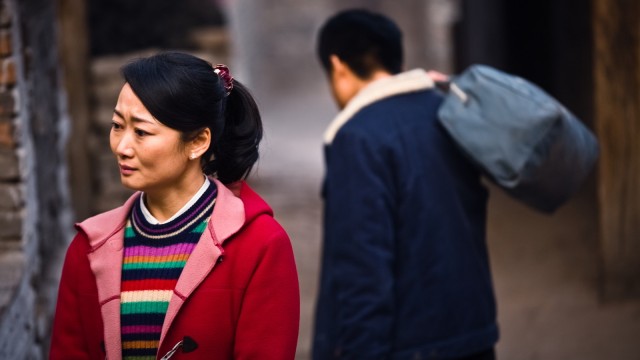
Zhang Jinsheng (Zhang Yi) shows his love for Shen Tao (Zhao Tao) in materialistic ways in Jia Zhangke’s MOUNTAINS MAY DEPART

MOUNTAINS MAY DEPART (SHAN HE GU REN) (Jia Zhangke, 2015)
Film Society of Lincoln Center
Monday, September 28, Alice Tully Hall, 6:00, and Tuesday, September 29, Francesca Beale Theater, 9:15
New York Film Festival runs through October 11
212-875-5050
www.filmlinc.org

Master Chinese writer-director Jia Zhangke returns to the New York Film Festival with Mountains May Depart, a melancholic look at love and relationships in which one decision can change the rest of your life, as well as an allegory about China itself and its path in the world. Jia’s wife and muse, Zhao Tao, stars as Shen Tao, a flighty, flakey young woman flirting with coal miner Liangzi (Liang Jin Dong) and burgeoning capitalist Zhang Jinsheng (Zhang Yi) in 1999 China, the country on the cusp of an economic crisis. It’s easy to see the young woman’s romantic decision as a microcosm of China’s economic decisions, as the working class battles the wealthy elite, and the effects of both are profound. The setup is reminiscent of the love triangle at the center of François Truffaut’s Jules et Jim, but Jia takes it much further, continuing the story in 2014, and then into 2025, a bleak future where individual happiness is painfully elusive. Jia (Still Life, The World, 24 City) and his longtime cinematographer, Yu Lik-wai, shoot the three time periods in different screen ratios, exemplifying how much things evolve as Chinese capitalism and globalism take over, affecting — and disaffecting — the next generation. But the past is always snapping at the characters’ heels; much of the film takes place in the Yellow River basin, where ancient structures recall China’s history, and in Jia’s vision of the future, vinyl LPs are back in fashion (although handheld devices are much cooler). Music plays a key role in the film, primarily Sally Yeh’s Cantonese song “Take Care” and the Pet Shop Boys’ cover of the Village People’s “Go West,” the latter a title that gets to the heart of the film.

MOUNTAINS MAY DEPART

Mia (Sylvia Chang) takes stock of her complicated life in MOUNTAINS MAY DEPART

Zhao is marvelous as the bittersweet Shen, from singing at the colorful Fenyang Spring Festival Gala as the new millennium approaches to trying to restore her relationship with her son (Dong Zijian), who her husband insisted be named Dollar. Her eyes are filled with emotion as she proceeds on a course that was never what she dreamed. In the third section, Sylvia Chang shines as Mia, a sensitive, divorced teacher from Hong Kong who grows close to Dollar in a future world in which English has eclipsed Chinese, so fathers and sons literally do not speak the same language. Navigating the four physical sufferings of Buddhist thought — birth, old age, sickness, and death, Jia avoids showing many key moments in the lives of the characters, often leaving it up to the audience to uncover what has happened over the years and decades, which has a certain grace, although the ambiguous ending is more than a bit frustrating, even if it makes sense as a parable for China as a whole. But it’s all encapsulated in the briefest of kisses in a helicopter that will both brighten and break your heart. And keep an eye out for the guy with the Guangdong Broadsword. Mountains May Depart is screening at the New York Film Festival on September 28 at 6:00 and September 29 at 9:15, with Jia and Zhao in person to talk about the film. In addition, Jia will take part in a free HBO Directors Dialogue at the Howard Gilman Theater on September 29 at 6:00, and Walter Salles’s documentary, Jia Zhangke, a Guy from Fenyang, is being shown at the festival on September 30 and October 1.

PUBLIC ART FUND TALKS AT THE NEW SCHOOL: JEPPE HEIN

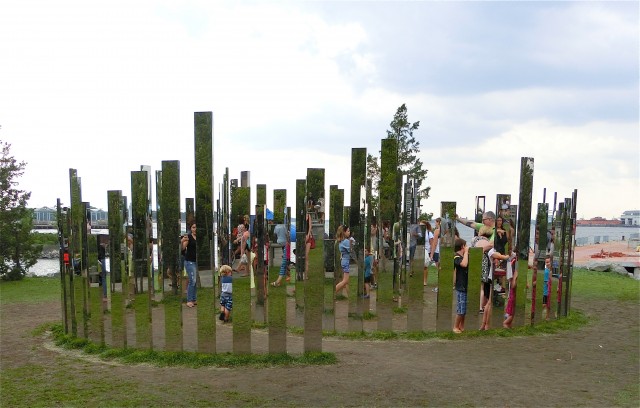
Jeppe Hein will be at the New School on September 29 to discuss his interactive Brooklyn Bridge Park installation (photo by twi-ny/mdr)

Jeppe Hein will be at the New School on September 29 to discuss his three-part interactive Brooklyn Bridge Park installation (photo by twi-ny/mdr)

PUBLIC CONTEXT, PRIVATE MEANING
The New School, Tishman Auditorium
63 Fifth Ave. between 13th & 14th Sts.
Tuesday, September 29, $10, 6:30
www.publicartfund.org

Jeppe Hein invites people to experience his work in tactile ways in “Please Touch the Art,” a three-part installation spread across Brooklyn Bridge Park. For the Public Art Fund project, the Danish artist, who lives and works in Berlin and Copenhagen, has created “Appearing Rooms,” a dancing water sculpture that visitors are encouraged to walk through and play in; “Modified Social Benches,” sixteen brightly colored red and orange uniquely shaped benches that people can sit on and climb; and “Mirror Labyrinth NY,” a circular maze of mirror-polished stainless-steel vertical planks that offers fun and fascinating reflections as you make your way in and around it, including mimicking the downtown Manhattan skyline across the river. (“Appearing Rooms” is on view until October 4, while the other two will remain in the park through April 17 of next year.) “People can use it; they don’t need to know it’s art or not,” Hein explains in a promotional video. “It’s just something twisting everyday life.” On September 29, Hein will give a participatory talk at the New School as part of the Public Art Fund series “Public Context, Private Meaning,” combining performance, audience interactivity, and interview. The Fall 2015 Public Art Fund Talks at the New School continue October 21 with Hank Willis Thomas and November 18 with Fiona Banner.

DORIS SALCEDO SYMPOSIUM AND EXHIBITION

(photo by David Heald/Solomon R Guggenheim Foundation)

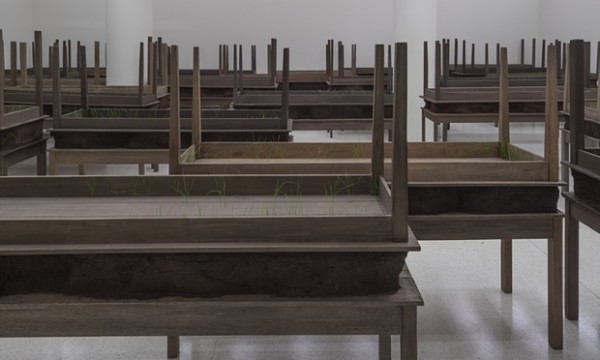
“Plegaria Muda” evokes mass graves in Doris Salcedo exhibition at the Guggenheim (photo by David Heald/Solomon R. Guggenheim Foundation)

Solomon R. Guggenheim Museum
1071 Fifth Ave. at 89th St.
Exhibition: Friday – Wednesday through October 12, $25
Symposium: Friday, October 2, $15, 11:00 am – 6:30 pm
212-423-3587
www.guggenheim.org

Colombian artist Doris Salcedo encapsulated her powerful, emotional oeuvre beautifully and succinctly in a recent interview with Marguerite Feitlowitz: “My work is based on the testimonies of victims of violence, on experiences that are alien to me,” she explained. “I am not a direct witness; I am witness to the witness, a secondary witness. I search for an intimate proximity with the victims of violence that will permit me to stand in for them as I actually make the work, but in such a way that their experience takes precedence over my own.” For three decades, the Bogotá native has been creating installations that examine the social injustice and violence experienced in Colombia and other parts of the world. She uses common domestic objects that each visitor can relate to, building on their evocation of memory and loss. Her current retrospective at the Guggenheim is installed on all four tower levels, allowing museumgoers plenty of time as they go from one section to another to process what they have just seen in one gallery before entering the next. “Plegaria Muda,” roughly translated as “silent prayer,” memorializes both mass gang killings in South Central Los Angeles and murders committed by the Colombian army between 2003 and 2009. The piece is a maze made of pairs of handcrafted tables inverted upon each other, with earth sandwiched between them. Blades of grass rise through the earth, life emerging from dozens of anonymous graves.

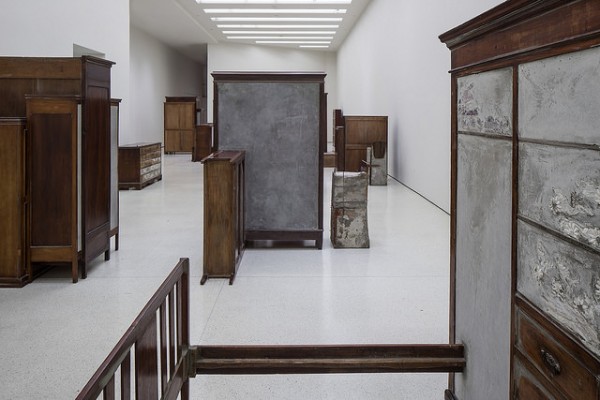
“La Casa Viuda”  is part of haunting retrospective at the Guggenheim (photo by David Heald/Solomon R Guggenheim Foundation)

“La Casa Viuda” is part of haunting retrospective at the Guggenheim (photo by David Heald/Solomon R. Guggenheim Foundation)

For “Atrabilarios,” Salcedo takes shoes left behind by los desaparecidos (individuals “disappeared” by security forces) and places them in wall niches, covering them with rectangles of semitranslucent animal fiber that is hand-stitched into the wall with medical sutures, the shoes fading away like slowly forgotten memories or barely healed scars. “A Flor de Piel” is a large floor piece composed of stitched-together, chemically treated rose petals, forming a kind of burial shroud for a Colombian nurse who was kidnapped, tortured, and killed. Salcedo uses silk thread and nearly twelve thousand burned needles to make “Disremembered,” a collection of barely there tuniclike hair shirts that combine beauty and pain. “Untitled” brings together hospital cots wrapped in animal fiber with stacks of crisply folded white shirts impaled by steel rebar, associating loss and violence with a place meant for healing. And “La Casa Viuda” is a room containing doors, dressers, tables, chairs, and other furniture connected, filled in, or closed off with concrete, a house devoid of people, no longer fit for human occupancy. Individually, the pieces demand silent contemplation and introspection, but as a whole, the exhibition will also make you angry about what is still happening all over the globe, brutal murders and disappearances that seemingly cannot be stopped. The moving exhibition, which also includes a video screening of Salcedo’s public projects, continues at the Guggenheim through October 12; on October 2, the artist will participate in an all-day symposium along with Elizabeth Adan, Carlos Basualdo, Katherine Brinson, Leslie Jamison, Roderick Mengham, Jean-Luc Nancy, and Alexander Nemerov.

NYFF53 MAIN SLATE: THE FORBIDDEN ROOM

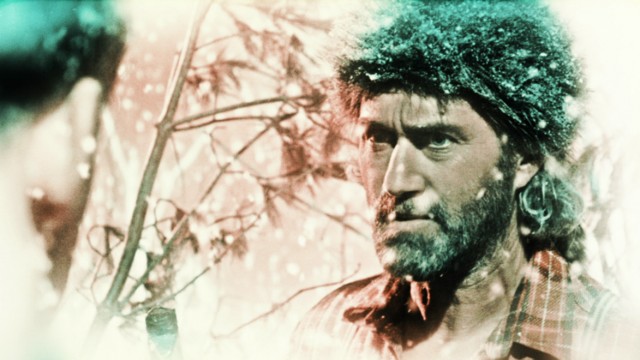
Roy Dupuis plays a heroic woodsman in Guy Maddin and Evan Johnsons unpredictably strange and wonderful homage to early cinema, THE FORBIDDEN ROOM

Roy Dupuis plays a heroic woodsman in Guy Maddin and Evan Johnson’s unpredictably strange and wonderful homage to lost early cinema, THE FORBIDDEN ROOM

THE FORBIDDEN ROOM (Guy Maddin & Evan Johnson, 2015)
Film Society of Lincoln Center, Walter Reade Theater
165 West 65th St. between Eighth Ave. & Broadway
Monday, September 28, 9:00, and Tuesday, September 29, 8:30
Festival runs through October 11
212-875-5050
www.filmlinc.org
theforbiddenroom-film.com

Guy Maddin and Evan Johnson’s The Forbidden Room is a deliriously mesmerizing epic tone poem, a crafty, complex avant-garde ode to cinema as memory, and memory as cinema. An homage to the lost films of the silent era, it is the illegitimate child of Bill Morrison and David Lynch, of Jack Smith and Kenneth Anger, of D. W. Griffith and Josef von Sternberg. The impossible-to-describe narrative jumps from genre to genre, from submarine thriller to Western adventure to murder yarn, from romantic melodrama and crime story to war movie and horror tale, complete with cannibals, vampires, poisoned leotards, “valcano” eruptions, caged lunatics, butt obsession, squid theft, explosive jelly, a fantastical mustache, and skeletal insurance defrauders. Intertitles that often fade away too soon to decipher help propel the plot, contain lines from John Ashbery and the Bible, and blast out such words as “Deliverer of Doom,” “Diablesa!” and “Trapped!” Text in intricate fonts announces each new character and actor, including Maddin regular Louis Negin as the Sacrifice Organizer, Slimane Dazi as shed-sleeper and pillow-hugger Baron Pappenheim, Lewis Furey as the Skull-Faced Man, and Roy Dupuis as a “mysterious woodsman” determined to rescue captured amnesiac Margot (Clara Furey) from the evil clutches of the Red Wolves. Also involved in the bizarre festivities are Udo Kier, Geraldine Chaplin, Mathieu Amalric, Charlotte Rampling, and Maria de Medeiros.

Although shot digitally, the film explores photographic emulsion and time-ravaged nitrate while treating celluloid as an art object unto itself, looking like Maddin (Tales from the Gimli Hospital, My Winnipeg) and Johnson stomped on, burned, tore up, and put back together the nonexistent physical filmstrip. Thus, major kudos are also due Maddin’s longtime editor, John Gurdebeke, and music composers Galen Johnson, Jason Staczek, and Maddin himself for keeping it all moving forward so beautifully. The film was photographed by Benjamin Kasulke and Stéphanie Anne Weber Biron in alternating scenes of black-and-white, lurid, muted color, and sepia tones that offer constant surprises. The Forbidden Room might be about the magic of the movies, but it is also about myth and ritual, dreams and fantasy as it explores storytelling as psychodrama. Oh, and it’s also about taking baths, as Marv (Negin) so eagerly explains throughout the film. But most of all, The Forbidden Room is great fun, a truly unpredictable and original work of art that is a treat for cinephiles and moviegoers everywhere. The Forbidden Room is screening at the New York Film Festival on September 28 at 9:00 and September 29 at 8:30, with Maddin and Johnson in person at the Walter Reade Theater. In addition, their thirty-one-minute documentary short, Bring Me the Head of Tim Horton, a behind-the-scenes account of the making of Paul Gross’s Afghanistan war movie, Hyena Road, is being shown both days (12 noon – 6:00; 8:30 – 11:00) for free at the Elinor Bunin Munroe Amphitheater across the street.