twi-ny recommended events

TWI-NY TALK: ROARKE MENZIES

(photo by Dusdin Condren)

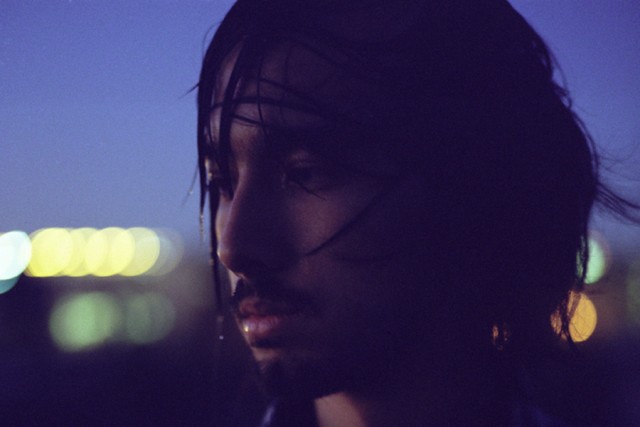
Roarke Menzies will celebrate the release of his debut album with an intimate party October 10 at Bunna Cafe (photo by Dusdin Condren)

Bunna Cafe
1084 Flushing Ave., Brooklyn
Saturday, October 10, free, 11:00 pm
www.roarkemenzies.com
bunnaethiopia.net

Vancouver-born, Brooklyn-based multidisciplinary artist, composer, and producer Roarke Menzies knows about collaboration. For the past ten years, Menzies has been working with dancers, storytellers, choreographers, visual artists, and film directors, creating soundscapes and scores primarily using electronics, vocals, and his body. He’s been involved in projects at the Kitchen, the New Museum, Jacob’s Pillow, Abrons Arts Center, the Bushwick Starr, and the Vancouver Biennale in addition to composing music for a VICE web pilot and an award-winning educational app for children. But now Menzies, a self-described “sonic explorer,” is entering new territory, putting himself front and center with the release of his debut album, Shapes (October 13, Coup de Glotte). The record features six soundscapes, running in length from 2:11 (“Man in the Myler”) to 13:58 (“Music for Spatial Shift”), that take listeners on an ethereal journey through space and time, from the gentle, lilting “Those Pretty Lights” to the echoing, wind-strewn “Pulse Inflections.” Earlier this year, we did a twi-ny talk with Menzies and Rome about their show Philadelphia and Other Stories. Now we go it alone with Menzies, as he discusses sonic phenomena and the material world, his rather heady reading list, Aboriginal artist Warlimpirrnga Tjapaltjarri, and more.

twi-ny: We first met five years ago, when artist Nuala Clarke invited us, along with several others, to perform at her art opening, “You Delight Me,” on Shelter Island. How’s life been treating you since then?

Roarke Menzies: Yeah, that was a lovely event. Nuala contacted me out of the blue. We’d never met before. I was working on some music with my brother in LA and got an email from her asking me to participate. I think she’d found something of mine online.

I’ve been so lucky, in a lot of ways. I get approached to work on a lot of compelling projects, and between that and my other jobs [in performing arts management] I’m able to earn enough to support myself and pursue creative endeavors.
(photos by Paul Rome)

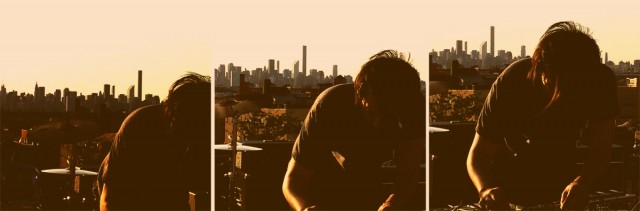
Roarke Menzies expands his horizons with new album, SHAPES (photos by Paul Rome)

twi-ny: I’m really enjoying your debut album, Shapes, which takes listeners on a fascinating sonic journey. You wrote and play all the music as well as handle the production, recording, and mixing. How long did it take you to put it all together?

RM: That’s awesome. I’m glad you’re enjoying it. These are works that have developed slowly over the past several years. The earliest recorded material on there is from late 2009 and has been revisited and reworked a number of times. I’ve put a lot of thought and care into these tracks. It’s a lot of work, but it’s definitely a labor of love.

twi-ny: You describe Shapes as both creating space and filling it up. Can you expand on that a little?

RM: I’m actually referring not just to the sounds on Shapes but to sound in general, and how we interpret sound phenomena in relation to our sense of space.

If you’re on an underground subway platform, every sound you hear reverberates in ways that inform your sense of that space. Even without visual cues, your mind can put together the cavernous space you’re in. That same effect can be simulated artificially using reverb. Sound designers and engineers make practical use of it all the time, in film or radio, for instance, creating the sense of size or the characteristics of the space you’re “in” using only sound. But that space doesn’t actually exist, at least not in the way “existence” is generally understood. It’s a fiction fabricated using particular signs and signals that your mind interprets as a space.

In other instances, the sheer “density,” “mass” or “volume” of a sound can create this feeling that it’s there in front of you — “a sound filled the room” — like you could just reach out and touch it in the same way you can touch a glass of whiskey or a person on the cheek. But sound doesn’t really behave that way either.

One of the curious aspects in working with sound as a material is that it’s not, in fact, material. And yet it seems to have this power to at times convince us of its materiality, even if just temporarily, and to completely change our sense of the material world around us. I’m interested in how those processes play out.

twi-ny: Where do you get your sonic inspirations? I have a feeling that when you traverse the city, you listen to all the cacophony and noise in a different way than the rest of us, gathering ideas for your work.

RM: I’m definitely a sound-obsessed person, and I’m often mesmerized and perplexed by the city’s sound culture. I do a lot of listening and a lot of reading. I find reading fuels my creative life like nothing else, whether articles, essays, books, blog posts, Wikipedia entries. Ben Lerner’s novel 10:04 is a recent favorite, and I have a long reading list that I’m slowly working through of texts related to performance, sound and technocultural studies. I think the next will be Brandon LaBelle’s Lexicon of the Mouth: Poetics and Politics of Voice and the Oral Imaginary.

twi-ny: That’s some heavy stuff. Shapes includes a tribute to the great La Monte Young. Who are some of your other musical influences?

RM: I feel like my influences are all over the place — Arvo Pärt, Portishead, Fluxus, Sam Cooke’s gospel recordings with the Soul Stirrers, Deerhunter’s Cryptograms, Geinoh Yamashirogumi’s soundtrack for Akira, Kanye West’s 808s & Heartbreak, the choral works of Morten Lauridsen, the rugged lands of early RZA, the pop masterpieces of Max Martin, the subterranean cityscapes of Burial, the codeine-soaked tapescapes of DJ Screw, the Courvoisier-soaked jiggyscapes of early 2000s Neptunes, etc. I’m a huge music appreciator.

twi-ny: Who do you listen to on your iPod?

RM: All that being said, there’s really not a lot of it on my iPhone. Other than work-related stuff and that U2 album we were all force-fed (I never bothered to listen to or erase it), all I’ve got on there at the moment is Cocteau Twins, Arthur Russell, Nico Muhly, Tim Hecker, Oneohtrix Point Never, James Blake, a vintage Soweto compilation, and a few mixes from the UK music publication The Wire.

twi-ny: What about seeing live music?

RM: Recent highlights that come to mind include Tyondai Braxton’s new Hive project at the Kitchen, FKA Twigs’ Congregata for Red Bull Music Academy, a riveting set from Pharmakon at St. Vitus, the experimental synth duo Long Distance Poison at Pioneer Works, and an improvised set from saxophonist Colin Stetson, bassist Trevor Dunn, and drummer Greg Fox (of Zs) at Outpost.

twi-ny: You also compose scores and soundscapes for Paul Rome’s story presentations, Jack Ferver’s multidisciplinary performances, and such choreographers as Adam Barruch and Meredith Glisson. How does your creative process differ for such diverse projects, or do you approach them all the same?

RM: My approach can be radically different, depending on the project and the working styles of the people involved. I try to learn the vocabulary and codes — “When they say this, they mean this” — then develop an understanding for what will best support the work.

twi-ny: You’ll be celebrating the release of your debut album, Shapes, with a party on October 10 at Bunna Cafe in Brooklyn, and you’ll be joined by Rome, Katie Mullins, and David Kammerer. What do you have planned for the event?

RM: I’m planning a very warm, intimate event. Bunna’s a great Ethiopian restaurant with a small stage. It’s a favorite spot of mine. We’ll likely open the evening with an Ethiopian coffee ceremony. Then Paul will read a new story he’s been working on, David and Katie will each play a few new songs of theirs, and I’ll perform a short solo set. The performances will be relatively brief since the focus is really to celebrate with friends.

I actually have a really exciting last-minute addition to the night’s festivities. The Ghanaian xylophone virtuoso SK Kakraba is going to come to Bunna after his show at Bossa Nova Civic Club for an informal late night solo set. I have to thank my good friend Mike Visser (of Imaginary Tricks) for arranging that one. It’s going to be a really special night.

twi-ny: What do you do when you take a break from music, if you ever take breaks from music?

RM: I definitely take lots of breaks. When I’m not at work or focusing on a specific project, I don’t like to be holed up in my studio for no reason. I like to get out and see things, or spend time with friends and loved ones.

I recently saw an incredible painting show at Salon 94 on the Bowery. It’s the first solo show in the US by an Australian Aboriginal artist named Warlimpirrnga Tjapaltjarri, who along with his family was living nomadically until they were “discovered” in the ’80s. [Ed. note: The show, “Maparntjarra,” continues at Salon 94 through October 24.] Apparently this guy is revered as an important leader and healer among Australian tribes and is also considered one of the most important innovators in contemporary indigenous art from Australia. All I can say is it was one of the most powerful experiences I’ve ever had at a painting show, incredibly inspiring.
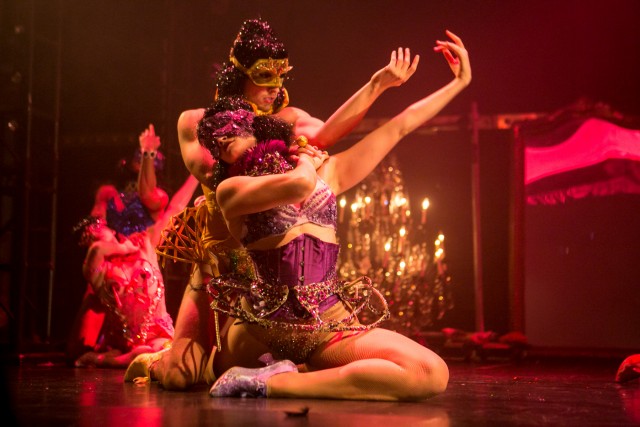
CINDERELLA: A BAROQUE BURLESQUE BALLET

(photo by Phillip Van  Nostrand)

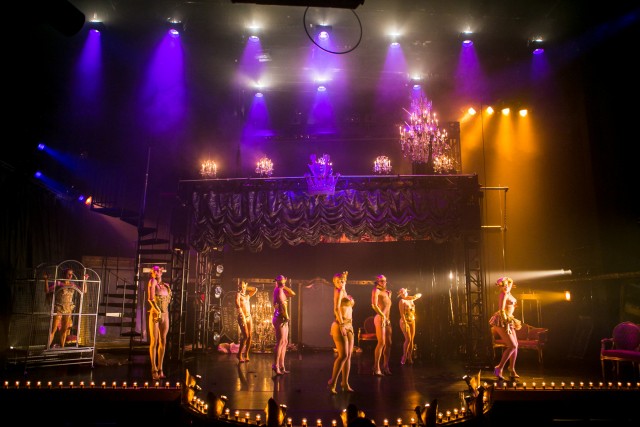
Austin McCormick and Company XIV give a whole new look to beloved fairy tale (photo by Phillip Van Nostrand)

Minetta Lane Theatre
18 Minetta Lane between MacDougal St. & Sixth Ave.
Tuesday – Sunday through November 15, $40-$100
companyxiv.com
minettalanenyc.com

New York-based Company XIV brings a rather decidedly decadent edge to Cinderella, the anti-Disney version of Charles Perrault’s 1697 fairy tale about an orphaned and abused girl on the cusp of womanhood, seeking her Prince Charming despite severe family dysfunction. Billed as a “Baroque Burlesque Ballet,” this Cinderella boasts bold sexuality, acrobatics, cross-dressing, pole dancing, and a wildly imaginative score, all brought together by company artistic director Austin McCormick. Outfitted in Zane Pihlstrom’s dazzling, body-baring costumes that quote drag ball and S&M style — Pihlstrom also designed the small set, which features a lush curtain topped by a glittering crown, a baroque backdrop, and a fun-house mirror — the twelve dancers put on a dazzling show, with Allison Ulrich as Cinderella, Steven Trumon Gray as the strikingly handsome prince, Marcy Richardson and Brett Umlauf as the dastardly stepsisters, Katrina Cunningham as the heroic Fairy Godmother (who takes nurturing to a new extreme), and Davon Rainey as the devious stepmother, a fearlessly erotic combination of Tim Curry in The Rocky Horror Picture Show and Billy Porter in Kinky Boots as conceived by the Marquise de Sade and Louis XIV. The two-hour-plus show, with two intermissions, contains almost no dialogue; instead, details of the plot are revealed by performers Hilly Bodin, Lea Helle, Jakob Karr, Nicholas Katen, Malik Kitchen, and Mark Osmundsen, who walk across the stage with two-sided chalkboards announcing scenes and acts in addition to their other roles. Jeanette Yew’s lighting shows off the heated dancing and eye-opening costumes to great effect.

(photo by Phillip Van  Nostrand)

Company XIV reimagining of CINDERELLA is a decidedly adult undertaking (photo by Phillip Van Nostrand)

Highlights include a virtuoso solo by Rainey, a provocative duet between Ulrich and Cunningham, the beautifully choreographed ball scene, and a cage dance by Ulrich, turning the standard fairy-tale musical inside out with more than a touch of strip-club bravado. The score contains eerie versions of such songs as Lorde’s “Royals,” Lana Del Rey’s “Born to Die,” Roxy Music’s “Love Is the Drug,” and Nicki Minaj’s “Get on Your Knees,” as well as works by Prokofiev, Tchaikovsky, Verdi, and Irving Berlin. During the two intermissions, the performers display their vast talents in out-of-character burlesque vignettes that are well worth sticking around for. Company XIV has previously staged such compelling, cutting-edge shows as Rococco Rouge and Lover. Muse. Mockingbird. Whore, and in November they’ll be bringing back their popular Nutcracker Rouge, with their rendition of Snow White scheduled for January. We can’t wait to see what this immensely skilled and adventurous company has in store for that.

OLD TIMES

(photo by Joan Marcus)

Clive Own, Eve Best, and Kelly Reilly delve into the mysterious past in Roundabout revival of Harold Pinter’s OLD TIMES (photo by Joan Marcus)

American Airlines Theatre
227 West 42nd St. between Broadway & Eighth Ave.
Tuesday – Sunday through November 29, $67-$137
212-719-1300
www.roundabouttheatre.org

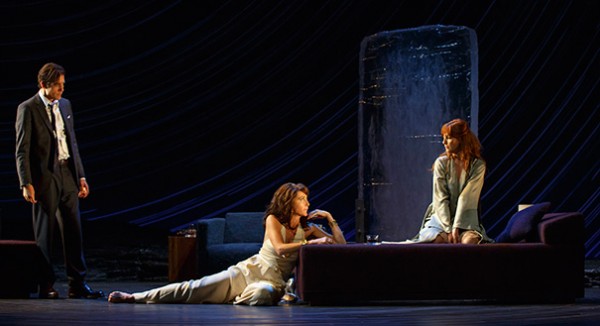
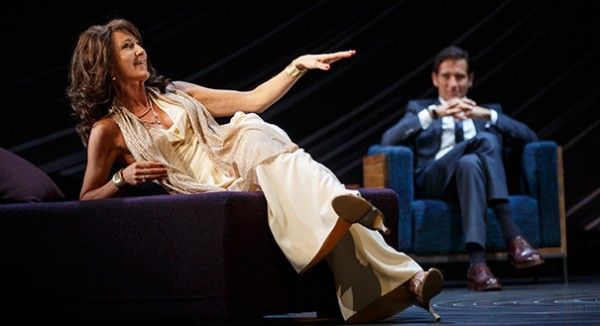
As the Roundabout’s Broadway revival of Harold Pinter’s Old Times opens, Deeley (Clive Owen) is man-spread on a fashionably modern chair, Kate (Kelly Reilly) lies on a matching couch, and Anna (Eve Best) stands between them, facing a large, rectangular block of ice, her back to the audience at the American Airlines Theatre. It looks as if something happened the night before, something no one wants to remember. “Dark,” Kate says to Deeley. Indeed, Old Times is dark. And this being Pinter, don’t expect there to be much light shed on exactly what might have happened the night before, or at all, during this seventy-minute journey into a never-defined past or present. Early on, Kate confesses to Deeley, her husband, that Anna was her best and only friend, that they once lived together, but she also admits, “I hardly remember her. I’ve almost forgotten her.” Meanwhile, Anna raves about the two women’s relationship in great detail, with verve and excitement, but she adds, “There are some things one remembers even though they may never have happened. There are things I remember which may never have happened but as I recall them so they take place.” They all discuss having seen Carol Reed’s IRA noir masterpiece, Odd Man Out, and at one time or another in the play, each of the characters becomes the “odd man out” as the other two bond by telling old stories, singing American classics, or debating a possible previous meeting. “Some people throw a stone into a river to see if the water’s too cold for jumping,” Anna says, continuing, “others, a few others, will always wait for the ripples before they will jump.” There are plenty of ripples in Old Times, which has a backdrop of ever-widening concentric circles that evoke the ripples in a lake, or the rays of a pitiless sun. Christine Jones’s (American Idiot, The Green Bird) set also features black clumps of dried lava (“I live on a volcanic island,” Anna says), a sharp counterpoint to the huge block of ice and the mural of rippling water or blazing sun, echoing the characters’ ability to go from hot to cold and back again in an instant.

(photo by Joan Marcus)

The sexy Anna (Eve Best) shares her memories in OLD TIMES (photo by Joan Marcus)

It’s been forty-four years since Old Times was last seen on Broadway, in its Great White Way debut with Robert Shaw, Rosemary Harris, and Mary Ure, and the Roundabout previously revived it in 1984 with Anthony Hopkins, Jane Alexander, and Marsha Mason. It is considered one of Pinter’s middle-period memory plays, which also include 1974’s No Man’s Land and 1978’s Betrayal, each of which has been revived on Broadway the last two years, the former a huge hit, the latter a major disappointment. Douglas Hodge, who has appeared in and directed many of Pinter’s works over the past two decades, makes his Broadway directorial debut here with a sure hand, keeping things appropriately mystifying, obscure, and utterly compelling, although the strobe lights and the onetime rotation of the stage seem unnecessary. Owen (A Day in the Death of Joe Egg, Closer) and Reilly (After Miss Julie, Russian Dolls) make strong impressions in their Broadway bows, he giving Deeley more than a little smarm, she imbuing Kate with an uncomforting yet sublime mystery, but Best, who was nominated for a Tony in 2008 for her performance as Ruth in Pinter’s The Homecoming, is an absolute whirlwind, dominating the stage in her gorgeous, sexy white pantsuit, making confident declarations with a commanding physicality. She mesmerizes even with a casual swipe of the floor with her bare foot. There are various theories exploring what Old Times is really about; perhaps Kate and Anna are two parts of the same person, or maybe one of the women has killed the other, or maybe they’re all dead, lingering in a kind of way station. Pinter never said, so we’ll never be sure. But we do know that there may be no one better at evoking the prismatic nature of time and memory and the brilliant refractions of human relationships than the iconoclastic British playwright.

ONASSIS FESTIVAL NY — NARCISSUS NOW: THE MYTH REIMAGINED

narcissus now 2

Onassis Cultural Center NY
Olympic Tower
645 Fifth Ave. at 51st St.
October 8-11
www.onassisfestivalny.org

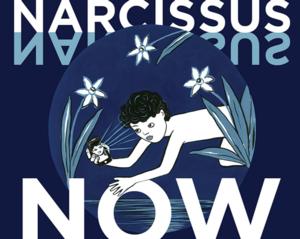
The Onassis Cultural Center is celebrating its newly renovated home in Midtown with a four-day festival built around the myth of Narcissus. As the Onassis Festival NY website explains, “From psychoanalysis to selfies, the Narcissus myth serves as an emblematic example of the unparalleled influence of Classical antiquity on our culture.” The festivities begin on October 8 with the opening-night presentation (free with advance RSVP) of choreographer Jonah Bokaer and composer Stavros Gasparatos’s specially commissioned Triple Echo, a site-specific work exploring mimesis, with solos by dancers Hristoula Harakas, Sara Procopio, and Callie Nichole Lyons, live percussion by Matt Evans, and recorded vocals by Savina Yannatou. The festival, curated by BAM director of humanities Violaine Huisman, continues through October 11 with more than two dozen free events (most requiring advance registration). Below are some of the highlights; there are also art installations by Lynda Benglis (“Now”), Blind Adam (“Columns”), Andreas Angelidakis (“Mirrorsite”), Jenny Holzer (“You Must Know Where You Stop and the World Begins”), and others, as well as satellite events at BAM and McNally Jackson.

Thursday, October 8
Triple Echo, by Jonah Bokaer and Stavros Gasparatos, featuring Hristoula Harakas, Sara Procopio, Callie Nichole Lyons, Matt Evans, and Savina Yannatou, Onassis Cultural Center Atrium and Gallery, 7:00

Friday, October 9
Narcissus & Art in the Woods: A Lecture with the Bruce High Quality Foundation, Onassis Cultural Center Gallery, 11:00 am

Narcissus & Fashion, with Sarah Lewis, Konstantin Kakanias, and Mary Katrantzou, moderated by Judith Thurman, Onassis Cultural Center Gallery, 2:30

Narcissus & Technology, with Zachary Mason and Sree Sreenivasan, moderated by Dominic Rushe, Onassis Cultural Center Gallery, 5:30

Saturday, October 10
Narcissus & Ballet, with Heléne Alexopoulos and Jennifer Homans, Onassis Cultural Center Gallery, 11:00 am

Narcissus & Acting, with Paul Giamatti and Vanessa Grigoriadis, Onassis Cultural Center Gallery, 1:00

As I Was Moving Ahead Occasionally I Saw Brief Glimpses of Beauty (Jonas Mekas, 2000), part of the BAMcinématek series “Diaries, Notes, and Sketches: Cinematic Autobiography,” BAM Rose Cinemas, $10, 2:00 – 7:20

Narcissus & Song, with Eleanor Friedberger, BAMcafé Live, Lepercq Space, 30 Lafayette Ave., 9:00

Sunday, October 11: Family Day
Narcissus & Space: A Short Film, Moon Mirrors, with filmmakers Sharon Shattuck and Ian Cheney and astronaut Jeffrey Hoffman, moderated by Matthew Stanley, Onassis Cultural Center Gallery, 10:00 am, 12 noon, and 2:00

Tell It Again! with Efi Latifi, Onassis Cultural Center Atrium, 11:15 am & 1:15 pm

Narcissus & Echo, with Benjamin Weiner, Onassis Cultural Center Atrium, 12:15 & 2:15

ADVANCE RESERVATION ALERT: OHNY WEEKEND

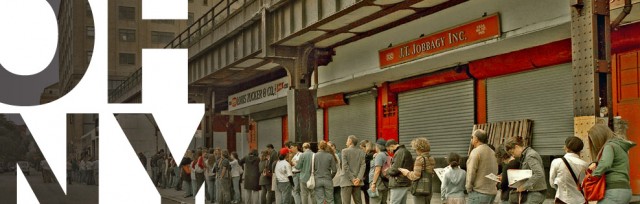
Advance reservations at many Open House New York events and tours should help you avoid long lines

Advance reservations at many Open House New York events and tours should help you avoid long lines

OPEN HOUSE NEW YORK
Multiple venues in all five boroughs
Saturday, October 17, and Sunday, October 18 (and additional events Friday, October 16), free
Advance reservations available October 7, $5, 11:00 am
OHNY Passport: $150 (sold out)
212-991-6470
www.ohny.org

Open House New York Weekend, during which hundreds of spaces throughout the five boroughs, often not accessible to the general public, open their doors to visitors, takes place October 17-18, but advance reservations are necessary to be able to check out some of the best local architectural wonders. On October 7 at 11:00 am, you can start booking spots for dozens and dozens of special events — at five bucks a pop — including the Vertical Tour of the Cathedral Church of St. John the Divine, Crossing Wallabout in Brooklyn, the DOT Art Bike Tour, the DSNY Hamilton Avenue Marine Transfer Station in Gowanus, Food Factory Friday (Breuckelen Distilling, Brooklyn Roasting Company, Raaka Chocolate, Tom Cat Bakery), General Grant National Memorial After-Hours Tours, Google Inc. — Design & Workplace Tour, High Line Engineering Tour, Hunter’s Point South Waterfront Park, Intrepid Sea, Air & Space Museum: Behind the Scenes in Aircraft Restoration, Maple Grove Cemetery, Marcus Garvey Park & “caesura: a forum” art installation, New York University: Edward Hopper Studio, Newtown Creek Wastewater Treatment Plant, Ridgewood Reservoir, the Thurgood Marshall United States Courthouse, Urban Post-Disaster Housing Prototype, Whose Art Is It? Landmark Skirmishes Over Artworks in the Public Realm, the Woolworth Building, and more. All tours and events that do not require advance reservations are first-come, first-served.

(T)ERROR

(T)ERROR

Documentary sheds light on curious side of FBI counterterrorism efforts

(T)ERROR (Lyric R. Cabral & David Felix Sutcliffe, 2015)
IFC Center
323 Sixth Ave. at Third St.
Opens Wednesday, October 7
212-924-7771
www.terrordocumentary.org
www.ifccenter.com

(T)error is a great name for a horror movie, but even though it turns out that Lyric R. Cabral and David Felix Sutcliffe’s debut is not part of that genre, there still is plenty scary about it. Winner of the U.S. Documentary Special Jury Award for Break Out First Feature at Sundance, (T)error is a surprising look inside one aspect of the FBI’s counterterrorism program. Shortly after Saeed “Shariff” Torres, a friend and neighbor of filmmaker and photojournalist Cabral’s, suddenly disappeared, he contacted her, eventually letting her inside his secret career as a longtime FBI informant. A Muslim and former Black Panther revolutionary, the sixty-three-year-old school kitchen employee and father of a young son goes on camera as he takes on what he claims will be his final assignment, cozying up to a Pittsburgh man named Khalifa Ali Al-Akili, previously known as James Marvin Thomas Jr., who the FBI thinks might be involved in terrorist plots. It’s not exactly the most thrilling game of cat and mouse; Cabral and codirector Sutcliffe (Adama) follow Shariff as he goes about a lot of mundane business, arguing over how much money the FBI gave him, text-messaging back and forth with agents and his prey, examining Facebook pages, and Skyping with his son, whose face is blurred for protection. And Sharrif is not quite the kind of well-trained operative you read about in books or see in action-packed movies, making one wonder just what the FBI is thinking — and how it’s spending our money — especially after a major twist occurs about halfway through the film, turning everything around and inside out, providing a new vantage point that makes the whole sting operation even more bizarre and surreal. But it’s all too real, and rather frightening in its own very strange way. After playing multiple film festivals, including Tribeca, Human Rights Watch, Sundance, and Full Frame, (T)error is getting its theatrical release beginning October 7 at the IFC Center.

THE FORBIDDEN ROOM

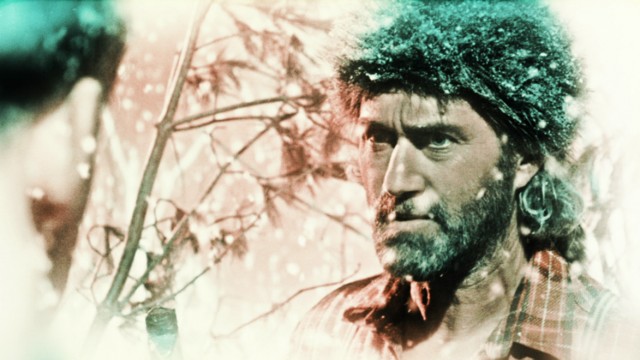
Roy Dupuis plays a heroic woodsman in Guy Maddin and Evan Johnsons unpredictably strange and wonderful homage to early cinema, THE FORBIDDEN ROOM

Roy Dupuis plays a heroic woodsman in Guy Maddin and Evan Johnson’s unpredictably strange and wonderful homage to lost early cinema, THE FORBIDDEN ROOM

THE FORBIDDEN ROOM (Guy Maddin & Evan Johnson, 2015)
Film Forum
209 West Houston St.
October 7-20
212-727-8110
filmforum.org
theforbiddenroom-film.com

Guy Maddin and Evan Johnson’s The Forbidden Room is a deliriously mesmerizing epic tone poem, a crafty, complex avant-garde ode to cinema as memory, and memory as cinema. An homage to the lost films of the silent era, it is the illegitimate child of Bill Morrison and David Lynch, of Jack Smith and Kenneth Anger, of D. W. Griffith and Josef von Sternberg. The impossible-to-describe narrative jumps from genre to genre, from submarine thriller to Western adventure to murder yarn, from romantic melodrama and crime story to war movie and horror tale, complete with cannibals, vampires, poisoned leotards, “valcano” eruptions, caged lunatics, butt obsession, squid theft, explosive jelly, a fantastical mustache, and skeletal insurance defrauders. Intertitles that often fade away too soon to decipher help propel the plot, contain lines from John Ashbery and the Bible, and blast out such words as “Deliverer of Doom,” “Diablesa!” and “Trapped!” Text in intricate fonts announces each new character and actor, including Maddin regular Louis Negin as the Sacrifice Organizer, Slimane Dazi as shed-sleeper and pillow-hugger Baron Pappenheim, Lewis Furey as the Skull-Faced Man, and Roy Dupuis as a “mysterious woodsman” determined to rescue captured amnesiac Margot (Clara Furey) from the evil clutches of the Red Wolves. Also involved in the bizarre festivities are Udo Kier, Geraldine Chaplin, Mathieu Amalric, Charlotte Rampling, and Maria de Medeiros.

Although shot digitally, the film explores photographic emulsion and time-ravaged nitrate while treating celluloid as an art object unto itself, looking like Maddin (Tales from the Gimli Hospital, My Winnipeg) and Johnson stomped on, burned, tore up, and put back together the nonexistent physical filmstrip. Thus, major kudos are also due Maddin’s longtime editor, John Gurdebeke, and music composers Galen Johnson, Jason Staczek, and Maddin himself for keeping it all moving forward so beautifully. The film was photographed by Benjamin Kasulke and Stéphanie Anne Weber Biron in alternating scenes of black-and-white, lurid, muted color, and sepia tones that offer constant surprises. The Forbidden Room might be about the magic of the movies, but it is also about myth and ritual, dreams and fantasy as it explores storytelling as psychodrama. Oh, and it’s also about taking baths, as Marv (Negin) so eagerly explains throughout the film. But most of all, The Forbidden Room is great fun, a truly unpredictable and original work of art that is a treat for cinephiles and moviegoers everywhere. Following its recent screenings at the New York Film Festival, The Forbidden Room is opening theatrically on October 7 at Film Forum, with Maddin present on October 12 for a Q&A after the 7:00 show (moderated by Jonathan Marlow) and to introduce the 9:30 show.