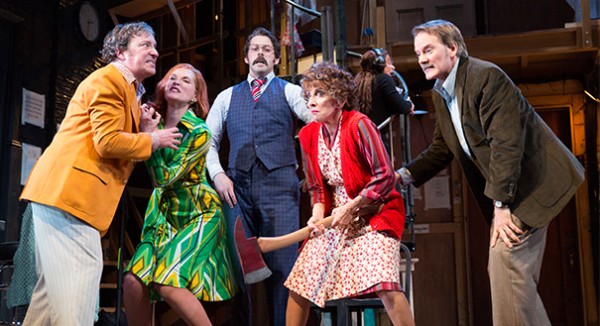
Riotous Roundabout revival of NOISES OFF goes behind the scenes of theater madness (photo by Joan Marcus)
American Airlines Theatre
227 West 42nd St. between Broadway & Eighth Ave.
Tuesday – Sunday through March 6, $67-$152
212-719-1300
www.roundabouttheatre.org
There’s a reason why so many critics consider Michael Frayn’s 1982 farce, Noises Off, one of the funniest plays ever written; it is a nonstop hilarious riff on the presentation of theater itself, and in its latest incarnation, a Roundabout revival at the American Airlines Theatre, it is performed with pinpoint precision timing that will have you gasping in admiration even as you nearly fall out of your chair laughing. The three-act romp begins as a small company is in its final tech rehearsal for the world premiere of Robin Housemonger’s sex comedy Nothing On before opening night at the Grand Theatre in Weston-super-Mare. (A fake program for the imaginary Nothing On is slipped inside the Noises Off Playbill to heighten the reality of the fictional play-within-a-play; Housemonger is credited with such previous works as Briefs Encounter and Socks Before Marriage.) Director Lloyd Dallas (Campbell Scott) has a lot on his plate: The actors can’t remember their lines, and his star, the aging doyenne Dotty Otley (Andrea Martin), is confused about where the sardines are. The fictional Nothing On itself is a wicked sendup of British country-house drama: Dotty is Mrs Clackett, elderly housekeeper for the Brent family’s country home, where dapper house agent Roger (David Furr as Garry Lejeune) is attempting a tryst on the sly with ditzy blonde bombshell Vicky (Megan Hilty as Brooke Ashton) while the owners, milquetoast nosebleeder Philip Brent (Jeremy Shamos as Frederick Fellowes) and his wife, the practical Flavia (Kate Jennings Grant as Belinda Blair), arrive for their own secret rendezvous (secret from Inland Revenue, that is; they are avoiding the scourge of the British upper class: income tax). Then a burglar (Daniel Davis as alcoholic has-been Selsdon Mowbray) arrives to add to the confusion. Doors are slammed, entrances are missed, doors are slammed, lines are botched, props are misused, and yet more doors are slammed. As evening turns into morning, the cast and crew — which also includes tense and nervous assistant stage manager Poppy Norton-Taylor (Tracee Chimo) and stage manager Tim Allgood (Rob McClure), who has a highly inappropriate last name — struggle to put it all together, for of course, the show must go on.
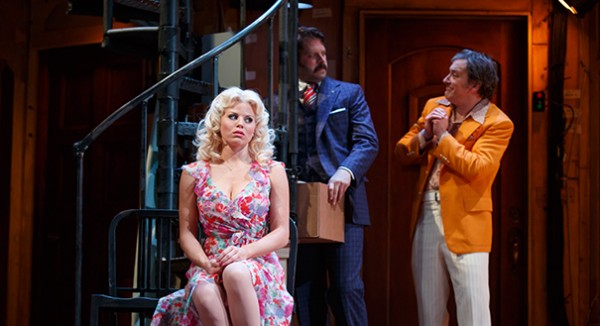
Megan Hilty nearly steals the show as pouty vixen Brooke Ashton at the American Airlines Theatre (photo by Joan Marcus)
The first act is set up as if the audience is watching the rehearsal of Nothing On; for the second act, the living room is flipped around so the audience sees it from the other side, revealing the backstage shenanigans one month later at the Theatre Royal in Ashton-under-Lyne. (The wonderful sets are by Emmy and Tony winner Derek McLane.) Frayn (Copenhagen, Benefactors) and director Jeremy Herrin (Wolf Hall Parts 1 & 2) now reveal the behind-the-scenes madness that goes on during the first act. The audience has already learned all of the cues, the entrances and exits, but witnessing it from this vantage point is utterly fascinating. The cast and crew’s secret liaisons slowly emerge, and the melodramatics escalate as they enter or leave the play-within-a-play, resulting in some riotous physical comedy while also getting a little too bogged down and repetitive. But all of that is necessary to make the third act one of the smartest and funniest you’ll ever have the pleasure to experience. The show is now concluding its tour at the Municipal Theatre in Stockton-on-Tees, where the company is once again performing the first act. Only this time, all of the actor’s quirks and failures, inside jokes and relationship problems from the first two acts collide in a delirious extravaganza of fun and nonsense worthy of John Cleese’s Fawlty Towers. Martin (Pippin, My Favorite Year), Davis (Wrong Mountain, Talking Heads), Furr (The Importance of Being Earnest, Accent on Youth), Jennings Grant (The Lyons, Proof), Hilty (Wicked, 9 to 5: The Musical), and Shamos (Clybourne Park, The Assembled Parties) do an exceptional job switching between their dual roles, with Martin in particular excelling and Hilty (who will not be performing February 12-14) nearly stealing the show with her squeaky voice and absurdly mannered body positions. (Noises Off debuted on Broadway in 1983 with Dorothy Loudon, Victor Garber, Brian Murray, Deborah Rush, Douglas Seale, and Amy Wright and was revived in 2001 with Patti LuPone, Peter Gallagher, Faith Prince, T. R. Knight, and Katie Finneran. The 1992 Peter Bogdanovich film starred Carol Burnett, Michael Caine, Christopher Reeve, John Ritter, Nicollette Sheridan, Denholm Elliott, Julie Hagerty, Mark Linn-Baker, and Marilu Henner.) Herrin does a marvelous job of maintaining the frenetic pace while allowing the characters to develop their unique personalities; he has a ball playing with the audience’s expectations, keeping everyone on the edge of their seat, both gaping in wonder and trying not to fall over in laughter. And through it all are those doors.
In “A Glimpse of the Noumenal,” a fake condensed essay from Eros Untrousered — Studies in the Semantics of Bedroom Farce that appears in the Nothing On program, JG Stillwater writes, “A recurring and highly significant feature of the genre is a multiplicity of doors. If we regard the world on this side of the doors as the physical one in which mortal men are condemned to live, the world or worlds concealed behind them may be thought of as representing both the higher and more spiritual plane into which the postulants hope to escape, and the underworld from which at any moment demons may leap out to tempt or punish. When the doors do open, it is often with great suddenness and unexpectedness, highly suggestive of those epiphanic moments of insight and enlightenment which give access to the ‘other,’ and offer us a fleeting glimpse of the noumenal.” This second Broadway revival of Noises Off — the title refers to offstage sounds — is chock full of epiphanic moments that are as noumenal as they are phenomenal, in more than just the Kantian meaning. It gives the audience an inside look at the potential catastrophes that await live theater, yet performed to near perfection in a joyful tribute to the glory of the stage.

 On November 4, 1995, Israeli prime minister Yitzhak Rabin was assassinated at the conclusion of a major peace rally in Tel Aviv. Israeli auteur Amos Gitai explores what led to, and followed, the tragedy in the tense and gripping Rabin, the Last Day. Gitai and cowriter Marie-José Sanselme combine archival footage of news reports, press conferences, political rallies, and public speeches with extensively researched re-created scenes of the killer, Yigal Amir (Yogev Yefet), loading his gun and, afterward, being interrogated, showing no remorse; of the Shamgar Commission, which conducted hearings to find out what went wrong with security and whether there was some kind of conspiracy; and of a small group of Israelis establishing a tiny settlement in Gaza. The film plays out like a procedural thriller with flashbacks as a radical right-wing rabbi tells his congregation that Rabin, who had signed the Oslo Accords and was negotiating with Yasser Arafat and the PLO about ceding parts of the Gaza Strip and the West Bank to the Palestinians, is subject to the Talmudic concept of din rodef (“the case of the pursuer”), marking the Nobel Peace Prize recipient for death; a psychiatrist (Dalia Shimko) declares that Rabin must be schizophrenic because of the decisions he is making; and a police officer (Gdalya Besser) gives information to a hungry press. Meanwhile, the Shamgar Commission chairman (Yitzhak Hiskiya) and two members (Pini Mittelman and Michael Warshaviak) question Rabin’s driver (Tomer Sisley) and bodyguard (Eldad Prywes), the director of the hospital (Tomer Russo) where Rabin was brought after the shooting, the intelligence officer (Shalom Shmuelov) in charge of security, and others as they attempt to uncover every detail of the horrific event to see if anything could have been done differently — and whether more people than just Amir were involved. However, when the name of GSS agent Avishai Raviv is raised, two commission lawyers (Ronen Keinan and Einat Weizman) suddenly stop the proceedings, declaring that anything relating to the secret operative is classified. Perhaps most frightening is the footage of rallies — led by then-Likud leader and now Israeli prime minister Benjamin Netanyahu — in which participants chant “Death to Rabin!” and hold up signs depicting Rabin dressed as a Nazi and as Arafat.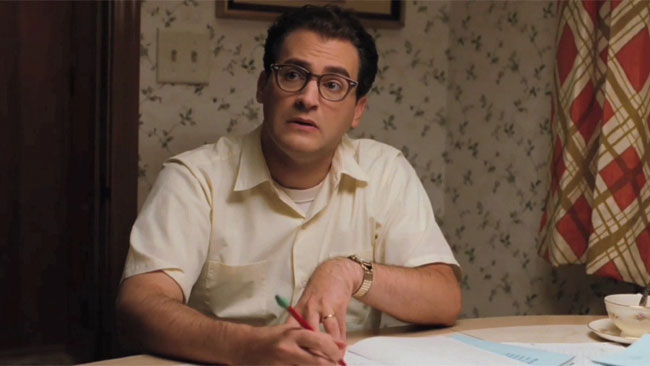
 The Coen brothers take their unique brand of dry, black comedy to a whole new level with A Serious Man. Poor Larry Gopnik (a remarkably even-keeled Michael Stuhlbarg) just keeps getting dumped on: His wife, Judith (Sari Lennick), wants to leave him for, of all people, touchy-feely Sy Ableman (Fred Melamed); his brother, Arthur (Richard Kind), keeps hogging the bathroom so he can drain his cyst; his son, Danny (Aaron Wolf), won’t stop complaining that F-Troop isn’t coming in clearly and is constantly on the run from the school drug dealer (Jon Kaminsky Jr.); his daughter, Sarah (Jessica McManus), wants to get a nose job; one of his students (David Kang) has bribed him for a passing grade; his possible tenure appears to be in jeopardy; and he gets no help at all from a series of funnier and funnier rabbis. But Larry keeps on keepin’ on in the Jewish suburbs of Minnesota in 1967, trying to make a go of it as his woes pile higher and higher. Joel and Ethan Coen have crafted one of their best tales yet, nailing the look and feel of the era, from Hebrew school to Bar Mitzvah practice, from office jobs to parking lots, from the Columbia Record Club to transistor radios, from television antennas to the naked neighbor next door. The Coens get so many things right, you won’t mind the handful of mistakes in the film, and because it’s the Coens, who’s to say at least some of those errors weren’t intentional? A Serious Man is a seriously great film, made by a pair of seriously great filmmakers. And while you don’t have to be Jewish and from Minnesota to fall in love with it, it sure can’t hurt.