Who: Emily Conlon, Sevrin Willinder What:Shakespeare Translate: The Complete Works Where:Caveat, 21A Clinton St. between East Houston & Stanton Sts., 212-228-2100 When: Sunday, December 1, $10 livestream, $18 in advance, $23 at door, 2:30 Why: In Hamlet, the title character says about a troupe of traveling actors, “He that plays the king shall be welcome. His majesty shall have tribute of me. The adventurous knight shall use his foil and target, the lover shall not sigh gratis, the humorous man shall end his part in peace, the clown shall make those laugh whose lungs are tickle o’ th’ sere, and the lady shall say her mind freely, or the blank verse shall halt for ’t. What players are they?”
Shakespeare included clowns or fools in most of his works, including Costard in Love’s Labours Lost, Dogberry in Much Ado About Nothing, the two Dromios in The Comedy of Errors, Feste in Twelfth Night, Lavache in All’s Well That Ends Well, Puck in A Midsummer Night’s Dream, and the fool in King Lear. On December 1 at Caveat, clowns Emily Conlon and Sevrin Willinder will present “Shakespeare Translate: The Complete Works,“ in which they will perform their favorite excerpts from every single play by the Bard, using original text that has been filtered through Google Translate fifteen times to give it a more contemporary feel; the show is directed by Melissa Ingle. Conlon describes herself as “a Brooklyn-based actor, singer, voice actor, and goofball,” while Willinder “is a ravishing young lad from Plympton, Massachusetts.” Advance tickets are $18, at the door $23; the performance, from Devon Loves ME! Productions, which was cofounded by Willinder, is also available via livestream for $10.
As Touchstone, the court jester, says in As You Like It, “The fool doth think he is wise, but the wise man knows himself to be a fool.” Find out more at Caveat (or online) on Sunday afternoon.
[Mark Rifkin is a Brooklyn-born, Manhattan-based writer and editor; you can follow him on Substack here.]
Introducing a press rehearsal of two scenes from Igor Golyak and Arlekin Players Theatre’s adaptation of The Merchant of Venice at Classic Stage, producer Sara Stackhouse said, “Igor directed a very early iteration of this — this is quite different — but it was the DNA of this version of The Merchant of Venice. It was hilarious, and devastating, in Boston. It was like a punch in the face to antisemitism, and there were a lot of folks at that time who said to us, ‘Why are you doing a play on antisemitism? Why are you doing a Jewish play?’ One of the things that I have found working with incredible artists, Igor being one of them, is the way they feel the undercurrent of what is happening in the world all the time, and often ahead of time, and begin to bring it to the surface in artistic projects. That has been true for all the project I’ve done with Igor and through Arlekin. Unfortunately, it has come further and further and further to the surface not only in the art we’re making but also in the world. So we’re now doing this version of The Merchant of Venice in the context of October 7 and what happened in Amsterdam and the election and a real rise in hatred and antisemitism in the world. That canary in the coal mine — there’s no mine now; it’s like a canary flying out around the world. But one of the ways that actual humans respond to tragedy is they don’t sit and cry; they try to laugh; they try to survive. So this play is a comedy, and it’s a blast until it’s devastating.”
Boston-based Arlekin continues its residency at Classic Stage with The Merchant of Venice, following its highly acclaimed staging of Polish playwright Tadeusz Słobodzianek’s 2008 drama, Our Class, which was inspired by a horrific 1941 pogrom that occurred in the small village of Jedwabne in Poland. Running November 22 to December 22, the uniquely unpredictable work is built around a cable access program that is putting on the play, complete with low-budget foibles, casting controversies, and technical glitches. T. R. Knight stars as the host of The Antonio Show, with Richard Topol as Shylock, Alexandra Silber as Portia, Gus Birney as Jessica, Tess Goldwyn as Nerisa, José Espinosa as Bassanio, Stephen Ochsner as Launcelot Gobbo, and Noah Pacht as Lorenzo. At one point, Shylock puts on a Dracula costume, a funny yet incisive way to demonize the character who famously declares, “If you prick us, do we not bleed?”
“The first Quarto published in 1600 titled this play The most excellent historie of the merchant of Venice with the extreame crueltie of Shylocke the Jewe towards the sayd merchant, in cutting a just pound of his flesh: and the obtayning of Portia by the choyse of three chests. That’s a mouthful,” Golyak, who was born in Kyiv and came to America as a Jewish refugee when he was eleven, said in a statement. “It casts Shylock as a cruel villain and sets the expectation of a love story, a comedy, and a ruinous tragedy all wrapped into one. We are true to this in our production and we deliver all of it — an undercurrent of bias, a comedy, romance, action, and escapades — a real romp of a performance. But antisemitism is a light sleeper, and as the story plays out, it inevitably awakens and the result is devastating. It mirrors who we are, the times we live in, and how quickly the tides can turn.”
Rich Topol stars as Shylock and José Espinosa is Bassanio in Arlekin’s Merchant at Classic Stage (photo by twi-ny/mdr)
“The more antisemitism rises in the world, the more people are hating on the Jews, the more Jewish I feel,” Golyak, whose great-grandparents were killed at Babi Yar, recently wrote. “But the play, and Jewish life, and this world are devastating. I’m shattered like glass. In sooth, as an artist, as a parent, as a Jew, and as a human, I guess I do know why I am so sad.”
“It’s a wild ride,” Golyak also noted about the play.
Judging from what I saw at the rehearsal — you can get a sneak peek here — it’s a wild ride we all need to take.
[Mark Rifkin is a Brooklyn-born, Manhattan-based writer and editor; you can follow him on Substack here.]
Peter Gallagher and Juliana Margulies star in Delia Ephron’s Left on Tenth (photo by Joan Marcus)
One of the most fun parts of being a theater critic is engaging with your fellow stage pundits. We greet one another before and after shows and during intermissions, discussing what we’ve seen lately that we’ve liked — and what we haven’t.
We have an unofficial community on social media, where we post our reviews and comment on those of others. While some appreciate different opinions, acknowledging that we all approach theater with personal biases, both conscious and unconscious, others are more insistent that their take is right and anyone who disagrees got it wrong.
One particular critic becomes dismayed on those rare occasions when she and I actually agree on a show.
Like I said, it’s fun.
But it can become disheartening when you find yourself on the opposite side of the fence from nearly all of your respected colleagues, which has happened to me often these last few extremely busy weeks.
I was charmed and delighted by author and screenwriter Delia Ephron’s Left on Tenth at the James Earl Jones Theatre, her adaptation of her 2022 memoir about finding love at the age of seventy-two shortly after losing her husband, Peter Kass, and right before finding out she has acute myeloid leukemia (AML). Julia Margulies stars as Delia, who often breaks the fourth wall and talks directly to the audience. Speaking of her childhood, she explains early on, “Every time I said something funny, my dad shouted, that’s a great line write it down. All four of us sisters grew up to be writers. But my parents were also angry alcoholics. My childhood was scary, often violent. With Jerry, I found my first true home. My first safe place. Now he wasn’t going to be here . . . Now . . . what?”
After writing an article in the Times about the trouble she had reconnecting online when Verizon canceled Jerry’s landline and, mistakenly, her internet access, she is contacted by Peter Rutter, a Jungian psychoanalyst who had briefly dated her in college, even though she does not remember him. Peter is elegantly portrayed by the ever-handsome Peter Gallagher. They rekindle their once-upon-a-time almost-relationship with passion and excitement — yes, older people can get hot and heavy — and he stands by her when she is hospitalized and things look bleak.
The play is directed by five-time Tony winner Susan Stroman and features Peter Frances James and Kate MacCluggage as multiple characters who make unbelievably fast costume changes. Although the show does get treacly, there was more than enough quality scenes for me to recommend it. My colleagues have not been kind to the play, writing, “Left on Tenth has the energy and the color scheme of a drugstore greeting card,” “Left on Tenth, billed as a romantic comedy, only fulfills half that description,” and “more suitable to the Hallmark Hall of Fame than Broadway.”
Although I don’t think so, perhaps my longtime admiration of Gallagher got in the way of my judgment? Thirty years ago, my wife and I moved into an apartment that was previously owned by him. (There was a lawyer in between who purchased it but never lived there, selling it to us.)
About twenty years ago, I met Gallagher at Powerhouse Theater’s annual New York Stage & Film benefit in Manhattan. Standing behind him, I said my address out loud so he could hear me. He whipped around and barked, “Who are you!” I calmed him down and explained that I now was in that apartment and told him that we occasionally still received junk mail for him. We talked about some of the unique advantages to the place. He then turned serious.
“You have to promise me something,” he said. “What?” I asked. Peter: “Is the yellow bookcase in the hall still there?” Me: “Yes.” Peter: “Promise me you’ll never take it down.” Me: “Why?” Peter: “Because I built in with my own two hands.”
I couldn’t help but think of that bookcase as I entered the James Earl Jones Theatre and saw that Beowulf Borritt’s main set is anchored by a gorgeous, filled-to-the-brim semicircular bookcase in Delia’s apartment. (It switches between that room, a restaurant, and the hospital where Delia is treated.) Books are discussed throughout the hundred-minute play; having worked my entire career in children’s and adult publishing, that was another plus for me, especially because it got the details of the industry right, which is rarely the case in theater, TV, and movies.
However, four other shows left me cold and dry, awash in disappointment.
Cousins Simone (Kelly McCreary) and Gigi (Pascale Armand) try to reconnect in Dominique Morisseau’s Bad Kreyòl (photo by Matthew Murphy)
Over at the Signature, I was all set for Dominique Morisseau’s Bad Kreyòl, a coproduction with Manhattan Theatre Club that has been extended through December 1. The Detroit native has been on a thrilling roll with Pipeline in 2017, Paradise Blue in 2018, Skeleton Crew and Confederates in 2022, and Sunset Baby earlier this year. Maybe it was a bad night — critics generally have several performances to choose from, so they are not seeing the same exact show — but Bad Kreyòl felt like a work-in-progress, unfinished, its characters not yet fully developed.
Simone (Kelly McCreary), a Haitian American, is returning to the island for the first time in thirty years, staying with her cousin Gigi (Pascale Armand), who runs a boutique with the help of Pita (Jude Tibeau), a gay restavek whose rural family sent him to the city when he was a child in order to get an education and learn a trade. Simone is concerned that the restavek system means Pita is more like an indentured servant; she is also worried about Lovelie (Fedna Jacquet), who sews pillows, ties, scarves, and other items for an import-export company run by Thomas (Andy Lucien), who might be ignoring how women workers such as Lovelie are being abused by one of his male employees. Simone, Gigi, and Pita feel out of place in their dangerous country; they run into trouble as they try to firmly establish their identities and decide what they want out of life.
The night I went, the Irene Diamond Stage at the Signature was about half empty. The audience was almost too quiet during the show’s two hours and fifteen minutes (with intermission) as jokes fell flat and key moments flirted with clichés. Directed by Tiffany Nichole Greene, the play felt muted, lacking energy; I was more interested in the person sitting off to the side who kept taking photos and short videos of the drama.
Meanwhile, here’s what some of my colleagues had to say: “an illuminating reminder that Haiti and its people are much more than just bad headlines,” “a story told with care and intelligence, both warm-hearted and sharp-eyed,” and “confirms her as one of our most consistently interesting playwrights; where will she take us next?”
A young, energetic cast appears in the Lazours’ We Live in Cairo(photo by Joan Marcus)
In the early 2010s, I saw Stefano Savano’s intense documentary Tahrir: Liberation Square and Jehane Noujaim’s powerful fiction film The Square, extraordinary works about the 2010 Arab Spring in Egypt. So I was excited for New York Theatre Workshop’s We Live in Cairo, a musical by Daniel and Patrick Lazour, directed by Taibi Magar, that follows a group of twentysomethings risking their freedom and safety as they carefully take part in the resistance against President Hosni Mubarak and the Muslim Brotherhood during the revolution of 2011.
The score, performed by an onstage band, is sensational, and Tilly Grimes’s ramshackle set is evocative, as are David Bengali’s street-art projections. But the lyrics and staging are too plain, and the acting is merely standard — and I don’t know what I was going to do if one more character ran out in a tizzy through the door at stage left. At two and a half hours with intermission, the show is too long; perhaps it would have been more effective if it had been condensed into a streamlined ninety minutes.
While We Live in Cairo did not receive across-the-board raves, here are some of the favorable quotes from professional reviewers: “a welcome blast of excitement and intelligence,” “underscores the appeal, the importance — and the fragility — of democracy,” “pulses with the promise and enthusiasm of idealistic youth,” and “the most hypnotic, moving, and unique original score so far this year!”
Erika Sheffer’s Vladimir traces one journalist’s attempts to take on Putin (photo by Jeremy Daniel)
Although it closed November 10, MTC’s Vladimir also baffled me. The first act was so unsatisfying that I told my guest that I wouldn’t mind if she went home, but I had to stay for the second act, as is my responsibility. She stayed, and the second act was significantly better, but not enough so to recommend it.
Erika Sheffer’s play was inspired by the real-life story of Russian journalist Anna Politkovskaya, who continued to write negative reports about new Russian president Vladimir Vladimirovich Putin and his government even after she was poisoned. Mark Wendland’s overdesigned set with seemingly endless screens makes you wonder where you should be looking. Francesca Faridany is fine as Raya, but the rest of the cast — two-time Tony winner Norbert Leo Butz, Erin Darke, Erik Jensen, David Rosenberg, and Jonathan Walker — have trouble finding their way through numerous scenes, as Tony-winning director Daniel Sullivan attempts to figure out the convoluted stage. Everything becomes more assured after intermission, although a few of the key subplots border on the absurd.
What did my colleagues think? “Vladimir, beyond many other excellent qualities, feels distressingly current,” “as tough and uncompromising a piece of writing to be seen on a New York stage right now,” “accumulates enough awful truth to leave you sore and shaken,” and “Francesca Faridany and Norbert Leo Butz are towering in this Stoppardian Moscow-set drama.”
Darren Criss and Helen J Shen play Helperbots who fall in love in Maybe Happy Ending (photo by Matthew Murphy and Evan Zimmerman)
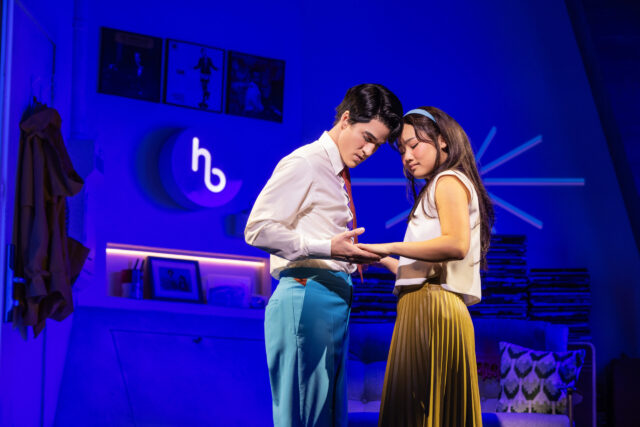
Which brings me to the reason I decided to write about this in the first place: Maybe Happy Ending. The instant-smash musical is about two retired Helperbots, Oliver (Darren Criss), a model 3, and Claire (Helen J Shen), the later model 5. They live across the hall from each other in a Seoul apartment complex where they are left to eventually power off forever. They meet-cute when Claire knocks on Oliver’s door because her charger is broken and can’t be fixed — replacement parts for both HBs are disappearing, so it’s clear, and very sad, that their time is limited, just like that of humans. “We have a shelf life, you know that,” Claire explains. “It’s the way that it has to be.”
When Oliver decides to return to his previous owner, James (Marcus Choi), he is joined by Claire for a road trip to Jeju Island; he is sure that James has been waiting years for him to come back because he needs him, while she wants to see the last colony of fireflies on the planet.
Director Michael Arden’s staging is nothing short of spectacular on Dane Laffrey’s magical set. Rectangular boxes open and close on a black screen, revealing the HBs’ differently decorated apartments similar to the way silent films irised in and out of scenes. Red LED lines stream across the screen. Crooner Gil Brentley (Dez Duron) rises from below to sing jazzy tunes. Round shapes are everywhere, representing the circle of life (for robots and humans), from windows, Claire’s soft and pillowy chair, and the moon to the HB logo, images on jazz posters, and Oliver’s beloved records, which he plays on an old-fashioned turntable. It might be 2064, but it’s jam-packed with nostalgic elements from the twentieth century, while George Reeves’s projections are filled with magic.
So why were my guest and I supremely bored through most of the show’s 105 minutes? The book, by Will Aronson and Hue Park, is littered with gaping plot holes that drain the narrative, while the music, by Aronson, and the lyrics, by Park, are more saccharine than sweet. Criss and Shen do an admirable job as the HBs, the former stiff and steady, the latter freewheeling, referencing how technology, especially AI, is becoming more human and personable. But I was not able to get past the numerous shortcomings and found the Brentley character wholly unnecessary and distracting.
Alas, nearly every other reviewer has been gushing with effusive praise: “In its gentle robot way, it helps us see ourselves through freshly brushed eyes,” “an undeniably moving, well-made, adorable musical,” “rapturous music and lyrics,” “an original show, charmingly acted and cleverly staged, with a touching take on love,” and “visually stunning, it epitomizes the journey of appreciation of the human world.”
Of course, when it comes right down to it, I’m right and they’re wrong, as any critic worth his salt should claim, even if, in some cases, I’m alone in, as HB3 calls it, “the world within my room.”
How’s that for a maybe happy ending?
[Mark Rifkin is a Brooklyn-born, Manhattan-based writer and editor; you can follow him on Substack here.]
WALDEN
Second Stage Theater
Tony Kiser Theater
305 West Forty-Third St. between Eighth & Ninth Aves.
Tuesday – Sunday through November 24, $52-$92 2st.com/shows
One of the best plays of the pandemic was TheaterWorks Hartford’s August 2021 hybrid production of Amy Berryman’s Walden. The play, which explores the dangers of climate change and the future of the planet as seen through the eyes of twin sisters, made its world premiere in May 2021 at the Harold Pinter Theatre in London; TheaterWorks Hartford recast it and staged it in a specially constructed wood-and-glass cabin on the edge of the woods by the Connecticut River, at a location appropriately known as Riverfront Recapture. It doesn’t get much more Thoreau-like than that.
In a March 1845 letter to his close friend Henry David Thoreau, American Transcendentalist poet William Ellery Channing wrote, “Go out upon that, build yourself a hut, & there begin the grand process of devouring yourself alive. I see no other alternative, no other hope for you.” A few months later, on July 4, Thoreau moved into a hut in a forest by Walden Pond in Concord, Massachusetts, living off the land for two years.
In his 1854 book, Walden; or Life in the Woods, Thoreau explained, “I went to the woods because I wished to live deliberately, to front only the essential facts of life, and see if I could not learn what it had to teach, and not, when I came to die, discover that I had not lived. I did not wish to live what was not life, living is so dear; nor did I wish to practice resignation, unless it was quite necessary. I wanted to live deep and suck out all the marrow of life, to live so sturdily and Spartan-like as to put to rout all that was not life, to cut a broad swath and shave close, to drive life into a corner, and reduce it to its lowest terms, and, if it proved to be mean, why then to get the whole and genuine meanness of it, and publish its meanness to the world; or if it were sublime, to know it by experience, and be able to give a true account of it in my next excursion.”
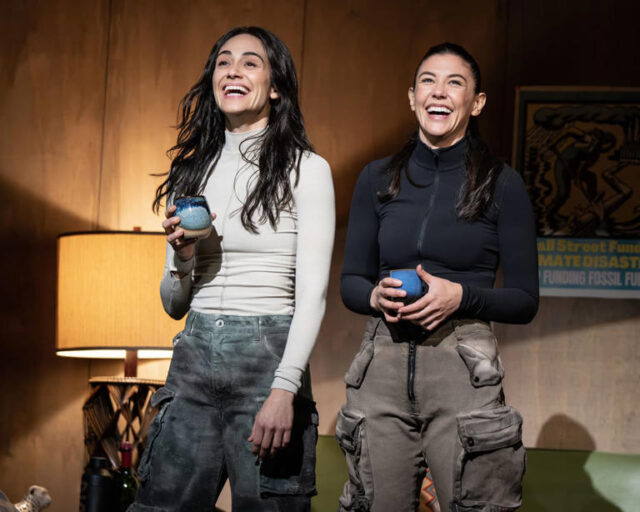
The play, continuing at Second Stage’s Tony Kiser Theater through November 24, is inspired by but not based on Thoreau’s experience. It takes place on Matt Saunders’s large-scale, one-story aluminum shed, with solar panels and a sustainable vegetable garden. Bryan (Motell Foster) and Stella (Emmy Rossum) live together in this wilderness; he is a staunch EA (Earth Advocate), a radical movement that believes the government must exhaust all possibilities of saving the planet before considering establishing habitats on the moon or Mars. Stella is a former prominent NASA architect who is adapting to her more private life with Bryan; although Bryan refuses to look at screens, Stella follows the news on a portable device. Bryan recently lost his beloved brother, while Stella’s estranged twin sister, Cassie (Zoë Winters), is visiting them after having spent a year in space as part of the Moon Habitat Team. Their father, James Ryan, was a famous astronaut who wanted his daughters to follow in his footsteps; it’s no coincidence he named one Stella, which means “star,” and the other Cassiopeia, after the constellation.
There’s a mega-tsunami crossing America, and more than a million people are believed to be missing or dead. While Bryan, with Stella’s support, wants to stay and fight climate change on Earth, Cassie insists the only path for survival is on Mars, where NASA wants her to lead a critical mission.
Cassie explains, “Here we are, at a precipice, our population is in grave danger, and the EA movement isn’t what’s going to save us; investing in a place far away is what will save us. And it’s the next step — it’s about innovation, it’s about adventure, and learning —”
Bryan argues, “Adventure? NASA finally was able to sucker our politicians into the palm of their hands, completely changed the course of our future, put all that money into ‘habitation’ — is that the word they want you to use? — put all that money into habitation when it could be spent — I don’t know — solving the water crisis? But no, let’s colonize for the ‘adventure’ of it — are you kidding me?”
As they fight over their personal futures and that of human civilization itself, the characters dig up long-held resentments that threaten to tear apart their relationships as the tsunami gets closer.
Berryman (Alien Girls,The Whole of You) smartly dances around preachy didacticism in making her points while leaving the fate of our big blue marble up in the air. The play is sharply directed by Tony winner Whitney White (Jaja’s African Hair Braiding,On Sugarland), taking no sides as the three characters engage in psychological battle. Lee Kinney’s sound design immerses the audience in the tonal diversity of nature, from the lively songs of insects and animals to a torrential storm.
Foster (Othello,) is a commanding presence as Bryan, a strong, proud man dealing with extreme grief, determined to push on as his brother would have wanted him to. The consistently excellent Winters (Heroes of the Fourth Turning,4000 Miles) is superb as Cassie, a woman who has sacrificed her personal life for the welfare of the human race, and Rossum (Shameless,The Phantom of the Opera) makes a sparkling debut as Stella, a deeply conflicted woman who is vulnerable but perhaps not as fragile as one might think as she contemplates bringing a child into this endangered planet.
Defending Bryan, Stella tells Cassie, “EAs believe small actions add up,” to which her sister replies, “Not enough to turn things around.”
Is it too little, too late?
As Thoreau wrote in Walden, “Not till we are lost, in other words, not till we have lost the world, do we begin to find ourselves, and realize where we are.”
[Mark Rifkin is a Brooklyn-born, Manhattan-based writer and editor; you can follow him on Substack here.]
Christian Marclay’s twenty-four-hour masterpiece, The Clock, unfolds in real time (photo courtesy Paula Cooper Gallery and White Cube)
CHRISTIAN MARCLAY: THE CLOCK
MoMA, the Museum of Modern Art
11 West Fifty-Third St. between Fifth & Sixth Aves.
Through February 17, $17-$30 www.moma.org
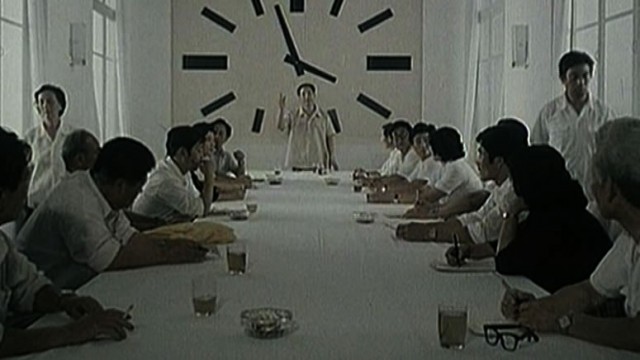
In 2010, the Whitney presented “Festival,” a thrilling interactive retrospective of the work of Christian Marclay, featuring multiple multimedia site-specific installations and live performances. The New York–based multidisciplinary artist followed that up with a supreme work of utter brilliance, the captivating twenty-four-hour video The Clock, which premiered at White Cube in London, then won the Golden Lion at the Venice Biennale. Over the years in New York it has screened at the Paula Cooper Gallery, the David Rubenstein Atrium at Lincoln Center, and in 2012–13 at the Museum of Modern Art; it is now back at MoMA, where this must-see experience will be on view through February 19. “I can’t believe a decade has gone by since The Clock was last shown at MoMA,” Marclay said in a statement. “We’ve all aged except the actors on the screen, who never age. They may die but on the screen they live forever.”
Time is of the essence in Christian Marclay’s dazzling film The Clock (photo courtesy Paula Cooper Gallery and White Cube)
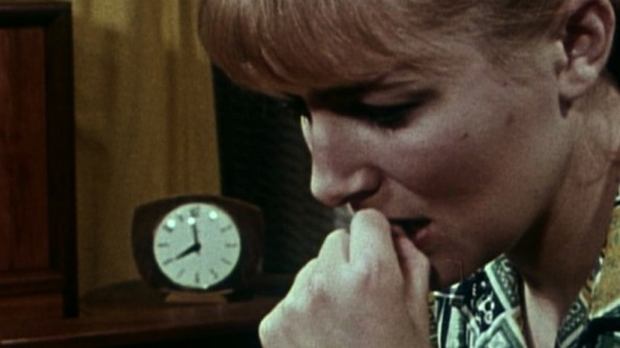
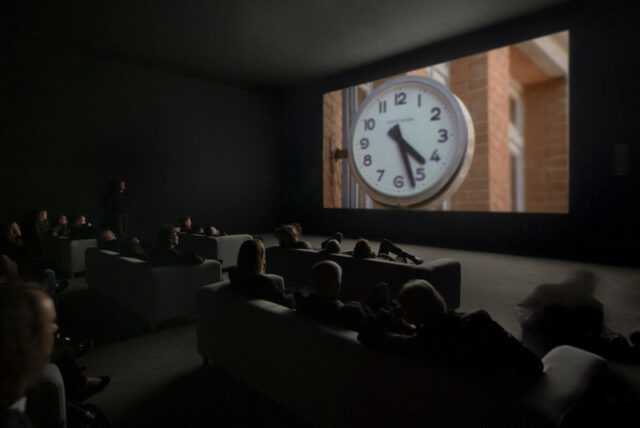
The film, always presented in a large, dark space with roomy, comfortable seats, unfolds in real time, composed of approximately twelve thousand clips from movies and television that feature all kinds of timepieces showing the minutes ticking away. Masterfully edited so that it creates its own fluid narrative, The Clock seamlessly cuts from romantic comedies with birds emerging from cuckoo clocks to action films in which protagonists synchronize their watches, from thrillers with characters battling it out in clock towers to dramas with convicted murderers facing execution and sci-fi programs with mad masterminds attempting to freeze time. Marclay mixes in iconic images with excerpts from little-known foreign works so audiences are kept on the edge of their seats, wondering what will come next, laughing knowingly at recognizable scenes and gawking at strange, unfamiliar bits.
Christian Marclay’s The Clock premiered at White Cube Mason’s Yard in London in 2010 (photo by Todd-White Photography)
Part of the beauty of The Clock is that while time is often central to many of the clips, it is merely incidental in others, someone casually checking their watch or a clock visible in the background, emphasizing how pervasive time is — both on-screen and in real life. Americans spend an enormous amount of time watching movies and television — and now addictively glued to social media platforms and videos on their phones — so The Clock is also a wry though loving commentary on what we choose to do with our leisure time as well.
The Clock is open during MoMA’s regular hours, with members getting priority. It is not necessarily meant to be viewed in one massive gulp, but it will be shown in its entirety on December 21 at 7:00, in conjunction with the Winter Solstice, and again on New Year’s Eve; ticketing will be announced soon. Since the film corresponds to the actual time, midnight should offer some fascinating moments, although you might be surprised how exciting even three o’clock in the morning can be. Expect huge crowds whenever you go — capacity is limited, on a first-come, first-served basis, and you can stay as long as you want — so be prepared to do something with all that valuable time spent on the digital line. But wait you should — it’s well worth every second.
[Mark Rifkin is a Brooklyn-born, Manhattan-based writer and editor; you can follow him on Substack here.]
Nicole Scherzinger sizzles as Norma Desmond in Sunset Blvd. revival (photo by Marc Brenner)
SUNSET BLVD.
St. James Theatre
246 West Forty-Fourth St. between Broadway & Eighth Aves.
Tuesday – Sunday through July 6, $59-$424 sunsetblvdbroadway.com
In 2017, the most memorable part of Lonny Price’s Broadway revival of Andrew Lloyd Webber’s Tony-winning Sunset Boulevard took place offstage, when, just before curtain, Hillary Clinton arrived and sat in the orchestra, receiving a standing ovation. It had been less than a month since Donald Trump had taken the oath of office as the newly elected president of the United States, having defeated Clinton in the Electoral College (but not in the popular vote). Close had supported Clinton’s run, so the moment was a palpable one, especially at a show about a woman hell-bent on making a comeback.
The most memorable parts of Jamie Lloyd’s current revival also take place offstage. The second act begins with Tom Francis, who plays screenwriter Joe Gillis, emerging from his dressing room at the St. James Theatre — where he was watching Billy Wilder’s 1950 film version — then descending several flights of stairs, greeting members of the cast and crew, and heading outside to perform the title song while walking down Forty-Fourth St. and across Shubert Alley before returning to the theater with the ensemble behind him.
The other occurred when Nicole Scherzinger, who stars as Norma Desmond in the musical, responded to an Instagram post by Russell Brand on election night in which the Trump-supporting English comedian waved a red MAGA-style cap with the words “Make Jesus First Again” on it, asking where she could get that hat. A media firestorm erupted — how dare a Broadway actress possibly support Trump! — and Scherzinger ultimately deleted the comment and apologized, explaining that she was not taking political sides but sharing her beliefs in love, faith, and Jesus.
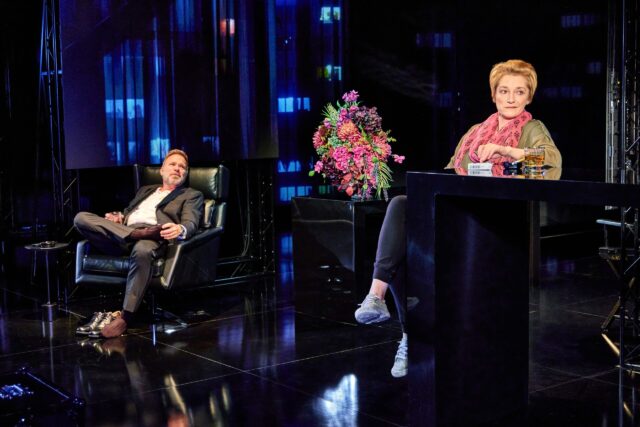
Okay, so what about what happens onstage? Well, it’s a confusing barrage of ear-piercing music and a giant screen that tries to make you forget how disappointingly mediocre the show is, although Scherzinger is electrifying.
Tom Francis, who plays Joe Gillis, operates a live-feed camera at the St. James Theatre (photo by Marc Brenner)
The plot takes a backseat to Lloyd’s overwrought staging, but it’s in there. Norma was a silent film star who has not made the transition to talking pictures; she’s holed up in her mansion, where her butler, Max Von Mayerling (David Thaxton), attends to her every need and fiercely defends and supports her. She is writing a script that she is sure Hollywood impresario Cecil B. DeMille (usually played by Shavey Brown, though I saw understudy Brandon Lavar) will make, returning her to the limelight.
Joe is a broke hack pitching his original screenplay, called Bases Loaded, to producer Sheldrake (Tyler Davis), whose assistant, Betty Schaefer (Grace Hodgett Young), is a fan of his and offers to help him. Betty is engaged to Joe’s friend and fellow screenwriter, Artie Green (Diego Andres Rodriguez). On the run from a pair of repo men who are after his car, Joe soon finds himself at Norma’s home, working with her on her screenplay (and in the bedroom), getting paid handsomely for his efforts. The narrative takes a dramatic shift when Norma and Joe visit DeMille at Paramount to discuss her movie.
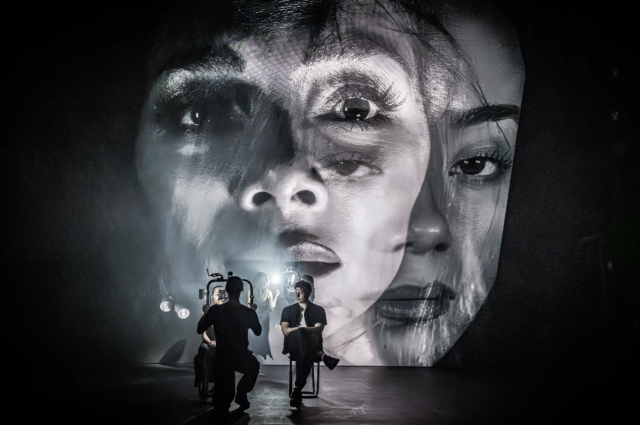
Soutra Gilmour’s dark, bare set is often immersed in smoke, referring to both the cigarettes that were so prevalent in films noir as well as the hell that Norma and Joe are living in. Lloyd gets carried away with one of the greatest lines in cinema history; when Norma says, “I am big. It’s the pictures that got small,” it stands in stark contrast to the twenty-three-foot-tall screen on which the characters are too often projected. There are just so many nostril shots that one can forgive. (The in-your-face live video is designed by cinematographers Nathan Amzi and Joe Ransom.)
It is odd that the screen lowers at an angle, not straight up and down. It is even odder that in order to get the shots, camera operators with equipment strapped across their bodies, looking completely alien in what is supposed to be old-time Hollywood, crowd the stage; the actors don’t play to the audience but to the cameras. At times, if you watch the screen, it appears that Joe is speaking directly with Norma, but in actuality they are facing different directions on the set.
Multimedia Sunset Blvd. revival makes it hard for the audience to know where to look (photo by Marc Brenner)
This hybrid approach — Lloyd opens and closes the show with movielike credits projected on the screen — sacrifices theatrical elements in favor of cinematic effects that drain scenes of power, as if admitting that this is a flawed musical that can’t stand on its own. In honoring the movie version in this way, it is also a constant reminder that Thaxton is not Erich von Stroheim, Francis is not William Holden, and Scherzinger is not Gloria Swanson. The film, written by Wilder and Charles Brackett, is a masterpiece about the fickle Hollywood studio system and the allure, and cost, of fame and fortune. Two-time Tony nominee Lloyd is a minimalist who has directed exemplary versions of Cyrano de Bergerac,Betrayal, and A Doll’s House as well as the visually stunning The Effect. But he gets caught in the middle with Sunset Blvd. — he has abbreviated the second word of the title, as if emphasizing his minimalism while also acknowledging the way the title first appears in the film — leaving fans of the musical and the movie scratching their head.
Sunset Boulevard has what is considered one of Lloyd Webber’s best scores, but that doesn’t mean it’s exceptional. There’s not much anyone can do to save such clunkers as “Let’s Have Lunch,” “Every Movie’s a Circus,” and “This Time Next Year,” although Thaxton nails “The Greatest Star of All,” and Scherzinger sizzles on “With One Look” and “As If We Never Said Goodbye,” receiving scattered show-stopping applause. The book and lyrics, by Don Black and Christopher Hampton, are fraught with underdeveloped characters and clichés even as they try to remain faithful to the movie. Fabian Aloise’s choreography is daring, performed by a talented ensemble; most poignantly, Hannah Yun Chamberlain plays a younger version of Norma, occasionally echoing her movement as the older Norma recalls her past success. Gilmour dresses the full troupe in black-and-white costumes, furthering the noir feel, along with Jack Knowles’s lighting and Adam Fisher’s sound.
Scherzinger (Guys and Dolls,Chicago), former lead singer of the girl group the Pussycat Dolls, firmly steps into a role previously performed by Rita Moreno, Betty Buckley, Patti LuPone, Diahann Carroll, and Petula Clark, availing herself well. She’s a camp vamp version, wearing the same long, slinky black dress through the whole show, barefoot, contorting her face and body as she glides across the stage. At forty-six she’s equivalent in age to Close, who was forty-seven the first time she played the part, and to Swanson, who was fifty when she made the film. Scherzinger is a determinedly sexier Norma, who is still mad from the start, creating a compelling dichotomy. I’m not sure that’s enough to recommend the show; the night I went, when the audience erupted into a thunderous, extended ovation during the curtain call, my friend and I couldn’t help but wonder whether they saw the same musical that we did.
I also still have trouble with the final minute, when Norma delivers one of the greatest closing lines in cinema history — and Lloyd Webber follows it with a brief reprise of “With One Look.”
No. Just no, regardless of who this Norma might have voted for.
[Mark Rifkin is a Brooklyn-born, Manhattan-based writer and editor; you can follow him on Substack here.]
Ani (Deirdre Lovejoy) and Jen (Donnetta Lavinia Grays) go about their jobs in different ways in Sarah Mantell’s latest play (photo by Valerie Terranova)
IN THE AMAZON WAREHOUSE PARKING LOT
Playwrights Horizons, Mainstage Theater
416 West 42nd St. between Ninth & Tenth Aves.
Through November 17, $62.50 – $102.50 www.playwrightshorizons.org
The unofficial motto of the US Postal Service is “Neither snow nor rain nor heat nor gloom of night stays these couriers from the swift completion of their appointed rounds.” The quote was taken from The Persian Wars by Herodotus, who is alternately known as the Father of History and the Father of Lies.
In Sarah Mantell’s Susan Smith Blackburn Prize–winning In the Amazon Warehouse Parking Lot, in the aftermath of an unnamed apocalyptic event, there is no more post office, no stores, only a society hanging on by a thread. All that is left are scattered people and — Amazon. Thanks, Jeff Bezos.
The play begins in an Amazon warehouse, where Jen (Donnetta Lavinia Grays) is taking packages off a conveyor belt. She is surprised when a new employee, Ani (Deirdre Lovejoy), shows up to work replacing Chris, the outbound supervisor. We never learn what happened to Chris; in this America, set only one generation in the future, people disappear without explanation.
As Jen places the boxes in vertical metal carts, she calls out the names on their address labels: “Flagstaff, Arizona.” “Carvers, Nevada. Oh that’s good. Wasn’t sure I’d see Nevada again.” “Rutland, New Hampshire.” “Greensboro, that’s a good one too. Haven’t gotten much North Carolina in a while.”
When Ani does not call out the names of the cities where her packages are going, Jen gets upset. “If you don’t read the labels, how will you know what’s going on out there?” she asks. Ani ignores her.
Jen also works shifts with El (Sandra Caldwell), who does call out the addresses. They see a package that seems to be addressed to Ash’s (Tulis McCall) cousin, in Ohio, and they memorize the exact location because writing it down is forbidden; they are subject to random searches by security guards. It slowly becomes evident why the addresses and the existence of other states, cities, and towns are so important.
When they’re not on the line, the crew of seven — Jen, Ani, El, Ash, Horowitz (Barsha), Sara (Ianne Fields Stewart), and Maribel (Pooya Mohseni), all queer women, nonbinary, or trans — gather outside by a highway next to a stunning mountainous landscape. They talk about work, share food, play a game called Werewolf, wonder what their coworkers might have done for a living in the before times, and recall moments from their past, like something as simple as eating an apple; in addition, most of the characters get their own personal monologue.
Jen sums it all up when she says, “Listen. It’s not like I don’t hate it. All the places, the names. All the calculating. On the days I don’t think I can take it anymore, I think about my friends who are searching for people, right? And if those names come by, I try to picture I’m like a waterslide, like it comes through me and I don’t have to hold it. It’ll just get where it’s going ’cuz I’m here?”
A group of queer Amazon workers try to plot their future in Sarah Mantell’s In the Amazon Warehouse Parking Lot (photo by Valerie Terranova)
Presented in association with Breaking the Binary Theatre, In the Amazon Warehouse Parking Lot paints a bleak portrait of the near-future, run by a corporate monolith where people are merely names on boxes, not individuals with real purpose. There is no communication, no connections; packages revolve on an overhead conveyor belt and are ultimately shipped off to destinations that might barely exist. It’s a world where no one can travel, except from Amazon job to Amazon job; the trucks will roar down that highway by the warehouse, but not the crew, who wonder where their friends and relatives are, whether they are alive or dead. The only thing that matters is that the packages get delivered, but it is never implied what might be in them. What other companies are even out there, still doing business?
Emmie Finckel’s scenic design switches between the packing room and the outside, a melding of utopia and dystopia; neither place offers the staff any sense of freedom. Cha See’s lighting and Sinan Refik Zafar’s sound create an enveloping sense of potential doom that could come at any moment. Mel Ng’s costumes feature the familiar Amazon orange vests, under which the employees wear regular clothing, sometimes with an edge, as with Ash’s T-shirt that depicts gay rights activist Marsha P. Johnson. (In the script, Mantell notes, “All of the characters are queer. . . . Jen is androgynous / butch / masc. I think El probably is too. Sara is transfeminine and high femme. At least half the cast should be gender nonconforming. The majority of the cast should be BIPOC — and Jen and Sara must be. Sara is ‘the baby,’ but the others are written to be over fifty. My hope is that these roles become something my generation of actors can age towards, and that by the time they get here, the pool will look very different than it does now.”)
Mantell’s (The Good Guys,Tiny) dialogue is sharp and incisive, and Battat (Problems Between Sisters,Layalina) directs with an astute sure-handedness. The ensemble is outstanding, led by Lavinia Grays (Men on Boats,In the Next Room or The Vibrator Play), who is like a stand-in for the audience, wanting to find out more, even if it involves taking risks. If this kind of apocalypse is ever going to happen, this is the group you want to be with. Then again, at that point, it might be too late. Fiddling with her Amazon device, El says, “Sometimes I think if I drop it just right it’ll short circuit and reconnect itself to the world beyond the corporation,” to which Maribel responds, “What world?”
As Herodotus also wrote, “One should always look to the end of everything, how it will finally come out.”
Just like Amazon, in the end, Mantell’s gripping play delivers.
[Mark Rifkin is a Brooklyn-born, Manhattan-based writer and editor; you can follow him on Substack here.]