twi-ny recommended events

JAPAN SINGS! THE JAPANESE MUSICAL FILM: THE HAPPINESS OF THE KATAKURIS

THE HAPPINESS OF THE KATAKURIS

A Japanese family can’t escape strange deaths in THE HAPPINESS OF THE KATAKURIS

THE HAPPINESS OF THE KATAKURIS (カタクリ家の幸福) (Takashi Miike, 2001)
Japan Society
333 East 47th St. at First Ave.
Saturday, April 23, 7:00
Festival runs through April 23
212-715-1258
www.japansociety.org

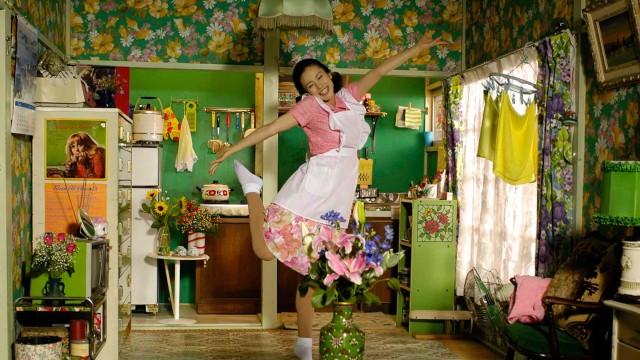
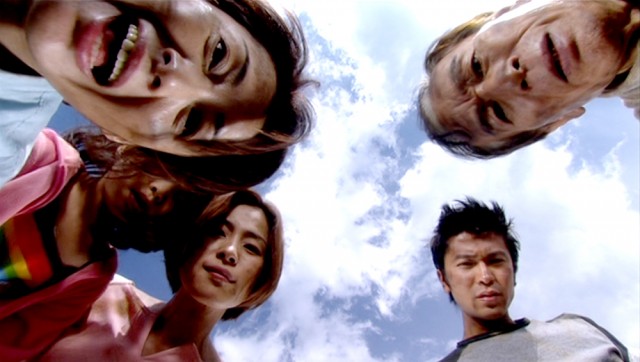
“Let’s forget any accidents by singing and dancing!” is the cry of the Katakuris, a seemingly cursed family in one of the craziest dark musical comedies you’re ever likely to see. Japanese genre king Takashi Miike, who has made more than 120 films in his twenty-five-year career, outdid himself in 2001’s The Happiness of the Katakuris, an endlessly inventive tale of a disaster-ridden clan that moves to the middle of nowhere to run a country inn, lured by a rumor that a railroad will be built nearby. Masao Katakuri (Kenji Sawada) is a laid-off department-store shoe salesman who has big dreams, supported by his devoted wife and former work colleague, Terue (Keiko Matsuzaka). Their daughter, Shizue (Naomi Nishida), is a divorced single mother who falls for suspicious navy officer Richard Sagawa (Kiyoshiro Imawano), while their son, Masayuki (Shinji Takeda), is a disgraced financier. Masao’s elderly father, Jinpei (Tetsurō Tamba), likes killing birds and playing with the family dog, Pochi. The film is narrated by Terue’s young daughter, Yurie (Tamaki Miyazaki), who is sharing her memories of one very bizarre summer. Desperate for paying customers at the bed and breakfast they have dubbed White Lovers, the family is excited when a guest finally arrives, but alas, he is there only to commit suicide. Afraid that news of his death would ruin any chances of success, the Katakuris decide to cover it up by burying the man and not reporting anything to the police. And when subsequent guests end up dead as well — in bizarre, ridiculous ways — there is no turning back.
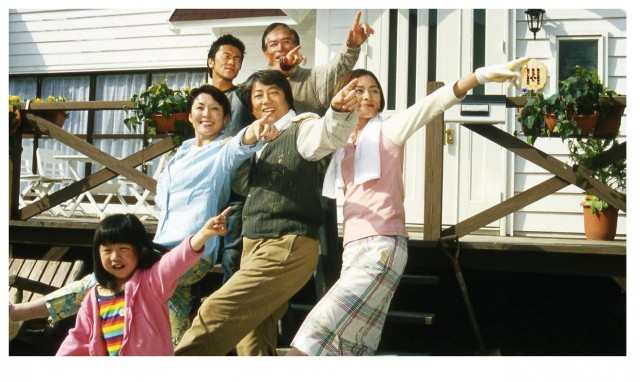
THE HAPPINESS OF THE KATAKURIS

Takashi Miike has a blast with crazy musical

Miike (Ichi The Killer, Audition, Thirteen Assassins) and screenwriter Kikumi Yamagishi (Miike’s Hara-Kiri: Death of a Samurai and Over Your Dead Body) masterfully mix comedy, romance, Claymation, music, murder, and mayhem in this enormously entertaining and highly original movie that is filled with a never-ending bag of surprises. Loosely based on Kim Jee-woon’s The Quiet Family, the film includes an adorably vicious animated angel-winged mini-monster, a quartet of Macbeth-like witch women, and odes to Psycho, The Rocky Horror Picture Show, and The Sound of Music. Each musical set piece, choreographed by Ryohei Kondo of the Condors, is done in a different style, going from bright and funny to dark and sinister, but always with a firm tongue in cheek. There’s lots of red blood, blue skies, and green, green grass as this oddball extended family try to make a better life for themselves, but luck is certainly not on their side. The Happiness of the Katakuris is screening April 23 at 4:00 in Japan Society’s rather eclectic 2016 Globus Film Series “Japan Sings! The Japanese Musical Film,” which concludes at 7:00 with another delightful offbeat musical, Memories of Matsuko.

TRIBECA FILM FESTIVAL: HERE ALONE

HERE ALONE

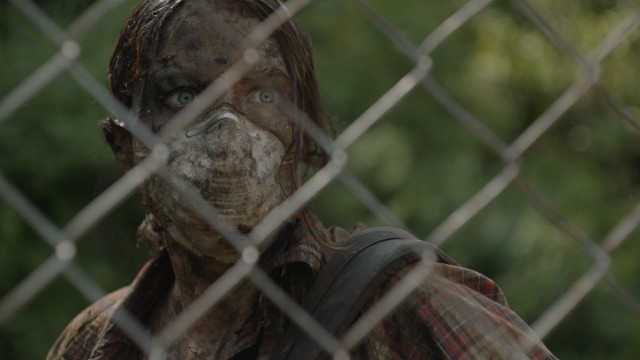
Ann (Lucy Walters) is struggling to survive a postapocalyptic nightmare in HERE ALONE

HERE ALONE (Rod Blackhurst, 2016)
Sunday, April 24, Bow Tie Cinemas Chelsea 5, 9:45
tribecafilm.com
www.herealonefilm.com

Rod Blackhurst’s tense 2013 short film, Alone Time, in which a New York City woman named Ann (Rose Hemingway) heads upstate for a few days of camping by herself, was based on a true story. Fortunately, Blackhurst’s feature debut, Here Alone, is not. The gripping postapocalyptic thriller is set in what has become our standard vision of the near future, when a virus has decimated the world’s population, turning people into cannibalistic zombies. (Are there any other kind?) Ann (Lucy Walters) is doing her best to survive in the forest by herself, raiding nearby houses for canned food while evading the hungry walking dead. The film flashes back and forth between the present and the recent past, when Ann, her husband, Jason (Shane West), and their baby left their home to seek safety in the woods. Along the way, Jason taught Ann detailed survival methods, which she uses to the best of her ability. When she finds a teenage girl, Olivia (Gina Piersanti), and her injured stepfather, Chris (Adam David Thompson), in the middle of the road, she has to decide whether to help and trust them — while also facing haunting memories, as they remind her of the family she has lost — in a future that is uncertain for all of them. Director and editor Blackhurst, screenwriter David Ebeltoft, and cinematographer Adam McDaid (Ebeltoft cowrote Alone Time with Blackhurst, and McDaid photographed the short) have crafted a nifty little horror film, mining familiar genre territory but twisting conventions just enough to keep viewers on the edge of their seat. You can’t take your eyes off Walters (Shame, Power), who gives Ann a tough yet vulnerable quality, focusing on her troubled psyche, with Thompson (A Walk among the Tombstones, Mozart in the Jungle) and Piersanti (It Felt Like Love) keeping things right on the edge of comfort and chaos. Here Alone is screening in the Midnight section of the Tribeca Film Festival on April 24 at 9:45.

AMANDA PARER: INTRUDE

(photo by twi-ny/mdr)

Amanda Parer has filled Brookfield Place with supersized rabbits that glow in the dark (photo by twi-ny/mdr)

Brookfield Place
250 Vesey St.
Daily through April 30, free, 12 noon – 9:00 pm (7:00 on Sundays)
212-945-0505
www.artsbrookfield.com
intrude slideshow

No, it’s not Night of the Lepus come to life, a pack of giant bunnies come to decimate humanity. Instead, in some ways, it’s the exact opposite. In 1788, the First Fleet introduced rabbits to Australia, but the real trouble began after a man named Thomas Austin brought two dozen wild rabbits into the country for sport. It wasn’t long before they multiplied to such levels that they became an invasive, unsustainable ecological hazard, destroying crops and contributing to soil erosion. Australian artist Amanda Parer references these problems in her installation “Intrude,” continuing at Brookfield Place through April 30.

(photo by twi-ny/mdr)

“Intrude” highlights invasive species through April 30 (photo by twi-ny/mdr)

Five large-scale white blow-up rabbits, made of 210D Nylon and reaching as tall and long as thirty-nine feet, have come across the seas; as bunnies do, they have grown in number, to seven, with four having taken root on Brookfield Place’s outside deck along the river and three more, two made specifically for New York City, inside the old Winter Garden. If you don’t speak with the people watching over each rabbit, you might not learn about the havoc the feral creatures are really causing, instead just seeing it as an adorable collection of picture-taking moments. But Parer, who is originally from Sydney but is now based in Tasmania, is very serious about spreading her message; “Intrude” has previously hopped into nineteen cities, including London, Paris, and Boston, with future migrations scheduled for Houston, Los Angeles, and Denver. Although the rabbits are cute during the day, they light up at night, becoming more than a bit ominous while adding to the ultimate cool factor, illuminating visitors in more ways than one.

(photo by twi-ny/mdr)

There’s more than meets the eye in new installation in Battery Park City (photo by twi-ny/mdr)

“I look forward to seeing the rabbits come to life at Brookfield’s properties throughout the United States,” Parer said in a statement. “I expect people will be drawn to the rabbits’ playful appearance, and I hope they will also take the time to understand the deeper meaning in the work and discuss how our actions impact the environment.” There are very specific rules for this warren of giant of rabbits: You can gently touch, kiss, pet, and hug them, but there is no kicking, punching, running, jumping, rolling, smoking, or feeding. Just remember to heed what Grace Slick once warned: “And if you go chasing rabbits / And you know you’re going to fall / Tell ’em a hookah-smoking caterpillar / Has given you the call / Call Alice / When she was just small.” And beware the Night of the Lepus

JAPAN SINGS! THE JAPANESE MUSICAL FILM: MEMORIES OF MATSUKO

Tetsuya Nakashima’s MEMORIES OF MATSUKO concludes Japan Society series focusing on the history of the Japanese musical

Tetsuya Nakashima’s MEMORIES OF MATSUKO concludes Japan Society series focusing on the history of the Japanese musical

MEMORIES OF MATSUKO (Tetsuya Nakashima, 2006)
Japan Society
333 East 47th St. at First Ave.
Saturday, April 23, 7:00
Festival runs through April 23
212-715-1258
www.japansociety.org

We called Tetsuya Nakashima’s 2004 hit, Kamikaze Girls, the “otaku version of Jean-Pierre Jeunet’s Amelie,” referring to it as “fresh,” “frenetic,” “fast-paced,” and “very funny.” His feature-length follow-up, the stunningly gorgeous Memories of Matsuko, also recalls Amelie and all those other adjectives, albeit with much more sadness. Miki Nakatani (Ring, Silk) stars as Matsuko, a sweet woman who spent her life just looking to be loved but instead found nothing but heartbreak, deception, and physical and emotional abuse. But Memories of Matsuko, is not a depressing melodrama, even if Nakashima (Confessions, The World of Kanako) incorporates touches of Douglas Sirk every now and again. The film is drenched in glorious Technicolor, often breaking out into bright and cheerful musical numbers straight out of a 1950s fantasy world. As the movie begins, Matsuko has been found murdered, and her long-estranged brother (Akira Emoto) has sent his son, Sho (Eita), who never knew she existed, to clean out her apartment. As Sho goes through the mess she left behind, the film flashes back to critical moments in Matsuko’s life — and he also meets some crazy characters in the present. It’s difficult rooting for the endearing Matsuko knowing what becomes of her, but Nakashima’s remarkable visual style will grab you and never let go. And like Audrey Tatou in Amelie, Nakatani — who won a host of Japanese acting awards for her outstanding performance — is just a marvel to watch. Memories of Matsuko is a fine choice to conclude Japan Society’s rather eclectic 2016 Globus Film Series “Japan Sings! The Japanese Musical Film.” As curator Michael Raine notes, “The ubiquity of music and song in postwar Japanese cinema became an anti-naturalist resource for modernist filmmakers to characterize social groups (Twilight Saloon, A Treatise on Japanese Bawdy Songs), or to tweak contemporary debates in avant-garde music by combining Buddhist chant and naniwabushi with West Side Story (Oh, Bomb!). We can hear echoes of that irony even in more recent musical films (The Happiness of the Katakuris, Memories of Matsuko), in which the utopian musical numbers only accentuate the bleakness of the lives they comment on. Seeing and hearing the tradition of musical films in Japanese cinema gives us a different view of Japanese popular culture that is smart as well as silly and sometimes devastating, too.”
FASSBINDER’S TOP TEN: LOLA MONTÈS

LOLA MONTES

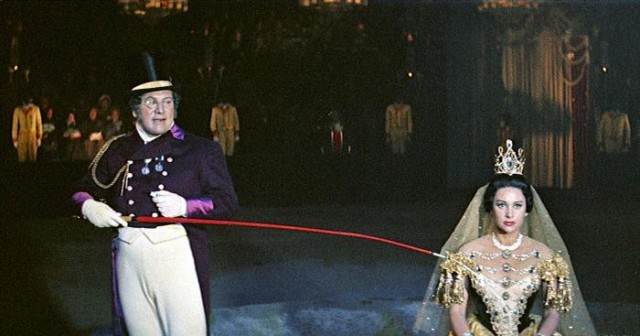
Ringmaster Peter Ustinov promises “Rumour! Scandal! Passion!” in presenting story of Lola Montès (Martine Carol)

LOLA MONTÈS (Max Ophüls, 1955)
Metrograph
7 Ludlow St. between Canal & Hester Sts.
Sunday, April 24, 5:00
Series runs April 22-30
212-660-0312
metrograph.com

“And now, the moment you’ve all been waiting for!” announces the monocled, whip-snapping Mammoth Circus ringmaster (Peter Ustinov) as Max Ophüls’s 1955 CinemaScope masterpiece, Lola Montès, begins. “The most sensational act of the century!” he continues, the camera following him in a breathtaking tracking shot as he introduces “a creature a hundred times more wild than any beast in our menagerie! A monster of cruelty . . . with the eyes of an angel!” Then, with much fanfare, Lola Montès (Martine Carol) arrives like a queen — albeit a circus queen — as the ringmaster tells the audience that they (we) are about to witness “the whole truth of the extraordinary life of Lola Montès.” What follows is not necessarily the true tale of the famed courtesan and entertainer who gained more notoriety for her scandalous love affairs and hourglass body than for her abilities as an actress and dancer. Lola’s story is told in a series of flashbacks showing her with Franz Liszt (Will Quadflieg), Lt. Thomas James (Ivan Desny), conductor Claudio Pirotto (Claude Pinoteau), a young student (Oskar Werner), and, most critically, King Ludwig I of Bavaria (a dashing Anton Walbrook). The episodes reveal her to be both loved and reviled as she struggles to succeed in her career, which ends up taking second place to the men in her life. Ophüls barely shows the cigar-loving Lola performing, instead letting the camera slowly dance around her, often depicting her through window frames, screens, and curtains as if she is a caged animal, all leading to a dangerous grand finale.
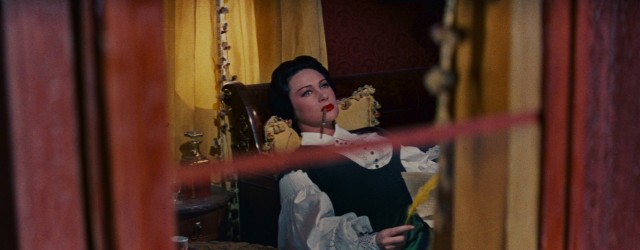
Lola (Martine Carol) dreams of a better life in Max Ophüls’s CinemaScope masterpiece

Lola (Martine Carol) dreams of a better life in Max Ophüls’s CinemaScope masterpiece

Lola Montès is filled with visual splendor; Jean d’Eaubonne and Willy Schatz’s sets are lush and elegant, and Georges Annenkov’s and Marcel Escoffier’s costumes are beautiful and appropriately extravagant, while cinematographer Christian Matras creates an emotionally powerful palette, bathing Ophüls’s first and only color film in bold reds and blues. (The director of such previous classics as La Ronde, Le Plaisir, and Letter from an Unknown Woman died in 1957 at the age of fifty-four while making Les Amants de Montparnasse.) It’s a dazzling cinematic achievement, one that was initially met with derision, then chopped up by the producers, but finally restored to its exquisite original version. Lola Montès is screening April 24 at 5:00 as part of the Metrograph series “Fassbinder’s Top Ten,” running April 22-30 and consisting of the ten films the German director cited as his favorites in 1982, shortly before his drug-related death at the age of thirty-seven. Held in conjunction with the upcoming release of the new documentary Fassbinder: To Love without Demands, the series also includes such classics as Nicholas Ray’s Johnny Guitar, Howard Hawks’s Gentlemen Prefer Blondes, Charles Laughton’s The Night of the Hunter, Pier Paolo Pasolini’s Salo, or the 120 Days of Sodom, and Luchino Visconti’s The Damned.

ME AND MR. JONES: MY INTIMATE RELATIONSHIP WITH DAVID BOWIE

Raquel Cion brings her deeply personal David Bowie tribute to the Slipper Room April 21 and May 15

Raquel Cion brings her deeply personal David Bowie tribute to the Slipper Room April 21 and May 15

The Slipper Room
167 Orchard St.
Thursday, April 21, and Sunday, May 15, $15-$25, 8:00
212-253-7246
www.slipperroom.com

In a November 2015 twi-ny talk, Raquel Cion said, “Isn’t it great to be amidst a flurry of Bowie activity?” referring to Bowie’s sudden resurgence with an off-Broadway musical, new album, and various other new songs. “Oh, I have so much to say.” But it should be fascinating, and potentially heart-wrenching, to hear what she has to say about Bowie now that he is no longer with us, having passed away in January at the age of sixty-nine. In Me & Mr. Jones: My Intimate Relationship with David Bowie, Cion reflects on her life through her worship of Bowie, singing Bowie songs and sharing deeply personal anecdotes that are both moving and funny. She is now bringing her glittery multimedia performance, which was nominated for a 2015 New York Cabaret Award for Best Musical Comedy or Alt Cabaret Show, to the Slipper Room on April 21 and May 15, joined by Jeremy Bass on guitar, Ian Jesse on bass, Michael Morales on drums, and Isai Centeno and DM Salsberg on vocals. The show is directed by Cynthia Cahill, and Cion’s glam outfits are by David Quinn. Tickets are $15 for general admission seating and standing and $25 for reserved seats.

TRIBECA FILM FESTIVAL AFTER THE MOVIE: STARRING AUSTIN PENDLETON

Austin Pendleton finally gets top billing in short documentary about his unique career

Austin Pendleton finally gets top billing in short documentary about his unique career

STARRING AUSTIN PENDLETON (Gene Gallerano & David H. Holmes, 2016)
Thursday, April 21, SVA Theater 2 Beatrice, 2:30
tribecafilm.com
www.facebook.com

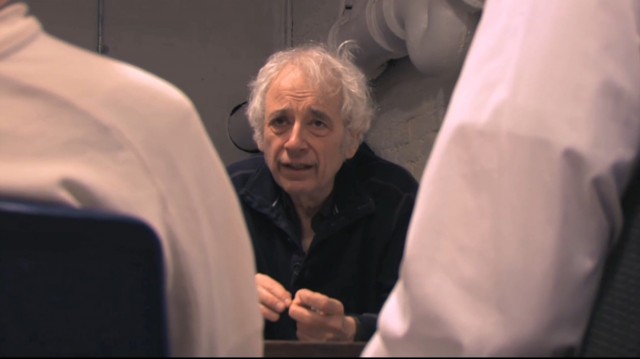
Starring Austin Pendleton is a charming little tribute to director, teacher, and film, television, and theater character actor Austin Pendleton, who finally gets top billing. Directors Gene Gallerano and David H. Holmes — the latter an actor who has studied with and acted in plays directed by Pendleton — have assembled quite an all-star lineup to sing Pendleton’s praises, including Meryl Streep, Philip Seymour Hoffman, Olympia Dukakis, Wallace Shawn, Natalie Portman, Peter Sarsgaard, Maggie Gyllenhaal, and John Simon. “If this guy didn’t look the way he looks — he’s got a stutter, he’s five-whatever-he-is, he’s a funny-looking guy, and his hair’s all screwy — he’d be Marlon Brando,” Ethan Hawke points out. You might not know the name, but as the clips roll by, you will certainly recognize the face as Pendleton is shown in such movies and television series as The Front Page, Good Times, The Muppet Movie, The Ballad of the Sad Café, Seinfeld, Catch-22, and the film he will likely most be remembered for, My Cousin Vinny, in which he played stuttering lawyer John Gibbons, a role that showcased an affliction he has suffered from his entire life. Starring Austin Pendleton is worth seeing just for the clips of Pendleton and Hoffman in 1995’s The Fifteen Minute Hamlet, in which the former portrays the title character and the latter plays Bernardo, Horatio, and Laertes. It is supremely enjoyable watching Pendleton discuss his craft and share some very funny anecdotes; my only complaint is that the documentary is way too short at only nineteen minutes, but it is about a character actor, after all, who is used to getting limited screen time. And how could it fail to mention that Pendleton originated the role of the tailor Motel Komzoil in the Broadway production of Fiddler on the Roof? On April 21, the film will be shown at the Tribeca Film Festival, followed by a conversation with Pendleton, directors Holmes and Gallerano, and Olympia Dukakis, Peter Sarsgaard, Denis O’Hare, and George Morfogen, moderated by Gordon Cox. You can also catch it as part of shorts programs at Tribeca on April 19, 21, and 23.