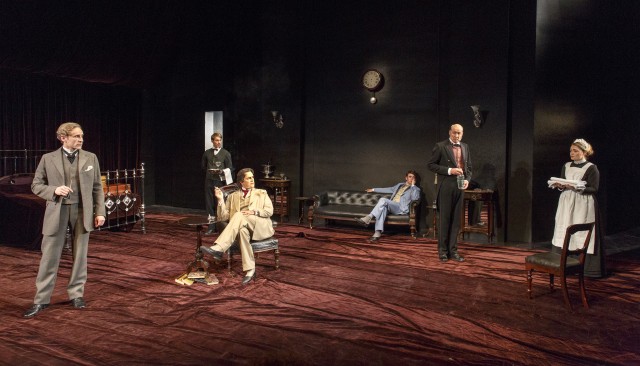
Oscar Wilde (Rupert Everett) contemplates what might be his last night of freedom in THE JUDAS KISS (photo by Richard Termine)
Brooklyn Academy of Music
BAM Harvey Theater
651 Fulton St.
Tuesday – Sunday through June 12, $30-$125
718-636-4100
www.bam.org
David Hare’s The Judas Kiss is a tale of two plays in more ways than one. The inaugural production in 1998 in London and on Broadway, starring Liam Neeson as Oscar Wilde, was such a critical flop that even Hare (Plenty, Skylight) himself admitted it was a failure. However, seeking to gain support for a film he wrote about Wilde, English actor Rupert Everett helped mount a 2012 revival of The Judas Kiss that has been garnering significantly better reviews as it tours the UK and Canada and has now settled in for a one-month run at the BAM Harvey through June 12. Everett (My Best Friend’s Wedding, An Ideal Husband) is triumphant as Wilde, but the disconnect between the first and second acts still prevents the play from being a complete success. (Interestingly, Hare made no changes to the script for this revival.) The Judas Kiss opens on April 5, 1895, at the Cadogan Hotel, as the staff, randy hotel employees Arthur Wellesley (Elliot Balchin) and Phoebe Cane (Jessie Hills) under the guidance of the staid and proper valet Sandy Moffat (Alister Cameron), prepares for the arrival of Wilde, who is being tried for “acts of gross indecency” by the Marquess of Queensberry, the father of Wilde’s lover, Lord Alfred Douglas (Charlie Rowe), affectionately known as Bosie. Wilde’s manager and former lover, Robert Ross (Cal MacAninch) soon arrives and the conflict is set in motion: Ross wants Wilde to leave England immediately in order to escape prosecution, while Bosie wants him to stay and fight the charges, as a way for the young lad to stand up to his father. “It appears that the whole of London is fleeing. I looked from my coach. Every invert in the metropolitan area is now packing his bags and heading for France,” Wilde says. “It is a veritable mass migration. I’d never imagined diaspora could be on this scale. The takings at certain fashionable restaurants will tonight be counted in pennies. At a single stroke, the opera will be stone-dead as an art form.” But before choosing his course of action, Wilde explains what is most important. “Let us be realistic. In the name of our common humanity, let us get our priorities straight. Let us pause, let us make the seminal decision: it seems that I still have time for my lunch.” Slapstick comedy mixes with graver matters of freedom and love as Ross and Bosie argue over Wilde’s fate and a phalanx of reporters attempts to storm the hotel. Through it all, Wilde is both witty and effete, courteous and haughty, but time is clearly running out on him, as evidenced by the clock in the room, which has no hands.
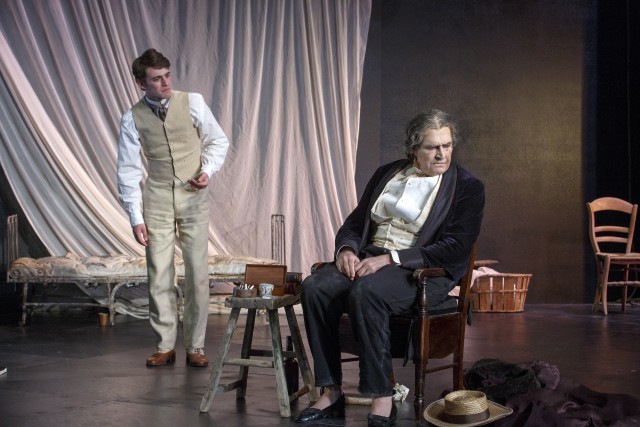
Bosie (Charlie Rowe) and Oscar Wilde (Rupert Everett) face some harsh realities in David Hare revival at BAM (photo by Richard Termine)
The second act is dreary and dour, set two years later in a ramshackle hotel in Naples. Recently released from Reading Gaol, Wilde looks decades older, barely able to move out of his chair. He is joined by Bosie and Bosie’s latest lover, local fisherman Galileo Masconi (Tom Colley), who casually walks around completely naked before sitting on the floor and eating a sugared bun still au naturel. “Oh, it’s wonderful, it’s like a child, isn’t it?” Wilde says, staring lustily at Galileo. “Who said one can never go back? If only I could go back to that! If I ever was like that! Like an animal, like a cat. Truly, one should throw him a ball of string. Look at the little fellow.” But there is no going back for Wilde, now a sad, nearly penniless recluse, wasting away in Italy. “There is no morality in what is called morality; there is no sense in what is called sense; and least of all is there meaning in what is held to be meaning,” he tells Bosie. Director Neil Armfield (Diary of a Madman, Exit the King) can’t quite find the right balance between the engaging first act and the more stationary second act, relying too much on Everett’s towering presence even as he shrinks away. But Everett’s performance makes this Judas Kiss more than worthy; he plays the role with relish and panache, breathing exciting life into a familiar figure, bringing humanity to an often caricatured personality. (In preparing for the role, he even slept in Wilde’s old room at the Cadogan.) You can’t take your eyes off him, whether he’s enjoying champagne and lobster, trapped in his chair, or seen in an enveloping shadow on the wall. (The lighting is by Rick Fisher, sets by Dale Ferguson.) Alan John’s soundtrack is relatively unnecessary; at times it was so soft and distant that it appeared to be a cell phone going off in the audience. But the play remains as relevant as ever, with the continuing controversies and bullying over gay marriage and LGBTQ discrimination. “Just a century ago a man — Oscar — could be imprisoned and ruined — killed off, basically — simply for being gay,” Everett wrote in a recent column for the New York Times, referring to the legalization of same-sex marriage in England. “But tonight a homosexual stood on equal ground with the rest of society, and I was, quite unexpectedly, extremely moved.” So it’s a genuine treat to have Wilde, in the personage of Everett, back at BAM, where, in 1882 in the institution’s original home on Montague St., Wilde spoke as part of his North American lecture tour.

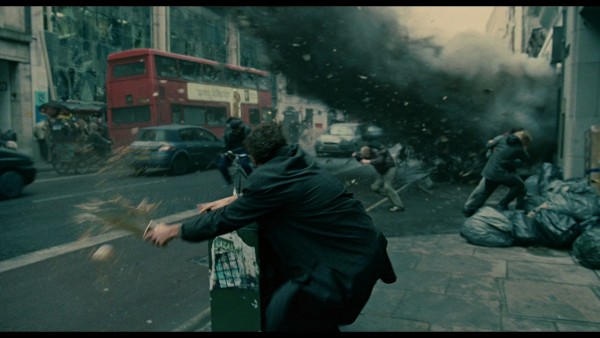
 It’s 2027, and there hasn’t been a baby born in the world in eighteen years. For some unknown reason, women have become infertile, leading to chaos around the globe. Only England perseveres, but it is on the brink of destruction as warring factions prepare for doomsday. Onetime revolutionary Theo (an as-even-keeled-as-ever Clive Owen) has settled down into a mundane life, but he’s thrust back into the middle of things when he is kidnapped by a radical organization run by his ex-wife, Julian (Julianne Moore), and her right-hand man, the hard-edged Luke (Chiwetel Ejiofor). Theo is forced to escort Kee (Claire-Hope Ashitey), a young fugee (refugee), through the danger zone and to the Human Project, a supposed safe haven that might not actually exist. Also staring extinction in the face are Theo’s brother, Nigel (Danny Huston); Theo’s hippie friend, Jasper (a longhaired Michael Caine); and homeland security officer Syd (Peter Mullan). Inspired by the novel by P. D. James, the chilling Children of Men is a violent, prescient, nonstop thrill ride, moviemaking of the highest order, cowritten and directed by Alfonso Cuarón (Y Tu Mamá También, Gravity) and photographed in vibrant filth and muddiness by Emmanuel Lubezki (Birdman, The Tree of Life). Nominated for three Academy Awards (Best Cinematography, Best Film Editing, Best Adapted Screenplay), Children of Men is one of the best of the dystopian science fiction films of the twenty-first century, predicting a future that is not as impossible as one might think. Stay through the credits for a tiny but critical coda. Children of Men is screening May 28 and 29 at 11:30 am as part of the Nitehawk Cinema series “May Brunch and Midnite: The Waste Land,” which also features Shaun of the Dead at 12:20 am Friday and Saturday night.
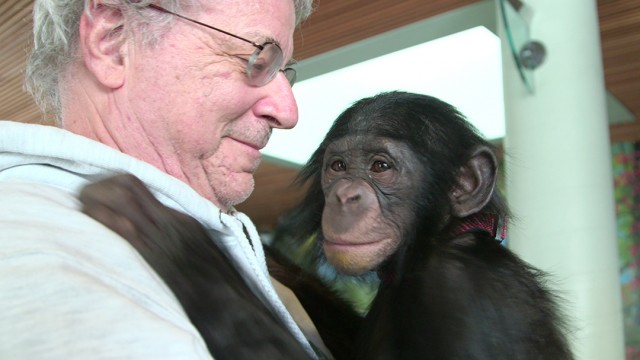
 Award-winning husband-and-wife documentarians D. A. Pennebaker and Chris Hegedus have been collaborating for forty-five years, working on films about such subjects as Bill Clinton’s presidential campaign (The War Room), Carol Burnett (Moon over Broadway), soul music (Only the Strong Survive), pastry chefs (Kings of Pastry), and Elaine Stritch (Elaine Stritch at Liberty). For their latest film, Unlocking the Cage, they spent three years following animal rights lawyer Steven M. Wise, the president and founder of the Nonhuman Rights Project, as he sought to establish “personhood” for several chimpanzees in order to free them from their caged existence and move them to more acceptable animal sanctuaries. Wise and his team, Natalie Prosin and attorneys Elizabeth “Liddy” Stein and Monica Miller, scour the internet searching for chimpanzees to represent as well as sanctuaries where the animals can be released. (The Nonhuman Rights Project focuses on great apes, elephants, and such cetaceans as dolphins and whales because of their autonomy, intelligence, and emotional capacity.) The concept is fascinating, and the film hits its high points when Pennebaker and Hegedus show some of the chimpanzees interacting with humans in compelling ways, watching television or figuring something out on a computer. Unfortunately, far too much of Unlocking the Cage deals with often murky legal discussions and courtroom arguments that drag on and on.