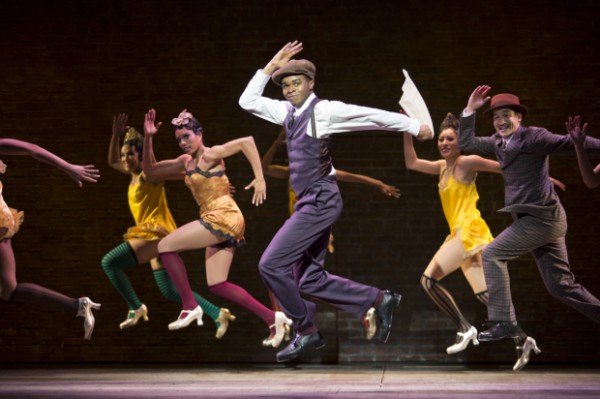
Savion Glover’s choreography powers SHUFFLE ALONG (photo © Julieta Cervantes)
SHUFFLE ALONG, OR THE MAKING OF THE MUSICAL SENSATION OF 1921 AND ALL THAT FOLLOWED
Music Box Theatre
239 West 45th St. between Broadway & Eighth Aves.
Tuesday – Sunday through October 9, $69 – $169
shufflealongbroadway.com
Shuffle Along, or, the Making of the Musical Sensation of 1921 and All That Followed has some of the best music and dancing you’ll find on Broadway right now. Unfortunately, it doesn’t have the book to support it. The show tells the story of the historic 1921 production of Shuffle Along, a landmark musical featuring music by Eubie Blake, lyrics by Noble Sissle, and book by vaudevillians F. E. Miller and Aubrey Lyles; Blake played the piano onstage (there was no orchestra pit at the 63rd Street Music Hall), while Sissle starred as detective Jack Penrose, Miller was mayoral candidate Steve Jenkins, and Lyles was candidate Sam Peck. The 1921 cast also included Lottie Gee as Jessie Williams, Gertrude Saunders as Ruth Little (later replaced by Florence Mills), and Adelaide Hall as a Jazz Jasmine in the large ensemble. George C. Wolfe (Jelly’s Last Jam, Bring in ’da Noise, Bring in ’da Funk) wrote the book for and directs the new show, which went through significant revisions during previews — at one point it was clocking in at more than three hours (the final version is two hours and forty minutes), and six-time Tony winner Audra McDonald (The Gershwins’ Porgy and Bess, Lady Day at Emerson’s Bar & Grill), who plays Gee, had to take time off for illness. (It was later revealed that she is pregnant and will be going on maternity leave July 24, when Carolina Chocolate Drops singer Rhiannon Giddens will take over her role.)

Eubie Blake (Brandon Victor Dixon) plays piano for Lottie Gee (Audra McDonald) in SHUFFLE ALONG (photo © Julieta Cervantes)
Savion Glover’s choreography is energetic and exhilarating while incorporating multiple genres, as are Ann Roth’s dazzling period costumes. But the relating of the behind-the-scenes efforts of a group of black men and women trying to storm Broadway is trite and clichéd, dragging down the rest of the show. Brandon Victor Dixon (The Color Purple, Motown: The Musical) and Joshua Henry (Violet, The Scottsboro Boys) are fine as Blake and Sissle, respectively, but Brian Stokes Mitchell (Man of La Mancha, Kiss Me, Kate) as Miller tries his best with dry lines, and Billy Porter (Kinky Boots, Miss Saigon is miscast as Lyles. Brooks Ashmanskas (Something Rotten, Fame Becomes Me) is fun as all the white men. It all makes for way too bumpy a ride, despite such songs as “Broadway Blues,” “Affectionate Dan,” “Honeysuckle Time,” “Love Will Find a Way,” “You Got to Git the Gittin’ While the Gittin’s Good,” and “(I’m Just) Wild About Harry,” with rousing orchestrations and arrangements by Daryl Waters (After Midnight, Memphis). The Playbill comes with a bonus re-creation of the original program (and some extra information) from when the show opened May 23, 1921, at the 63rd Street Music Hall. Shuffle Along wants to be both historic and historical, instead losing its focus as it gamely attempts to meld substance with style.

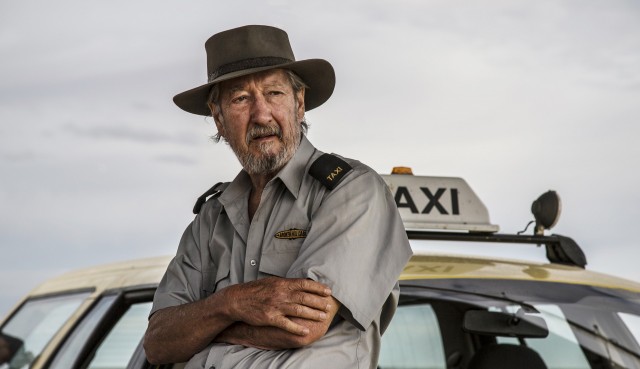
 Jeremy Sims’s Last Cab to Darwin is a poignant road-trip movie about a man determined to end things on his own terms. Australian star Michael Caton (The Castle, The Sullivans) is Rex, a grizzled, gruff cabdriver who has never been outside his small hometown of Broken Hill, a mining city in the far west of the country. In his late sixties, he has reached the point where he says and does whatever he wants in life, regardless of the consequences. But when he is diagnosed with stomach cancer and given three months to live, he decides to get in his taxi and drive nearly two thousand miles across Australia to meet with Dr. Farmer (Oscar nominee Jacki Weaver), who has just developed a controversial new assisted suicide method in Darwin that Rex wants to be the first to use. Barely acknowledging his neighbor and lover, an Aboriginal woman named Polly (Ningali Lawford-Wolf), Rex hits the road, where he eventually picks up a young indigenous hustler, Tilly (Mark Coles Smith), and a British nurse-slash-barmaid, Julie (Emma Hamilton), and the three get caught up in some crazy adventures.
 About midway through The Music of Strangers: Yo-Yo Ma and the Silk Road Ensemble, the renowned international group performs an exhilarating song in a studio that leaves them just as thrilled as the audience. Renowned cellist Ma might be the heart of the ensemble, but it’s the joy of creating and playing music no matter what that makes this documentary soar. And music is something that director Morgan Neville clearly understands, having previously made the Oscar-winning 20 Feet from Stardom as well as Muddy Waters: Can’t Be Satisfied, Respect Yourself: The Stax Records Story, and Johnny Cash’s America. In The Music of Strangers, Neville traces the history of the Silk Road Ensemble, named for the thousands-of-years-old trading route across Asia, from China to the Mediterranean. Born as an improvised gathering of musicians at Tanglewood in 2000, it became a venture that tours the world, promoting collaboration and celebrating international interaction. “The idea of culture is not so much to preserve tradition but to keep things alive and to evolve things,” says Ma, who has had to deal with accusations of cultural appropriation and dilution. Neville focuses on five members of the ensemble: Ma, the Paris-born Chinese-American cellist who has been a star his whole life (archival footage shows him at age seven with Leonard Bernstein, performing for President Kennedy and first lady Jacqueline); Chinese pipa virtuoso Wu Man, the first Chinese artist to play at the White House; Kinan Azmeh, a Syrian clarinetist who is the artistic director of the Damascus Festival Chamber Music Ensemble; Cristina Pato, a rock star on the gaita, the Galician bagpipe; and Iranian Kayhan Kalhor, a three-time Grammy nominee who is an expert on the kamancheh, the Persian bowed lute. Each shares stories of their personal history, focusing on their relationship with their native countries, which have undergone major changes over the last fifteen years.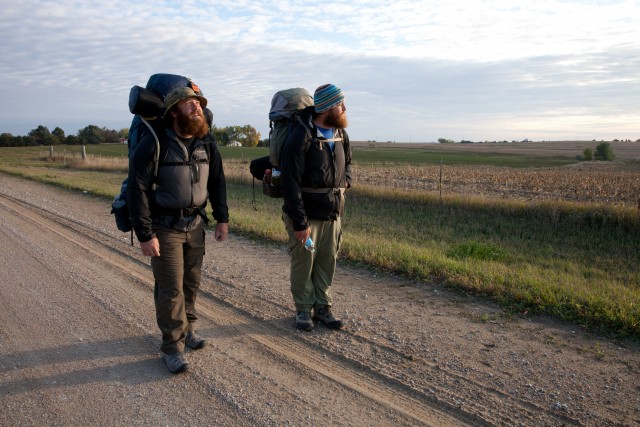
 Michael Collins’s emotionally gripping documentary, Almost Sunrise, is built around an absolutely shocking statistic: According to the Department of Veteran Affairs, twenty-two U.S. veterans commit suicide every day. That’s one self-inflicted death every sixty-five minutes. In the film, two young veterans of Operation Iraqi Freedom, facing depression and suicidal thoughts themselves, decide to walk from their homes in Milwaukee, Wisconsin, to Los Angeles, California, in order to clear their own heads and raise awareness of this horrifying issue. Tom Voss and Anthony Anderson, a pair of big, bushy-haired men, became media darlings as they continued what became known as