twi-ny recommended events

PAM TANOWITZ DANCE: DAY FOR NIGHT

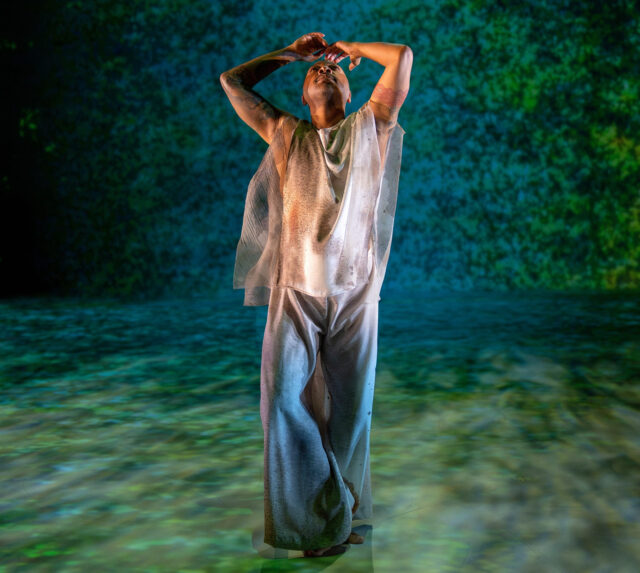
Three-part Day for Night goes from daylight to dusk to evening (photo by Liz Devine)

DAY FOR NIGHT
The Amph at Little Island
Pier 55, Hudson River Park at West Thirteenth St.
July 17-21, $15 standing room, $25 seats sold out, 8:30
littleisland.org
www.pamtanowitzdance.org

Little Island’s inaugural season of site-specific commissions continues with Bronx-born choreographer Pam Tanowitz’s Day for Night, which blends beautifully with the surroundings of the outdoor Amph theater. As the audience makes its way past the grassy green hills that leads to the venue, the dancers are scattered along the path, offering a prologue, clad in diaphanous green costumes. As the audience is being seated in the Amph’s wooden rows, the sun is setting over the Hudson, a golden glow that evokes the title of the show, the term used when a film is shooting a nighttime scene during the day.

The sixty-minute piece was inspired by François Truffaut’s 1973 film, Day for Night, which goes behind the scenes of the making of a movie, featuring a British actress (Jacqueline Bisset) who has recently suffered a nervous breakdown, an aging French star (Jean-Pierre Aumont), an Italian diva (Valentina Cortese), and a young French actor (Jean-Pierre Léaud); Truffaut portrays the harried director.

The dance begins with Lindsey Jones, Marc Crousillat, and Maile Okamura forming an extended pony-stepping trio in which various emotions boil to the surface, including jealousy, power, and revenge. They are later joined by Morgan Amirah and Brian Lawson, who peer out over the river, in addition to Sarah Elizabeth Miele and Victor Lozano. In all black, Melissa Toogood delivers an impressive solo, looking serious and concerned.

The dancers move up the aisles, climb to a pair of scaffold balconies, and rest on the first row of benches, which is covered in fake green grass. They jump, run around in a circle, and lie down on the empty stage. The soundtrack features gentle tones as well as harsher drones, accompanied by recordings of the natural environment of Little Island, from birds and wind to lapping waves, human murmurings, and traffic. When the BBC’s Shipping Forecast plays over the sound system, I initially thought it was coming from a boat passing in the distance. (The immersive sound and music are by Justin Ellington.)

Reid Bartelme and Harriet Jung’s costumes come in multiple colors echoing the environs, with loose-fitting tops and tighter bottoms; old-fashioned striped swimming trunks provide contrast to the vertical picket fence bordering the water. Lighting designer Davison Scandrett blasts out red, orange, yellow, blue, green, and almost blinding white.

Tanowitz, who has previously choreographed such works as I Was Waiting for the Echo of a Better Day, Law of Mosaics, and Four Quartets, for such companies as New York City Ballet, the Royal Ballet, Martha Graham, Paul Taylor, Ballet Austin, and her own Pam Tanowitz Dance, teases the audience with a series of false endings and bows before everyone moves over to the Glade, where Toogood, in silver sequins, dances a forceful epilogue to Caroline Shaw and Sö Percussion’s slow, elegiac cover of ABBA’s “Lay All Your Love on Me,” in which Shaw nearly whispers, “Don’t go wasting your emotion / Lay all your love on me / Don’t go sharing your devotion / Lay all your love on me.”

“Cinema is king!” Truffaut’s character says in Day for Night. On Little Island right now, it’s dance that rules.

[Mark Rifkin is a Brooklyn-born, Manhattan-based writer and editor; you can follow him on Substack here.]


MODERNISM, INC.: THE ELIOT NOYES DESIGN STORY

Modernism, Inc. subject Eliot Noyes is hard at work in his New Canaan office (courtesy of the Pedro Guerrero Estate)

MODERNISM, INC. (Jason Cohn, 2023)
IFC Center
323 Sixth Ave. at West Third St.
Opens Friday, July 19
212-924-7771
www.ifccenter.com

“Good design is good business” was the mantra employed by architect Eliot Noyes, who, with IBM CEO Tom Watson Jr., helped rebrand the company through its public image from top to bottom, from its logo to the look of its products, creating a legacy that is still in evidence today.

Noyes’s career is detailed in Jason Cohn’s documentary Modernism, Inc., opening July 19 at IFC Center, with Cohn on hand for Q&As on Friday and Saturday night at the 6:50 screening.

The eighty-minute film skips over Noyes’s childhood, beginning with his disgruntlement with the old-fashioned ideas taught at Harvard in the 1930s. In 1937, he started studying with German American architect and Bauhaus founder Walter Gropius and never looked back. Noyes wanted to incorporate the reality of modern life, including social and economic problems, into his work. “Gropius pushed Noyes to see the continuity between art, architecture, and the design of everyday objects, what Gropius called the total theory of design,” narrator and French actor Sebastian Roché explains.

In 1939, Noyes, who was born in Boston in 1910, was hired as the first director of industrial design at the Museum of Modern Art, where he staged the important 1941 exhibition “Organic Design in Home Furnishings.” He enlisted in the Army Air Force during WWII, exploring the efficacy of using gliders in battle. He espoused his theory of design on the television program Omnibus. From 1947 to 1960, he wrote an influential column for Consumer Reports called “The Shape of Things.”

In 1956, one of his colleagues on the Pentagon’s glider project, Watson, brought him over to IBM to remake its corporate culture; Noyes refused to become a full-time employee, instead accepting the position of consultant director of design, working from his home in New Canaan, Connecticut, where he and his wife, Molly Weed, who contributed to many of his designs, raised four children: Eli, Fred, Meridee, and Derry. New Canaan became a hub for designers, as Marcel Breuer, Philip Johnson, Joe Johansen, and others soon moved into the exclusive suburb.

Eliot Noyes was IBM’s consultant director of design from 1954 to 1977 (courtesy of the Eliot Noyes Family)

“Eliot Noyes had quite a curious view of Modernism, a deep-seated belief that design could be at the core of building a future society,” design historian Alice Twemlow says in the film. Noyes’s designs, from the conversation chair, IBM Selectric, and large computers to logos for such companies as IBM, Mobil, Westinghouse, Pan Am, and Xerox to his unique houses, felt as new as free jazz and abstract expressionism, interweaving form and function. He collaborated with such industry luminaries as Charles Eames and Paul Rand, known as “Matisse on Madison Ave.” Not everything was successful; one notable failure was his bubble house.

Describing what went into constructing a house for her family in 1978, Lyn Chivvis, interviewed in her Noyes-designed kitchen with her husband, Arthur, tells Cohn, “El was able to talk to his clients, my parents and us, and find out, what do you need for your daily life? El developed the open-shelving idea. He actually measured the shelves for me. It doesn’t fit you. It doesn’t fit you, it doesn’t fit anyone else but me.”

Cohn also speaks with IBM design head Katrina Alcorn, Noyes biographer Gordon Bruce, IBM chief archivist Jamie Martin, University of Toronto architecture professor and historian John Harwood, IBM design manager Tom Hardy, design historian Thomas Hine, and Noyes’s children, integrating archival footage, home movies, industrial films, and old advertisements (the film was edited by Kevin Jones), accompanied by a sensitive score by Steven Emerson/Ever Studio.

Noyes’s career trajectory took a turn at the 1970 International Design Conference Aspen, which he headed, when the theme of design fusing with the environment was seized upon by counterculture activists to protest against corporate greed, the Vietnam War, and the misuse of natural resources by design firms. The conference was filmed by his son Eli and director Claudia Weil, who captured intense moments. “I’m not a political guy. I’m interested in making my points through my work,” the elder Noyes tells Oscar-winning graphic designer Saul Bass. (Eli, who died this past March at the age of eighty-one, had been nominated for an Oscar for his 1964 claymation short Clay or the Origin of Species.)

“The designers who were at Aspen, their consciousness was good design can change things. I think Eliot Noyes would profess this,” Chip Lord, the cofounder of the alternative architecture collective Ant Farm and a conference attendee, explains. “Good design makes a good product or a good branding. It is a form of change. But our critique was beyond that because it didn’t matter how well you designed a gigantic SUV if it’s just guzzling fuel.”

The conference changed Noyes; he resigned from the IDCA and spent more time with his family. His children note that they really didn’t get to know their father until his later years, including a particularly memorable trip together.

Noyes died in 1977 at the age of sixty-six; he may not be a household name, but his impact on the visual and architectural history of twentieth-century American culture is still unmistakable in corporations and households around the world.

[Mark Rifkin is a Brooklyn-born, Manhattan-based writer and editor; you can follow him on Substack here.]
THE JOURNALS OF ADAM AND EVE: THE WORLD’S FIRST LOVE STORY

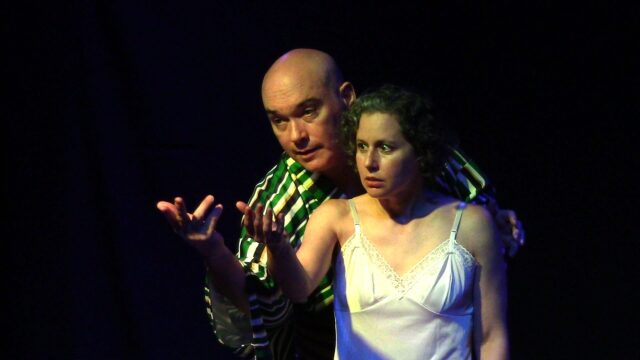
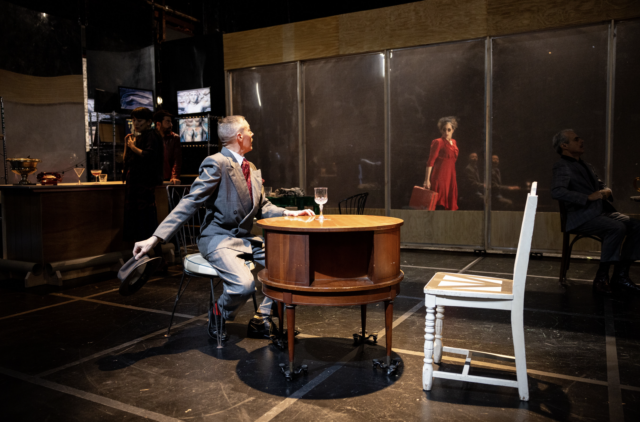
Hal Linden and Marilu Henner play Adam and Eve in new play at Sheen Center (photo by Paul Aphisit)

THE JOURNALS OF ADAM AND EVE
Loreto Theater, the Sheen Center for Thought & Culture
18 Bleecker St. at Elizabeth St.
Wednesday – Sunday through July 28, $39-$99
212-925-2812
www.sheencenter.org

In September 2022, nine-time Emmy-winning writer and producer Ed. Weinberger presented Two Jews, Talking at the Theatre at St. Clement’s, a two-character play in which television icons Hal Linden and Bernie Kopell played a pair of old Jewish men, first in the desert escaping slavery in Egypt, then sitting on a park bench, complaining about the state of the modern world.

Weinberger has followed that up with The Journals of Adam and Eve at the Sheen Center, a two-character play in which television icons Linden and Marilu Henner portray the planet’s first couple. The ninety-minute show is an adaptation of two short stories written by Mark Twain late in his career, 1904’s “Extracts from Adam’s Diary” and 1906’s “Eve’s Diary,” hilariously retold in the style of Borscht Belt comedians (and with a nod to John Milton’s Paradise Lost).

Although it is a staged reading with the actors at music stands, they know most of the lines, allowing them to gesticulate, whether speaking to the audience or to each other. They do regularly refer to the script, but only to pick up a word or phrase. Behind them, a projection of the sky turns from blue skies to clouds to the sun and the moon.

“Much to my amazement, I was born a full-grown man. How old exactly I never knew,” Adam says at the beginning. “But I was made on the sixth day after G-d created everything else in the world. I like to think of myself as G-d’s ‘big finish.’ After me, He rested.”

Discussing being the only man on Earth, Adam explains, “My first day was one damn thing after another. Figuring out what was edible and what was not. Which fruit to eat as is and which fruit I had to open or peel took serious concentration. My first banana almost choked me to death.” He discovers a pleasing herb that gives him the munchies, realizes that the figure looking back at him in a brook is himself, and wonders what the two dangling objects between his legs are for.

He is tasked with naming everything, but he fails miserably. He asks for an assistant, and G-d gives him Eve. “Now, there have been those — poets mostly — who have described our first meeting as ‘love at first sight.’ Nothing could be further from the truth,” he says. Eve responds, “You can say that again.” The gender wars have begun.

Eve is not so willing to accept G-d’s word as sacrosanct; she doesn’t believe that she was made from Adam’s rib, and she refuses to be Adam’s inferior. She declares, “Well, it just so happens that this living thing that ‘moveth’ is not one of your birds, fishes, or any other animal you have dominion over. So maybe you and this G-d ought to have another little talk about who is whoest and what is whateth.”

Eve shows an immediate talent for doling out names, starting with herself, as she recognizes the beauty of the Garden of Eden, but she also wonders what those two dangling objects between Adam’s legs are for. When Adam takes her to the brook, she sees her reflection and opines, “I must do something about my hair,” then asks Adam, “You think this makes me look fat?” In the skillful hands of Linden and Henner, these old jokes still elicit laughter. (Oddly, the joke that fell the flattest is a retread from Two Jews, Talking, where it fell flat as well.)

Weinberger details their initial sexual encounter, which is both romantic and humorous as it explores classic tropes. “Was it as good for you as it was for me?” Adam asks. Eve replies, “Better,” then tells the audience, “I lied.”

But their idyllic existence is turned upside down after Eve is lured by a snake to take a bite of an apple from the Tree of Knowledge, leading to Adam and Eve’s exile from the Garden of Eden. They must make a new life for themselves, experiencing guilt and shame, fighting like husbands and wives do, raising two boys, Cain and Abel, and learning to fear death. But amid it all, Adam tells the world’s first joke.

Director Amy Anders Corcoran (Christmas in Connecticut, Unexpected Joy) gives plenty of space for Bronx-born ninety-three-year-old Tony and Emmy winner Linden (Barney Miller, The Rothschilds) and Chicago-born seventy-two-year-old Henner (Taxi, Madwomen of the West, Gettin’ the Band Back Together) to strut their stuff, delighting in the words of Philly-born seventy-eight-year-old Weinberger (The Mary Tyler Moore Show, Taxi, The Cosby Show).

Linden, in casual gray slacks and a brown shirt that probably came from his closet, and Henner, in dazzling form-fitting black spandex, have a lovely camaraderie. (In the Los Angeles version of the play earlier this year, two-time Emmy winner Sally Struthers was Eve.) You can feel their warmth as Adam and Eve poke fun at each other, argue, and make love. Their relationship echoes a battle of the sexes that has been going on since, well, creation, especially as depicted in television sitcoms, from Ralph and Alice and Lucy and Ricky to Sam and Diane and Homer and Marge.

Even though the play is at the Sheen Center, a venue “where art and spirituality meet” — the program features a welcome that includes Bible verses — it does not proselytize. Instead, it is a very funny comic look at the ups and downs of life on Earth between men and women, asking eternal questions while (barely) skirting clichés and, most important, making us all laugh, at Adam and Eve and ourselves.

[Mark Rifkin is a Brooklyn-born, Manhattan-based writer and editor; you can follow him on Substack here.]
LITTLE ISLAND: DAY FOR NIGHT

DAY FOR NIGHT
The Amph at Little Island
Pier 55, Hudson River Park at West Thirteenth St.
July 17-21, $15 standing room, $25 seats sold out, 8:30
littleisland.org
www.pamtanowitzdance.org

Bronx-born choreographer Pam Tanowitz turns to a French Nouvelle Vague auteur for her latest evening-length piece, Day for Night, playing only five performances July 17-21 at the Amph on Little Island.

François Truffaut’s 1973 film, Day for Night — the French title is La Nuit américaine, or “The American Night” — goes behind the scenes of a movie being shot on location in Nice. Cast and crew members intertwine in all sorts of ways as a British actress (Jacqueline Bisset) who has recently suffered a nervous breakdown, aging French star Alexandre (Jean-Pierre Aumont), Italian diva Séverine (Valentina Cortese), and young French actor Alphonse (Jean-Pierre Léaud) spend a lot of time doing everything except making a film, upsetting the director, played by Truffaut himself. The title comes from the technique in which nighttime shots are made during the day.

The Little Island commission will be danced by Morgan Amirah, Marc Crousillat, Lindsey Jones, Brian Lawson, Sarah Elizabeth Miele, Maile Okamura, and Melissa Toogood, with costumes by Reid Bartelme and Harriet Jung, lighting by Davison Scandrett, and sound and music by Justin Ellington. Tanowitz has previously choreographed such works as I Was Waiting for the Echo of a Better Day, Law of Mosaics, and Four Quartets, for such companies as New York City Ballet, the Royal Ballet, Martha Graham, Paul Taylor, Ballet Austin, and her own Pam Tanowitz Dance.

“I make my dances in response to everything contained in the frame, like a film still, turning things over and over to discover what I haven’t yet found,” Guggenheim fellow and Bessie winner Tanowitz said in a statement. “Little Island is the exact right place for me to examine the way something can be seen and re-seen. When we look at something long enough it reveals what’s been forgotten, or taken for granted, or not yet noticed, and rewards us with new discoveries.”

As a bonus reward, Toogood will perform a short epilogue several times each night beginning at 9:30 in the cozy Glade; admission is free, first-come, first-served.

[Mark Rifkin is a Brooklyn-born, Manhattan-based writer and editor; you can follow him on Substack here.]
KÄTHE KOLLWITZ

Käthe Kollwitz, Female Nude, from Behind, on Green Cloth (Weiblicher Rückenakt auf grünem Tuch), crayon and brush lithograph with scraping needle, printed in two colors on brown paper, 1903 (Kupferstich-Kabinett, Staatliche Kunstsammlungen Dresden / © Kupferstich-Kabinett, Staatliche Kunstsammlungen Dresden / photo by Herbert Boswank)

KÄTHE KOLLWITZ
MoMA, the Edward Steichen Galleries, third floor south
11 West Fifty-Third St. between Fifth & Sixth Aves.
Through July 20, $17-$30
www.moma.org

“My art serves a purpose. I want to exert an influence in my own time, in which human beings are so helpless and destitute,” artist Käthe Kollwitz said. The depiction of the helpless and destitute were central to Kollwitz, who was born in Prussia in 1867, spent almost fifty years based in Berlin, and died in Saxony in 1945, experiencing two world wars and a global depression. Kollwitz’s dark world view is on display in the poignant and powerful MoMA exhibition simply titled “Käthe Kollwitz,” consisting of approximately 120 prints, drawings, and sculptures that envelop museumgoers in a haunting atmosphere.

Käthe Kollwitz, War (Krieg), portfolio of seven woodcuts, 1922 (the Museum of Modern Art, New York / Gift of the Arnhold Family in memory of Sigrid Edwards / photo by twi-ny/mdr)

Divided into six sections, “Asserting Herself,” “Forging an Art of Social Purpose,” “Her Creative Process,” “Love and Grief,” “War and Its Aftermath,” and “Maternal Protection,” the show focuses on the struggles of the working class and mothers’ desperate attempts to safeguard their children. Kollwitz was married to a doctor who cared for the poor; they had two sons, one a soldier who was killed during WWI. Using charcoal, black ink, crayon, graphite, and chalk along with etchings, bronzes, woodcuts, and lithographs, she rendered the horrors of the “Peasants’ War,” unemployment, sacrifice, lamentation, and death. The titles alone tell only part of the story: Call of Death, Storming the Gate — Attack, The Downtrodden, Dance around the Guillotine, Death Seizes the Children, and multiple versions of Woman with Dead Child. Even works called Uprising, Charge, Inspiration, Love Scene, The Lovers, and The Survivors are bleak and ghostly.

In the large bronze sculpture Mother with Two Children, a woman clutches her two kids as if in the midst of terrible danger. In The People, skeletal faces are barely visible in the blackness. In Home Worker, Asleep at the Table, a woman has draped her head on a table, overwhelmed with exhaustion, looking as if she never wants to get up again. In Love Scene I, a man and a woman hold tight to each other as if barely clinging to life. In The Mothers, a group of women are huddled in a circle, forming a kind of human shield. And in self-portraits dating from 1890 to 1934, Kollwitz looks directly at the viewer in an almost accusatory manner, demanding we take action; the portraits continue until she is old and forlorn, as if it’s too late.

Käthe Kollwitz, The Mothers (Mütter), line etching, sandpaper, needle bundle, and soft ground with the imprint of laid paper overworked with black ink, opaque white, charcoal, and pencil, 1918 (collection Ute Kahl, Cologne. Fuis Photographie)

“I have no right to withdraw from the responsibility of being an advocate,” Kollwitz wrote. “It is my duty to voice the sufferings of men, the never-ending sufferings heaped mountain-high.”

This stunning exhibition captures all that and more — and, sadly, serves today as a frightening warning.

[Mark Rifkin is a Brooklyn-born, Manhattan-based writer and editor; you can follow him on Substack here.]
BILL’S 44th

Bill, operated by Dorothy James and Andy Manjuck, hosts a party to remember at HERE Arts center (photo by Richard Termine)

BILL’S 44th
HERE Arts Center
145 Sixth Ave.
Tuesday – Sunday through July 28, $35-$100
here.org

Bill’s 44th is the must-attend party of the summer, and everyone is invited. Although it looks like his friends, relatives, and colleagues have something else to do, their loss is our gain.

Bill is all prepared for his forty-fourth birthday. He puts out the hors d’oeuvres, makes the punch, and gets out the party hats. The music is flowing — it starts with Burt Bacharach’s bright and buoyant theme song from the comic 1967 James Bond film Casino Royale, performed by Herb Alpert & the Tijuana Brass — and Bill is ready to celebrate.

He keeps checking the clock and the door, but as time passes, no one shows up.

There’s a knock at the front, but when he answers it, he sees only a small box on the floor all by itself, from his mother, who apparently has sent a package but will be skipping the festivities as well. Growing sadder by the second, Bill becomes even more dejected when his mother’s present breaks. Bill draws a happy face on a balloon, but, magically, the smile turns upside down into a frown.

Nothing is going right for poor Bill; we feel his pain, his loneliness, his disappointment. We’ve all been there at one point or another, desperate to make a connection with anyone, anything.

Oh, did I mention that Bill is a puppet?

The protagonist is a puppet with a bald head, empty eye sockets, bushy eyebrows, a thick black moustache, two long arms, and a paunchy stomach. He is operated by sound designer Andy Manjuck and puppet designer Dorothy James, who created the piece together; dressed all in black and wearing black masks over their mouths, James handles Bill’s right side, while Manjuck takes care of the left. They each have one arm in a sleeve of Bill’s sweater, using their other arm to move Bill’s head and torso. It takes only a few minutes to get used to the setup and believe that Bill is just another human being, trying to enjoy life and beat the ticking clock.

But with faith in people, trust in oneself, and a boundless imagination, even potential disasters can become moments to treasure.

Bill is afraid that no one is coming to his party in the ingenious Bill’s 44th (photo by Ben Wright Smith)

Running at HERE through July 28 as part of the Dream Music Puppetry Program, Bill’s 44th is a fifty-five-minute rollercoaster of emotions that will both break your heart and lift your spirits. There is no dialogue, evoking the silent films of Charlie Chaplin and Buster Keaton in addition to Jacques Tati’s beloved 1950s and ’60s character Monsieur Hulot, who never speaks as he encounters unusual situations in the city, at the beach, and other places.

Eamon Fogarty’s playful score picks up where Bacharach left off, accompanied by M. Jordan Wiggins’s mood-enhancing lighting and Peter Russo, Joseph Silovsky, and Taryn Uhe’s props, which range from balloons and birthday cakes to an unforgettable carrot stick and a dazzling scene in miniature. Jon Riddleberger joins in by operating surprise puppets that are utterly delightful.

With Bill’s 44th — which next travels to the Edinburgh Fringe — Manjuck and James have delivered a marvelously inspired gift, an involving and infectious experience that explores the human condition in ingenious ways that, well, will turn that frown upside down.

This is one party you truly do not want to miss.

[Mark Rifkin is a Brooklyn-born, Manhattan-based writer and editor; you can follow him on Substack here.]
OPEN THROAT

Chris Perfetti is one of three actors who portray a queer mountain lion in Open Throat on Little Island (photo by Julieta Cervantes)

OPEN THROAT
The Amph at Little Island
Pier 55, Hudson River Park at West Thirteenth St.
July 10-14, $25, 8:30
littleisland.org

In the theater, an actor is said to be “on book” if they are using the script onstage. Most often this occurs in previews because they are still working on their lines. A performer can also be on book if they are a last-minute replacement or, as in the case of the protagonist in Marin Ireland’s current Pre-Existing Condition, as a directorial choice relating to the character’s state of mind.

The full cast is on book — literally — in Henry Hoke’s expert adaptation of his highly acclaimed 2023 novel, Open Throat. Throughout the eighty-minute play, the actors read from either the hardcover or paperback edition as they walk across the spare set at the Amph on Little Island, the 687-seat open-air theater that borders the Hudson River. Because of rights issues, and probably also because there are only five performances of the piece, which was commissioned for the space, it had to be a staged reading with scripts in hand, but director Caitlin Ryan O’Connell uses that to her advantage, as the play becomes a celebration of the written word as well as clever stagecraft.

The story is narrated by a queer mountain lion (portrayed first by Chris Perfetti, then Calvin Leon Smith and Jo Lampert) living under the Hollywood sign in the Los Angeles hills, avoiding confrontations with humans, unwilling to be the hunter or the hunted, instead surviving on bats and small animals. “I’ve never eaten a person but today I might,” the lion says early on. The lion, who was inspired by P-22, a puma who lived for ten years in Griffith Park in LA, has no name; a young man in a homeless tent city calls the lion “fucker cat,” “shitfuck cat,” or “goddamn fuck cat.” His mother gave him a name he cannot share and people would be unable to pronounce, while his father gave him a name he won’t repeat. It’s all part of his search for his identity and his place in a foreign world he is trying to understand.

As the lion ventures closer to humans and vice versa, impeding on each other’s territory, the lion encounters a scary man who cracks a whip, a gay couple having sex in a cave, a woman yapping away on a phone, and various hikers and tourists. The lion listens as the people discuss capitalism, therapy, veganism, and dating. But the lion’s life changes dramatically when taken in by a young woman named slaughter who has domestication on her mind.

Henry Hoke’s Open Throat begins just as the sun sets over the Hudson River (photo by Julieta Cervantes)

Open Throat is a beguiling parable about personal identity, family, language, and being part of a community. It feels right at home in the Amph, surrounded by grassy hills, wind whipping through trees, and, on the west side, a beckoning river. At one point, just when the lion is describing how a young man in town refers to machines flying in the sky as “fucking helicopters,” a helicopter actually flew over the water. Unfortunately, many more did, creating loud distractions. The lion often refers to the “long death,” which is a busy street where many animals have met their end, being hit by cars; it’s hard not to compare that to the West Side Highway, which must be crossed in order to enter Little Island. And there are numerous mentions of “a deep forest on the edge of the water,” which is an apt description of the environment encircling the Amph.

Noah Mease’s set features a large, octagonal “O” on the floor; the missing center is represented twice as an object on which Steven Wendt makes shadow puppets with his hands, depicting moments from the lion’s past with his parents, including a poignant kill. Wendt also makes ingenious analog sound effects from atop a scaffold balcony. Perfetti, Smith, and Lampert each brings a different flavor to the lion, involving gender, color, and sexuality, as if any one of us could be the crafty animal. The rest of the characters are played by Marinda Anderson, Alex Hernandez, Layla Khoshnoudi, Ryan King, and Susannah Perkins, moving from the wings to the aisle steps to a balcony; rising star Perkins — she’s excelled in such plays as Grief Hotel, The Welkin, The Wolves, The Low Road, and The Good John Proctor — is particularly effective as the young slaughter, adding depth and nuance while having clearly memorized many of her lines.

Mease also designed the props and masks — each lion portrayer has a small costume element that identifies them as a cat — although they are kept to a minimum. Most of the props are imaginary, and cast members’ appearances do not change in order to match the text. The superb lighting, which emerges as the sun sets, is by 2024 special Drama Desk Award winner Isabella Byrd, with playful choreography by Lisa Fagan and immersive sound and music by Michael Costagliola. O’Connell (King Philip’s Head Is Still on That Pike Just Down the Road, Twin Size Beds) directs with a sure hand, whether depicting a tragic fire, an animal fight, an earthquake, or a road trip; a Disney dream sequence is the only scene that felt out of place. Even the actors using the script becomes organic to the tale.

Not only is the Amph itself a kind of character in the narrative but so is New York City. “they talk about new york a lot in ellay / in new york you don’t need a car,” the lion says. (The book contains no punctuation, and only the pronoun “I” is capitalized, furthering the idea of establishing one’s identity.)

“is new york where I have to go,” the lion asks. The answer is a resounding yes, as Open Throat could not have happened quite like this anywhere else.

[Mark Rifkin is a Brooklyn-born, Manhattan-based writer and editor; you can follow him on Substack here.]