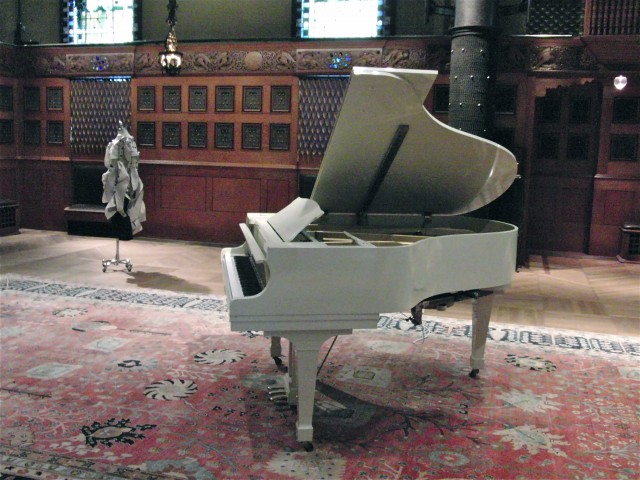
A piano makes a different kind of music in “Martin Creed: The Back Door,” at the Park Ave. Armory through August 7 (photo by twi-ny/mdr)
THE BACK DOOR
Park Ave. Armory
643 Park Ave. between 66th & 67th Sts.
Through August 7, $15 (free with IDNYC card)
212-933-5812
www.armoryonpark.org
www.martincreed.com
UNDERSTANDING
Pier 6, Brooklyn Bridge Park
Through October 23, free, 6:00 am – 11:00 pm
www.publicartfund.org
understanding slideshow
Upon going through the front door of the Park Ave. Armory and entering the lobby to see “Martin Creed: The Back Door,” visitors are greeted by Creed’s recent music video “Understanding,” which features the multidisciplinary British artist playing multiple characters. “We were arguing / And I was saying, ‘I’m a victim’ / And you were saying, ‘I’m a victim’ / And I was saying, ‘I’m a victim,’” Creed sings to a bouncy pop tune. Meanwhile, to the right, a vertical white neon sculpture hangs from the ceiling, slowly turning, with the word “Other” on one side and “People” on the reverse. The pair of works serves as an excellent introduction to Creed, who over the course of his thirty-year career has worn numerous hats (and hairstyles), building an oeuvre that includes painting, sculpture, film, installation, music recordings, performance, and more that challenge the status quo and call into question political and social convention around the world. Given full rein in the first floor of the historic armory, Creed and big-time curators Tom Eccles and Hans-Ulrich Obrist have created a masterful display, emphasizing Creed’s wide diversity and whimsical nature. Doors and curtains open and close, lights go on and off, an object partially blocks entrance to a space, and a piano isn’t used quite as expected. A marching band leads a small procession, an abandoned bar invites curiosity, and short films show people puking, defecating, and, despite physical disabilities, crossing a New York City street without canes, crutches, walkers, or wheelchairs. One room is half-filled with balloons, while another features a wall of abstract portraits that call to mind the dignified paintings of military men that can be found throughout the armory; Creed’s sensibility so takes over that you might find yourself wondering whether certain of the military portraits aren’t pranks made by Creed. In the library, Creed has surreptitiously placed objects in the cabinets that display historical artifacts, exploring the very nature of labels and identification. Also in the library are small vitrines that contain exactly what their names explain they are or where they are: “Work No. 218: A sheet of paper crumpled into a ball,” “Work No. 158: Something on the left, just as you come in, not too high or low,” and “Work No. 74: As many 1″ squares as are necessary cut from 1″ masking tape and piled up, adhesive sides down, to form a 1″ cubic stack.”
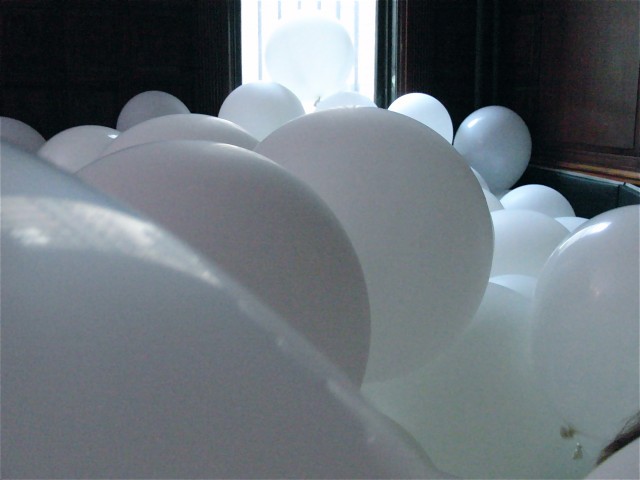
Martin Creed’s “Work No. 2497: Half the air in a given space” allows visitors to play in a room half-filled with white balloons (photo by twi-ny/mdr)
In the Wade Thompson Drill Hall, Creed projects his “Mouth” series onto a massive screen, short videos of people (including his mother) chewing, followed by a surprise at the back of the hall that references, among other things, what eventually happens after one eats. In the bunkers to the side, eighteen of Creed’s videos are on constant loop in different spaces, including “Let Them In” and “Border Control,” which deal with immigration and basic human rights; “Flower Kicking,” in which a man kicks a plant as if it were a soccer ball; the romantic “You’re the One for Me,” in which Creed frolics on a beach and in the ocean; and “Fuck Off,” eighty-one seconds of Creed screaming the title words. “Martin Creed: The Back Door” is an endlessly inventive intervention that confirms once again that the armory is one of the city’s most unusual and exciting places to see exhibitions that can’t be held anywhere else. (On Thursday and Friday nights, the exhibition is open till 10:00, with a bar in one of the period rooms.)
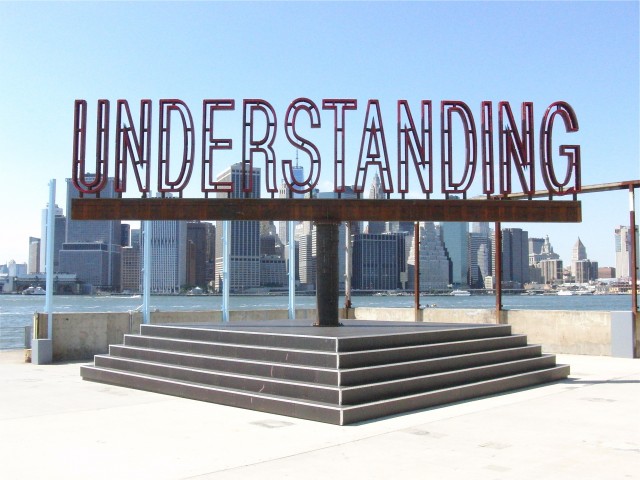
Martin Creed asks for “Understanding” in Brooklyn Bridge Park (photo by twi-ny/mdr)
In a companion piece in Brooklyn Bridge Park, the Turner Prize-winning Creed, who was born in England, raised in Glasgow, and currently lives and works in London, has installed a giant revolving neon sign that very simply declares, “Understanding.” The ten-foot-tall letters, which sit atop a fifty-foot-long steel I-beam, spin around at varying speeds, sometimes coming to a brief stop, giving viewers a chance to reflect on the meaning of the word, whether seen frontward or backward. The kinetic sculpture, a project of the Public Art Fund, is visible from far away, mimicking an advertising sign, or can be viewed up close and personal, with steps that allow you to walk right up to it. As with most of Creed’s works, “Understanding” succeeds on numerous levels, particularly in a world torn apart by xenophobia, racism, hatred, and war. It is also the name of Creed’s most recent single and video, which, as noted above, can be seen in “The Back Door” (and here) and deals with victimhood. (“Understanding” can be found on Creed’s latest album, Thoughts Lined Up, which also includes such songs as “I’m Going to Do Something Soon,” “Everybody Needs Someone to Hate,” “Let’s Come to an Arrangement,” and “Difficult Thoughts.”) In addition, Lower Manhattan is visible through the letters and across the East River, where One World Trade Center has risen in the ashes of the Twin Towers. “Understanding” might seem somewhat quaint and obvious, but that’s part of the point, another thought-provoking work from an iconoclastic virtuoso who is finally getting his due.