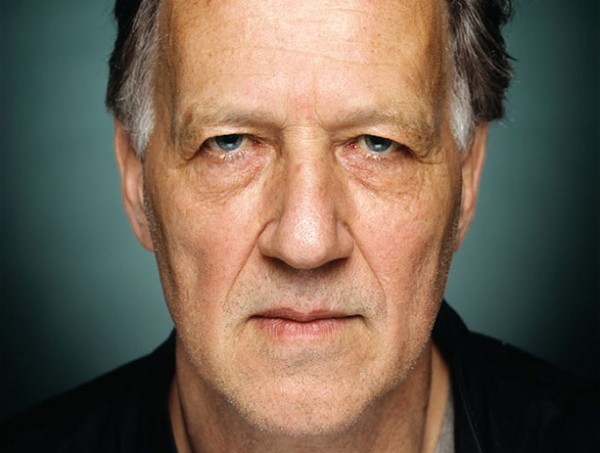
Werner Herzog’s unique journeys into the hearts and minds of unique characters and locations around the world is on full display in IFC Center documentary series (photo by Robin Holland)
ECSTATIC TRUTHS: DOCUMENTARIES BY HERZOG
IFC Center
323 Sixth Ave. at Third St
August 12-18
212-924-7771
www.ifccenter.com
www.wernerherzog.com
No other filmmaker has traveled the world, uncovering unique characters and exotic locations, like Werner Herzog. Born in Munich in 1942, the German writer-director has made more than sixty films across his fascinating career, including such well-regarded fiction works as The Enigma of Kaspar Hauser, Stroszek, Nosferatu the Vampyre, Fitzcarraldo, and Aguirre, the Wrath of God, deeply psychological tales told in boldly original ways. But it’s his nonfiction films that take center stage in the superb IFC Center series “Ecstatic Truths: Documentaries by Herzog.” From August 12 to 18, IFC will screen twenty of Herzog’s docs, many as part of double features. “Every time you make a film you should be prepared to descend into Hell and wrestle it from the claws of the Devil himself,” the German New Wave master warns in the 2014 book Werner Herzog — A Guide for the Perplexed: Conversations with Paul Cronin. In his documentaries, Herzog, who narrates most of them, goes to both Heaven and Hell and beyond while displaying his wry sense of humor. (Over the last few years, he has voiced characters on The Boondocks, The Simpsons, Metalocalypse and American Dad! in addition to making a hysterical cameo on Parks and Recreation.
The series is being held in conjunction with the August 19 release of his latest film, Lo and Behold, Reveries of the Connected World, in which he explores virtual reality. The series kicks off August 12 with 1984’s Ballad of the Little Soldier and 1976’s How Much Wood Would a Woodchuck Chuck, followed by such other seldom-shown flicks as 1993’s Bells from the Deep with 1989’s Herdsmen of the Sun, 1985’s The Dark Glow of the Mountains with 1974’s The Great Ecstasy of Woodcarver Steiner, and 1981’s God’s Angry Man and Huie’s Sermon in addition to some of the more well known films critiqued below. A Lo and Behold poster signed by Herzog will be given away at the opening night 7:30 screening on August 12 of 1971’s Fata Morgana. “The problem isn’t coming up with ideas, it is how to contain the invasion,” he tells Cronin. “My ideas are like uninvited guests. They don’t knock on the door; they climb in through the windows like burglars who show up in the middle of the night and make a racket in the kitchen as they raid the fridge. I don’t sit and ponder which one I should deal with first. The one to be wrestled to the floor before all others is the one coming at me with the most vehemence. I have, over the years, developed methods to deal with the invaders as quickly and efficiently as possible, though the burglars never stop coming.” Herzog’s remarkable films keep coming as well, and IFC Center is now offering a chance to see many rarities on the big screen in this weeklong series named after one of twelve declarations he wrote for the Walker Art Center in 1999: “There are deeper strata of truth in cinema, and there is such a thing as poetic, ecstatic truth. It is mysterious and elusive, and can be reached only through fabrication and imagination and stylization.”
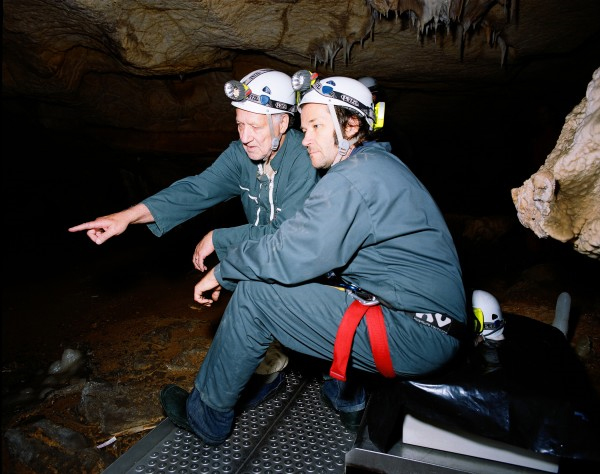
Werner Herzog goes spelunking in 3-D in exciting documentary
CAVE OF FORGOTTEN DREAMS IN 3-D (Werner Herzog, 2010)
Friday, August 12, 10:45, 12:45, 3:00, 5:15, 9:30, and Saturday, August 13, 12:45 pm
www.wernerherzog.com
 An adventurer as much as a filmmaker, German director Werner Herzog has headed into the Amazon in Fitzcarraldo (1982), burning Kuwaiti oil fields in Lessons of Darkness (1992), and Antarctica in Encounters at the End of the World (2008). In his 2010 documentary Cave of Forgotten Dreams, he goes where few have ever gone before. In December 1994, speleologists Jean-Marie Chauvet, Éliette Brunel, and Christian Hillaire discovered the Chauvet-Pont-d’Arc Cave in France, a vast series of chambers filled with remarkable paintings and engravings as well as animal bones, including the skulls of the extinct cave bear. The works were painted onto and carved into the walls, not limited to flat surfaces but around formations that jut out into the cavern. Dating back more than thirty thousand years, they are the oldest cave paintings ever found, well preserved through crystallization over the centuries and now by the intense and careful protection of the French government. Only a handful of scientists have been given access to the cave, until the spring of 2009, when Herzog, who has been entranced by cave paintings since he was twelve years old, was allowed to bring in a shoestring crew using specially devised equipment to film the space over the course of six four-hour sessions. The four-person crew — including Herzog manning the lights and his longtime cinematographer, Peter Zeitlinger, behind the 3-D camera — were not allowed to touch anything and had to stay on a narrow metal walkway that winds through the cave. They were accompanied by a team of specialists on the rare public journey: handprint expert Dominique Baffier, cave bear researcher Michel Philippe, the husband and wife team of Gilles Tosello and Carole Fritz, who map out the social connection between art and archaeology, Jean Clottes, the former director of the Chauvet Cave Research Project, and current director Jean-Michel Geneste. In true Herzog style, he also speaks with a master perfumer and two prehistoric flute archaeologists. Herzog’s decision to use 3-D — for what he says will be the only time in his career — was a stroke of genius, allowing viewers to feel like they’re walking through the cave with him, nearly able to reach out and touch the remarkable drawings, engravings, and skeletons. Herzog’s narration does get too dreamy at times, veering off on philosophical tangents before he adds a cool but silly coda, but, as always, he adds his trademark humor and charm.
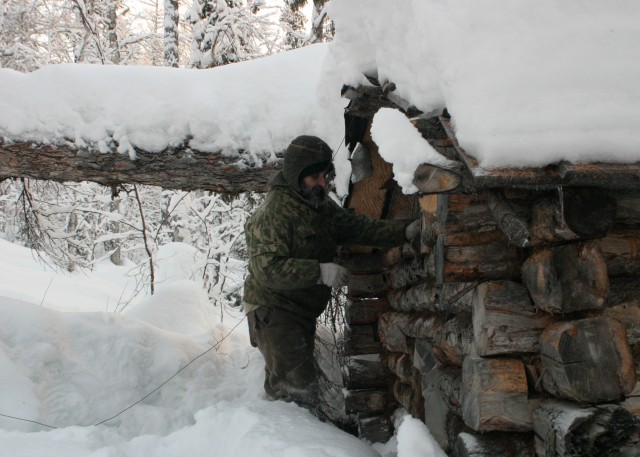
HAPPY PEOPLE explores the fascinating world of Siberian hunters living in virtual solitude year-round
HAPPY PEOPLE: A YEAR IN THE TAIGA (Dmitry Vasyukov & Werner Herzog, 2010)
Saturday, August 13, 10:45 am, and Wednesday, August 17, 10:45, 12:45, 3:00, 5:15, 9:30
www.musicboxfilms.com
 In Happy People: A Year in the Taiga, Werner Herzog and codirector Dmitry Vasyukov follow Russian fur trapper Gennady Soloviev and others as they set their traps and capture their prey, living a solitary existence away from friends and family, but that is exactly how they like it. They do things the old-fashioned way, using the tools and methods of their fathers and their fathers before that, getting by with their hands, their ingenuity, and their brute strength, along with the help of their ever-faithful dogs. Soloviev, who first came to Siberia under the communist regime, decided to stay, doing his part to support the local economy while continuing the Muzhik traditions. He speaks openly and honestly about his daily existence, getting emotional when talking about the bonds he forms with his dogs, and one in particular. The footage was shot several years ago by Vasyukov, and Herzog came upon it quite accidentally, seeing it when paying a surprise visit to a friend. He got in touch with Vasyukov, who allowed Herzog to edit the footage, add a musical score by Klaus Badelt, and write his own English-language narration, which he delivers with great admiration, often getting philosophical about what is being shown onscreen. Unfortunately, the film does not have quite the visual vibrancy of Herzog’s original films, usually shot by cinematographer Peter Zeitlinger, and Herzog’s words lack the personal touch that has made such works as Grizzly Man and My Best Fiend, among many others, so magical. Still, Happy People is a fascinating look at a little-known group of men who live a very different kind of life in the twenty-first century. “You don’t need to pity us; we are proud,” Soloviev told Vasyukov upon learning that Herzog wanted to repurpose the footage. Happy People in no way pities these men, instead celebrating their adherence to the old ways and honoring their intimate connections to nature.
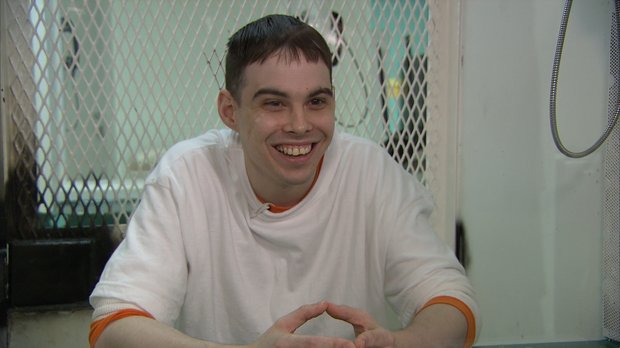
Werner Herzog speaks with Death Row inmate Michael Perry in INTO THE ABYSS
INTO THE ABYSS: A TALE OF DEATH, A TALE OF LIFE (Werner Herzog, 2011)
Sunday, August 14, 12:45, and Tuesday, August 16, 10:45, 12:45, 3:00, 5:15, 9:30
www.wernerherzog.com/films-by.html
Upon meeting convicted murderer Michael James Perry on Death Row eight days before the twenty-eight-year-old was going to be executed by the state of Texas, master filmmaker Werner Herzog tells him, “I have the feeling that destiny, in a way, has dealt you a very bad deck of cards. It does not exonerate you, and when I talk to you, it doesn’t necessarily mean that I have to like you, but I respect you, and you are a human being, and I think human beings should not be executed.” After explaining his personal view on capital punishment, Herzog then lets the rest of the compelling documentary Into the Abyss: A Tale of Death, a Tale of Life play out like a police procedural as he investigates how and why two teenage boys murdered three people in October 2001. Herzog opens the film by speaking with Death House chaplain Rev. Richard Lopez in a potter’s field graveyard, then follows that with four sections that detail the crime, the community in which it occurred, and the family members on both sides of the law affected by the grisly, senseless murders. Herzog divides the film into four primary chapters — “The Crime,” “The Dark Side of Conroe,” “Time and Emptiness,” and “A Glimmer of Hope” — as he talks with the often smiling Perry and his cohort, Jason Aaron Burkett; Lt. Damon Hall, who shares the specific aspects of the murders of Sandra Stotler, her seventeen-year-old son, Adam, and Adam’s friend Jeremy Richardson, supplemented by original crime-scene video; Charles Richardson, Jeremy’s older brother; Lisa Stotler-Balloun, Adam’s sister, who has seen more than her fair share of loss; Melyssa Thompson-Burkett, who fell in love with Burkett after he was incarcerated; Delbert Burkett, Jason’s stepfather, who is also behind bars; and Captain Fred Allen, who oversaw executions in the Huntsville prison. Herzog asks penetrating but not leading questions that get the subjects to talk openly and honestly about the crime and its aftermath and their lives in general, many of which seem trapped in a vicious cycle of violence, jail, poor education, and other endless hardships. Into the Abyss is a powerful film that, because of Herzog’s extremely sensitive handling of an extremely controversial topic, is not nearly as polemical or political as it could have been.
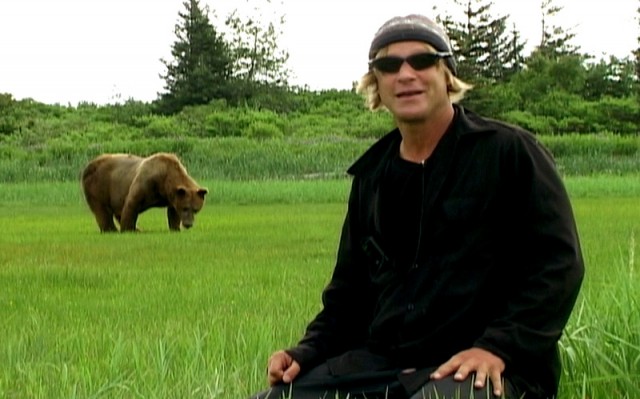
Timothy Treadwell learns a rather painful lesson about living with bears in GRIZZLY MAN
GRIZZLY MAN (Werner Herzog, 2005)
Sunday, August 14, 10:45 & 9:30, and Thursday, August 18, 10:45, 12:45, 3:00, 5:15
www.grizzlypeople.com
 For thirteen straight summers, Timothy Treadwell ventured into the wilds of Katmai National Park in Alaska, where he lived among grizzly bears. For the last five of those years, he brought along a video camera and detailed his life with them and his battle to protect the bears (all of which he named) from poachers. “I have no idea if there’s a God, but if there’s a God, God would be very, very pleased with me,” Treadwell says into his camera in Werner Herzog’s brilliant documentary Grizzly Man, “because he can just watch me, how much I love them, how much I adore them, how respectful I am of them, how I am one of them. . . . Be warned: I will die for these animals, I will die for these animals, I will die for these animals. Thank you so much for letting me do this. Thank you so much to these animals for giving me a life. I had no life. Now I have a life.” In October 2003, Treadwell and his girlfriend, Amie Huguenard, were brutally killed and eaten by one of the bears. Herzog, who knows a little something about filming in treacherous locations (Fitzcarraldo, Little Dieter Needs to Fly, Aguirre, the Wrath of God), made Grizzly Man from more than one hundred hours of tape, supplementing that with interviews with Treadwell’s friends and family. They all talk about a much-loved but troubled man who was desperate to be famous. His life with the bears got him onto television with Rosie O’Donnell and David Letterman, but it also got him killed, which some people think was what he deserved for crossing the line and thinking he could survive living with grizzlies. But Herzog shows him to be a thoughtful, compassionate man who just might have found his true purpose in life. (To find out more about Treadwell, check out The Grizzly Man Diaries here.). Although the film, which features a gorgeous score by Richard Thompson, won or was nominated for numerous awards (including editing, directing, and best documentary), it was curiously shut out at the Oscars.