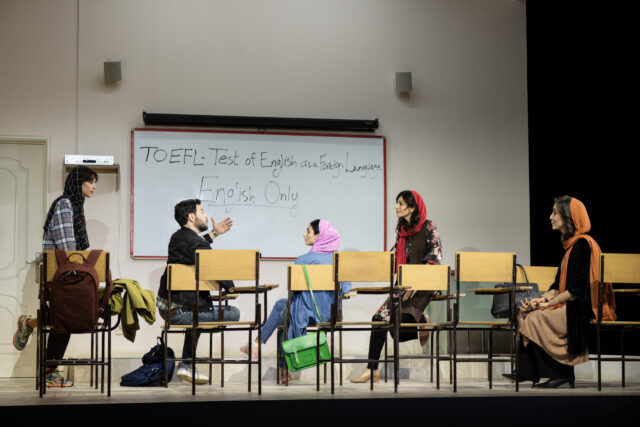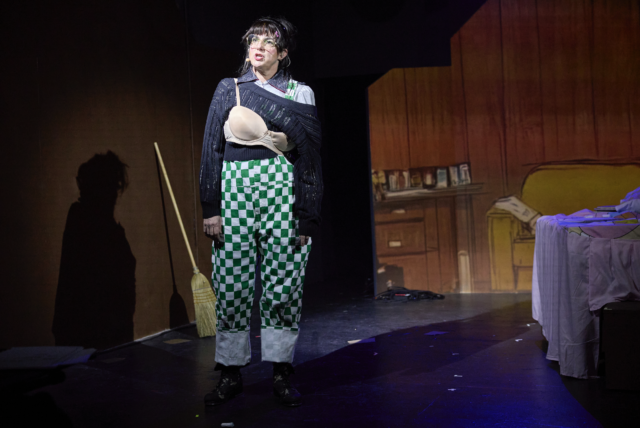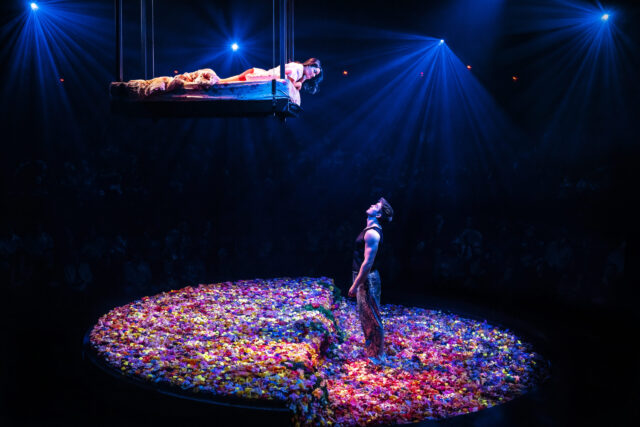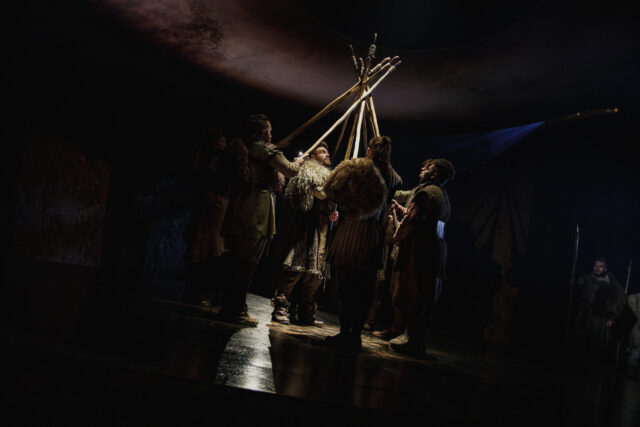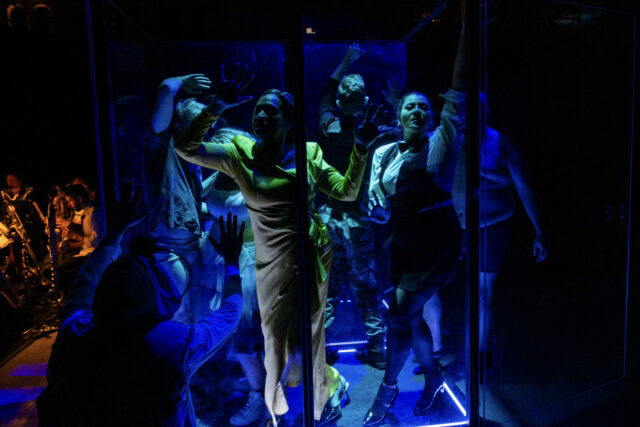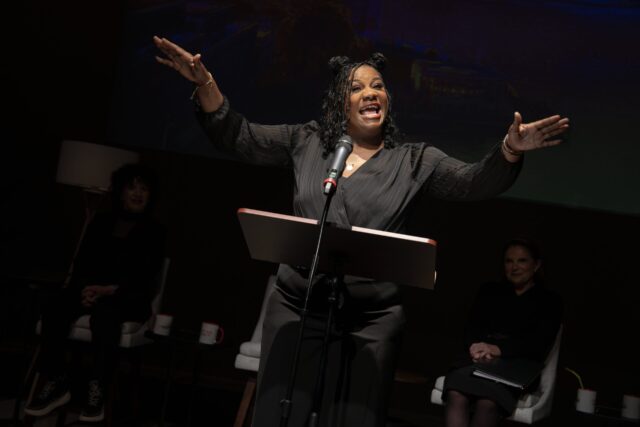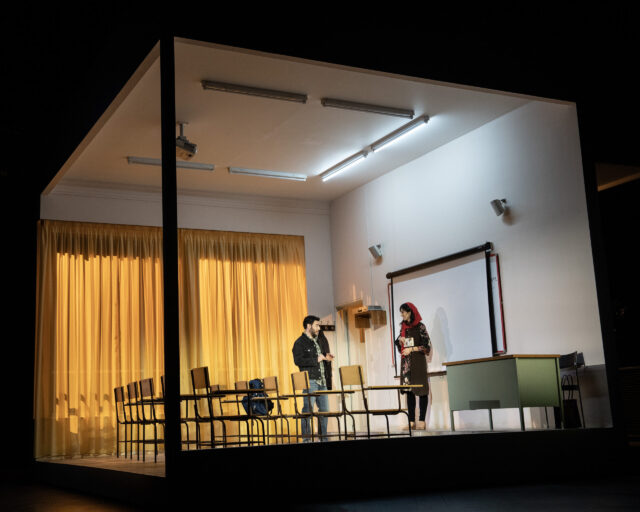
Table 17 goes back and forth in time as a couple looks at their past, present, and future (photo by Daniel J. Vasquez)
TABLE 17
Susan & Ronald Frankel Theater
Robert W. Wilson MCC Theater Space
511 West Fifty-Second St. between Tenth & Eleventh Aves.
Through September 29, $60-$150 mcctheater.org
Writer Douglas Lyons and director Zhailon Levingston have followed up their sweet and savory 2021 Broadway debut, Chicken & Biscuits, with another culinary collaboration, MCC Theater’s Table 17, although this one is more appetizer and dessert, skipping the main course.
The eighty-five-minute play was inspired by Lyons’s admiration of Black rom-coms, including Love & Basketball,How Stella Got Her Groove Back,Poetic Justice, and Love Jones; posters of various films line the hallway lobby. Each audience member gets a pseudo menu for a restaurant called Bianca’s, which has information about the show and “Today’s Special,” a message from Lyons that asks everyone to “unbutton your top button, the pants too, and let yourself be. When the characters ask you for advice, don’t be shy, talk to ’em.”
Jason Sherwood’s set features sixteen glowing white tables surrounding a round platform where another table sits under a disco ball; at the back of the stage is a long wall with compartments that can open, changing from windows to plush cushions to bars with glasses and bottles, with embedded LED and neon lighting by Ben Stanton.
The incomparable Kara Young, who has been nominated for three Tonys in successive years, 2022, 2023, and 2024, as Best Featured Actress for Clyde’s,Cost of Living, and Purlie Victorious: A Non-Confederate Romp Through the Cotton Patch, winning for the last one, stars as Jada Cory, a frantically harried young woman who enters to Chaka Khan’s “I’m Every Woman” and asks the audience whether she should change her outfit as she gets ready to meet her ex-fiancé for the first time in two years. “Him calling outta the blue caught me off guard,” she explains. “But, I know Dallas. His pride would not allow him to reach out to me unless he missed me. And I mean, why wouldn’t he?”
Playwright, filmmaker, and actor Biko Eisen-Martin (soft,3rd and Palou) is Dallas Thompson, a would-be smooth operator who thinks he looks great in corduroy and enters to Usher’s “Nice & Slow.” “Do I miss her? I can’t say I don’t,” he says. “But, if I was saying I did, I’d wanna know she missed me first, before I admitted it. Though, this ain’t me admittin’ it — so, chill out.”
Dallas Thompson (Biko Eisen-Martin) and Jada Cory (Kara Young) rehash old times in MCC world premiere (photo by Daniel J. Vasquez)
And Michael Rishawn, who originated roles in Handjob and Ain’t No Mo’, takes on multiple roles, from snarky restaurant host River Wilks to a cocky bartender who brags about his success with women to Eric, a flight attendant colleague of Jada’s.
As Jada and Dallas play a kind of cat-and-mouse game in the present over whether they are still attracted to each other, the narrative is interrupted by flashbacks to their meet cute, blossoming romance, and eventual breakup. It’s also interrupted by River, who has to be their server as well that evening, offering such pearls of wisdom as “Life sucks, don’t it?” and, when Jada asks him to recommend a dish, “No, I work here. I don’t eat here.”
Young is a delight to watch, even when she goes over the top; she is a master of physical comedy and hilarious facial expressions. Eisen-Martin is steadfast as Dallas, who thinks he’s a lot more cool, calm, and collected than he really is. And Rishawn is a barrel of energy switching among his parts, although he too often takes things too far, the comic relief becoming too absurd.
Like so many rom-coms, Table 17 is light fare that goes down easy, a tasty eighty-five-minute morsel that doesn’t have a lot of meat on its bones but is still yummy.
[Mark Rifkin is a Brooklyn-born, Manhattan-based writer and editor; you can follow him on Substack here.]
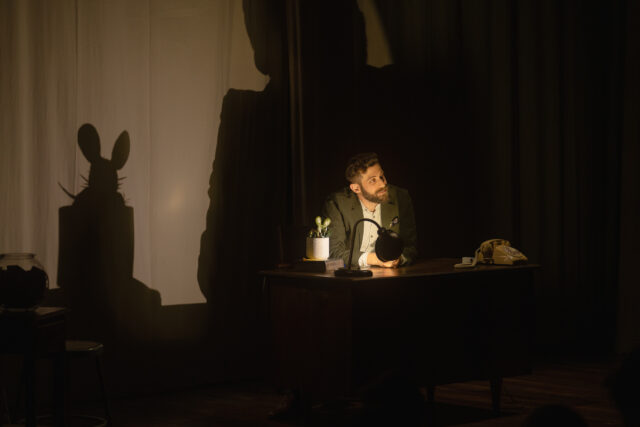
Ivan (Mark Eydelshteyn) and Ani (Mikey Madison) set off on a frenetic romance in Anora
MAIN SLATE: ANORA (Sean Baker, 2024)
Film at Lincoln Center
Saturday, September 28, 6:15
Sunday, September 29, noon www.filmlinc.org
The sixty-second edition of the New York Film Festival is under way, and the first standout is Sean Baker’s Anora.
Winner of the Palme d’Or at Cannes, Anora is a nonstop wild ride through the frenetic, unpredictable relationship between a stripper and the scion of a Russian oligarch. It starts out luridly but quickly morphs into a touching and surprisingly human tale.
Mikey Madison, who starred in the 2022 Scream sequel, shows off her mighty pipes in the film, making a career breakthrough as Ani, a stripper living in a Brighton Beach railroad apartment who catches the eye of Ivan Zakharov (Mark Eydelshteyn), who buys her for a week, lighting up the nights in a cavalcade of sex and drugs while developing what appears to be turning into a real relationship. But when his parents, Nikolai (Aleksei Serebryakov) and Galina (Darya Ekamasova), find out about it, they sic their guard dogs, Igor (Yura Borisov), Toros (Karren Karagulian), and Garnick (Vache Tovmasyan), on them, leading to hilariously violent scenes as Ani sets out to prove that she is not a hooker and is not ashamed of being a sex worker.
Written, edited, and directed by Baker, whose previous work includes Take Out,Tangerine,The Florida Project, and Red Rocket,Anora is an aggressive, in-your-face trip that races from Coney Island to Las Vegas, with lush cinematography by Drew Daniels, a pulsating score by Matthew Hearon-Smith, and fanciful costumes by Jocelyn Pierce.
Madison, a regular on Better Things and Lady in the Lake, is fearless as Ani, a determined young woman who knows what she wants and is not afraid to say it out loud and fight for it. The coda is disappointing — it would have been much better if the film ended before the final moments in the car — but otherwise Anora is a thrilling cinematic experience.
Anora is screening September 28 and 29, with Baker and Madison on hand for Q&As. The ferocious film will then return to Lincoln Center for a theatrical run in mid-October, with Baker and Madison participating in Q&As October 16 and 18. Keep watching this space for more reviews from NYFF62.
Iris (Isabelle Huppert) takes notes while teaching Isong (Kim Seungyun) French in Hong Sangsoo’s A Traveler’s Needs
MAIN SLATE: A TRAVELER’S NEEDS (Hong Sangsoo, 2024)
Film at Lincoln Center
Wednesday, October 2, 9:00
Thursday, October 3, 6:15 www.filmlinc.org
Longtime New York Film Festival favorite Hong Sangsoo returns to Lincoln Center with two touching works for NYFF62. For nearly thirty years, the South Korean Hong has been making contemplative, character-driven films in which writers or directors develop different kinds of relationships with actors, fans, students, and other admirers amid a lot of drinking, eating, and smoking as they discuss art, love, human nature, and film itself.
In such gems asOki’s Movie,The Day He Arrives,Yourself and Yours,Like You Know It All, and Right Now, Wrong Then, Hong constructs slow-paced, intriguing philosophical narratives in which not much necessarily happens but nearly every minute is imbued with meaning.
In A Traveler’s Needs, Isabelle Huppert, in her third Hong film (following 2012’s In Another Country and 2017’s Claire’s Camera), stars as Iris, a mysterious Frenchwoman who seems to just appear and disappear; we know almost nothing about her or why she is in Seoul.
When we first encounter her, she is teaching French to a young pianist, Isong (Kim Seungyun), asking her questions using index cards and an old cassette recorder that looks almost like a toy. We soon find out that Iris is not a trained teacher but someone who only recently developed her unique method, which involves asking her students how they feel deep inside, and that she has no idea if it will actually work.
Iris, who dresses like she is on vacation, wearing a flowery dress, green sweater, and wide-brimmed hat, next visits Wonju (Lee Hyeyoung) and her husband, Haesoon (Kwon Haehyo), to teach them French. Wonju is suspicious of Iris and her technique, but as they partake of more of the milky rice wine known as makgeolli, everyone loosens up a bit.
Later, Iris returns home, to an apartment she shares with Inguk (Ha Seongguk), a younger man who is not quite ready to introduce her to his mother, Yeonhee (Cho Yunhee), although the relationship between Inguk and Iris is unclear.
So how does A Traveler’s Needs make you feel? Like many of Hong’s films, it’s a calm tale featuring lots of conversation and long takes, highlighted by another superb performance by Huppert. It might be best exemplified by a scene in which Iris approaches a tiny river, takes off her shoes, steps into the water, looks around while humming, and drops one of her shoes. It’s hard to tell if it was supposed to happen, but Huppert lets out an adorable sigh, picks it up, shakes it out, and carries on.
Hong also incorporates an oddly endearing repetition in the film, in dialogue, character traits, and Iris’s movement, particularly how she walks when she exits a scene. She practically floats in and out of her world, innocent and carefree, like a child. Hong’s camera loves her — he wrote, directed, photographed, produced, and edited the film in addition to composing the score — and so will you.
A Traveler’s Needs is screening October 2 at 9:00 and October 3 at 6:15, with Huppert participating in Q&As after each show; she will also return to Lincoln Center November 21 for a Q&A when the film opens at the Walter Reade Theater.
Jeonim (Kim Minhee) and her uncle, Chu Sieon (Kwon Haehyo), reunite at a university in By the Stream
MAIN SLATE: BY THE STREAM (Hong Sangsoo, 2024)
Film at Lincoln Center
Friday, October 4, 9:00
Friday, October 11, 6:45 www.filmlinc.org
“I’ll light the smallest lamp in the corner and protect it until I die,” a college student tells Chu Sieon (Kwon Haehyo) when he asks four young women what they want to do in the future in Hong Sangsoo’s By the Stream. It’s a subtle admission in a subtle film filled with small lamps in corners, literally and figuratively.
Hong wrote, edited, produced, directed, photographed, and composed the score for the film, another intimate, eloquent drama about people just going about their daily lives, eating, drinking, and talking about creativity and love. It takes place on a lovely campus at a woman’s university in Seoul, where it’s time for the annual skit contest, when the various departments put on ten-minute shows. Art professor Jeonim (Kim Minhee) is in a jam when the director in charge of the script for her department has been kicked out after sleeping with three of the students.
Jeonim makes a desperate call to her uncle, Chu, a onetime popular actor who was canceled for unstated reasons and has been running a small bookstore on a remote lake for decades. Niece and uncle have not spoken for ten years, but Sieon accepts the offer, returning to the school where he got his start forty years before. While the four art students are not exactly psyched about the script he has written for them, the head of the department, Jeong (Cho Yunhee), is instantly smitten with him, an adoring fan who wants to spend more and more time with him — and he doesn’t seem to mind all the attention.
With skit night approaching, Jeonim, Sieon, and Jeong do a lot of eating, talking, and drinking, enjoying eel and the milk rice wine known as makgeolli, as relationships grow more complicated and characters reexamine who they are and what they want.
By the Stream is Hong’s thirty-second film since his debut, 1996’s The Day a Pig Fell into the Well. It’s also the thirteenth Hong film Kim has starred in; they began an affair in 2015 — they are both separated from their spouses, with whom they have children, which caused a scandal in South Korea — and Kim, an award-winning international star, has not worked for another director since Park Chan-wook’s 2016 The Handmaiden. Hong is twenty-two years older than Kim; Kwon is seventeen years older than Cho. That is not to imply that By the Stream is autobiographical, but it appears to have personal elements that add intrigue to the gentle magic of the storytelling and characterization.
Kim won the Best Performance award at Locarno for her role as Jeonim, who spends much of her time drawing the ripples in a stream, the water ever changing and constantly moving, like life. She then re-creates the patterns on her loom, finding solace in making art. Chu is reenergized by his decision to direct the skit, interacting with people as he hasn’t since isolating himself at his bookstore. And Jeong shows a different side of herself as she becomes a fan girl forming a connection with the object of her affection.
Hong often leaves his camera fixed as the action unfolds, particularly when the three protagonists are at tables, eating, drinking, and talking, composing a kind of flowing, ever-changing portrait. Water has been a leitmotif throughout Hong’s career; several of his films have the words water,river,beach, and stream in them, and in others, water plays a part, like the beautiful scene in A Traveler’s Needs when Iris (Isabelle Huppert) steps into a small stream.
As in so many of Hong’s works, By the Stream proceeds at its own hypnotic pace, offering profound if understated treatises on the little things in life, like that small lamp in the corner.
Larry Cotton (Andrew Robinson) and his daughter, Kirsty (Ashley Laurence), have their hands full in Hellraiser
REVIVALS: HELLRAISER (Clive Barker, 1987)
Saturday, October 5, 9:15
Wednesday, October 9, 1:00 www.filmlinc.org
“What’s your pleasure?” an unseen character asks at the beginning and end of Clive Barker’s Hellraiser, now screening at NYFF62 in a 4K restoration. Adapted from his novella The Hellbound Heart, the horror film made quite a splash when it was released in 1987, and its legacy as a genre classic has only grown over the years, despite, not because of, nine sequels, none of which Barker wrote or directed. The film faced bans and censorship, so Barker had to make some concessions, editing certain ultraviolent and S&M scenes, but there are still plenty in there to justify its cult status.
“We did a version which had some spanking in it and the MPAA was not very appreciative of that,” Barker said in the DVD audio commentary. “[They also] told me I was allowed two consecutive buttock thrusts from Frank but a third would be deemed obscene.”
The film begins with Frank Cotton (Sean Chapman) in Morocco acquiring a puzzle box and, upon solving it in his suburban American home, getting sent to a hell realm where pain mixes with pleasure, a decadent take on the hot nightclub scene of the 1980s. Years later, Frank’s brother, Larry (Andrew Robinson), returns to the family homestead with his second wife, Julia (Clare Higgins), who unbeknownst to him had a torrid affair with Frank. Larry’s daughter, Kirsty (Ashley Laurence), shows up to provide support, but it’s instantly clear that she and Julia are not besties.
When Larry severely cuts his hand while helping the creepy movers bring a bed upstairs, the blood oozes into the floorboards and awakens Frank, who is a skinless terrifying creature (portrayed by Oliver Smith). Frank reveals to Julia, who still has the hots for him, that he can regain his skin and they can have a life together if she feeds him other human beings, so she hits the bars, bringing men home to be devoured by her lover. Larry is completely oblivious to what is going on right under his nose, but Kirsty grows suspicious, leading to an appropriately blood-soaked, out-of-this-world climax.
Hellraiser is most remembered and revered for the Cenobites, ghoulish S&M characters known as the Chatterer (Nicholas Vince), Butterball (Simon Bamford), the unnamed female (Grace Kirby), and their leader, Pinhead (Doug Bradley), who became a breakout star. The general plot is derivative and the acting has a heavy dose of soap opera attitude, but Barker pushes it all beyond the limits of standard genre fare, toying with cliché so you won’t always know what’s coming. Christopher Young’s score, Michael Buchanan’s production design, Jocelyn James’s art direction, and Aileen Seaton’s hair stylings capture the ’80s sensibility and look better than ever in the restoration, as do the special effects and intense makeup and costumes.
All in all, this version of Hellraiser provides the answer to the question “What’s your pleasure?”
Prabha (Kani Kusruti) takes a new look at her life in All We Imagine as Light
MAIN SLATE: ALL WE IMAGINE AS LIGHT (Payal Kapadia, 2024)
Film at Lincoln Center
Monday, October 7, 6:00
Tuesday, October 8, 9:15
Free talk Wednesday, October 9, 4:00
Thursday, October 10, 3:30 www.filmlinc.org
Indian filmmaker Payal Kapadia won the Golden Eye at Cannes in 2021 for best documentary for A Night of Knowing Nothing, a film that mixes fact and fiction while telling the story of two lovers trying to stay connected via letters amid student protests in India. Kapadia mixes fact and fiction again in her follow-up, the tender and deeply poignant All We Imagine as Light, which won the Grand Prix at Cannes earlier this year.
The new work opens with gritty shots of the streets of Mumbai, as unseen people share their difficulties trying to make a new life for themselves after migrating from the country. “There’s always the feeling I’ll have to leave,” one person says. Another opines, “The city takes time away from you.” A third argues, “Why would anyone want to move back?”
Kapadia, who was born in Mumbai, then shifts to the fictional tale of two nurses and a third hospital employee fighting loneliness as they care for sick people. Prabha (a heart-wrenching Kani Kusruti) and the younger Anu (Divya Prabha) live together in an apartment in the city. Prabha, who is in an arranged marriage, has not seen her husband, who is working in Germany, for more than a year. Anu, whose family is Hindi, is in love with a Muslim man, Shiaz (Hridhu Haroon), keeping their relationship secret for fear of being discovered and shunned. And Parvaty (Chhaya Kadam) is a recent widow who is being evicted from her home of twenty-two years because her name is nowhere on the paperwork left behind by her husband.
When Prabha receives a brand-new German rice cooker in the mail, she assumes it is from her spouse, perhaps a message that he is not coming back and that she should proceed with her life. But she is tentative to start dating, even as she is pursued by the goofy but sweet Dr. Manoj (Azees Nedumangad), who writes poetry for her.
The three women decide to hit the road, taking a trip to Parvaty’s seaside Maharashtrian hometown, where they take stock of their lives, particularly after a man washes up onshore.
All We Imagine as Light is sensitively shot by cinematographer Ranabir Das, with a soft, jazzy score by Topshe as soft rain falls, trains pass by in the background, and Prabha and Parvaty throw stones at a billboard for a pending skyscraper that proclaims, “CLASS is a privilege reserved for the PRIVILEGED.”
All We Imagine as Light is an engaging and touchingly lyrical look at womanhood in contemporary Mumbai, as the city threatens three women with potential isolation and alienation until they bind together. The youngest, Anu, instills new energy into the others to reevaluate their situations and take action. “Do you ever think of the future?” Anu asks.
The film appropriately provides no firm answers in the end, but it is clear that Kapadia’s future is a bright one.
All We Imagine as Light is screening at NYFF62 on October 7, 8, and 10, with the writer-director participating in Q&As following the first two showings. She will also be at the Amphitheater at the Elinor Bunin Munroe Film Center on October 9 at 4:00 for a free talk with Portuguese director Miguel Gomes, whose Grand Tour is screening October 8, 9, and 11 at the festival.
[Mark Rifkin is a Brooklyn-born, Manhattan-based writer and editor; you can follow him on Substack here.]
NYFF62: FREE TALKS
New York Film Festival
Elinor Bunin Munroe Amphitheater
144 West Sixty-Fifth St. between Broadway & Amsterdam Ave.
September 28 – October 11, free tickets available one hour before showtime (unless otherwise noted) www.filmlinc.org
The sixty-second annual New York Film Festival kicks off today, with more than ninety feature films and shorts, from US premieres to unexpected revivals. The opening night selection is RaMell Ross’s Nickel Boys, the centerpiece Pedro Almodóvar’s The Room Next Door, and the closing night choice Steve McQueen’s Blitz. Many screenings will be followed by Q&As with members of the cast and crew, including Saoirse Ronan, Sean Baker, Mikey Madison, Adrien Brody, Felicity Jones, Jia Zhangke, Mike Leigh, Marianne Jean-Baptiste, Paul Schrader, David Cronenberg, Isabelle Huppert, Elton John, Selena Gomez, Zoe Saldaña, Naomi Watts, and Bill Murray.
In addition, there are free talks nearly every day in the Elinor Bunin Munroe Amphitheater that will go behind the scenes of numerous films at the festival; no advance RSVP is required except for a few special events.
Saturday, September 28, 7:30
Sunday, September 29, 8:00
Monday, September 30, 7:30
Tuesday, October 8, 7:30
Cinephile Game Night: NYFF62 Edition, including movie trivia, Six Degrees, a card game, prizes, and special guests, hosted by Jordan Raup, Conor O’Donnell, and Dan Mecca, Amphitheater, free with advance RSVP
Sunday, September 29
Deep Focus: RaMell Ross (Nickel Boys), in conversation with Barry Jenkins, Amphitheater, 6:00
Monday, September 30
Roundtables: New Asian Auteurs, with Neo Sora (Happyend), Trương Minh Quý (Việt and Nam), and Yeo Siew Hua (Stranger Eyes), Amphitheater, 4:30
Tuesday, October 1
Deep Focus: No Other Land, with directors Basel Adra, Yuval Abraham, and Rachel Szor, Amphitheater, 6:00
Wednesday, October 2 On exergue – on documenta 14, with director Dimitris Athiridis, curator Adam Szymczyk, D14 artist Naeem Mohaiemen, and curator and writer Serubiri Moses, moderated by Rachael Rakes, Amphitheater, 5:00
Thursday, October 3
Crosscuts: Alex Ross Perry (Pavements) & Andrei Ujică (TWST / Things We Said Today), Amphitheater, 6:00
Saturday, October 5
Deep Focus: Sigrid Nunez (The Friend,The Room Next Door), moderated by A. O. Scott, Amphitheater, 1:00
Film Comment Live: Collective Protagonists, with Rob Nilsson and John Hanson (Northern Lights), Brett Story and Stephen Maing (Union), moderated by Devika Girish and Clinton Krute, Amphitheater, 7:00
Sunday, October 6
Crosscuts: Zeinabu irene Davis (Compensation) & Madeleine Hunt-Ehrlich (The Ballad of Suzanne Césaire), Amphitheater, 6:00
Monday, October 7
IndieWire Presents: Screen Talk Live, with Anne Thompson and Ryan Lattanzio, Amphitheater, 4:00
Tuesday, October 8
The 2024 Amos Vogel Lecture: Jia Zhangke (Caught by the Tides), interpreted by Vincent Cheng, Walter Reade Theater, $12.50-$17.50, 5:00
Wednesday, October 9
Crosscuts: Miguel Gomes (Grand Tour) & Payal Kapadia (All We Imagine as Light), moderated by Devika Girish, Amphitheater, 4:00
Crosscuts: Julia Loktev (My Undesirable Friends: Part I — Last Air in Moscow) & Roberto Minervini (The Damned), moderated by Madeline Whittle, Amphitheater, 6:00
Friday, October 11
Film Comment Live: Festival Report, with Devika Girish and Clinton Krute, Amphitheater, 7:00
[Mark Rifkin is a Brooklyn-born, Manhattan-based writer and editor; you can follow him on Substack here.]
Tom Hewitt gives an unforgettable performance in Aaron Mark’s darkly mesmerizing Another Medea (photo by Aaron Mark)
ANOTHER MEDEA
Sheen Center for Thought and Culture
Frank Shiner Theater
18 Bleecker St. between Mott & Elizabeth Sts.
Tuesday, October 8, $53-$78, 7:30 Medea: Re-Versed continues through October 13 www.redbulltheater.com
In conjunction with its presentation of Medea: Re-Versed, Luis Quintero’s hip-hop reimagining of the Euripides tragedy, Red Bull is hosting a one-night-only special Revelation Reading encore performance of Aaron Mark’s Another Medea, taking place October 8 at the Sheen Center. “Funny, insightful, and haunting, it is a fascinating contemporary play about a disarming psychopath and also a twisted love letter to classical theater,” Red Bull founding artistic director Jesse Berger said in a statement. “With the inimitable Tom Hewitt as our guide to this labyrinth, audiences are in for a deceptively simple and revelatory theatrical journey.”
Below is my original review of the show when it ran in October 2013 at the All for One Solo Theater festival at the Cherry Lane; it was originally produced earlier that year at the Duplex in the West Village and then New York Theatre Workshop at Dartmouth and later played at the Wild Project.
Aaron Mark’s Another Medea is as intense and gripping a show as you’re ever likely to see, a harrowing examination of Euripides’s Medea myth, set in modern-day New York City. The eighty-minute one-man show is spectacularly acted by Tom Hewitt, in a 180-degree turn from his Broadway resume, which includes such villainous musical characters as Dr. Frank N Furter in The Rocky Horror Show, Billy Flynn in Chicago, Scar in The Lion King, and Pontius Pilate in Jesus Christ Superstar. Hewitt plays an actor determined to meet fellow thespian Marcus Sharp, who is in prison for committing a horrific crime. For most of the show, Hewitt is seated behind a small table, retelling the story that Sharp told his onetime understudy when they finally met.
Sharp shares his tale in precise, exacting detail, using multiple voices as he talks about his relationship with a wealthy British doctor named Jason, one that ends in heartbreaking tragedy. Writer-director Mark (Commentary, Failed Suicide Attempts, Random Unrelated Projects) wrote the show specifically for Hewitt, who is performing it at the third annual All for One Theater Festival at the Cherry Lane Studio Theatre (and for the first time without the script in front of him). Hewitt is nothing short of breathtaking, immersing himself in the role of an extremely complex and conflicted character whose crime is unfortunately all too familiar in these difficult times. His mastery of the material is stunning, poetically delivered without calling attention to itself. Brutal and beautiful at the same time, Another Medea is a one-of-a-kind theatrical experience that deserves to have a longer life in a bigger venue.
[Mark Rifkin is a Brooklyn-born, Manhattan-based writer and editor; you can follow him on Substack here.]
Who: Roberta Wallach, Penny Fuller, James Naughton, Michael Citriniti What:Staged reading Where:Ethical Culture Society, 2 West Sixty-Fourth St., Ceremonial Hall, 646-366-9340 When: Thursday, September 26, $25, 2:00 Why: “Life goes on. With or without you. You can either shut down or join in,” Nick Springer once said. On September 26 at 2:00, the life of the Paralympic gold medalist will be honored with a staged reading of the new play Someone Is Sending a Message, taking place at the New York Society for Ethical Culture’s Ceremonial Hall. Springer, a quadriplegic who won his gold in wheelchair rugby at the 2008 Beijing Games, died in April 2021 at the age of thirty-five; he had contracted meningococcal meningitis in 1999 but led a courageous fight to make the most of his life. “A lot of people look at me like I’m fragile,” he told the New York Times in 2003. “Sports gives me a chance to get out there and bang myself up.”
Written by Susan Charlotte, directed by Antony Marsellis, and presented by Cause Célèbre, the play features Drama Desk nominee Roberta Wallach, Tony nominee Penny Fuller, two-time Tony winner James Naughton, and Michael Citriniti in a story about an artist friend of Nick’s who must face her future without him as well as her brother, who also passed away in his thirties. Tickets are $25 for this special event.
Axis puts a dark spin on Shakespeare’s Twelfth Night (photo by Pavel Antonov)
TWELFTH NIGHT
Axis Theatre Company
One Sheridan Sq. between West Fourth & Washington Sts.
Wednesday – Saturday, September 25 – October 26, $11-$44, 8:00
866-811-4111 www.axiscompany.org
Following its initial run earlier this year, Axis’s dark and involving theatrical adaptation of Twelfth Night is back at the company’s Sheridan Square home for an encore engagement running September 25 to October 26. Below is twi-ny’s original review from May.
I described the last two productions I saw of William Shakespeare’s 1601–02 Twelfth Night as “light and lively,” “ecstatic,” “a joy to behold,” and “a pure delight.” I would not use any of those words to describe Axis Theatre Company’s streamlined new production, but that won’t stop me from heartily recommending it.
Shakespeare professor Marc Palmieri’s adaptation focuses on the darker side of this mistaken-identity romantic comedy about unrequited love, which has been trimmed to a fast-paced ninety minutes. David Zeffren’s lighting remains dim throughout on director Randall Sharp’s haunting stage, where actors are surrounded by large rectangular blocks and shadowy entrances; in one corner, guitarist and sound designer Paul Carbonara and pianist Yonatan Gutfeld (the keyboards are embedded in one of the blocks) perform Carbonara’s subtle Baroque-like score. Karl Ruckdeschel’s costumes — men’s suits and long coats, women’s gowns — are muted grays, lavenders, and earth tones; even Malvolio’s socks are a subdued yellow, not as garishly ridiculous as usual.
“If music be the food of love, play on / Give me excess of it,” Duke Orsino (Jon McCormick) declares as the show begins. The story is familiar to Shakespeare aficionados: In faraway Illyria, the wealthy countess Olivia (Katy Frame) rejects all suitors, including Orsino, who is in love with her. Her loyal steward, Malvolio (Axis producing director Brian Barnhart), also harbors a secret passion for the noblewoman. Twins Viola (Britt Genelin) and Sebastian (Eli Bridges) survive a shipwreck and wash up onshore, each ignorant that the other is still alive. One of the duke’s gentlemen, Curio (Robert Ierardi), explains to Viola, who has now disguised herself as a man named Cesario, that Olivia keeps repulsing Orsino’s advances. Viola quickly decides that she will convince Olivia to see Orsino in order to secure a place for herself in the duke’s employ.
Sebastian was rescued by Antonio (Jim Sterling), a sea captain who requests to be his servant. Believing his sister to be dead, Sebastian disguises himself as Roderigo and heads to the court of Orsino, where Antonio is not welcome.
Meanwhile, a group of conniving drunks hover around Olivia: her uncle, the raunchy Sir Toby Belch (George Demas); Sir Toby’s friend, the faux-elegant squire Sir Andrew Aguecheek (Andrew Dawson), who Sir Toby presents to Olivia as a potential suitor; Olivia’s chambermaid, Maria (Dee Pelletier); Olivia’s fool, Feste (Spencer Aste); and her servant Fabian (Brian Parks). “You must confine yourself within the modest limits of order,” Maria warns Sir Toby, who replies, “Confine! I’ll confine myself no finer than I am: these clothes are good enough to drink in; and so be these boots too.”
Axis Theatre Company’s Bard adaptation is back for an encore engagement (photo by Pavel Antonov)
After Malvolio chastises them for their ill behavior, Sir Toby, Sir Andrew, Feste, and Fabian, under Maria’s lead, concoct a plan to embarrass Malvolio in front of everyone. Maria explains, “Marry, sir, sometimes he is a kind and affectioned ass / the best persuaded of himself, so crammed, as he thinks / with excellencies, that it is his grounds of faith / that all that look on him love him / and on that vice in him will my revenge find / notable cause to work.”
It all comes to a head in a grand finale that, while not as boisterous as in other iterations, is as satisfying in its exactitude.
Axis refers to Twelfth Night as “Shakespeare’s most painful comedy,” and that’s just what Sharp, Palmieri, and the superb cast deliver. The company’s dungeonlike space on Sheridan Square is tailor-made for eerie, chimeric stories bathed in gloom, doom, and gothic and apocalyptic humor. In such previous works as High Noon,Dead End,Last Man Club, and Worlds Fair Inn, Axis founding artistic director Sharp has presented stark, compelling productions heavy in dark atmosphere but not without comic moments.
In this Twelfth Night, Olivia is fretful, often edgy with anxiety. She has no friends, only those who want her wealth or favor. Many of the characters, from Malvolio and Olivia to Feste and Sir Toby Belch, have a slightly pathetic bent to them. When Sir Andrew proclaims, “Shall we set about some revels?” and Sir Toby replies, “What shall we do else?,” the revelries that follow are not exactly a fanciful, fun frolic. Feste sings “O Mistress mine where are you roaming?” and “When that I was and a little tiny boy (With hey, ho, the wind and the rain)” and Carbonara and Yonatan Gutfeld’s music ramps up, accompanied by Lynn Mancinelli’s period choreography, but it’s not quite a royal ball. A subtle cloud of desperation hangs over the festivities. In fact, sometimes it feels like a night on the Bowery. Even the revelation scenes are kept relatively low key.
Twelfth Night demonstrates precisely what Sharp and Axis do best, whether offering an original play or a fresh take on an old chestnut. As always, they also include a related window display at the bottom of the theater entry stairs, this time providing added ambience and some shipwreck Easter eggs but no cakes and ale.
[Mark Rifkin is a Brooklyn-born, Manhattan-based writer and editor; you can follow him on Substack here.]
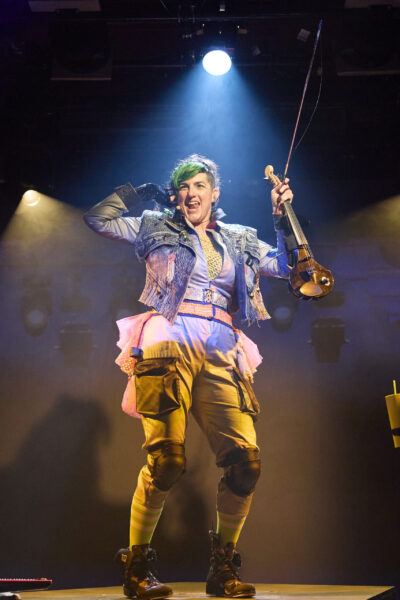
Mickey re-creates original pose at Adam Dressner opening in Grand Central Terminal (photo by twi-ny/mdr)
HELLO STRANGER
Grand Central Terminal, Vanderbilt Hall
89 East 42nd St. between Lexington and Vanderbilt
September 24-26, free, 9:00 am – 9:00 pm www.adamdressner.com grandcentralterminal.com
One can see a lot of fascinating faces and figures racing through Grand Central Terminal every day, but they seldom stop for close inspection, nor do commuters get to see a full-size portrait gallery of their fellow everyday New Yorkers. Yet that’s exactly what Adam Dressner’s new pop-up show, “Hello Stranger,” running September 24–26 on the east side of Vanderbilt Hall in GCT, provides.
After graduating from Yale Law School, New York City native Dressner briefly practiced as an attorney before turning to painting. He uses his studies of criminology, civil liberties, and facial recognition technology to create colorful, large-scale portraits of individuals he places in whimsical settings. For his latest show, he depicts people he met in Washington Square Park, relatives, and friends of friends; nearly all of them are not models and have never posed before.
Among the more than thirty works are paintings of his father, Robert, sitting cross-legged at a table, reading; the elegant Mr. Love, in hat and bowtie, dangling major bling; ABT dancer Georgia Duisenberg in the middle of a pose; Hannah, in fencing gear; a triptych of three people enjoying themselves in Averill Park in upstate New York; his favorite subject, his grandmother Sonia Segoda Dressner, who died in 2020 at the age of ninety-nine; and collaborations with artists De La Vega and Keion Kopper.
At the opening, I asked Dressner, who was dressed casually and wearing one of his many blue baseball caps, about how he chooses who to paint.
“Well, a lot of them were chance encounters,” he said. “That’s where I met [jeweler] Greg Yüna, who introduced me to many of the people who are in the paintings. It’s random chance. I have this umbrella that’s over here where I paint people from life; it’s self-selecting in the sense that people come over and ask to be painted, and if I think they’re a particularly interesting subject, I’ll ask them if they’d be interested. In some cases people ask me if I’d paint them; in many cases I ask them. I place people in imaginary environments where I think that they might want to be placed.”
He noted that Shar told him that she liked sharks, so he added a hammerhead hovering in the background. At the opening, Shar was sitting behind a table with another subject, Betty, handing out information about the show as well as postcards. Also on the table was a mixed-media cash register with the word Sales on top, although the postcards are free.
Jessie poses in front of one of two portraits of her in “Hello Stranger” show in Vanderbilt Hall (photo by twi-ny/mdr)
Several subjects were at the event, posing in front of their paintings, including Mickey, who mimicked his exuberant pose; Wendy, sitting next to her small cart with a stuffed red monkey attached to it; and Jessie, who is in two paintings, one of her reading on the beach, the other standing in a blue dress in front of a pink window.
Jessie said that she found the experience of posing for Dressner in his East Village studio “unnerving,” adding, “I love his work so much that I wanted to see what he would do with me, even though I was a little afraid. It’s a strange thing to see yourself captured on canvas, then against this strange background.”
In the center of the space is a Steinway piano, where live performances will take place during the three-day run of the show. I took a peek at the playlist on the piano and noticed several Christmas songs, “Amazing Grace,” “Ave Maria,” and two Johann Strauss pieces.
Dressner is inspired by classic works he’s seen at the Met and MoMA while also exploring his personal feelings and memory. Talking about his portrait of Shar, Dressner admitted, “It’s a little bit of an absurd painting, but that’s what I do. I draw with paint; I will paint the person on a white canvas, then I’ll figure out some shapes that make sense to me, and then after that I will figure out a story.”
[Mark Rifkin is a Brooklyn-born, Manhattan-based writer and editor; you can follow him on Substack here.]