twi-ny recommended events

UGETSU

UGETSU

Genjurō (Masayuki Mori) makes his pottery as son Genichi (Ikio Sawamura) and wife Miyagi (Kinuyo Tanaka) look on in UGETSU

UGETSU (UGETSU MONOGATARI) (Kenji Mizoguchi, 1953)
Film Forum
209 West Houston St.
March 3-9
212-727-8110
filmforum.org

Film Forum is presenting a new 4K restoration of one of the most important and influential — and greatest — works to ever come from Japan. Winner of the Silver Lion for Best Director at the 1953 Venice Film Festival, Kenji Mizoguchi’s seventy-eighth film, Ugetsu, is a dazzling masterpiece steeped in Japanese storytelling tradition, especially ghost lore. Based on two tales by Ueda Akinari and Guy de Maupassant’s “How He Got the Legion of Honor,” Ugetsu unfolds like a scroll painting beginning with the credits, which run over artworks of nature scenes while Fumio Hayasaka’s urgent score starts setting the mood, and continues into the first three shots, pans of the vast countryside leading to Genjurō (Masayuki Mori) loading his cart to sell his pottery in nearby Nagahama, helped by his wife, Miyagi (Kinuyo Tanaka), clutching their small child, Genichi (Ikio Sawamura). Miyagi’s assistant, Tōbei (Sakae Ozawa), insists on coming along, despite the protestations of his nagging wife, Ohama (Mitsuko Mito), as he is determined to become a samurai even though he is more of a hapless fool. “I need to sell all this before the fighting starts,” Genjurō tells Miyagi, referring to a civil war that is making its way through the land. Tōbei adds, “I swear by the god of war: I’m tired of being poor.” After unexpected success with his wares, Genjurō furiously makes more pottery to sell at another market even as the soldiers are approaching and the rest of the villagers run for their lives. At the second market, an elegant woman, Lady Wakasa (Machiko Kyō), and her nurse, Ukon (Kikue Mōri), ask him to bring a large amount of his merchandise to their mansion. Once he gets there, Lady Wakasa seduces him, and soon Genjurō, Miyagi, Genichi, Tōbei, and Ohama are facing very different fates.

UGETSU

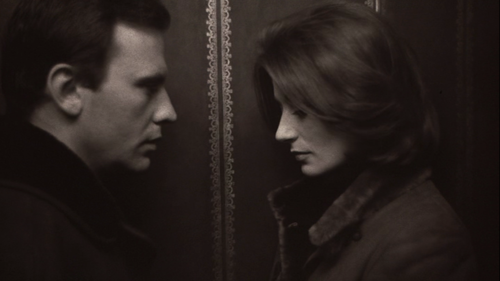
Lady Wakasa (Machiko Kyō) admires Genjurō (Masayuki Mori) in Kenji Mizoguchi postwar masterpiece

Written by longtime Mizoguchi collaborator Yoshitaka Yoda and Matsutaro Kawaguchi, Ugetsu might be set in the sixteenth century, but it is also very much about the aftereffects of World War II. “The war drove us mad with ambition,” Tōbei says at one point. Photographed in lush, shadowy black-and-white by Kazuo Miyagawa (Rashomon, Floating Weeds, Yojimbo), the film features several gorgeous set pieces, including one that takes place on a foggy lake and another in a hot spring, heightening the ominous atmosphere that pervades throughout. Ugetsu ends much like it began, emphasizing that it is but one postwar allegory among many. Kyō (Gate of Hell, The Face of Another) is magical as the temptress Lady Wakasa, while Mori (The Bad Sleep Well, When a Woman Ascends the Stairs) excels as the everyman who follows his dreams no matter the cost; the two previously played husband and wife in Rashomon, which kicked off the Asia Society series. Mizoguchi, who made such other unforgettable classics as The 47 Ronin, The Life of Oharu, Sansho the Bailiff, and Street of Shame, passed away in 1956 at the age of fifty-eight, having left behind a stunning legacy, of which Ugetsu might be the best, and now looking better than ever.

THE SETTLERS

THE SETTLERS

Settler recites Jewish prayer in compelling documentary about ongoing battle between Israelis and Palestinians over land ownership and governance

THE SETTLERS (Shimon Dotan, 2016)
Film Forum
209 West Houston St.
Opens Friday, March 3
212-727-8110
filmforum.org
www.facebook.com

Shimon Dotan’s The Settlers opens with purposefully shaky, uneasy shots from a car speeding down a highway and through a tunnel, then cuts to a calm, peaceful view of a vast, beautiful landscape interrupted by a community of bland houses, creating just the right mood shifts for this compelling documentary, which traverses the history of the controversial Israeli settlements that have been a pivotal part of a possible peace treaty between Israelis and Palestinians. Dotan speaks with Rabbi Hanan Porat, the Israeli man considered to be one of the founders of the settlement movement; Palestinian human rights activist Raja Shehadeh, esq.; and a wide range of settlers who defend their right to live where they want to. Dotan also traces the political history of the region over the last century, examining several wars and how the map of the area has continued to change. The film opens March 3 at Film Forum, with writer-director Dotan, whose previous award-winning films include Hot House and The Smile of the Lamb, participating in Q&As following the 7:30 show Friday night, the 7:15 show on Saturday, and the 2:50 show on Sunday.

THE LAST LAUGH

Gilbert Gottfried is one of many comedians discussing humor and the Holocaust in THE LAST LAUGH

Gilbert Gottfried is one of many comedians discussing humor and the Holocaust in THE LAST LAUGH

THE LAST LAUGH (Ferne Pearlstein, 2016)
Lincoln Plaza Cinema
1886 Broadway at 63rd St.
Opens Friday, March 3
212-757-2280
www.lastlaughfilm.us
www.lincolnplazacinema.com

“Without humor I don’t think we would have survived,” an elderly man says at a Holocaust survivors convention in Las Vegas in Ferne Pearlstein’s The Last Laugh. “Sorry, I didn’t find any humor at all, just sadness and tragedy,” a senior citizen sitting next to him counters. In 1993, Pearlstein’s friend Kent Kirshenbaum gave her a forty-page college paper he had written entitled “The Last Laugh: Humor and the Holocaust,” telling her to make a film about it. Pearlstein’s resultant thought-provoking, poignant documentary, which focuses on the limits of bad taste in comedy, has been playing the festival circuit all over the world and is now opening March 3 at Lincoln Plaza. In the film, Pearlstein speaks with such comic greats as Mel Brooks, Carl Reiner, Harry Shearer, Jeffrey Ross, Lisa Lampanelli, David Steinberg, Susie Essman, writer Alan Zweibel, writer-director Larry Charles, and Rob Reiner, as well as former Anti-Defamation League national director Abraham Foxman and author Shalom Auslander, who share their views on the relationship between comedy and tragedy. “The thing about a joke about the Holocaust, the AIDS crisis, 9/11 — it’s all about the funny,” Jewish lesbian comedian Judy Gold explains. “It’s gotta be funny.” Sarah Silverman, who has never met a boundary she wouldn’t dare to cross, notes, “Comedy puts light onto darkness, and darkness can’t live where there’s light. So that’s why it’s important to talk about things that are taboo because otherwise they just stay in this dark place and they become dangerous.” And Auschwitz survivor Robert Clary, who starred as Corporal Louis LeBeau on Hogan’s Heroes, the controversial 1960s sitcom set in a German WWII POW camp, laughs as he points out, “You have to have a sense of humor. If you don’t have a sense of humor, just go to your grave or get cremated or something.”

The heart and soul of the film is remarkable Auschwitz survivor Renee Firestone, whom Pearlstein follows as she visits her husband’s resting place, stops for lunch in an old Nazi bunker with her daughter Klara, goes to a Holocaust museum, watches stand-up comedy online, and does the dishes while discussing her encounter with Josef Mengele, the Nazi doctor who performed experiments on Jewish men, women, and children, including Firestone’s sister, who was killed at Auschwitz. “Most people don’t expect survivors to have much humor after the Holocaust, and that’s really not the case at all,” Klara says. “The survivors actually have some of the worst gallows humor ever. And I guess that they’re the only ones allowed to do that.” The Last Laugh, which shares its name with F. W. Murnau’s 1924 German Expressionist classic, was inspired in part by the 2005 documentary The Aristocrats, about an industry-secret improvisational taboo joke that Gilbert Gottfried surprisingly revealed to the public shortly after 9/11; he had told what many believe to be the first professional 9/11 joke and, not getting any laughs, quipped, “Too soon?”

THE LAST LAUGH

Auschwitz survivor Renee Firestone and director Ferne Pearlstein prepare for a scene in THE LAST LAUGH

Pearlstein, who directed and edited the film and wrote and produced it with her husband, Robert Edwards, includes clips from such television shows as Curb Your Enthusiasm, Da Ali G Show, All in the Family, The Larry Sanders Show, Seinfeld, and Chappelle’s Show and such comics as Louis CK, Amy Schumer, Chris Rock, George Carlin, Ricky Gervais, and Joan Rivers, who died two days before she was going to be interviewed by Pearlstein. One of the most fascinating aspects of the film is watching these expert comics talk about the crafting of a joke, what makes it work — and where it can go wrong. The film highlights Brooks’s The Producers, which is about the faux Broadway musical Springtime for Hitler, and his 1978 comedy special, Peeping Times, consisting of home movies of Adolf Hitler as portrayed by Brooks. “Anything I could do to deflate Germans — I did,” Brooks proudly proclaims. There’s also footage of concentration camp entertainment from Theresienstadt and none-too-favorable explorations of Roberto Benigni’s Oscar-winning Life Is Beautiful and Jerry Lewis’s infamous, never-to-be-seen The Day the Clown Died. “You can do jokes about Nazis,” Gottfried says, sitting in Sammy’s Roumanian Steakhouse on the Lower East Side, “but if you say ‘Holocaust,’ then it becomes bad taste.” But maybe Carl Reiner sums it up best: “I don’t have a philosophy about it. I just know that it’s much more fun to laugh than not to laugh.” Pearlstein will be at Lincoln Plaza for Q&As following the 7:30 show on March 3 and the 5:15 screenings on March 4 and 5.

NIHON BUYO DANCE

(photo courtesy of the artists)

Geimaruza will perform nihon buyo dance at Japan Society this weekend (photo courtesy of the artists)

Japan Society
333 East 47th St. at First Ave.
March 3-4, intro lecture & demonstration, $12 (free for same-night ticket holders), 6:30
March 3-4, performances, $55, 8:00
Saturday, March 4, workshop, $75, 2:00
Sunday, March 5, family program, $28, 4:00
212-715-1258
www.japansociety.org
www.geimaruza.com

Geimaruza, a Japanese troupe consisting of alumni from Tokyo University of the Arts, will be at Japan Society this weekend with “Nihon Buyo Dance,” offering a mélange of kabuki and folk-dance performances, workshops, and a family-friendly event, melding the contemporary with the traditional. On March 3 and 4 at 8:00, six dancers and eight musicians (playing shamisen, fue, taiko, otsuzumi, and kotsuzumi) will perform Ayatsuri Sanbaso (Puppet Sanbaso), Oshukubai (The Nightingale in the Plum Tree), Shunkashuto (Four Seasons), and the musical numbers “Nagare,” “Toki,” and “Shishi.” featuring three drummers and fue). Each show will be preceded at 6:30 ($12, free for ticket holders) by the lecture-demonstration “A Comprehensive Intro/Demo to Nihon Buyo with Geimaruza.” On Saturday at 2:00 ($75), the workshop “Nihon Buyo Dance & Music with Geimaruza” will teach participants various movements, set to live music. The weekend comes to a close on Sunday at 4:00 ($28) with “Nihon Buyo Dance for Kids & Families,” featuring an introduction to kabuki-based dance and performances of Ayatsuri Sanbaso (Puppet Sanbaso) and Oshukubai (The Nightingale in the Plum Tree).

ALL THE FINE BOYS

(photo by Monique Carboni)

Emily (Isabelle Fuhrman) and Jenny (Abigail Breslin) chatter away in world premiere play from the New Group (photo by Monique Carboni)

The New Group at the Pershing Square Signature Center
Ford Foundation Studio Theatre
480 West 42nd St. between between Ninth & Tenth Aves.
Tuesday – Sunday through March 26, $65-$85
www.thenewgroup.org

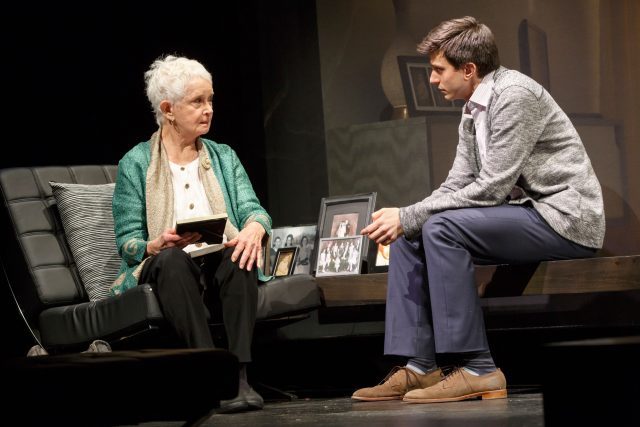
The New Group’s All the Fine Boys is an extremely uncomfortable show to watch and hard to recommend, dealing with a controversial topic in challenging ways. The play, which opened last night at the tiny Ford Foundation Studio Theatre at the Pershing Square Signature Center, is well written, well acted, but clumsily directed by playwright Erica Schmidt, the wife of Emmy-winning actor Peter Dinklage and whose previous credits include the musical adaptation of Debbie Does Dallas. In a South Carolina suburb in the late 1980s, fourteen-year-old besties Jenny (Abigail Breslin) and Emily (Isabelle Fuhrman) watch horror movies and talk about boys and death. “I don’t really want to get older? I mean, I want to get out of middle school and I really want it to be summer and I’m excited to have a birthday party but getting older? I don’t know,” Jenny says. “I know what you mean. Like, sometimes I think, we’ll never ever be younger,” Emily responds. “This morning I looked in the mirror and thought: This is it. It’s never going to get better than this,” Jenny adds. Emily has her heart set on losing her virginity to dreamy seventeen-year-old Adam (Alex Wolff), a serious guitarist and poet who is starring in the high school play, Our Town, while Jenny is attracted to Joseph (Joe Tippett), a skeet-shooting champion from her church who is twice her age. Each girl explores her burgeoning sexuality with very different results.

(photo by Monique Carboni)

Things get dark quickly in Erica Schmidt’s uncomfortable coming-of-age drama ALL THE FINE BOYS (photo by Monique Carboni)

Fuhrman (The Hunger Games, Orphan) and Oscar nominee Breslin (Little Miss Sunshine, The Miracle Worker) are terrific as the adolescent girls, endlessly chatting away with no real understanding of what they are getting themselves into. Fuhrman brings a sweetly innocent charm to Emily, who is worried about how big her breasts are getting, while the gravelly voiced Breslin evokes Emma Kenney’s portrayal of Debbie Gallagher in Shameless, as the chunky Jenny heads to a point of no return. Schmidt’s dialogue is sharp and on target; throughout the show, I couldn’t help but notice many women in the audience nodding in agreement at various things the two girls say to each other. It’s important to note that both actresses are actually twenty, especially in a critical scene between Jenny and Joseph that will have you upset that you’re not looking away (as well as wondering if it was necessary to be so graphic). Meanwhile, Wolff (The Naked Brothers Band, Patriots Day) and Tippett (Airline Highway, Familiar) do a strong job keeping their stock characters from becoming clichés. Amy Rubin’s set is a fairly standard suburban living room, with couch, television, radio, and VCR, a bathroom/entrance on one side and hallway on the other. Small changes are made as the action shifts from Jenny’s house to Adam’s room to Joseph’s place, but the overlaps (for example, leaving a pizza box on a table as the location changes) are distracting. The period soundtrack features songs by Hall & Oates, the Psychedelic Furs, the Cure, and the Smiths. All the Fine Boys is a flawed coming-of-age drama that explores a formidable topic in provocative ways that make it hard to recommend, but it will stick in your psyche long after you leave the theater.

CRITICAL JUNCTURES: GLENN LIGON

Glenn Ligon and Samora Pinderhughes will be in conversation at YoungArts event at NYLA

Glenn Ligon and Samora Pinderhughes will discuss pivotal moments at YoungArts event at New York Live Arts on March 5

Who: Glenn Ligon, Samora Pinderhughes
What: National YoungArts Foundation Salon Series
Where: New York Live Arts Theater, 219 West 19th St., 212-691-6500
When: Sunday, March 5, $10, 2:00
Why: In 2011, New York City–based visual artist Glenn Ligon had a major midcareer retrospective, “Glenn Ligon: America,” at the Whitney. In 2009, Berkeley high school pianist and composer Samora Pinderhughes was named a YoungArts Winner in Jazz Keyboard. On March 5 at 2:00 at New York Live Arts, the two will take part in the latest edition of the National YoungArts Foundation Salon Series, “Critical Junctures: Glenn Ligon,” as they look at pivotal moments in their creative process while placing it in sociohistorical context. The Salon Series, which “brings together creative alumni voices and offers audiences an opportunity to engage with internationally renowned and emerging artists,” will be back at New York Live Arts on May 14 with “Critical Junctures: Alexei Ratmansky,” in which the Russian-American choreographer will be in conversation with 2011 YoungArts Dance Winner and ABT soloist Cassandra Trenary.

BROOKLYN MUSEUM FIRST SATURDAY: FUTURE FEMINISMS

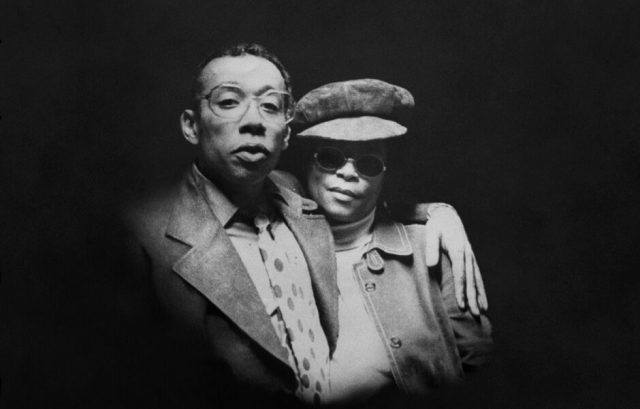
Alfred Stieglitz, “Georgia O’Keeffe,” gelatin silver print, circa 1920–22 (© Georgia O’Keeffe Museum)

Alfred Stieglitz, “Georgia O’Keeffe,” gelatin silver print, circa 1920–22 (© Georgia O’Keeffe Museum)

Brooklyn Museum
200 Eastern Parkway at Washington St.
Saturday, March 4, free, 5:00 – 11:00
212-864-5400
www.brooklynmuseum.org

The Brooklyn Museum goes feminist to the hilt with the First Saturday program “Future Feminisms,” part of its 2017 theme “A Year of Yes: Reimagining Feminism at the Brooklyn Museum.” There will be live performances by Charlotte Dos Santos, Buscabulla, and Natasha Diggs with #SoulInTheHorn; a Blues Lounge Bar; a screening of Timothy Greenfield-Sanders’s The Trans List, followed by a discussion with writer Kate Bornstein and DJ and philanthropist Lina Bradford, facilitated by the Sylvia Rivera Law Project; a hands-on art workshop in which participants can make wearable handmade paper flowers inspired by the new exhibit “Georgia O’Keefe: Living Modern”; a Postcard Write-In hosted by Forward March NY; a Scholar Talk with Linda Grasso about her upcoming book Equal Under the Sky: Georgia O’Keeffe and Twentieth-Century Feminism; a screening of Suha Araj’s The Cup Reader and Pioneer High; pop-up gallery talks on “Marilyn Minter: Pretty/Dirty,” hosted by teen apprentices; a tour of “Georgia O’Keefe: Living Modern” led by guest curator Wanda Corn; and the Brooklyn premiere of Fatimah Asghar and Sam Bailey’s web series Brown Girls, followed by a talkback with members of the cast and crew, moderated by Lindsay Catherine Harris. In addition, you can check out such exhibits as “Iggy Pop Life Class by Jeremy Deller,” “The Dinner Party by Judy Chicago,” “Marilyn Minter: Pretty/Dirty,” “Infinite Blue,” “A Woman’s Afterlife: Gender Transformation in Ancient Egypt,” and, at a discounted admission price of $12, “Georgia O’Keefe: Living Modern.”