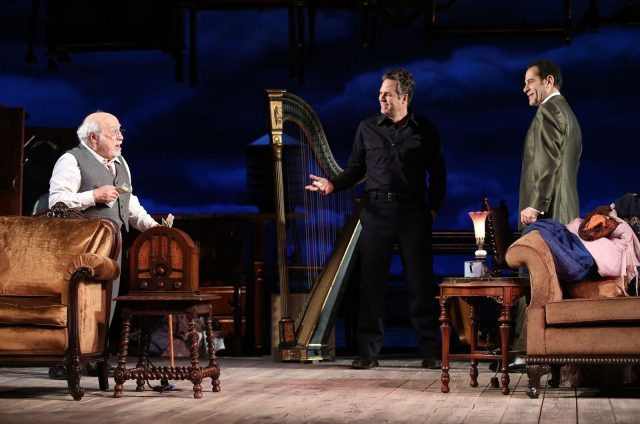
Gregory Solomon (Danny DeVito) seeks to make a deal with brothers Victor (Mark Ruffalo) and Walter Franz (Tony Shalhoub) in THE PRICE (photo by Joan Marcus)
American Airlines Theatre
227 West 42nd St. between Broadway & Eighth Ave.
Tuesday – Sunday through May 14, $69-$169
212-719-1300
www.roundabouttheatre.org
The past looms over a family like so much old furniture in Terry Kinney’s edge-of-your-seat adaptation of Arthur Miller’s 1968 drama, The Price. The last few years have seen a resurgence of Miller’s work in conjunction with the 2015 centennial of the native New Yorker’s birth, including Ivo van Hove’s dual versions of The Crucible and A View from the Bridge on Broadway in 2016 and Signature’s Incident at Vichy and New Yiddish Rep’s Death of a Salesman off-Broadway in 2015 (not to mention Mike Nichols’s 2012 Great White Way revival of Salesman with Philip Seymour Hoffman). Underrated and underseen, The Price is a powerhouse family tale that, in the hands of Kinney and a superb cast, proves to be one of Miller’s masterpieces. It’s 1968, and patrolman Victor Franz (Mark Ruffalo) has returned to the Manhattan home where he grew up. The building is being torn down, so he is selling off the old furniture, much of which holds deep-set memories for him, especially as he approaches fifty and considers retirement. The room is packed with tables, chairs, dressers, lamps, sofas, and more, with dozens of pieces hanging on the walls and from the ceiling, as if ghosts with their own stories to tell. (Miller’s introductory note explains, “The room is monstrously crowded and dense, and it is difficult to decide if the stuff is impressive or merely overheavy and ugly,” a concept that is nailed by set designer Derek McLane.) Victor is joined by his wife, Esther (Jessica Hecht), who presses him to bargain for a good deal and not just give the furniture away; although she loves him, she is disappointed in the choices he has made, especially involving money and career, and now, with their son off at MIT, she wants more out of life. “Just because it’s ours why must it be worthless?” she says to Victor, who does not think the furniture has much financial value, like the rest of his life.
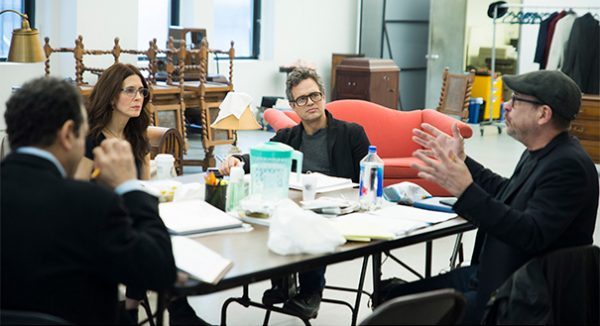
Tony Shalhoub, Jessica Hecht, and Mark Ruffalo listen to director Terry Kinney at rehearsal of THE PRICE (photo by Jenny Anderson)
Soon, making his way up the steps, is eighty-nine-year-old Russian-Yiddish furniture appraiser Gregory Solomon (Danny DeVito), a shrewd businessman who can’t help but share his unique insights about existence. “It was very good stuff, you know,” Victor says about the furniture, to which Solomon replies, “Very good, yes . . . I can see. I was also very good; now I’m not so good. Time, you know, is a terrible thing.” A moment later he adds, “When do they call me? It’s either a divorce or somebody died. So it’s always a new story. I mean it’s the same, but it’s different.” Victor says, “You pick up the pieces.” Solomon adds, “That’s very good, yes. I pick up the pieces. It’s a little bit like you, I suppose.” In the middle of their negotiation — with Victor growing more and more frustrated while Solomon cannily avoids naming a price — Victor’s long-estranged brother, Walter (Tony Shalhoub), a dapper, erudite, pristinely dressed surgeon, enters, throwing a wrench into the proceedings as the siblings try to relate to each other after sixteen years of silence between them following their father’s death. Solomon serves as a kind of intermediary, even when Esther returns and they all start reaching deep inside and arguing over past events that shaped their very different lives.
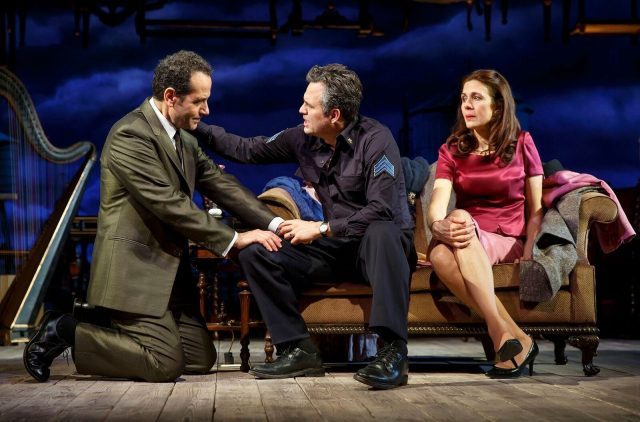
Estranged siblings Walter (Tony Shalhoub) and Victor (Mark Ruffalo) reconnect as Ester (Jessica Hecht) looks on (photo by Joan Marcus)
As in Tennessee Williams’s The Glass Menagerie, the absent family patriarch hovers over everyone and everything; in Menagerie, it’s an unseen portrait of Amanda Wingfield’s husband, while in The Price, it’s the chair, front and just off center, where Mr. Franz would sit. Over the course of the play, each character sits in it, feeling its power, and its lacking. McLane’s imposing set allows the cast to weave through it intricately as they come upon items that spark remembrances, from an old laughing record to an épée to a harp. The nimble Hecht (A View from the Bridge, The Assembled Parties), the ever-elegant Shalhoub (Act One, Golden Boy), and the brusque Ruffalo (This Is Our Youth, Awake and Sing!), Tony nominees all, form an intimate trio, three pros at the top of their game, each character burdened with faded dreams, while DeVito makes an impressive Broadway debut, hanging right with them, injecting humor and smart sarcasm as the old dealer who just might be in it for the thrill of the battle more than any potential profit. Steppenwolf cofounder Kinney (One Flew over the Cuckoo’s Nest, reasons to be pretty) gets right to the heart of the play, examining the choices we all make and the costs, visible and hidden, that come with them, the prices, both financial and not, we pay as we continue through life with differing views of what is of value and what is worth sacrificing. In the first act, just as Solomon and Victor have apparently reached an agreement, a price, Solomon has trouble parting with the money, while Victor keeps getting distracted as the bills are slowly put into his hand. He spends the rest of the play grasping an incomplete sum, as if he is perpetually caught in the middle, agonizing over the choices he made when he was younger as well as those he is making today, a lost soul who has still not come to grips with his past. The price is both literal and figurative, haunted by the ever-present shock of buyer’s remorse. “What have you got against money?” Solomon asks Victor just before naming his price. In this glorious revival, money, of course, is never the answer.

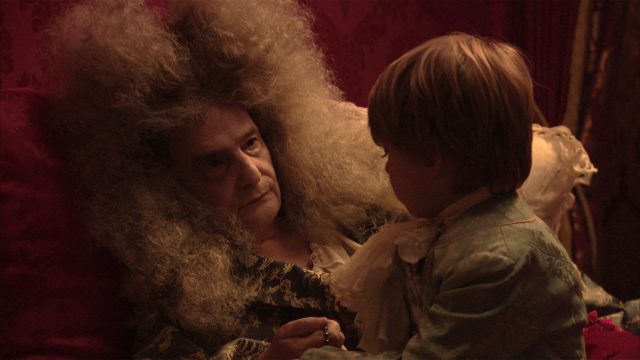
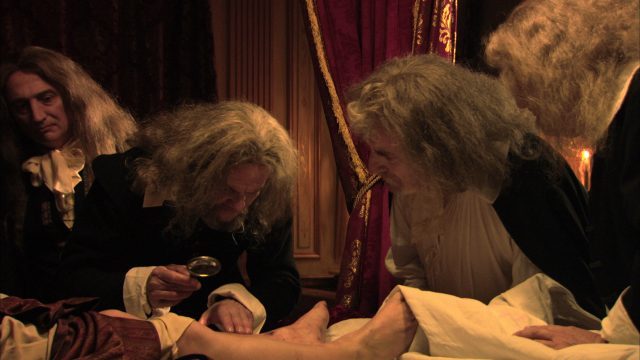
 Albert Serra’s The Death of Louis XIV is the crowning achievement of Jean-Pierre Léaud’s majestic sixty-year career. Léaud first came to prominence in the late 1950s and 1960s, starring in François Truffaut’s Antoine Doinel films (The 400 Blows, Stolen Kisses) and classics by Jean-Luc Godard (Masculin Féminin, Made in U.S.A.). In The Death of Louis XIV, we get to watch the seventy-two-year-old actor play a character dying, very slowly, portraying the last three and a half weeks of the Sun King’s life, the end of a seventy-two-year reign, the longest in French history. Based on actual accounts of the king’s death, including the memoirs of the Duke of Saint-Simon and Philippe de Courcillon de Dangeau, the film takes place primarily in Louis XIV’s bedchamber, where he is watched over by his valet (Marc Susini as Blouin), doctors (Patrick d’Assumçao as Fagon, Bernard Belin as Mareschal), and priests (Jacques Henric as Father Le Tellier, Philippe Dion as Cardinal de Rohan) and visited by sycophantic but concerned courtiers. Wearing a spectacular wig that makes him look like an elderly Max from Maurice Sendak’s Where the Wild Things Are, the king lies on his back, seldom speaking or moving, as he is poked and prodded and fed and the doctors consider amputating his infected leg. He gets polite applause when he swallows a bite of egg. A possible charlatan (Vicenç Altaió as Le Brun) gives him a supposedly magic elixir. He proffers advice to his grandson, Louis, Duke of Orléans (Francis Montaulard), who is destined to succeed him. Desperate to maintain his dignity, the king is soon as helpless as a newborn baby, dribbling as the end nears.