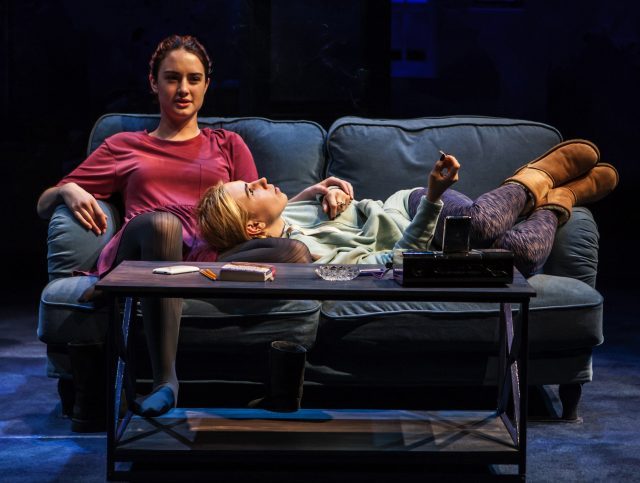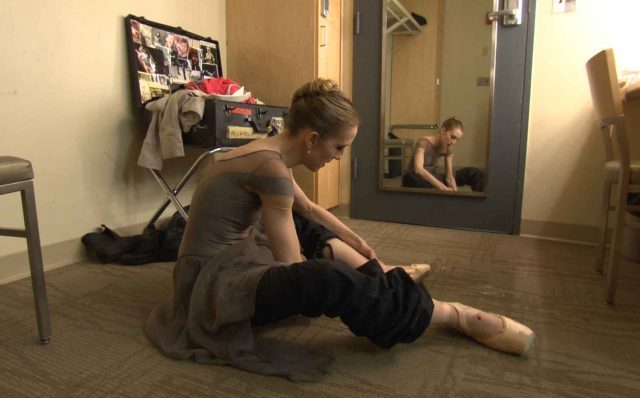
Ballet star Wendy Whelan invites audiences it to watch her attempt to get back onstage in Restless Creature
RESTLESS CREATURE: WENDY WHELAN (Linda Saffire & Adam Schlesinger, 2016)
Film Forum, 209 West Houston St., 212-727-8110
Film Society of Lincoln Center, Francesca Beale Theater, Elinor Bunin Munroe Film Center, 144 West 65th St. between Eighth Ave. & Broadway
Opens Wednesday, May 24
www.facebook.com/restlesscreatureww
 “I’ve always been extremely devoted to what I do, and I love being a part of the New York City Ballet. But I do feel the ticking clock, and at times I’ve thought, if I don’t dance, I’d rather die. I’ve actually said that,” longtime New York City principal dancer Wendy Whelan says in the intimate and revealing documentary Restless Creature: Wendy Whelan. Whelan gave directors and producers Linda Saffire and Adam Schlesinger remarkable access as she faces a turning point in her life and career. In 2013, she began to notice she wasn’t getting the parts she used to excel in and decided to get reconstructive hip surgery, hoping that she could return to dancing full-time, at top level. She allows Saffire and Schlesinger into the operating room as Dr. Marc J. Philippon performs the procedure on her torn right labrum. “Ballerinas are probably God’s best athletes,” Dr. Philippon, says. The film then documents her hard-fought battle to return to the stage, as it’s unclear that she will ever regain her skills — or if Peter Martins and the New York City Ballet will even want her back. “What the fuck is this gonna be like when I can’t do this anymore,” she wonders, later adding, “I need to get back in the game, because I don’t have a ton of time left at my game.” With an inspiring dedication, brave honesty, and self-deprecating sense of humor, Whelan, who turned fifty earlier this month, works with physical therapists Marika Molnar and James Gallegro and discusses options with her husband, choreographer and creative director David Michalek; her manager, Ilter Abramowitz; her mother, Kay; and friends Adam Barrett and Maria Scherer, holding nothing back about the choices she must make. Concerned that soon she will not physically be able to be at her best in ballet, she starts the “Restless Creature” contemporary dance project with choreographers Kyle Abraham, Josh Beamish, Brian Brooks, and Alejandro Cerrudo. But she still aches to return to her home of thirty years, the New York City Ballet, where decades of balletomanes, twi-ny included, have thrilled to her technical precision, insight, musicality, and breathtakingly beautiful line.
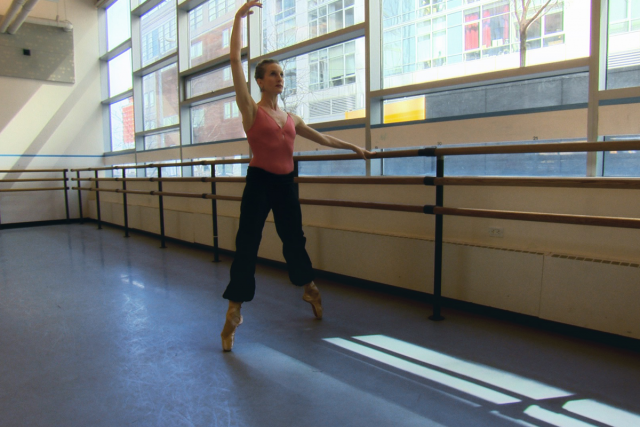
Wendy Whelan faces a crossroads in her career in intimate and revealing documentary
Saffire and Schlesinger, who previously collaborated on such documentaries as Smash His Camera and Sporting Dreams, combine home movies and photos with lovely clips of Whelan in pieces by Christopher Wheeldon, George Balanchine, William Forsythe, Jerome Robbins, and Alexei Ratmansky. They mix in scenes of her being interviewed by dance writers, partying with friends and colleagues, talking with former dancers Jock Soto and Philip Neal, and rehearsing with NYCB soloist Craig Hall and principal dancer Tyler Angle. Only once during the year-and-a-half shoot did Whelan ask for privacy; otherwise, her life is an open book, and it’s both exhilarating and heartbreaking to watch, as the film is about much more than just one artist’s struggle to remain relevant; it’s an inherently relatable story about the effects of age, how each of us might react to the inevitable decline of the body. Whelan expresses how hard it is to know that there are certain moves she will never be able to perform again, no matter how well her rehab goes, so there is an underlying sadness throughout the film even as we cheer her on to accomplish her lofty goals. But what really makes the film work is Whelan herself; all of the behind-the-scenes intrigue and personal reflections are fascinating, but Whelan proves to be an extraordinary human being. “You changed how people behave in this profession,” former principal dancer and current Pacific Northwest Ballet artistic director Peter Boal tells her. Restless Creature: Wendy Whelan will likely make many viewers take a good look at their own future with new enthusiasm as they approach critical crossroads. The film opens May 24 at Film Forum and Lincoln Center; there will be Q&As with Whelan, Saffire, and Schlesinger (sometimes joined by executive producer Diana DiMenna) at the former on May 25 and May 26 at 7:00 and May 27 at 4:40 and at the latter on May 24 at 7:00, May 25 at 5:00, May 27 at 7:00, and May 28 at 1:00.