twi-ny recommended events

THE HAIRY APE

(photo by Stephanie Berger)

Robert “Yank” Smith (Bobby Cannavale) asserts himself in Richard Jones’s fierce revival of Eugene O’Neill’s THE HAIRY APE (photo by Stephanie Berger)

Park Ave. Armory, Wade Thompson Drill Hall
643 Park Ave. at 67th St.
Tuesday – Sunday through April 22, $60-$195
212-933-5812
www.armoryonpark.org

If it’s subtlety you’re looking for, you won’t find it in Eugene O’Neill’s 1922 play, The Hairy Ape, which continues through April 22 at the Park Avenue Armory in a grunting, ferocious production imported from the Old Vic. Written shortly after he won two Pulitzer Prizes (for Beyond the Horizon and Anna Christie), The Hairy Ape is O’Neill’s clarion call against capitalism, classism, socialism, slavery, and even ageism, focusing on the role of each unique person in contemporary American society. “I have tried to dig deep in it, to probe in the shadows of the soul of man bewildered by the disharmony of his primitive pride and individualism at war with the mechanistic development of society,” he said of his first draft of the play, which was partially inspired by the suicide of a friend of his, a stoker named Driscoll. Bobby Cannavale is fierce as Robert “Yank” Smith, a brute of a man who is the ersatz leader of a group of men working in the stokehole of an ocean liner, feeding coal to the fires to keep the vessel moving. Stewart Laing’s eye-opening conveyor-belt set rotates on a revolving, slightly elevated strip, half of which is in front of the audience, half of it behind. The men work in a long but not very high rectangular bright-yellow metal container that is open on one side, with two locked entrances at the end, one barred, as if they’re animals in a cage. Covered in black soot that looks like it will never come off, the men sing and play rough in drunken camaraderie, fully aware of their dank and dreary situation. “T’hell wit home. Where d’yuh get dat tripe? Dis is home, see?” Yank says in his tough New York City accent. A tipsy Long (Chris Bannow) rages, “Listen ’ere, Comrades! Yank ’ere is right. ’E says this ’ere stinkin’ ship is our ’ome. And ’e says as ’ome is ’ell. And ’e’s right! This is ’ell. We lives in ’ell, Comrades — and right enough we’ll die in it.” Old Paddy (David Costabile) remembers how things once were, when the men intertwined with nature, aboard clippers, working in the fresh air and sunshine. “’Twas them days men belonged to ships, not now,” he says. “’Twas them days a ship was part of the sea, and a man was part of a ship, and the sea joined all together and made it one.” But Yank is having none of that. “I belong and he don’t. He’s dead but I’m livin’,” he declares about Paddy. “Listen to me! Sure I’m part of de engines! Why de hell not!” Later, when the stokers are hard at work with their shovels, Mimi Jordan Sherin’s dazzling lighting, filled with ever-changing primary colors, turns the container red, as if the men are trapped in the fiery furnaces of hell itself.

Stewart Laing’s sculptural sets and Mimi Jordan Sherin’s colorful lighting look stunning in Park Avenue Armory (photo by Stephanie Berger)

Rich kid Mildred Douglas (Catherine Combs) tells her aunt (Becky Ann Baker) that she’s planning on visiting the stokers working down below (photo by Stephanie Berger)

Meanwhile, Mildred Douglas (Catherine Combs), the twenty-year-old heiress to the steel company for whom the stokers toil down below, is on the promenade deck of the ship, with her aunt (Becky Ann Baker). Dressed in white, Mildred walks through the oversized sans serif logo of her father’s company as she tells her aunt that she has arranged to go meet the men. The rich Mildred believes she can help them, make their lives better, but she also sees them merely as animals. “When a leopard complains of its spots, it must sound rather grotesque,” she says in a mocking tone. “Purr, little leopard. Purr, scratch, tear, kill, gorge yourself and be happy — only stay in the jungle where your spots are camouflage. In a cage they make you conspicuous.” Her visit doesn’t go very well — Yank can’t tell if she’s an angel or a ghost — but she awakens something deep inside him; he starts considering who he really is and where he truly belongs, leading to a string of absurdist adventures in New York City.

(photo by Stephanie Berger)

Stewart Laing’s sculptural sets and Mimi Jordan Sherin’s colorful lighting look stunning in Park Avenue Armory (photo by Stephanie Berger)

O’Neill pulls no punches in the play, pitting rich vs. poor, heaven vs. hell, old vs. young, male vs. female, and the concept of “clean” vs. “dirty.” His stage notes compare the men’s camaraderie to “the bewildered, furious, baffled defiance of a beast in a cage” and calls them “chained gorillas.” Cannavale (Boardwalk Empire, The Motherfucker with the Hat) is explosive as Yank — a role previously played onstage by Paul Robeson and Willem Dafoe and on the silver screen by William Bendix — whether taking a moment and posing as Rodin’s “Thinker” or pounding his chest, expressing his mental and physical superiority. The container can’t contain him; when Yank does venture out, Laing’s objects disappear and instead Yank is faced with a large, dark, unknown space, as Olivier Award–winning theater and opera director Jones (Too Clever by Half, The Illusion) takes full advantage of the massive Wade Thompson Drill Hall while adding surreal elements. In addition, composer Sarah Angliss contributes an immersive sound design, making the audience feel as if it is trapped as well. Not everything works; for example, the face of Mildred’s father shows up in a few strange places, and it probably wasn’t necessary. Costabile excels as Paddy, waxing poetic as he drinks himself into oblivion. The cast also includes Cosmo Jarvis as a prisoner, Mark Junek as the second officer, Henry Stram as a socialist secretary, and Tommy Bracco, Emmanuel Brown, Nicholas Bruder, Jamar Williams, and Amos Wolf as stokers. (It would be unfair to give away who Phil Hill portrays.) The play features existential movement by choreographer Aletta Collins (Anna Nicole, La Traviata) and dance captain (and ensemble member) Isadora Wolfe, starts and stops that are curious but effective. The seats, arranged in rising rows against the east wall of the drill hall, are all bright yellow, matching the container, making the audience complicit in O’Neill’s marvelous manipulations. The word “yellow” is used several times in the play, primarily representing the fear that lies in the heart of humanity, particularly when it’s up against dehumanizing industrial progress; Yank calls both Long and Paddy yellow, as well as the unseen engineer blowing a whistle that means the men have to get back to work. “He ain’t got no noive. He’s yellow, get me?” Yanks says. “All de engineers is yellow. Dey got streaks a mile wide. Aw, to hell wit him!” The Hairy Ape might not be one of O’Neill’s most popular plays — although he thought it was his best — but it’s a treat to see it in such a dazzling, unpredictable version, powered by a bold and brutal lead performance.

MY ENTIRE HIGH SCHOOL SINKING INTO THE SEA

MY ENTIRE HIGH SCHOOL SINKING INTO THE SEA

Students have to fight for their future in Dash Shaw’s MY ENTIRE HIGH SCHOOL SINKING INTO THE SEA

MY ENTIRE HIGH SCHOOL SINKING INTO THE SEA (Dash Shaw, 2016)
Metrograph
7 Ludlow St. between Canal & Hester Sts.
Opens April 14
212-660-0312
metrograph.com
www.gkids.com

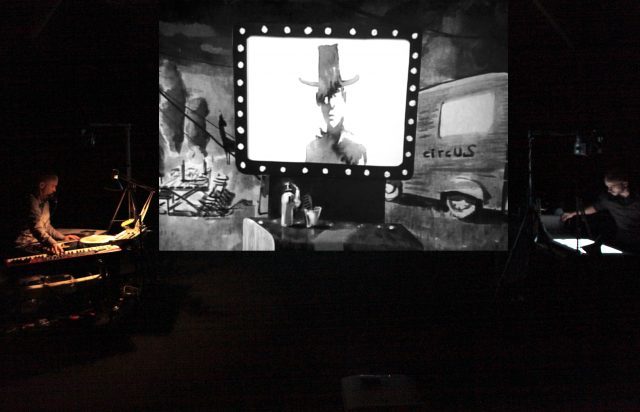
Daria and Scooby-Doo meet The Poseidon Adventure and Titanic in graphic novelist Dash Shaw’s first full-length feature animation, the awkwardly titled, awkwardly plotted, yet awkwardly entertaining My Entire High School Sinking into the Sea. In the somewhat semiautobiographical tale, Dash (voiced by Jason Schwartzman) runs the school newsletter with his best friend, Assaf (Reggie Watts); the two consider themselves investigative journalists, even if no one reads their stories. Dash is further frustrated when Assaf shows an interest in Verti (Maya Rudolph), who has different ideas for the newsletter. After publicly embarrassing Assaf, a stunt that disappoints the relatively cool Principal Grimm (Thomas Jay Ryan), Dash discovers that the high school’s new roof, which is under construction, is not up to code. Just as he starts telling everyone that, the school begins breaking apart and falling into the ocean. Dash soon finds himself with Assaf, lunch lady Lorraine (Susan Sarandon), and his archenemy, Mary (Lena Dunham), as they try to stay above water and survive the maelstrom that is swirling all around them. In order to make it, they’ll have to go from the freshman floor, the lowest one, up through the sophomore, junior, and senior floors to potential safety, a clever way of having them grow up fast. But their journey is a gory one as they encounter plenty of dead students and teachers along with lots of body parts.

MY ENTIRE HIGH SCHOOL SINKING INTO THE SEA

Survival is the name of the game in animated disaster epic set in high school

Shaw (Cosplayers, Bottomless Belly Buttons) wrote and directed the film, with his partner, Jane Samborski, serving as lead animator, creating much of the DIY-style art in his Brooklyn kitchen; the two previously collaborated on the online series The Unclothed Man in the 35th Century A.D., based on Shaw’s 2009 graphic novel. The cartoon style is all over the place, from sketchy and purposely amateurish to hallucinogenic and surreal, incorporating images of real fire and water; at times it looks like the film is being projected by the iconic 1960s psychedelic Joshua Light Show. (In fact, one of the other animators was Curtis Godino, who has worked with JLS and founder Joshua White; Frank Santoro also contributed to the film.) A cool elevator sequence pays homage to early German animator Lotte Reiniger. The narrative contains ginormous plot holes; try to suspend disbelief and just let the tongue-in-cheek madness play out onscreen. Shaw and Samborski do a good job of capturing the general angst and ennui of high school life, although it does become repetitive during the too-long seventy-seven-minute running time. And a direct reference to Shaw’s publisher is completely gratuitous. The film also features the voices of Alex Karpovsky as slacker Drake, John Cameron Mitchell as jock Brent Daniels, and Louisa Krause as popular girl Gretchen, with music by Rani Sharone of the band Stolen Babes and the haunting solo project Thrillsville. A selection of the New York Film Festival, My Entire High School Sinking into the Sea opens April 14 at Metrograph, with Q&As with Shaw, Samborski, and producer Kyle Martin at the 7:00 shows April 14-16. (The April 14 Q&A will be moderated by Mitchell.)

TICKET ALERT: AN EVENING WITH GEORGE TAKEI

(photo courtesy George Takei)

George Takei will be at BAM on May 1 to discuss social media, online activism, LGBTQ rights, and his life and career (photo courtesy George Takei)

Who: George Takei, Jay Kuo
What: “Where No Story Has Gone Before”: George Takei in conversation with Jay Kuo
Where: BAM Howard Gilman Opera House, 30 Lafayette Ave. between Ashland Pl. & St. Felix St., 718-636-4100
When: Monday, May 1, $28-$75, 7:30
Why: On April 1, social media sensation and Star Trek favorite George Takei announced that he was running for Congress, moving out of LA and to Visalia, California, with his husband to make a grab for embattled Republican representative Devin Nunes’s seat in 2018. It turned out that it was all an April Fools’ Day setup to endorse Jon Ossoff, who is a candidate in a special election in Georgia on April 18. But it’s no joke that Takei, who will turn eighty on April 20, will be at BAM on May 1 for the special presentation “Where No Story Has Gone Before,” where he will talk about his life and career with theater composer Jay Kuo, who wrote the book, music, and lyrics for Allegiance, the Broadway musical inspired by Takei’s experiences in a Japanese internment camp during WWII. Takei played Sam Kimura in the show; the portrayer of Hikaru Sulu is currently appearing as the Reciter in Classic Stage Company’s revival of Stephen Sondheim’s Pacific Overtures. Takei and Kuo will also explore activism and the internet; with millions of followers, Takei is a major figure in the fight for social justice, marriage equality, and LGBTQ rights. Meanwhile, Kuo (Upwardly Mobile, Insignificant Others, Worlds Apart), the head of Team Takei and the chief creative officer at the Social Edge, recently tweeted, “The Ministry has fallen. Obamadore has left Hogwarts. Bellatrix Conway shrieks lies. Elizabeth McGonnowarren is holding back the Dementors.” As Takei has been known to say, “Oh my!”

SWEAT

SWEAT

A local bar serves as the main set in Broadway production of Lynn Nottage’s SWEAT

Studio 54
254 West 54th St.
Tuesday – Sunday through October 1, $59-$149
212-719-1300
sweatbroadway.com

Pulitzer Prize-winning playwright Lynn Nottage at last makes her Broadway debut with the timely Sweat, as powerful and searing at Studio 54 as it was last year at the Public Theater. The two-act play takes place in 2000 and 2008 in Reading, Pennsylvania, where the futility of the American dream is on display. The play opens with a scene in 2008, as former best friends Chris (Khris Davis) and Jason (Will Pullen) have been released from prison after eight years behind bars for an undisclosed crime. Flashback to 2000, when factory workers Cynthia (Michelle Wilson), Chris’s mother, who’s married to the drug-addicted Brucie (John Earl Jelks); Tracey (Johanna Day), Jason’s mother; and Jessie (Alison Wright), a divorced drunkard, are celebrating a birthday in a bar run by former factory worker Stan (James Colby) and his bus boy, Oscar (Carlo Albán). When a front-office job at the factory becomes available, Cynthia shows an interest in getting off the floor, leading to dissension in the ranks, jealousy, envy, and, ultimately, violence.

SWEAT

Tracey (Johanna Day), Cynthia (Michelle Wilson), and Jessie (Alison Wright) weigh their options over pints of beer in SWEAT

Sweat has transferred exceedingly well from the Public to Broadway, with only very minor tweaks to the script by Nottage (Intimate Apparel, Meet Vera Stark), while the direction by Kate Whoriskey (How I Learned to Drive, The Piano Teacher), who also helmed Nottage’s Ruined, is even sharper. The only cast change is Wright (The Americans), who adds more depth to the role of Jessie; Lance Coadie Williams also returns as a parole officer assigned to Chris and Jason, along with John Lee Beatty’s expertly designed rotating set. (All of the actors give strong performances, but Day stands out as a single mother who is willing to see only so far in front of her.) The play gets right to the heart of what has been happening in the United States during and after the recent presidential campaign, as Democrats and Republicans continue to argue over jobs, particularly in the Rust Belt. Nottage did a lot of firsthand research in Reading, the steel and textile town that was ranked as the most impoverished city in America in 2011 and has remained in the top ten ever since, with extremely high unemployment and low education leading to a poverty rate of more than forty percent. She met with many of the struggling people there, encountering feelings of desperation, sadness, and betrayal, and turned their poignant stories into Sweat, a fierce and fiery work with plenty of heart and soul, a brilliant microcosm of a deeply divided nation where hardworking people have to live with choices no one should be forced to make. [Ed. note: Sweat has just earned Nottage her second Pulitzer Prize, announced on April 10; she also won in 2009 for Ruined, making her the first female playwright to win multiple Pulitzers.]

JOHN WATERS: MAKE TROUBLE

Tuesday, April 11, Barnes & Noble Union Square, 33 East 17th St., 212-253-0810, free, 7:00
Thursday, April 13, Alamo Drafthouse Downtown Brooklyn, 445 Albee Square West, 718-513-2547, 8:00
www.maketrouble.com

On May 30, 2015, filmmaker, writer, artist, and provocateur John Waters, aka the People’s Pervert and the Prince of Puke, gave the commencement speech at the Rhode Island School of Design, offering his unique advice about life after college, telling the graduating students, “Go out in the world and fuck it up beautifully.” That talk has now been adapted into the eighty-page book Make Trouble (Algonquin, April 11, $14.95), featuring line drawings by Eric Hanson. On April 11, Waters, who has made such films as Hairspray, Female Trouble, and Pink Flamingos, will be at the Union Square Barnes & Noble for a conversation with Christopher Bollen, editor at large at Interview magazine and author of Lightning People and Orient. After the conversation, Waters will sign copies of Make Trouble and just about anything else fans bring, and he will pose for photos as well. Wristbands will be given out beginning at 9:00 that morning to people who have purchased the new book at that B&N. Then, on Thursday, April 13, Waters will head to the Alamo Drafthouse in downtown Brooklyn for a screening of his 1970 cult classic, Multiple Maniacs, preceded by a Q&A with Waters; a copy of Make Trouble comes with every ticket.

STREB: SEA (AN HOUR OF ACTION)

The countdown is on until STREB: SEA returns to Brooklyn

The countdown is on until STREB: SEA returns to Brooklyn

SINGULAR EXTREME ACTIONS
SLAM (STREB Lab for Action Mechanics)
51 North First St. between Kent & Wythe Aves., Brooklyn, 718-384-6491
Thursday – Sunday, April 13 – May 7, $25 in advance, $29 at door (includes popcorn and one drink)
streb.org/seaanhrofaction

Elizabeth Streb and her impressive action heroes are daring performers who combine dance and acrobatics in dazzling ways. They’ve strutted their stuff in such venues as the Park Avenue Armory, Gansevoort Plaza, and the World Financial Center, as well as around the world, as documented in Born to Fly: Elizabeth Streb vs. Gravity and OXD: One Extraordinary Day. They are now bringing back Sea to their Williamsburg home, performing the “wild kaleidoscope” from April 13 through May 7. Led by associate artistic director Fabio Tavares and action heroes Leonardo Giron Torres, Cassandre Joseph, Jackie Carlson, Daniel Rysak, Felix Hess, Jamarious Stewart, Loganne Bond, and Matt McEwen, the sixty-minute work will feature DJs and an emcee, invented hardware, and breathtaking — and dangerous — site-specific action events. “In the past few years, it occurred to me that instruments in an orchestra don’t just compose one symphony. A guitar doesn’t just invent one riff or a single melody. Our ‘action machines’ have more than one dance in them,” Streb explains on the company website. Tickets are $25 in advance and include popcorn and one drink.

MARCEL DUCHAMP’S “FOUNTAIN” TURNS 100

Marcel Duchamp, “Fountain,” (1950 version of 1917 original), Philadelphia Museum of Art, 125th Anniversary Acquisition, gift (by exchange) of Mrs. Herbert Cameron Morris, 1998 (© Artists Rights Society, ARS, New York / ADAGP, Paris / Estate of Marcel Duchamp)

Marcel Duchamp, “Fountain,” (1950 version of 1917 original), Philadelphia Museum of Art, 125th Anniversary Acquisition, gift (by exchange) of Mrs. Herbert Cameron Morris, 1998 (© Artists Rights Society, ARS, New York / ADAGP, Paris / Estate of Marcel Duchamp)

On Sunday, April 9, at 3:00, the Philadelphia Museum of Art, which has an extensive collection of works by French ready-made Dada master Marcel Duchamp, will host The Richard Mutt Case, a site-specific performance by members of Pig Iron Theatre Company reenacting the scandal over Duchamp’s most famous piece, the upside-down porcelain urinal known as “Fountain,” which the Society of Independent Artists rejected for an open New York exhibition exactly one hundred years ago. In celebration of the centennial, the museum is offering free entry between 3:00 and 4:00 on Sunday to visitors who say “Richard Mutt” or “R. Mutt,” the name used to sign “Fountain” (it actually says “R. Mutt”), at the admissions desk. The event is being held in conjunction with the exhibition “Marcel Duchamp and the Fountain Scandal,” which continues through December 3. So why is a publication entitled “This Week in New York” hyping something happening in Philadelphia? Well, there are numerous museums around the world participating in the free-admission password homage, including institutions in Beijing, Jerusalem, Stockholm, Basel, London, Kyoto, Amsterdam, Paris, and Berlin. No New York City museum has officially stated that it will be taking part in the program, which is too bad. But that doesn’t mean you can’t try. Getting rejected could make you empathize a bit with Duchamp, who wrote at the time to his sister, “One of my female friends under a masculine pseudonym, Richard Mutt, sent in a porcelain urinal as a sculpture; it was not at all indecent — no reason for refusing it. The committee has decided to refuse to show this thing. I have handed in my resignation and it will be a bit of gossip of some value in New York.” One hundred years later, it is still valuable gossip. (For an additional New York City angle, on April 10, Francis M. Naumann Fine Art, a major Duchamp collector located on West Fifty-Seventh St., will open “Marcel Duchamp Fountain: An Homage,” consisting of related works by John Baldessari, Marcel Dzama, Sherrie Levine, Sophie Matisse, Richard Pettibone, Ai Weiwei, and more than two dozen others that were directly influenced by “Fountain,” which went missing many years ago.)