twi-ny recommended events

AFTERIMAGE

Afterimage

Władysław Strzemiński (Bogusław Linda) looks out on a changing Poland in Andrzej Wajda’s film film, Afterimage

AFTERIMAGE (POWIDOKI) (Andrzej Wajda, 2016)
Lincoln Plaza Cinema
1886 Broadway at 63rd St.
Opens Friday, May 19
212-757-2280
www.lincolnplazacinema.com
www.filmmovement.com

In his final film, Polish master Andrzej Wajda makes a grand statement about the importance of art and its place in society. Afterimage, which was the opening-night selection of the thirteenth New York Polish Film Festival earlier this month, is based on a true story while also serving as a stern warning. Bogusław Linda, who has previously appeared in Wajda’s Man of Iron and Danton, gives a towering performance as real-life Polish avant-garde artist Władysław Strzemiński, a one-armed, one-legged painter considered one of the greatest Polish artists and theoreticians of the twentieth century but whose legacy was destroyed during the rise of Stalinism and social realism. The film begins with a bright, gleeful scene in which Professor Strzemiński and his students roll around a lush green field, smiling and laughing and loving life. Hanna (Zofia Wichłacz) arrives, wanting to study with the professor as well. “The image has to be what you absorb from this,” he tells her, pointing at the beautiful landscape while his students listen with rapt attention. “When we gaze at an object, we get its reflection in our eye. When we stop looking at it and move our gaze elsewhere, an afterimage of the object remains in the eye — a trace of the object with the same shape but the opposite color. An afterimage. Afterimages are the colors, the inside of the eye which looks at an object. Because a person really only sees what he is aware of.” He then gazes out with a big grin and closes his eyes — and Wajda cuts to him in his apartment in 1948, with the Polish United Workers’ Party now in charge; cinematographer Paweł Edelman switches to a very different color scheme, primarily dank grays save for the pervasive red of the Communist party. Virtually day by day, Strzemiński has his ability to make art and to teach stripped away a little at a time as the party enforces a strict code of what is permitted and what is not under its regime. “The purpose of art is to improve its truth on reality,” Strzemiński explains, and he has to face a series of disturbing new truths himself, especially when his young daughter, Nika (Bronislawa Zamachowska), whose mother is famous sculptor Katarzyna Kobro (Aleksandra Justa), starts falling in line with Communist ideals.

Andrzej Wajda directs Bronislawa Zamachowska on the set of Afterimage (photo © Akson Studio/Anna Włoch)

Andrzej Wajda directs Bronislawa Zamachowska on the set of Afterimage (photo © Akson Studio/Anna Włoch)

The film, written by Andrzej Mularczyk based on an idea by Wajda (The Maids of Wilko, The Promised Land), is a fitting finale for the Polish auteur, who won such prestigious prizes as the Palme d’Or, an honorary Golden Bear, and an honorary Academy Award before passing away in October at the age of ninety, following a sixty-five-year career. (In addition, four of his works were nominated for Best Foreign Language Film Oscars.) Afterimage might take place between 1948 and 1952, but it is frighteningly relevant today with so many countries around the world under dictatorships and the value of art and arts education in schools facing scrutiny even here in the United States. Much of the film has an elegiac tone, including the score, which features the music of the late Polish composer Andrzej Panufnik. Linda is brilliant as Strzemiński, who is almost always deep in thought, finding it hard to believe the lengths the party will go to in order to silence artists, including his eager students and his good friend, poet Julian Przyboś. The disheartened stares he makes while watching Nika become part of the problem instead of the solution are intensely moving. Rising Polish star Wichłacz (Warsaw 44) gives a touching performance as Hania, the new student who wants to fight the authorities and is determined to help Professor Strzemiński finish his master opus, The Theory of Vision, before everything is taken away from him. Even though the film shows Wajda at the top of his game, it might not be a stretch to suggest that the aging director identified with Strzemiński, a man who didn’t let the loss of two limbs prevent him from creating art, just as Wajda, approaching ninety at the time, didn’t let anything stop him as well; he joined up with the Polish resistance in 1942, trained to be a painter and then a filmmaker after the war, and was a major supporter of Lech Wałęsa’s Solidarity movement in the 1980s, ultimately making the film Wałęsa: Man of Hope. In the end, both Wajda and Strzemiński are inspiring figures whose works seal their legacies, from the former’s many films to the latter’s paintings and theories as well as his revolutionary Neoplastic Room, which was reconstructed in 1960 at the Muzeum Sztuki w Łodzi. “Everyone sees differently,” Professor Strzemiński says in the film, which is likely to leave a long-lasting afterimage on those who watch it.

SHRED FEST 2017

(photo courtesy AARP New York)

AARP teamed up with the New York State attorney general’s office at last year’s ninth annual Shred Fest (photo courtesy AARP New York)

Multiple locations in all five boroughs
Saturday, May 20, and Sunday, May 21, free, 10:00 am – 4:00 pm
www1.nyc.gov

No, this is not a wild and crazy guitar festival. Now that tax season is over and spring is upon us, it’s time to get rid of that annoying paperwork you no longer need. But with identity theft such a real problem, you might just want to take advantage of New York City’s tenth annual Shred Fest, a two-day public elimination of bank statements, pay stubs, credit card applications, and anything else that contains vital personal information. On Saturday, May 20, there will be shredders strutting their stuff from ten in the morning till about four in the afternoon (or until they are filled, which is likely to be earlier) at Franz Sigel Park in the Bronx, Bensonhurst Park and Cadman Plaza in Brooklyn, St. Nicholas Park in Manhattan, Flushing Meadows Corona Park in Queens, and the Franklin D. Roosevelt Boardwalk and South Beach on Staten Island. On Sunday you’ll have to head to Triangle Plaza in Co-op City in the Bronx, Prospect Park in Brooklyn, Union Square Park in Manhattan, and the Springfield Gardens Stop & Shop Plaza Shopping Center in Queens. This is a whole lot more satisfying and exciting than merely ripping paper up and throwing it down the garbage chute in your apartment building, so we’ll see you there; just don’t show up too late.

TERRY ZWIGOFF: ART SCHOOL CONFIDENTIAL

Art School Confidential</em is part of Metrograph tribute to Terry Zwigoff

Art School Confidential is part of Metrograph tribute to Terry Zwigoff

ART SCHOOL CONFIDENTIAL (Terry Zwigoff, 2006)
Metrograph
7 Ludlow St. between Canal & Hester Sts.
Saturday, May 20, 4:00
Series runs May 19-21
212-660-0312
metrograph.com

Director Terry Zwigoff, who has claimed to “not be interested in comics too much” and who made the fab 1995 documentary Crumb, about comic book artist R. Crumb, reteamed with comics legend Daniel Clowes for the outrageously entertaining Art School Confidential, inspired by a four-page black-and-white strip Clowes wrote in a 1991 edition of his comic book Eightball. (The two previously worked together in 2001 on the outstanding Ghost World, earning them an Oscar nomination for Best Adapted Screenplay.) Clowes has expanded Art School Confidential into a very funny satire/murder mystery set in a New York City art school based somewhat on Pratt in Brooklyn (though the film was shot in Southern California). Max Minghella (The Social Network, The Handmaid’s Tale) stars as Jerome Platz, an art student from the suburbs who dreams of becoming the next Picasso. Used to being beat up by bullies, he is desperately looking to fit in somewhere, and he might just find his place in Strathmore art school, along with Beat Girl, Kiss-Ass, Army Jacket, Vegan, Filthy-Haired Girl, Preppy Girl, Nympho, and other stereotypes, as well as the art teacher claiming to be preparing for his own exhibition (John Malkovich, also one of the film’s producers). Jerome is befriended by Bardo (Joel David Moore), a disillusioned student who can’t figure out yet which stereotype Jerome is. Bardo introduces Jerome to Jimmy (Jim Broadbent), a drunken, failed artist who represents many a Strathmore student’s future. Jerome falls hard for Audrey (Sophia Myles), a part-time model who is also being courted by the ridiculously straitlaced and seemingly talentless, though celebrated, Jonah (Matt Keeslar). And one of Jerome’s roommates, the hyperactive Vince (Ethan Suplee), is making a movie about the Strathmore Strangler, who has claimed several victims and is still on the loose. Art School Confidential gets just about everything right (save for two brief appearances of the boom mic), turning clichés inside out in hysterical ways. You don’t have to be a comic-book fan geek to love this film, which is screening May 20 at 4:00 as part of Metrograph’s weekend tribute to Zwigoff, who will be on hand to discuss the work. The series also includes Ghost World, Louie Bluie, Crumb, and the New York premiere of the director’s cut of Bad Santa, with Zwigoff at Metrograph for all screenings.

PRESENT LAUGHTER

(photo by Joan Marcus)

Liz (Kate Burton) comforts ex-husband and master thespian Garry Essendine (Kevin Kline) in Broadway revival of Present Laughter (photo by Joan Marcus)

St. James Theatre
246 West 44th St. between Broadway & Eighth Aves.
Tuesday – Sunday through July 2, $59 – $199
laughteronbroadway.com

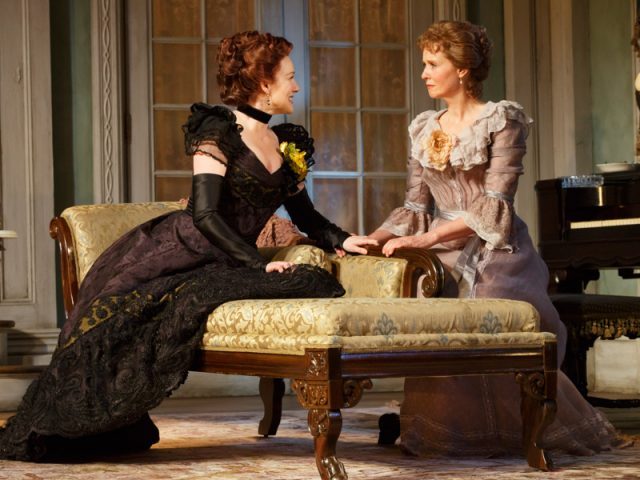
In the latest Broadway revival of Noël Coward’s WWII-era comedy Present Laughter, two-time Tony winner and Oscar recipient Kevin Kline gets to put his stamp on Garry Essendine, one of the great characters of twentieth-century British theater, and he does so with devilishly wicked delight. He ferociously devours the scenery, following in the footsteps of such previous ferocious scenery devourers as Albert Finney, George C. Scott, Peter O’Toole, Frank Langella, Ian McKellen, Clifton Webb, and the original Essendine, Coward, who based the role on himself; other characters and incidents were inspired by real people and events as well, lending the show an intimate charm with plenty of knowing winks and nods. Essendine is a master thespian preparing for a tour of Africa, but not in peace and quiet — his apartment becomes a carnival of friends, colleagues, staff, lovers, and an oddball stranger. Late one morning, upon learning that Daphne Stillington (Tedra Millan), a young woman he apparently brought home the night before, is in the guest room, Essendine complains to his longtime assistant and confidante, Monica Reed (Kristine Nielsen), “Why didn’t you tell her to dress quietly like a mouse and go home? You know perfectly well it’s agony here in the morning with everybody banging about.” Also turning his impressive London flat (designed by David Zinn) into Victoria Station over the course of the play are Essendine’s ex-wife, Liz (Kate Burton); his manager, Morris Dixon (Reg Rogers); his producer, Henry Lyppiatt (Peter Francis James); Henry’s hot-to-trot wife, Joanna (Cobie Smulders); Daphne’s mother, Lady Saltburn (Sandra Shipley); would-be playwright Roland Maule (Bhavesh Patel); and Essendine’s irrepressible, good-natured valet, Fred (Matt Bittner), and rather strange housekeeper, Miss Erikson (Ellen Harvey). Essendine has built a kind of extended family around himself, one that he might not be able to hold together as things start falling apart, in classically British ways.

(photo by Joan Marcus)

Garry Essendine (Kevin Kline) makes a point in semiautobiographical Noël Coward play (photo by Joan Marcus)

Kline (The Pirates of Penzance, On the Twentieth Century) is masterful as Essendine, his every gesture and utterance beautifully overplayed to the hilt, as if the character can’t tell the difference between the stage and real life, always acting, be it Shakespeare or vaudeville. Kline shows a flair for slapstick comedy reminiscent of Monty Python’s John Cleese — Kline won his Oscar for his supporting role in A Fish Called Wanda, which was written by Cleese and starred fellow Python Michael Palin — whether he’s falling down stairs or trying not to be seduced. The women in the show, which takes its name from a line from the Bard’s Twelfth Night — “Present mirth hath present laughter” — are terrific, led by the stalwart Burton, who played Daphne in Scott’s 1982 production; her Liz is not about to take any garbage from Garry while getting a kick out of all the crazy shenanigans going on around him. The always excellent Nielsen (Betty’s Summer Vacation, Vanya and Sonia and Masha and Spike) turns Monica into a den mother with a wry sense of humor about her boss’s philandering, and Harvey (How to Succeed in Business without Really Trying, Mary Poppins) is nearly unrecognizable as the dour Miss Erikson, who is not the most caring of housekeepers. Smulders (How I Met Your Mother; Love, Loss, and What I Wore), in her Broadway debut, is sexy and elegant as the manipulative Joanna, while Millan, in her Broadway debut, follows up her success in The Wolves with another strong performance as the overexcited, high-pitched Daphne, determined to get what she wants. The men, however, do not fare as well; Bittner has fun with Fred, but James (Stuff Happens, Hamlet with Kline) and Rogers (Holiday, Privacy) can’t keep up with Kline, looking lost at times, and Patel (War Horse, Indian Ink) is so over the top as Roland that he seems to be in the wrong play. But director Moritz von Stuelpnagel (Hand to God, Important Hats of the Twentieth Century) is able to keep reeling it in whenever it threatens to go a little bit off track, with the help of Kline, who has such an impressive command of the stage and the character that there’s never a doubt that you will presently be laughing; even the way he checks his hair several times in a mirror almost as an aside is an absolute treat, capturing the essence of Garry, and Kevin, with just a few scant motions.

BORDER CROSSINGS: BABEL

Richard (Brad Pitt) gets some bad news in Babel

Richard (Brad Pitt) gets some bad news in Alejandro González Iñárritu’s Babel

WEEKEND CLASSICS: BABEL (Alejandro González Iñárritu, 2006)
IFC Center
323 Sixth Ave. at West Third St.
Nay 19-21, 11:00 am
212-924-7771
www.ifccenter.com

Fearing that the people of the world, who all spoke the same language, were capable of anything after building a tower that reached to the heavens, the Old Testament God confused their languages and scattered them all over the earth. The inability of people to communicate with one another is at the center of Alejandro González Iñárritu’s fascinating, compelling Babel. The plot follows three stories that slowly intertwine. On vacation in Morocco, Susan (Cate Blanchett) is the victim of a random gunshot fired by a small boy (Boubker Ait El Caid), sending her husband, Richard (Brad Pitt), into a frenzy to try to save her life. Meanwhile, their housekeeper, Amelia (Adriana Barraza), who is looking after their children, has to decide what to do with them on the day of her son’s wedding in Mexico, turning to her crazy nephew Santiago (Gael García Bernal) for help. And in Tokyo, Chieko (Rinko Kikuchi) is a deaf-mute teenager who desperately wants to fall in love, but all the boys she meets — and her father (the great Kôji Yakusho, from The Eel, Cure, and Shall We Dance?) — don’t take the time to listen to and understand her. Despite a couple of minor wrong turns, Iñárritu recovers to make Babel a whirlwind of a movie, laying bear the tragic consequences that can occur when people refuse to simply communicate, even in the most basic of ways.

The film, the finale in the unofficial Death Trilogy written by Guillermo Arriaga (preceded by Amores Perros and 21 Grams), received seven Oscar nominations, including Best Picture, Best Director, Best Original Screenplay (Guillermo Arriaga), and Best Supporting Actress (both Barraza and Kikuchi). It was part of the triple play of fabulous films by Mexican directors in 2006, along with Guillermo del Toro’s Pan’s Labyrinth (nominated for six Oscars, including Best Foreign Language Film) and Alfonso Cuarón’s Children of Men (three Oscar nominations, including Best Adapted Screenplay), all three of whom are among the world’s best filmmakers more than ten years later; Iñárritu’s films have earned three Best Picture nominations and two Best Foreign Language nods (Amores Perros, Biutiful), winning for Birdman or (The Unexpected Virtue of Ignorance); he has been named Best Director twice, for Birdman and The Revenant. A 35mm print of Babel is screening May 19-21 at eleven o’clock in the morning in the IFC Center series “Weekend Classics: Border Crossings,” which continues Friday, Saturday, and Sunday mornings through July 2 with such other films as John Sayles’s Lone Star, the Coen brothers’ No Country for Old Men, and Gregory Nava’s El Norte.

IN CONVERSATION — “IF I HAD POSSESSION OVER JUDGEMENT DAY: COLLECTIONS OF CLAUDE SIMARD”

The life and career of influential artist and collector Claude Simard will be celebrated at Jack Shainman Gallery on May 17

The life and career of influential artist and collector Claude Simard will be celebrated at Jack Shainman Gallery on May 17

Who: Hank Willis Thomas, Leslie Wayne, Sarah Douglas, Ian Berry, Jack Shainman
What: Roundtable discussion in conjunction with “If I Had Possession over Judgement Day: Collections of Claude Simard,” running through September 24 at the Frances Young Tang Teaching Museum and Art Gallery at Skidmore College
Where: Jack Shainman Gallery, 513 West 20th St. between Tenth & Eleventh Aves., 212-645-1701
When: Wednesday, May 17, free with RSVP, 6:30
Why: In September 2014, influential gallerist and artist Claude Simard, the cofounder of Jack Shainman Gallery (first in DC, then NYC), passed away suddenly at the age of fifty-eight. In conjunction with the new exhibition “If I Had Possession over Judgement Day: Collections of Claude Simard,” at the Tang Museum at Skidmore, Jack Shainman Gallery will host a roundtable discussion on Simard, with artists Hank Willis Thomas and Leslie Wayne and ARTnews editor in chief Sarah Douglas, a former assistant to Simard and Shainman. The event will be hosted by Tang director and exhibition curator Ian Berry, and Shainman will be in attendance. “Simard dedicated over thirty years of his life to engaging with and enriching the lives of artists as both muse and patron,” the exhibition website explains. “His voracious drive to collect and discover resulted in a sizable collection of art and artifacts from across centuries and continents.” The Skidmore show features works by John Ahearn, Matthew Barney, Alighiero e Boetti, Nick Cave, Jean Dubuffet, Marcel Duchamp, Leon Golub, Kerry James Marshall, Roberto Matta, Chris Ofili, Gabriel Orozco, Nancy Spero, Jessica Stockholder, Wayne, Thomas, and many others. You can read the reactions of Skidmore students to specific works in the show here. Currently on view at Jack Shainman is “Becky Suss: Homemaker.”

HARLEM EATUP! FESTIVAL

Ginny’s Supper Club is one of dozens of eateries participating in third annual Harlem EatUp!

Ginny’s Supper Club is one of dozens of eateries participating in third annual Harlem EatUp! Festival

A CELEBRATION OF CULTURE AND SPIRIT
Multiple locations in Harlem
May 15-21, free – $1,500
harlemeatup.com

The third annual Harlem EatUp! Festival takes place May 15-21, with dozens of chefs, restaurants, culinary organizations, mixmasters, and artists participating in tastings, walking tours, dinners, concerts, and more celebrating Harlem culture. Below is only a handful of the nineteen special events happening across the borough.

Tuesday, May 16
Homage to Billie Holiday, with Alvin Ailey Dance Theater, Rickie Lee Jones, Lizz Wright, Bettye LaVette, Deva Mahal, Ruthie Foster, William Bell, Southside Johnny, Rachael Price, members of Antibalas, and others, hosted by Bevy Smith, the Apollo Theater, $40 – $1,500, 8:00

Wednesday, May 17
Dine In Harlem: Ginny’s Supper Club, with food prepared by Michael Anthony and Marcus Samuelsson and live music from Nate Lucas and the Rakiem Walker Project, $125, 7:00

Friday, May 19
The Harlem EatUp! Annual Luminary Awards Dinner Honoring Jonelle Procope of the Apollo Theater, with food prepared by Roger Mooking and Alex Becker and live music by the Rakiem Walker Project, hosted by Marcus Samuelsson, Ginny’s Supper Club, $230, 6:30

Saturday, May 20
The Harlem Stroll: Ultimate Grand Tasting, featuring dishes from more than two dozen Harlem restaurants, including BLVD Bistro, Charles Country Pan Fried Chicken, Harlem Chocolate Factory, Harlem Pizza Co., Melba’s Restaurant, Madison Street Bakehouse, Red Rooster Harlem, Settepani, Sisters Caribbean, and Zoma, with Bordeaux wine classes and live music from the Rakiem Walker Project, Morningside Park, $85-$110, 12:30 – 5:30

Saturday, May 20
and
Sunday, May 21

The EatUp! Main Stage, Morningside Park, with Marcus Samuelsson, Karl Franz Williams, Brian Washington Palmer, Donatella Arpaia, Darryl Burnette, Roger Mooking, Lorenzo Boni, Raymond Mohan & Leticia “Skai” Young, Daniel Holzman, Johnny Mambo & Friends, Vy Higgensen’s Choir from Harlem, Lorenzo Laroc, the Rakiem Walker Project, Pierre Thiam, DJ Stormin Norman, and New Beginnings Drum & Bugle Corps, free, 12:30 – 5:30

The Harlem Stroll Marketplace, with more than two dozen food vendors, a kids’ zone, demonstrations, live performances, and more, Morningside Park, free, 12:30 – 5:30

Sunday, May 21
The Harlem Stroll: Ultimate Grand Tasting, featuring dishes from more than two dozen Harlem restaurants, including Sexy Taco Dirty Cash, Chaiwali, Shake Shack, Safari Restaurant, SpaHa Soul, Solomon & Kuff Rum Hall, Mere Viola’s Sweet Delight, Lady Lexis Sweets, LoLo’s Seafood Shack, and Harlem Tavern, with Bordeaux wine classes and live music from the Rakiem Walker Project, Morningside Park, $85-$110, 12:30 – 5:30