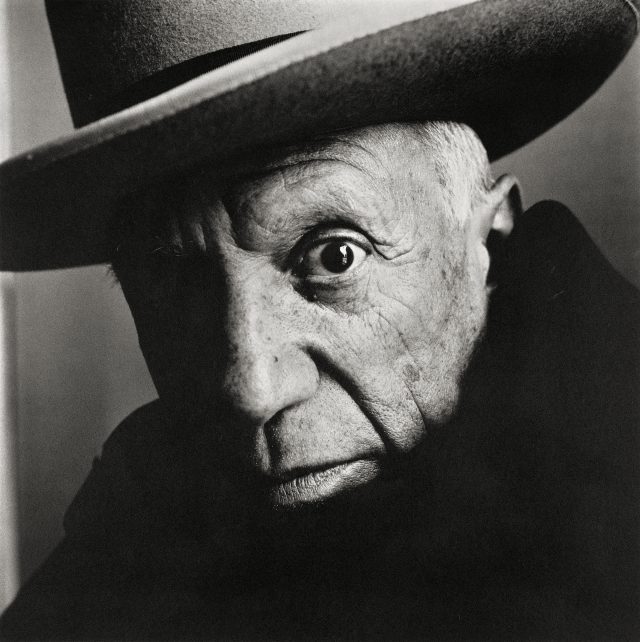
Irving Penn, “Pablo Picasso at La Californie, Cannes, 1957,” platinum-palladium print, 1985 (The Metropolitan Museum of Art, New York, Promised Gift of The Irving Penn Foundation / © The Irving Penn Foundation)
Met Fifth Avenue
Metropolitan Museum of Art, Gallery 199
1000 Fifth Ave. at 82nd St.
Through July 30, $12-$25
212-535-7710
metmuseum.org
www.irvingpenn.org
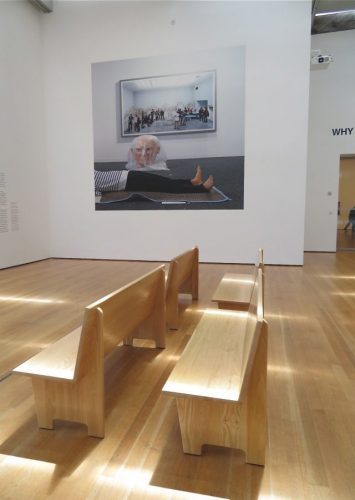
One of the twentieth century’s most influential and innovative photographers, Irving Penn would have turned one hundred this past June. The Met more than does justice to his legacy in the sparkling exhibition “Irving Penn: Centennial,” continuing at the Met Fifth Avenue through July 30. Both Irving and his younger brother, Arthur, knew how to tell stories visually; while Penn did it through still photography, Arthur was a successful stage and screen director, helming such films as Bonnie and Clyde and The Miracle Worker and such Broadway productions as Wait Until Dark and Golden Boy. Born in Plainfield, New Jersey, Irving Penn tried his hand at drawing, painting, and designing before making a name for himself as a fashion photographer at Vogue, shooting 165 covers from 1943 to 2009, when he died at the age of ninety-two. In addition to fashion, Penn photographed celebrities and working people, cigarettes and other trash he found on the street, nudes, flowers, vessels, and people from Dahomey, New Guinea, Peru, and Morocco. The Met show features nearly two hundred photos, arranged in series, that reveal the breadth of Penn’s remarkable ability to capture the essence of his subject with exquisite simplicity while treating them all with equal weight, whether a Hollywood star, an Issey Miyake staircase dress, a muddy glove, a naked body, or a shoe. In a 1939 silver gelatin print, Penn, who did not like being the focus of attention himself, rarely giving interviews and spurning self-portraiture, is seen in shadow, taking a photo of the shadows of a key and a gun on a New York City street. In his Corner Portraits, he asked famous subjects to do whatever they wanted in a makeshift tight corner in his studio, resulting in iconic shots of Marcel Duchamp, Joe Louis, Truman Capote, and Elsa Schiaparelli. In “Balenciaga Sleeve,” model Régine Debrise’s face is starkly cut off at the top of the frame, breaking with tradition. In “Rochas Mermaid Dress,” model Lisa Fonssagrives, Penn’s wife of forty-two years, stands just off-center on a backdrop that Penn doesn’t hide; in fact, the backdrop is on view in the exhibit, along with one of Penn’s Rolleiflex cameras. Penn reveals his experimental side with four prints of “Girl Drinking,” taken of Mary Jane Russell in 1949 but not printed until 1960, 1976, 1977, and 2000, each slightly different.
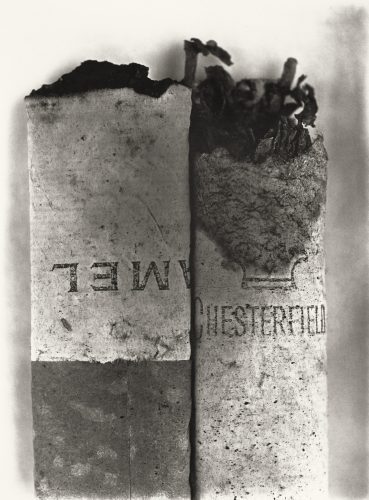
Irving Penn, “Cigarette No. 37, New York, 1972,” platinum-palladium print, 1975 (The Metropolitan Museum of Art, New York, Promised Gift of The Irving Penn Foundation / © The Irving Penn Foundation)
As you make your way through the show, you’ll also come upon pictures of men, women, and children from Cuzco, Peru, including a porter, two Quechuan Indians, and a street vendor wearing multiple hats; a spread-eagled Salvador Dalí; a hand in a white glove holding a black shoe; a color still-life of parts of after-dinner games, with a die, playing cards, a chess horse, and a poker chip; a group of fleshy nudes in which the folds of the bodies form abstract shapes, taken in the 1950s but not printed until 1980 because of pornographic concerns; stunning portraits of Richard Burton, Colette, Pablo Picasso, Ingmar Bergman (with his fingers pressing down on his closed eyes), and Audrey Hepburn; a New Guinea tribesman with a large nose disc; covered women from Morocco; a 1986 color print of a mouth with numerous shades of lipstick, shot for a L’Oreal campaign, that seems to prefigure the main advertising image for Jonathan Demme’s 1991 The Silence of the Lambs,; and even a 1999 ink drawing reminiscent of Morandi. The exhibition also includes a rare video taken by Fonssagrives-Penn showing her husband in Morocco in 1971, shooting portraits in his portable studio. Through it all, Penn never complicates the background, instead focusing on the object itself. “A good photograph is one that communicates a fact, touches the heart, and leaves the viewer a changed person for having seen it; it is in one word, ‘effective,’” Penn once said. The Met show, held in conjunction with a promised gift of 187 photographs from the Irving Penn Foundation, accomplishes all that and more.


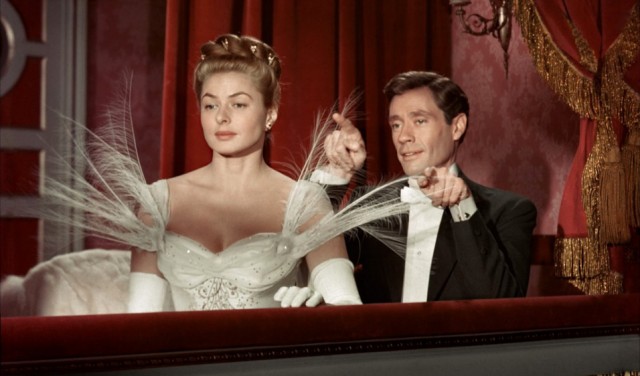
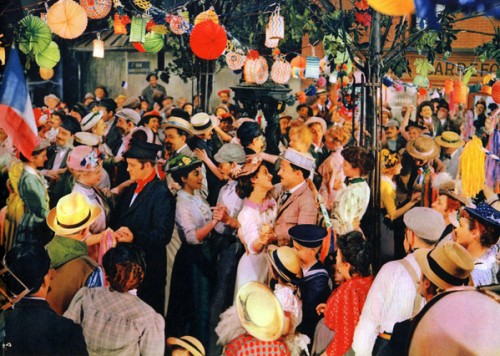
 The tenth anniversary of the Films on the Green series, in which such artists as Wes Anderson, Wanda Sykes, Jim Jarmusch, Laurie Anderson, and Saul Williams selected French films to be shown for free in parks around the city, continues July 28 with Isabella Rossellini’s pick, Jean Renoir’s intriguing, lesser-known 1956 “musical fantasy,” Elena and Her Men, starring her mother, Ingrid Bergman. In this small gem of a film, also known as Paris Does Strange Things, Bergman plays Elena Sokorowska, a splendiferous Polish princess living the high life in fin de siècle Paris, quickly running out of money and strongly advised by her aunt to find a rich husband. After dispatching one lover, composer Lionel Villaret (Jean Claudio), the princess has a trio of suitors: the much older Martin-Michaud (Pierre Bertin), a stuffy, aristocratic shoe mogul; the heroic General François Rollan (Jean Marais, playing a character based on the real-life General Georges Boulanger), who is being celebrated on Bastille Day; and the playboy Count Henri de Chevincourt (Mel Ferrer), who instantly falls madly in love with her — and wishes to take her home the very day he meets her. It’s 1915, and the streets are filled with French men, women, and children singing the praises of General Rollan while wondering what will come next for the government, with talk of a coup and a dictatorship making the rounds. In the middle of it all is Princess Sokorowska, whose lavish charm beguiles nearly everyone she meets, except, of course, the general’s mistress, Paulette Escoffier (Elina Labourdette). As the men fight over her, the princess hands out daisies to bring various people good luck.