Who: Cobweb, Raju Lama and the Angels Band, Aditya Lama, Dewaj Thapa, Karanjit Singh, Rahul Rai, Tshering Dorje, Teddy, Kunga Chemi, Suraj, Jay Gurung, Akesha Bista, DJ Rokesh, DJ Reet, DJ Spin What:DashainLaya concert in Queens Where:Melrose Ballroom, 36-08 33rd St., When: Friday, September 8, 8:00, through Saturday, September 9, 4:00 am, $35-$50 Why: KTMEntertainment is hosting DashainLaya, an all-night festival of Nepalese and Tibetan music, on September 8-9 at the Melrose Ballroom in Queens. A portion of the proceeds from the show, headlined by Cobweb and Raju Lama (playing with the Angels Band) and emceed by Akesha Bista, Miss Nepal 2012, will go to families suffering from the devastating floods in southern Nepal. General admission tickets are $35, while $50 VIP seats come with a meet-and-greet with the artists. Anybody born in September gets in free. This summer, floods in Nepal, India, and Bangladesh have resulted in more than twelve hundred fatalities and affected twenty million people. Of course, if you can, you should also contribute to organizations helping the victims of Hurricane Harvey in Texas, including the Red Cross,the Humane Society, and many others.
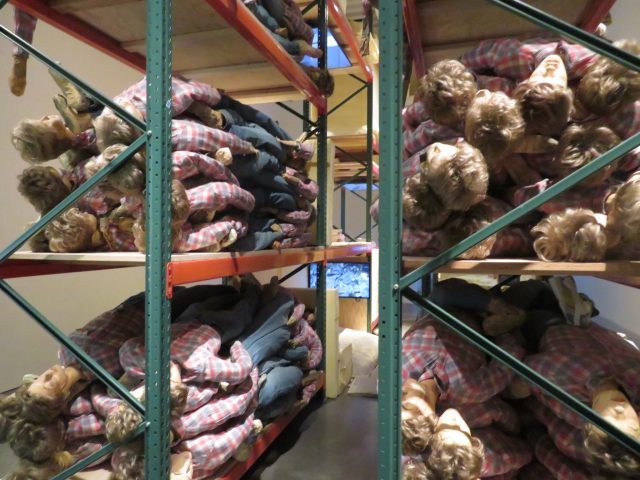
In Kaari Upson’s first solo New York museum show, “Good thing you are not alone,” the California native goes in search of the perfect double as it relates to consumption, mass production, the ideal of America, and her relationship with her mother. Consisting of drawing, painting, sculpture, and video, the exhibition is centered by “Hers” and “Idiot’s Guide Womb Room,” an interactive installation, constructed of steel Costco shelves, urethane foam, aluminum, plastic, and wood, in which visitors can take a seat, watch videos of Upson dressed as her mother and performing rituals, read various Complete Idiot’s Guide books, and check out piles of life-size replicas of her mother made of latex, synthetic hair, fabric, foam, duct tape, and debris. Upson, who has portrayed her mother in more than thirty videos, sees it as an “amalgamation of it being not just my own real mom but a multiplicity of a type of woman that’s transitioning from being objectified, like a certain particular age where she almost becomes invisible,” she tells curator Margot Norton on the audio guide. “So that idea that she can almost have agency through her invisibility allowed me to go up in spaces and do very strange things.”
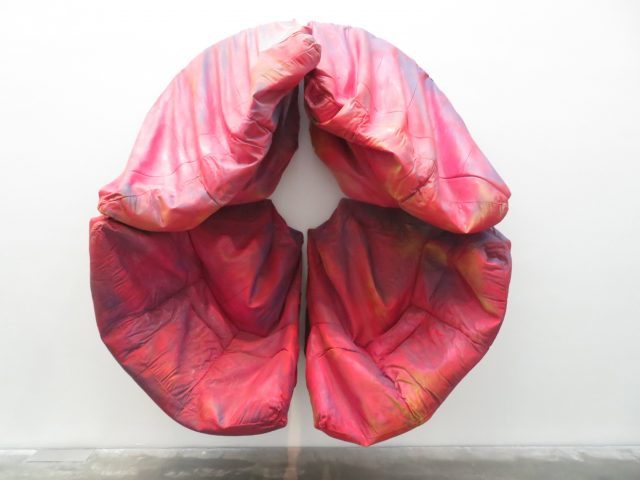
Kaari Upson, “Who’s Afraid of Red, Yellow and Blue,” urethane, pigment, and aluminum, 2014 (photo by twi-ny/mdr)
Upson references her mother’s fondness for soda in “Teeth on Pepsi Plinth,” rows of fossilized aluminum-cast cans (“Lifetime Supply”) with crystalline teeth (“Crocodile Mother”) on top of them, part of her ongoing “MMDP (My Mother Drinks Pepsi)” project. She recasts discarded furniture into drooping wall pieces that recall the work of Lynda Benglis and Claes Oldenburg, in “Brown Recluse,” “Who’s Afraid of Red, Yellow, and Blue,” and “You Don’t Need a Rope to Pinch a Stranger’s Butt.” In the intense video Split Eye, Upson films her eye in close-up, using glass and mirrors to create intriguing, often disturbing effects. And in her latest body of work, a series of graphic drawings explores a family living in a Las Vegas tract house, incorporating such phrases as “Where all autonomy is lost” in “home’” and “Caught in a pattern of endless reproduction” in “event horizon.” In “Good thing you are not alone,” Upson makes the private public, and the public private, delving into the subconscious of contemporary American culture with a forensic approach, uncovering a repetitive world from which there appears to be no escape.
MetLiveArts
Metropolitan Museum of Art, Grace Rainey Rogers Auditorium
1000 Fifth Ave. at 82nd St.
September 6-7, $45-$60 (including same-day museum admission), 7:00
212-570-3949 crossingthelinefestival.org www.metmuseum.org
At FIAF’s 2014 Crossing the Line Festival, Japanese multimedia artist Ryoji Ikeda dazzled audiences at the Metropolitan Museum of Art with the sold-out U.S. premiere of superposition, an audiovisual marvel that explored technology, philosophy, probability, and the future of existence. He’s now back with the follow-up, supercodex [live set], which kicks off the 2017 festival, again at the Met. (Ikeda’s gallery show, “the transcendental,” was part of the 2010 festival, at FIAF.) The piece, which was conceived and composed by Ikeda and features computer graphics and programming by Tomonaga Tokuyama, is the culmination of Ikeda’s Raster-Norton trilogy of albums that began with Dataplex and continued with Test Pattern, as Ikeda investigates the limits of technological-human connection. Viewers will be enveloped in black-and-white digital imagery while experimental music blasts throughout the space. Ikeda, who lives and works in Japan and Paris and also blew people’s minds with the immersive, site-specific the transfinite at the Park Avenue Armory in 2011, mines the “data of sound” and the “sound of data” in his work, incorporating scientific and mathematical elements, and the New York premiere of supercodex [live set] should bring that to a whole new level. (Tickets include museum admission, so be sure to go early and check out such exhibits as “The Theater of Disappearance,” “Talking Pictures: Camera-Phone Conversations Between Artists,” “Sara Barman’s Closet,” and “Japanese Bamboo Art: The Abbey Collection.”)
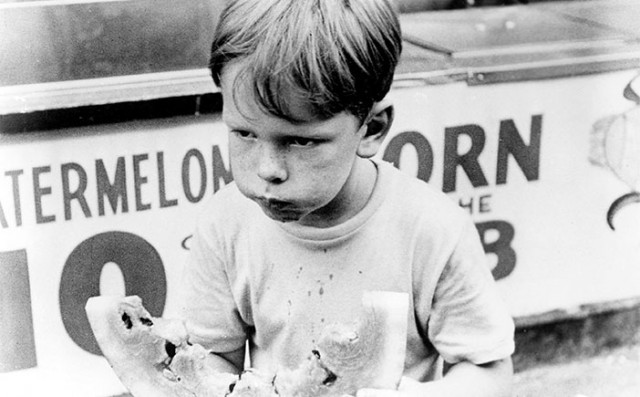
Joey Norton goes on the adventure of a lifetime in Coney Island in underground indie classic Little Fugitive
LITTLE FUGITIVE (Morris Engel, Ray Ashley, and Ruth Orkin, 1953)
Film Forum
209 West Houston St.
Monday, September 4, 12:30 & 4:00
Series continues through September 5
212-727-8110 filmforum.org
Labor Day is the traditional end of summer, and Film Forum gets in on the fun with an inspired double feature of two Coney Island specials. Screening at 12:30 and 4:00, Morris Engel’s charming Little Fugitive is one of the most influential and important — and vastly entertaining — works to ever come out of the city. The underground classic won the Silver Lion at the Venice Film Festival in 1953, was nominated for a Best Screenplay Oscar, and was entered into the National Film Registry in 1997. Written and directed with Ray Ashley and Ruth Orkin, Engel’s future wife, Little Fugitive follows the gritty, adorable exploits of seven-year-old wannabe cowboy Joey Norton (Richie Andrusco, in his only film role), who runs away to Coney Island after his older brother, Lennie (Richard Brewster), and his brother’s friends, Harry (Charlie Moss) and Charley (Tommy DeCanio), play a trick on the young boy, using ketchup to convince Joey that he accidentally killed Lennie. With their single mother (Winifred Cushing) off visiting her ailing mother, Joey heads out on his own, determined to escape the cops who are surely after him. But once he gets to Coney Island, he decides to take advantage of all the crazy things to be found on the beach, along the boardwalk, and in the surrounding area, including, if he can get the money, riding a real pony.
A no-budget black-and-white neo-Realist masterpiece shot by Engel with a specially designed lightweight camera that was often hidden so people didn’t know they were being filmed, Little Fugitive explores the many pleasures and pains of childhood and the innate value of home and family. As Joey wanders around Coney Island, he meets all levels of humanity, preparing him for the world that awaits as he grows older. Meanwhile, Engel gets into the nooks and crannies of the popular beach area, from gorgeous sunrises to beguiling shadows under the boardwalk. In creating their beautifully told tale, Engel, Ashley, and Orkin use both trained and nonprofessional actors, including Jay Williams as Jay, the sensitive pony ride man, and Will Lee, who went on to play Mr. Hooper on Sesame Street, as an understanding photographer, while Eddie Manson’s score continually references “Home on the Range.” Rough around the edges in all the right ways, Little Fugitive became a major influence on the French New Wave, with Truffaut himself singing its well-deserved praises. There’s really nothing quite like it, before or since. The 12:30 show will be introduced by Mary Engel, the daughter of Morris Engel and Ruth Orkin.
Harold Lloyd has a crazy time in Coney Island in Speedy
SPEEDY (Ted Wilde, 1928)
Film Forum
209 West Houston St.
Monday, September 4, 2:00
Series continues through September 13
212-727-8110 filmforum.org
In between the two showings of Little Fugitive is another delightful treat, Ted Wilde’s Speedy, with live musical accompaniment by pianist Steve Sterner. Much like the end of the silent film era itself, the last horse-drawn trolley is doomed in Harold Lloyd’s final silent film. Big business is playing dirty trying to get rid of the trolley and classic old-timer Pop Dillon. Meanwhile, Harold “Speedy” Swift, a dreamer who wanders from menial job to menial job (he makes a great soda-jerk with a unique way of announcing the Yankees score), cares only about the joy and wonder life brings. But he’s in love with Pop’s granddaughter, Jane (Ann Christy), so he vows to save the day. Along the way, he gets to meet Babe Ruth. Wilde was nominated for an Oscar for Best Director, Comedy, for this thrilling nonstop ride through beautiful Coney Island and the pre-depression streets of New York City. Film Forum’s second annual Festival of Summer Double Features continues through September 5 with such other sweet pairings as Panique and Peeping Tom, Point Blank and The Killers, and The Big Lebowski and The Last Picture Show.
MoMA PS1
22-25 Jackson Ave. at 46th Ave.
Thursday – Monday through September 10, suggested donation $5-$10 (free for New York City residents), 12 noon – 6:00 pm
718-784-2084 www.moma.org
For more than twenty-five years, painter Maureen Gallace has let her work do her talking for her. The Stamford-born, New York-based artist gives very few interviews, and the only monograph about her seems to be a thirty-two-page accompaniment to a small 2004 gallery show, with text by Rick Moody, who was born in New York City but also grew up primarily in Connecticut. For Gallace’s first major survey, the gorgeous “Clear Day,” continuing at MoMA PS1 through September 10, MoMA has provided very only the most basic of information; there is no catalog, no extensive wall or label text, and very spare press materials about the nearly seventy works. But that goes hand in hand with the wonderful aura and mystery that surround her small canvases, mostly exquisitely rendered paintings of homes on Cape Cod, each much more than it first appears. In 2016, as part of the Met’s “Artist Project,” Gallace made a short video discussing the still lifes of Paul Cézanne, concentrating on his paintings of apples. It’s a fascinating analysis of the painter and the painting; in fact, change just a few words here and there and Gallace could have just as easily been referring to her own creative process and output.
“[Cézanne] was taking this simple, naïve everyday object that we’re all familiar with, but the paintings don’t ever feel about copying the apples. The paintings are about painting; you can see the canvas. Everything points back at what it took to make the painting,” she says over shots of some of Cézanne’s works. “Every single mark is laid bare, so he really wanted everybody to know the experience of the painter, and he took forever to make the paintings. . . . I’m someone who often takes an hour to make a brushmark; painting is a lot of thinking, a lot of staring. The emotion comes from the way paint is handled. The forms seem kind of crude because they’re built up from the marks. They’re so solid, the apples, they almost become sculpture. It’s like you could feel those apples in your hand. . . . There is an uneasiness to these paintings, and I think that comes from the shifting perspective. There’s no horizon line . . . and the tilting can be a little claustrophobic and destabilizing. There’s perfectionism in there; it’s so Type B, controlled, but also, it wasn’t about the one painting that was going to be the masterpiece. I mean, I think that was the point, to keep going, keep going, keep going and getting better and better and better, and so it was okay to fail. There’s less pressure on the painting because you’ll just get it right the next time. I think he was trying to put everything that he knew about painting into each object. . . . It’s a type of experience that some painters have; they need to distill things down to get at the essence of what painting is, even if it’s just choosing an apple.”
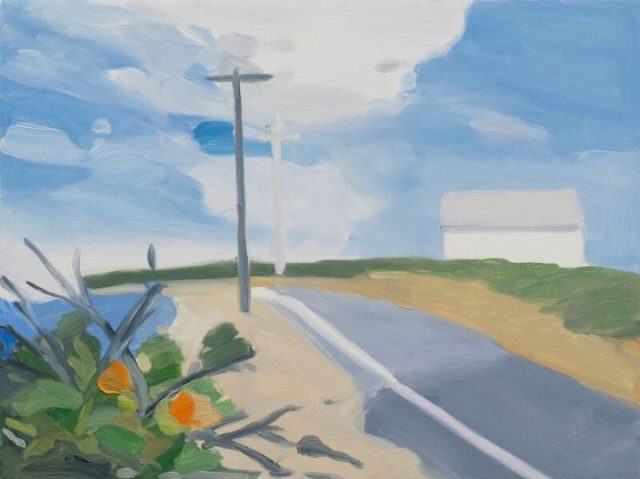
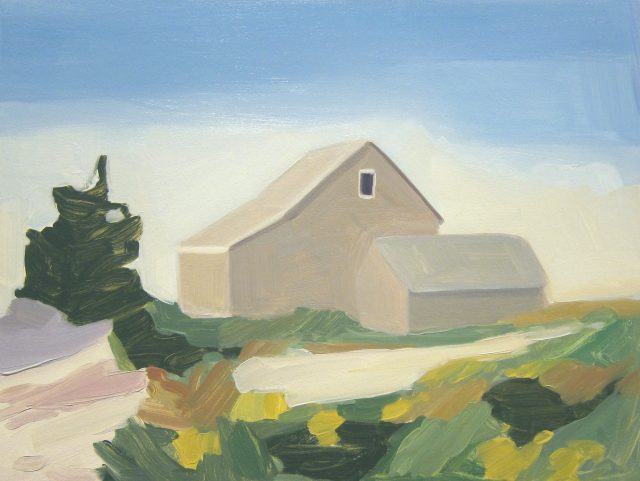
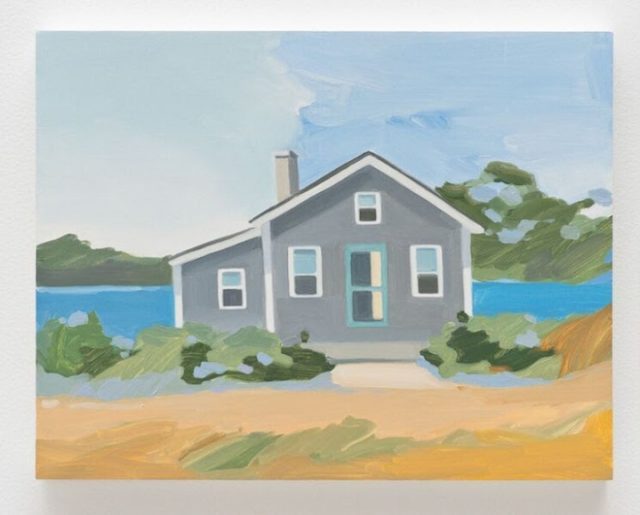
In Gallace’s case, the apples have been replaced by cottages along the water on the Cape. Each house is different, but nearly every structure is not quite a true representation of reality, with compelling flourishes of abstraction. Gallace, who works from sketches and photographs rather than en plein air, often leaves out doors and windows, or paints roads that twist in impossible ways, or depicts a house that seems to be built right on top of the water. There are no interiors; in some works, you can see right through windows and across the ocean, as if there is no furniture inside, and there are no people anywhere. Gallace’s use of line, light, and color is breathtaking, much more complex than one might initially notice. The horizontal and angled lines of “Cape Cod, Winter” make the work resemble a Dali-esque faceless double portrait. The blue and white of the structure in “Blue Beach Shack” nearly disappears into the blue and white of the sky. Lush greenery surrounds a gray house in “September 1.” “Surf Road” consists of a patch of flowers in the left foreground, a windowless white and gray barn in the right background, and a deserted roadway through the middle, a pair of telephone poles standing like ghosts, with no wires connecting them to anything. There are no cars to be seen on “Merritt Parkway, Winter,” one of Connecticut’s busiest thoroughfares, a curious overpass awaiting in the distance. The “Clear Day” show seems to falter only in a series of flower still lifes, which are more direct, lacking the deft sense of otherworldliness and isolation that can be found in the cottage canvases.
Arranged at eye level across several galleries at PS1, one after another in a nearly endless display that disorients visitors’ sense of place, the paintings evoke the phenomenal still lifes of Italian master Giorgio Morandi, which featured bottles, pitchers, bowls, and other common objects. In addition to Morandi, Gallace has also cited Fairfield Porter, Edward Hopper, Jane Freilicher, Albert York, Agnes Martin, and Robert Ryman as influences. In a short 2009 piece for Travel & Leisure magazine, “An Artist’s New England,” Gallace wrote of Truro, in Cape Cod, “Part of the reason I love Truro is that Edward Hopper lived here. His work has been a big influence on mine. His landscapes are so beautifully painted and are so much about the essence of the places he depicts.” As with her description of Cézanne’s works, she could be talking about her own paintings, which are beautiful indeed, and transport viewers to another place. “The house doesn’t mean anything per se. It’s an empty vessel,” she told Elle Décor in 2010, when she was part of the 2010 Whitney Biennial. Gallace skillfully imbues these empty vessels with a kind of psychological mystery, leaving it up to each viewer to come up with their own private narrative.
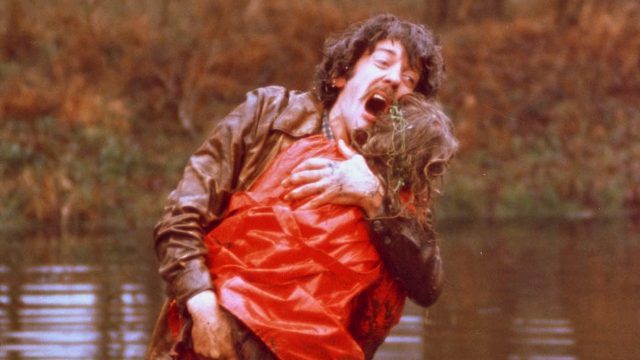
John Baxter (Donald Sutherland) cradles his dead daughter (Sharon Williams) in Nicolas Roeg’s psychological horror masterpiece, Don’t Look Now
DON’T LOOK NOW (Nicolas Roeg, 1973)
Quad Cinema
34 West 13th St. between Fifth & Sixth Aves.
September 1, 9:00, September 3, 5:45, September 5, 6:55, September 7, 9:10
Series runs September 1-7 quadcinema.com
The Quad invites film lovers into the very strange cinematic world of eighty-nine-year-old British writer, director, and cinematographer Nicolas Roeg in the one-week series “Look Now: The Universe According to Nicolas Roeg,” beginning September 1. The eleven works in the series celebrate Roeg’s spectacular visual sense as well as his love of celebrity, the supernatural, and pop culture. The centerpiece of the Quad presentation is Roeg’s 1973 masterpiece, the haunting and harrowing psychological horror tale Don’t Look Now. Written by Allan Scott and Chris Bryant and based on a short story by Daphne du Maurier, the film is an extraordinarily rich and detailed study of a family trying to regain itself following the tragic loss of a young daughter. “Nothing is what it seems,” John Baxter (Donald Sutherland) says, alerting the viewer early on. In the opening, scene, Christine (Sharon Williams) and her brother, Johnny (Nicholas Salter), are playing outside, he in a blue jacket, riding his red bike over the green grass and through trees, she playing with a talking doll and red-striped white ball while wearing a red raincoat even though the sun is shining bright on a nearly cloudless day. Over Pino Donaggio’s gentle piano score, Anthony B. Richmond’s camera zeroes in on a puddle next to a pond, then editor Graeme Clifford cuts to a fire raging in a fireplace in front of which the children’s mother, Laura (Julie Christie), is reading about Lake Ontario and their father, John (Donald Sutherland), is looking at glass slides of a church in Venice he has been asked to restore. In one image of a stained-glass window, Christ, in a red robe, is cradling the lamb symbolizing sinners, while a figure in a red hood sits in a front pew, gazing up at it. The scene then shifts back to Christine in her red mac, seen reflected upside down in the pond. Johnny rides over a pane of glass, breaking it and falling to the ground. John looks up, sensing something. Laura reads aloud from her book. She innocently puts her hand to her mouth. Christine puts her hand to her mouth. John smiles at Laura. Johnny tries to fix one of the wheels on his bicycle. Christine throws the ball in the air. John tosses a pack of cigarettes to Laura. The ball splashes in the pond. John knocks over a glass. The ball swirls in the water. Red liquid oozes from the figure in the church slide. John feels something is wrong and heads outside. Johnny runs toward him. Christine, lying on her back, slowly submerges under the water. John rushes into the pond. Laura looks at the bloody slide. With a gasp, John dives under the water. Laura tosses the slide onto her book, Beyond the Fragile Geometry of Space. The blood spreads further across the slide as Donaggio’s music turns ominous. John lifts the lifeless body of his daughter out of the pond, letting out a heartbreaking howl. John is too late to save Christine. Laura sees what is happening and screams. Roeg cuts to a power drill marked with a red panel drilling into the wall of the church in Venice that John is renovating. It’s a spectacular scene, every second critical to the rest of the film and how it’s photographed and edited, dominated by the color red (along with sharp blues and greens), shattering glass, people falling, and water representing death as John and Laura try to put together the pieces of their devastatingly fractured life.
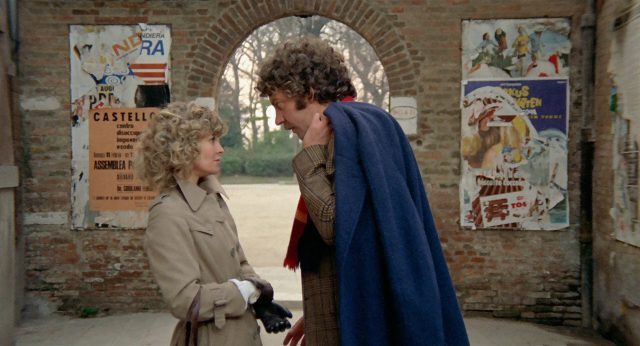
Laura (Julie Christie) and John Baxter (Donald Sutherland) try to get their fractured life back on track in Venice in Don’t Look Now
In a restaurant in Venice, the City of Canals, a pair of elderly sisters, Heather (Hilary Mason) and Wendy (Clelia Matania), stare at Laura and John. Heather, a blind woman with second sight, tells Laura that she can see Christine and that she is happy. Laura wants to believe her, but John is skeptical. The couple soon return to their hotel, where they engage in one of the most graphic sex scenes of its time, as Roeg cuts between their lovemaking and John and Laura getting dressed matter-of-factly afterward, the fiery emotion of their passion underscored by their practical desire to create another child. Meanwhile, a serial killer is on the loose in Venice, the victims being pulled from the canals. And John becomes obsessed with a figure in red he spots in the corners of the narrow streets and bridges of the city, wondering whether his dead daughter is trying to contact him. It all leads to an unforgettable finale of sheer genius. Viewers mustn’t look away from the screen for even a split second, as Roeg imbues each shot with power and meaning, from music and color to dialogue and cross-cutting, metaphorical clues and red herrings melding together, leaving nothing to chance.
Even the making of the film is filled with fascinating intrigue and classic stories. Wandering through Venice, Roeg came upon a church that was actually being renovated; coincidentally, it was named St. Nicolo dei Mendicoli, and there was already a sign on it that read “Venice in Peril.” When a stuntman refused to do a dangerous scene inside the church, Sutherland hesitantly did it himself, not knowing that the wire he was told would protect him was liable to break at any moment. For a long time it was rumored that the sex scene between Christie and Sutherland, which was added at the last moment, was not simulated but real, a claim vehemently denied by the participants (and one that did not make Warren Beatty too happy). Renato Scarpa, who plays the police inspector, could not speak English, so he performed his lines phonetically, not knowing what he was saying. And Roeg discovered Donaggio, a singer who had never composed a film score before, working on a gondola; Donaggio went on to compose the soundtrack for dozens and dozens of movies, including several for Brian De Palma. (Donaggio had already had a big hit with “Lo Che Non Vivo [Senza Te],” which Dusty Springfield turned into “You Don’t Have to Say You Love Me.”) But all of that merely enhances what is already a remarkable film, one of the greatest psychological horror movies of all time, and one that begs to be watched over and over again because of its many intricacies and nuances. Roeg might be telling us not to look, but we can’t help ourselves. You’ll also never think of the color red again in quite the same way. In addition to Don’t Look Now and the below films, the Quad is also screening Bad Timing: A Sensual Obsession, Castaway, Far from the Madding Crowd, Insignificance, Eureka, and Petulia, with such stars as George C. Scott, Theresa Russell, Tony Curtis, Gene Hackman, Oliver Reed, Richard Chamberlain, Harvey Keitel, and Art Garfunkel, all either directed and/or photographed by Roeg.
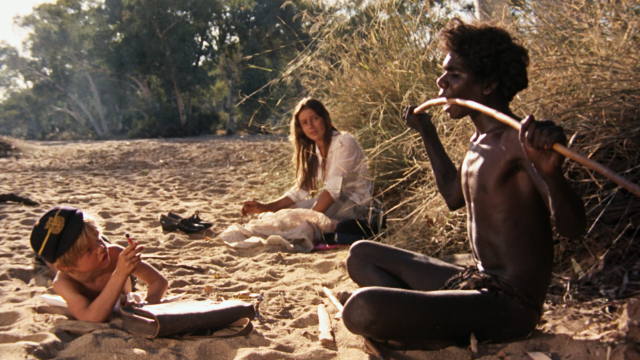
Runaway siblings (Jenny Agutter and Luc Roeg) learn about life from an Aborigine (David Gulpilil, later to be seen in Peter Weir’s The Last Wave) in Nicolas Roeg’s Walkabout
WALKABOUT (Nicolas Roeg, 1971)
Quad Cinema
September 1, 4:50, and September 2, 3:10 quadcinema.com
Nicolas Roeg’s first solo project, as director and cinematographer, is a beautiful film about a teenage girl (Jenny Agutter) and her young brother (Roeg’s real-life son, Luc Roeg) lost in the Australian outback after their father (John Meillon) tries to kill them. The full ninety-six-minute version soars when the siblings encounter an Aborigine (David Gulpilil, later to be seen in Peter Weir’s The Last Wave) on a walkabout, living off the barren land to prove his manhood. The film was written by Edward Bond, based on James Vance Marshall’s novel. Agutter went on to star in such films as Logan’s Run, Equus, and An American Werewolf in London.
Mick Jagger and Anita Pallenberg show off their acting chops in Donald Cammell and Nicolas Roeg’s very strange Performance
PERFORMANCE (Donald Cammell and Nicolas Roeg, 1970)
Quad Cinema
Friday, September 1, 6:50, Sunday, September 3, 1:00, and Wednesday, September 6, 9:10 quadcinema.com
A British gangster on the run hides out with a psychedelic rock star in this strangely enticing film from writer-director Donald Cammell (The Demon Seed) and Nicolas Roeg (making his big-screen directorial debut as well as serving as cinematographer). James Fox didn’t know what he was getting into when he signed on to play Chas, a mobster who finds sanctuary with mushroom-popping rock-diva has-been Turner, played with panache by Mick Jagger. Throw in Anita Pallenberg, a fab drug trip, and the great “Memo to Turner” scene and you have a film that some consider the real precursor to MTV, some think a work of pure demented genius, and others find to be one of the most pretentious and awful pieces of claptrap ever committed to celluloid.
Anjelica Huston has a wicked blast in Nicolas Roeg’s Roald Dahl adaptation, The Witches
THE WITCHES (Nicolas Roeg, 1990)
Quad Cinema
Saturday, September 2, 1:15, and Tuesday, September 5, 5:00 quadcinema.com
Executive producer Jim Henson’s feature-film swan song is an enchanting tale of a young boy who, upon encountering a witches convention led by the evil Grand High Witch (Anjelica Huston), is given a tail — well, actually, he’s turned into a cute little mouse. The witches have come up with a plan to rid the world of children by turning them all into rodents, and little Luke (Jasen Fisher) and old Helga (Mai Zetterling) are the only ones who can stop them. However, this is no Stuart Little (Rob Minkoff, 1999); based on a wicked story by Roald Dahl and directed by Nicolas Roeg (whose 1973 stunner, Don’t Look Now, dealt with a couple’s agony over their dead child), The Witches is definitely not for little kids. The cast also includes turns by such British faves as Rowan Atkinson, Jane Horrocks, and Brenda Blethyn.
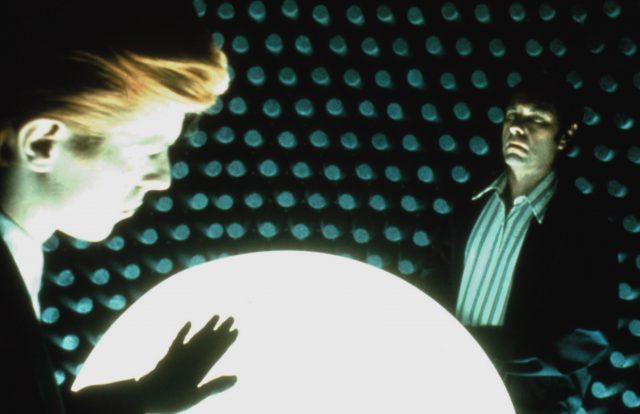
David Bowie made his feature-film debut in Nicolas Roeg’s The Man Who Fell to Earth
THE MAN WHO FELL TO EARTH (Nicolas Roeg, 1976)
Quad Cinema
Saturday, September 2, 5:15, and Sunday, September 3, 8:00 quadcinema.com
Nicolas Roeg’s adaptation of Walter Nevis’s 1963 science-fiction novel, The Man Who Fell to Earth, is a nearly unwatchable unmitigated mess, with gorgeous visuals and beautiful individual scenes getting lost in a narrative nightmare. Written by Paul Mayersberg, the 1976 film served as a vehicle for androgynous pop star David Bowie, in his movie debut, playing television-addicted Thomas Jerome Newton, a soft-spoken alien who has come to Earth to figure out a way to save his water-starved planet. He enlists the aid of attorney Oliver V. Farnsworth (Buck Henry, in hysterically thick bottle glasses) and college professor and scientist Dr. Nathan Bryce (Rip Torn) as he builds up his World Enterprises Corporation and develops an awkward, volatile relationship with hotel employee Mary-Lou (Candy Clark). Editor Graeme Clifford can’t assemble the many hackneyed scenes into any kind of intelligible narrative; even the numerous sex scenes, in which we get to see various naked women as well as Torn’s schvantz and Bowie’s thin white duke, get confusing fast. Shortly before his death in January 2016 at the age of sixty-nine, Bowie participated in a musical adaptation of the film and novel, Lazarus, that was equally strange if somewhat more successful.

![Supercodex [live set], 2013, © Ryoji Ikeda photo by Ryo Mitamura](https://twi-ny.com/wp-content/uploads/2017/09/supercodex-e1504369221398.jpg)
 Labor Day is the traditional end of summer, and Film Forum gets in on the fun with an inspired double feature of two Coney Island specials. Screening at 12:30 and 4:00,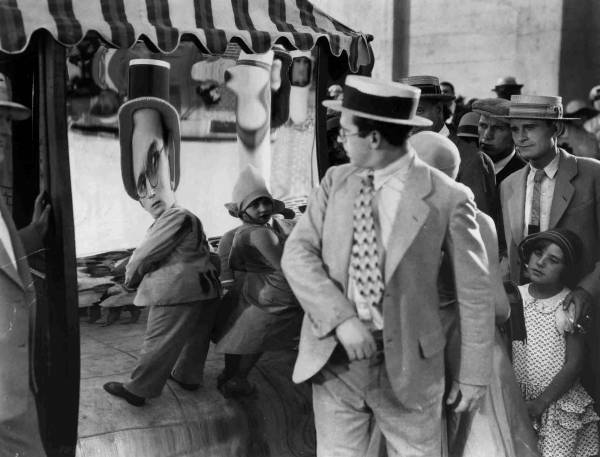
 In between the two showings of Little Fugitive is another delightful treat, Ted Wilde’s Speedy, with live musical accompaniment by pianist Steve Sterner. Much like the end of the silent film era itself, the last horse-drawn trolley is doomed in Harold Lloyd’s final silent film. Big business is playing dirty trying to get rid of the trolley and classic old-timer Pop Dillon. Meanwhile, Harold “Speedy” Swift, a dreamer who wanders from menial job to menial job (he makes a great soda-jerk with a unique way of announcing the Yankees score), cares only about the joy and wonder life brings. But he’s in love with Pop’s granddaughter, Jane (Ann Christy), so he vows to save the day. Along the way, he gets to meet Babe Ruth. Wilde was nominated for an Oscar for Best Director, Comedy, for this thrilling nonstop ride through beautiful Coney Island and the pre-depression streets of New York City. Film Forum’s second annual Festival of Summer Double Features continues through September 5 with such other sweet pairings as Panique and Peeping Tom, Point Blank and The Killers, and The Big Lebowski and The Last Picture Show.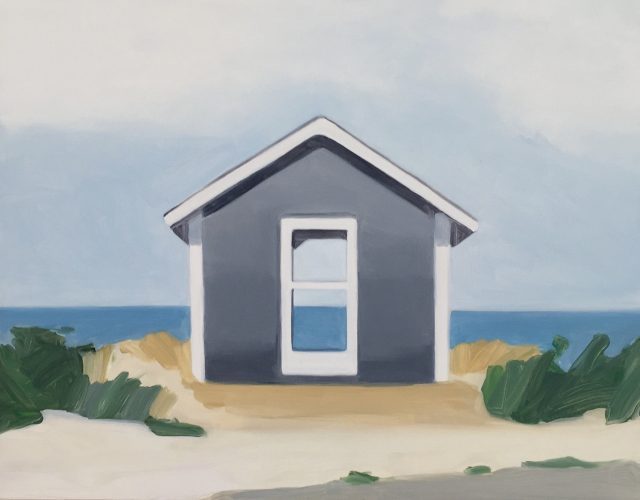
 Nicolas Roeg’s first solo project, as director and cinematographer, is a beautiful film about a teenage girl (Jenny Agutter) and her young brother (Roeg’s real-life son, Luc Roeg) lost in the Australian outback after their father (John Meillon) tries to kill them. The full ninety-six-minute version soars when the siblings encounter an Aborigine (David Gulpilil, later to be seen in Peter Weir’s The Last Wave) on a walkabout, living off the barren land to prove his manhood. The film was written by Edward Bond, based on James Vance Marshall’s novel. Agutter went on to star in such films as Logan’s Run, Equus, and An American Werewolf in London.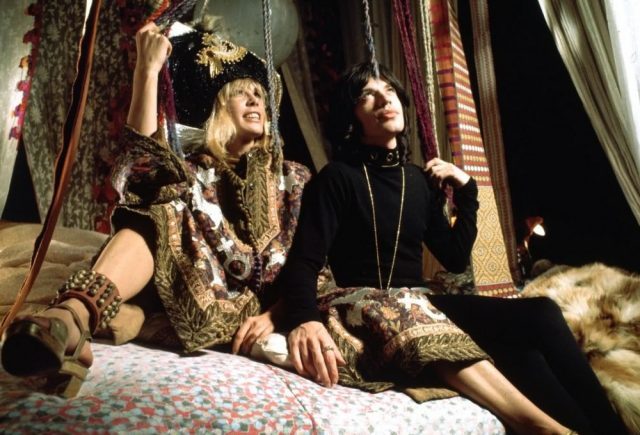
 A British gangster on the run hides out with a psychedelic rock star in this strangely enticing film from writer-director Donald Cammell (The Demon Seed) and Nicolas Roeg (making his big-screen directorial debut as well as serving as cinematographer). James Fox didn’t know what he was getting into when he signed on to play Chas, a mobster who finds sanctuary with mushroom-popping rock-diva has-been Turner, played with panache by Mick Jagger. Throw in Anita Pallenberg, a fab drug trip, and the great “Memo to Turner” scene and you have a film that some consider the real precursor to MTV, some think a work of pure demented genius, and others find to be one of the most pretentious and awful pieces of claptrap ever committed to celluloid.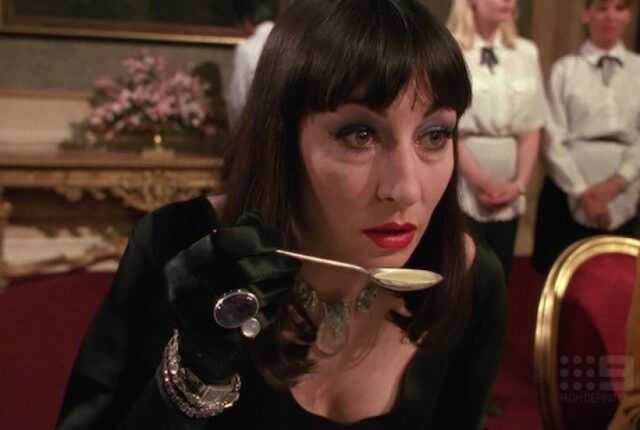
 Nicolas Roeg’s adaptation of Walter Nevis’s 1963 science-fiction novel, The Man Who Fell to Earth, is a nearly unwatchable unmitigated mess, with gorgeous visuals and beautiful individual scenes getting lost in a narrative nightmare. Written by Paul Mayersberg, the 1976 film served as a vehicle for androgynous pop star David Bowie, in his movie debut, playing television-addicted Thomas Jerome Newton, a soft-spoken alien who has come to Earth to figure out a way to save his water-starved planet. He enlists the aid of attorney Oliver V. Farnsworth (Buck Henry, in hysterically thick bottle glasses) and college professor and scientist Dr. Nathan Bryce (Rip Torn) as he builds up his World Enterprises Corporation and develops an awkward, volatile relationship with hotel employee Mary-Lou (Candy Clark). Editor Graeme Clifford can’t assemble the many hackneyed scenes into any kind of intelligible narrative; even the numerous sex scenes, in which we get to see various naked women as well as Torn’s schvantz and Bowie’s thin white duke, get confusing fast. Shortly before his death in January 2016 at the age of sixty-nine, Bowie participated in a musical adaptation of the film and novel,