twi-ny recommended events

AXIS DANCE COMPANY: THIRTIETH ANNIVERSARY SEASON

(photo by David DeSilva)

AXIS Dance marks its thirtieth anniversary with its first-ever New York season at Gibney Dance (photo by David DeSilva)

Gibney Dance Performing Arts Center, Studio H
280 Broadway between Chambers & Reade Sts.
November 16-18, $20-$25, 8:00
646-837-6809
gibneydance.org

California-based AXIS Dance Company is celebrating its thirtieth anniversary with its debut New York City season, November 16-18 at Gibney Dance. The company, founded in 1987 by Thais Mazur, brings together performers with and without physical disabilities through artistry, engagement, and advocacy. Under new artistic director Marc Brew, AXIS will present three works in Gibney’s Studio H, featuring company dancers James Bowen, Lani Dickinson, Scotty Hardwig, Carina Ho, Dwayne Schuneman, and Yuko Monden. Brew’s Radical Impact, a collaboration with composer and pianist JooWan Kim of Ensemble Mik Nawooj, explores identity politics and what it means to be human. Amy Seiwert is reworking her 2013 piece, The Reflective Surface, with an original score by Darren Johnston, seeking to surprise the audience and challenge its expectations. The evening will also include an excerpt from 2015’s In Defense of Regret, an examination of interior landscapes choreographed by Maurya Kerr, Alex Ketley, and Bobbi Jene Smith, with music by Emily Adams and Matan Dasaki. In addition, AXIS will be curating a series of integrated technique classes November 14-17 ($20, 10:00 am) with Brew (11/14), Mark Travis-Rivera (11/15), Heidi Latsky (11/16), and Alice Sheppard (11/17).

MOHAU MODISAKENG: ZION

(Mohau Modisakeng, ZION 2017. Courtesy of Whatiftheworld, Ron Mandos and Performa)

Mohau Modisakeng will lead a procession through the city for ZION (photo courtesy of Whatiftheworld, Ron Mandos, and Performa)

PERFORMA 17
Multiple locations
Saturday, November 11, free, 11:00 am – 5:15 pm
17.performa-arts.org
www.mohaumodisakeng.com

For Performa 17, South African multidisciplinary artist Mohau Modisakeng has created ZION, a procession through Manhattan invoking his native country’s history of colonialism, apartheid, and violent displacement. Beginning at 11:00 on November 11, Modisakeng and twenty dancers, carrying personal possessions, will make their way from Mother Zion Church in Harlem, zigzagging down Malcolm X Blvd. and Adam Clayton Powell Jr. Blvd. and to Hotel Theresa. At 2:00 the march stops at the Metropolitan Museum of Art and heads into Central Park, crossing the Great Lawn and Summit Rock. At 4:30, photographer, filmmaker, performance artist, and sculptor Modisakeng, whose previous work includes Passage, Metamorphosis, and Endabeni, will go from Anita’s Way public plaza to Times Square for a grand finale. The choreographed exodus equates what has happened in Cape Town’s District 6 and to Native Americans in Seneca Falls, New York, which was also the site of the first women’s rights convention, while also focusing on the current international refugee crisis.

DOC NYC: MIRACLE ON 42nd STREET

Terrence Howard is one of the performers singing the praises of Manhattan Plaza in Miracle on 42nd Street)

Terrence Howard is one of the performers singing the praises of Manhattan Plaza in Miracle on 42nd Street

MIRACLE ON 42ND STREET (Alice Elliott, 2017)
SVA Theatre
333 West 23rd St. between Eighth & Ninth Aves.
Saturday, November 11, $19, 1:30
Festival runs November 9-16 (various passes $75-$750)
www.docnyc.net
miracleon42ndstreet.org

If you’ve been watching The Deuce on HBO, you have a pretty good idea of what the Times Square area was like in the 1970s, a haven for drugs, prostitution, massage parlors, and pornography. A few blocks west was the dangerous area known as Hell’s Kitchen, which had a history of gang violence and other troubles. But in the mid-1970s, Richard Ravitch and HRH Construction began building Manhattan Plaza, two commercial skyscrapers, more than forty floors each, a project aiming to revitalize the neighborhood by bringing in upwardly mobile people. But the recession, urban blight, and the lack of interest in moving into the area stopped the building in its tracks until someone — it is still argued exactly who — came up with the idea to transform Manhattan Plaza into an arts community, offering low-income housing to qualified performers working in the Theater District, Times Square, and other parts of the city. Oscar-nominated producer, cowriter, and director Alice Elliott recounts the story of Manhattan Plaza in Miracle on 42nd Street, which is having its world premiere November 11 at the DOC NYC film festival. Situated between Forty-Second and Forty-Third Streets and Ninth and Tenth Avenues, Manhattan Plaza has been home to a vast array of artists, from Tennessee Williams and Dexter Gordon to James Earl Jones and Mickey Rourke; seventy percent of the rooms are allocated for artists on a limited income, with fifteen percent for the elderly and the disabled and fifteen percent for neighborhood residents. Elliott speaks with such actors, musicians, and comedians as Larry David, Alicia Keys, Giancarlo Esposito, Angela Lansbury, Donald Faison, Estelle Parsons, Terrence Howard, and Kenny Kramer, all of whom lived in Manhattan Plaza, as well as Samuel L. Jackson, who worked the night shift there as a security guard. (Two of the producers, Mary Jo Slater and Nancy McLeod Perkins, were also longtime Manhattan Plaza residents.)

miracle 2

They all speak fondly of the welcoming atmosphere that helped them hone their crafts. “For as much as I could have a sense of community, there was a sense of community at Manhattan Plaza,” notes David, who lived across the hall from Kramer; their relationship formed the basis for the Seinfeld characters George Costanza, Jerry Seinfeld, and Cosmo Kramer. “That building raised me,” Faison says. Lansbury calls it a “wonderful sociological experiment.” And Howard adds, “That place nurtured my dreams.” Meanwhile, the behind-the scenes development of the project and history of the location are recalled in interviews with longtime director of operations Richard Hunnings, Shubert Organization chairman Gerald Schoenfeld, former assistant NYPD chief Mickey Schwartz, operations director Rodney Kirk, former NEA chairman Rocco Landesman, 42nd St. Development Corp. founder Fred Papert, and builder Irving Fischer, who proudly says, “This wasn’t just a place to live; it was a community. . . . Manhattan Plaza revitalized the center of the city.” The interviews, some of which were conducted more than five years ago, are intercut with archival footage of New York City streets and Mayors John Lindsay and Abe Beame, along with clips from a 1978 Manhattan Plaza talent night in which David and Kramer both performed. Elliott (The Collector of Bedford Street. Body & Soul: Diana & Kathy) cowrote the film with Joal Ryan and Steve Ryfle; unfortunately, narrator Chazz Palminteri never finds the proper rhythm of the text, regularly emphasizing the wrong words. The sixty-eight-minute film also shows how the idea spread to other cities, where arts-based housing helped rebuild neighborhoods, but in today’s financial climate, it’s hard to imagine any more Manhattan Plaza–like projects popping up in the city. Miracle on 42nd Street is screening November 11 at 1:30 at the SVA Theatre and will be followed by a Q&A with Elliott, Parsons, Palminteri, and Kramer. In addition, the film will be preceded by Lucy Walker’s five-minute short, Oh, What a Beautiful Symphony (A City Symphony).

MINI MAKER FAIRE 2017

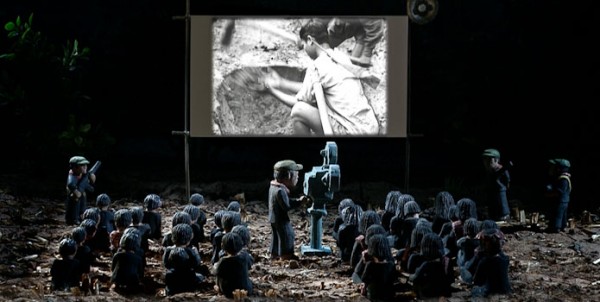
Multimedia artist Taezoo Park will discuss his TV Being 009 series as part of the Mini Maker Faire at B&N this weekend (photo courtesy Taezoo Park)

Multimedia artist Taezoo Park will discuss his TV Being 009 series as part of the Mini Maker Faire at B&N this weekend (photo courtesy Taezoo Park)

Multiple Barnes & Noble locations
Saturday, November 11, and Sunday, November 12, 12 noon, free
www.barnesandnoble.com

B&N is hosting its third annual all-ages Mini Maker Faire around the country on November 11 and 12, featuring inventors, innovators, 3D printers, hobbyists, hackers, robots, virtual reality, coding, and other cutting-edge technology and creators. On Saturday at 12:30 at the Eighty-Sixth St. store, Max Bogue will give a talk, “From Concept to a Million Pens Sold,” about the 3Doodler Pen, followed at 2:00 by Danny Sigler and Ruben Dax of ROLI discussing the Lightpad Block and the Seaboard Block and Frank Dautant showing off the Lomo’Instant Camera White. At 3:00, Samantha Razook Murphy of Curious Jane magazine will give a presentation. (Curious Jane will also be at the Park Slope B&N Saturday afternoon.) On Sunday at the Union Square B&N, Cyant CEO Barbara Hanna will discuss art and tech at 2:00, followed at 3:00 by multimedia sculptor Taezoo Park, who will talk about his very cool TV Being 009 project. And over at the Tribeca B&N, Pixel Academy will be on hand Saturday afternoon from 12 noon to 4:00, while Stuyvesant Pulse Robotics Team will give a battle-bots demonstration on Sunday at noon.

DOC NYC: MOLE MAN

Mole Man

Ron Heist shares his love of building in DOC NYC world premiere, Mole Man

MOLE MAN (Guy Fiorita, 2017)
Friday, November 10, Cinépolis Chelsea, 260 West Twenty-Third St. at Eighth Ave., 212-691-5519, $19, 7:30
Monday, November 13, IFC Center, 323 Sixth Ave. at West Third St., $12, 12:15
Festival runs November 9-16 (various passes $75-$750)
www.docnyc.net
www.facebook.com

After appearing on a 2010 episode of the History Channel series American Pickers, Ron Heist gained cult status for the massive structure he had been building in his parents’ large backyard in Butler, Pennsylvania, since 1965. The director of that episode, Guy Fiorita, has now made the bittersweet documentary Mole Man, a fascinating look inside the life and times of a unique man. Born in 1950, Ron has been obsessed with building things since he was a child. Now sixty-seven, toothless, and usually wearing a dark hoodie, Ron has constructed twenty-five buildings and twenty-three cellars linked by narrow passageways on his family’s property. He built it all by hand and by himself, scavenging items from more than seven hundred abandoned homes and factories, many of which had been left vacant following the closing of the Pullman Standard railcar plant in 1982. He refuses to use nails or mortar or even a level, relying on his own feel and intuition. He gets on his motorcycle, puts on his helmet, and meanders through the woods until he finds these houses, then brings back wood, doors, window frames, cinder blocks, chests, and whatever else he can fit on the back of his bike, as well as balls, plungers, clocks, license plates, and other items he collects. “People shouldn’t be as wasteful,” he says while showing off some treasures he has just found. Ron was always different, and his father, Chuck, treated him special; but the film’s real subject is Ron’s prospects: following the recent death of his father, Ron is left with his ninety-year-old mother, Mary, and his future becomes doubtful. The family, including Ron’s brother, Tim, and sister, Christine, who love Ron dearly, think that their mother would be better off in a smaller home, and they don’t have enough money to maintain the house. Meanwhile, they finally get Ron tested by a therapist to confirm that he has autism — he was previously diagnosed as “mentally challenged,” as were many of a lost generation of undiagnosed adults with the condition — and might be eligible for certain health benefits, although they worry about what might happen to Ron if he has to live elsewhere. “His routine, his environment . . . that’s his safety zone,” Tim says. But when Ron tells three of his friends, Sean Burke, Mike, and his cousin-in-law, John Burkert, that he knows where the Piney Mansion is, they believe they might find more than enough valuable objects, particularly some old, classic cars, to keep Ron living at home, so off into the woods they go, on a rather difficult journey. “To see Ron pulled out of that place, I think, would kill him, plain and simple,” John explains. “I just don’t think he’d want to live anymore.”

Mole Man

Mole Man Ron Heist picks up materials and brings them back home on his motorcycle

Ron is an endearing, eminently likable character. He has a childlike enthusiasm and even somewhat resembles a taller version of the Mole Men from the 1951 Superman film, although that’s not where he got his nickname from. “He loves being the Mole Man,” Burkert says. Like many people with autism, he has trouble holding conversations unless it’s on a subject that interests him, like time, numbers, construction, and scavenging. People naturally are drawn to his love of life and his dedication to his ever-expanding living quarters, although safety issues are a growing concern. Fiorita never exploits Ron, instead celebrating his individuality while also recognizing that Ron’s immediate future is at risk. Mole Man is having its world premiere at DOC NYC on November 10 and 13, with Fiorita, producers Cassidy Hartmann and James DeJulio, and some of the film’s subjects participating in postscreening Q&As. DOC NYC runs November 9 to 16 at Cinepolis Chelsea, the SVA Theatre, and IFC Center, with more than 150 features and shorts, by such documentarians as Barbara Kopple, Errol Morris, Laura Poitras, and Heidi Ewing and Rachel Grady; the films highlight such diverse figures as Eric Clapton, Curtis Sliwa, Lorraine Hansberry, Sammy Davis Jr., and David Bowie in addition to exploring many contemporary sociocultural issues from around the world.

PEOPLE, PLACES & THINGS

(photo by Teddy Wolff)

Emma (Denise Gough) doesn’t want to get with the program in People, Places & Things (photo by Teddy Wolff)

St. Ann’s Warehouse
45 Water St.
Tuesday – Sunday through December 3, $81-$91
718-254-8779
stannswarehouse.org

Denise Gough gives a career-redefining performance as an actress struggling through rehab in Duncan Macmillan’s People, Places & Things, which has been extended at St. Ann’s Warehouse through December 3. The broke Gough nearly quit the business before getting the role of Emma, a drug addict and alcoholic who checks herself into a rehab center; her riveting portrayal earned her an Olivier Award. The narrative arc is all too familiar: Emma’s addictions make it hard for her to keep a job, so she’s looking to “graduate” from a rehab to show she’s okay now. She proclaims, “I shouldn’t be here,” to the staff doctor (an excellent Barbara Marten), who replies, “It’s pretty obvious that you should. You came here for a reason. That was a good impulse.” As Emma’s hands shake, the doctor continues, “Your addiction will fight any progress. It’s a parasite and it will fight for its own survival until you’re dead. But progress is possible. I just need to hear you say that you are willing and motivated to make changes.” But Emma resists the twelve-step program, which requires mandatory group therapy. Emma, who at first goes by the name Nina — the play opens with a scene from Chekhov’s The Seagull in which Emma, as Nina, spins out of control — insists she is different from the other members of the group, which is led by a therapist (Marten) and includes Shaun (Himesh Patel), Laura (Laura Woodward), Charlotte (Charlotte Gascoyne), T (Jacob James Beswick), Jodi (Jacqui Dubois), Paul (Kevin McMonagle), Mark (Nathaniel Martello-White), and Foster (Alistair Cope), a former addict who completed the program and now works at the facility, helping others. Although she is an actress, Emma refuses at first to participate in role-playing exercises or share the details of her story; she is used to playing fictional characters onstage, so she steers away from the truth despite repeated admonitions that she must be truthful and hold nothing back. “Drugs and alcohol have never let me down. They have always loved me,” Emma says. “There are substances I can put into my bloodstream that make the world perfect. That is the only absolute truth in the universe.” But soon it is clear that if Emma doesn’t clean up her act, she is going to die.

(photo by Teddy Wolff)

Emma (Denise Gough) is spinning out of control in Duncan Macmillan play (photo by Teddy Wolff)

A coproduction of the National Theatre and the British Headlong company, the play is superbly directed by Jeremy Herrin (This House, Wolf Hall) with a bold energy that never lets up, with scene changes indicated by loud noises and lightning-like flashes, evoking the ups and downs of addiction, as if synapses are firing wildly. Bunny Christie’s set is a rectangular white-tiled room with hidden doorways in the walls; the audience sits on opposite sides, able to see one another through the whole show. After intermission, the simple move of a desk makes it feel like the entire set has been turned around, like Emma’s life. As Emma seeks her real identity, she suffers hallucinations in which she is surrounded by multiple Emmas, threatening her sanity. Martello-White excels as Mark, a fellow patient who bonds with Emma — and shares the same name as the brother she claims is dead. McMonagle stands out as Paul, a paranoid addict who is first seen shirtless, the words “The End” on his stomach in what appears to be blood. And Marten gives a thoughtful, caring performance as the doctor and the therapist. “You look like my mother,” Emma tells the doctor, who claims that it is just projection. “No, you really fucking look like her,” Emma says. Indeed, later Marten plays Emma’s mother as well. Macmillan (1984, Lungs, Every Brilliant Thing) gets too caught up in religion and recovery; the play suffers when the characters espouse the program, becoming far too preachy and treacly. It works much better when it is more abstract, Emma’s problems relating to twenty-first-century ills that we all can understand. “Self-medicating is the only way to survive in a world that is broken,” she explains. Gough, who was born in Ireland and has been a longtime London denizen, had never been to New York before this show; she was determined to step foot in the city for the first time only as an actress in a play. She is now taking New York by storm, currently off Broadway at St. Ann’s, and next as Harper in the upcoming Broadway revival of Tony Kushner’s Angels in America. We are all fortunate that she stuck with the program, ultimately refusing to give up on her hopes and dreams.

ZVI DANCE: LIKE

ZviDance

ZviDance relies on the participation of the audience in new evening-length piece, Like (photo courtesy ZviDance)

New York Live Arts
219 West 19th St. between Seventh & Eighth Aves.
November 8-11, $20-$25
212-924-0077
newyorklivearts.org
www.zvidance.com

ZviDance founder and artistic director Zvi Gotheiner concludes his trilogy about social interaction and technology with Like, making its world premiere at New York Live Arts November 8-11. Following 2010’s Zoom and 2014’s Surveillance, the new evening-length piece allows the audience to participate in the proceedings by using their cell phones to vote in a reality-television dance competition to determine the course of events and dancers. Choreographed by the Israeli-born, New York City-based Gotheiner, the work features eight dancers, a score by Scott Killian, lighting by Mark London, and media design by Joshua Higgason, with numerous cameras, computers, and screens following the action and providing resampled live streams, prerecorded news footage, and real-time interviews with the performers as well as members of the audience.