twi-ny recommended events

THE GREEN FOG / VERTIGO

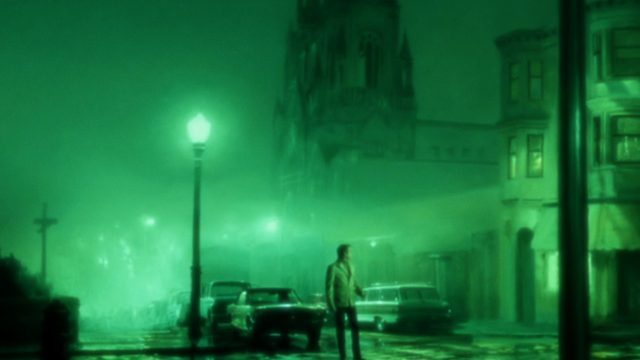
The Green Fog

Guy Maddin, Evan Johnson, and Galen Johnson reimagine Alfred Hitchcock’s Vertigo with clips from old films in The Green Fog

THE GREEN FOG (Guy Maddin, Evan Johnson, and Galen Johnson, 2017)
IFC Center
323 Sixth Ave. at West Third St.
Opens Friday, January 5
212-924-7771
www.ifccenter.com
guy-maddin.com

Winnipeg-based filmmakers Guy Maddin, Evan Johnson, and Galen Johnson ingeniously reimagine Alfred Hitchcock’s psychosexual masterpiece, Vertigo, using clips from dozens of movies and television shows in the mesmerizing pastiche The Green Fog. When Maddin, who has made such previous films as Careful, The Saddest Music in the World, and My Winnipeg, which use early-cinema conventions and look like rediscovered, decayed old works, was commissioned by the San Francisco International Film Festival to make a film for its sixtieth anniversary, Maddin turned to the Johnson brothers, his collaborators on The Forbidden Room and Bring Me the Head of Tim Horton, and began poring over movies and TV shows set in the City by the Bay. Along the way they were continually reminded of Vertigo as they recognized locations from the classic thriller about an agoraphobic detective obsessed with a woman who resembles his former love. So the trio decided to re-create Vertigo with found footage, not shot-by-shot like Gus Van Sant did with Psycho but by employing themes, places, pacing, mood, and tension similar to Hitchcock’s, and in about half the time. (The Green Fog runs sixty-three minutes, Vertigo slightly more than two hours.)
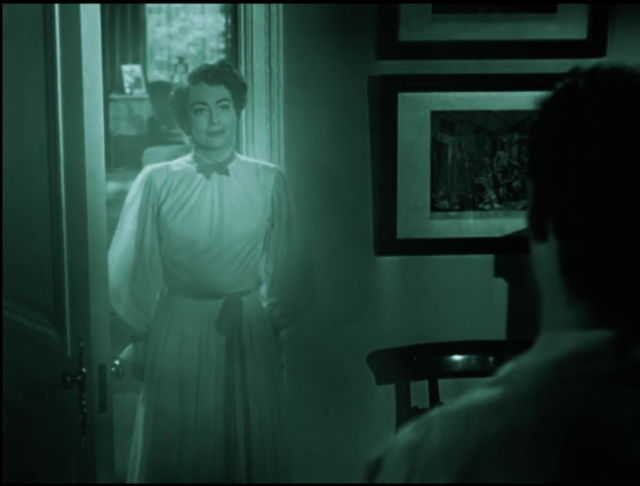
The Green Fog

The Green Fog incorporates clips from such genre movies as Sudden Fear, starring Joan Crawford

In sections with such titles as “Prologue,” “Weekend at Ernie’s,” and “Catatonia,” Maddin and the Johnsons follow the general story line of Vertigo,, with the Jimmy Stewart role “played” primarily by Rock Hudson from McMillan & Wife, Vincent Price from Confessions of an Opium Eater, and Chuck Norris from Slaughter in San Francisco and An Eye for an Eye. There’s a rooftop chase, a visit to a flower shop, scenes in restaurants and with paintings in museums, and a trip up a tower. Occasionally a green fog threatens ominously. In the vast majority of the clips, the dialogue has been cut out, so the characters are seen in choppy edits looking at each other in offbeat ways, allowing viewers to infer their own Vertigo-esque narrative. Because viewers are likely not to be familiar with many of the scenes from the movies and thus don’t know the relationships between the characters, issues of sexuality, homoeroticism, and even incest arise as Maddin and the Johnsons redefine the male gaze — so prevalent in Hitchcock films — while passing the Bechdel test. Snippets of conversation occasionally come through, usually involving people watching surveillance footage on film or monitors or listening to tape recordings, commenting with inside jokes and references to the making of The Green Fog. “What are we looking for, sir?” Sgt. Enright (John Schuck) asks Commissioner McMillan (Hudson), who responds, “I don’t know, but at this point I’ll take anything.” McMillan also says, “That’s the trouble with that old film,” and later sets fire to filmstrips, leading to a series of disasters of epic proportions. And Michael Douglas as Det. Steve Keller from The Streets of San Francisco watches Michael Douglas as Det. Nick Curran from Basic Instinct get out of bed and walk to the bathroom naked. “Boy, you look good, Mike. You ever thought about going into showbiz?” Keller says to Lt. Stone (Malden).
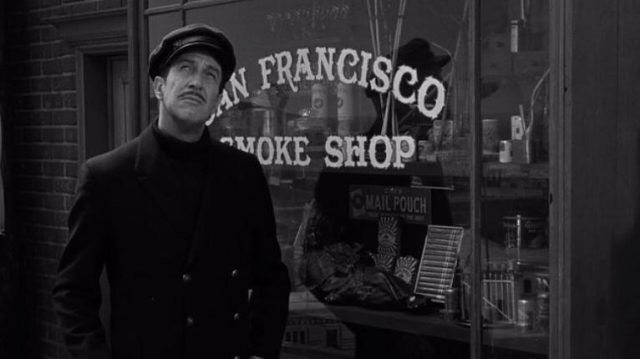
Vincent Price

Vincent Price is one of many actors who “portray” John “Scottie” Ferguson (Jimmy Stewart) in mesmerizing cinematic collage based on Vertigo

Many shots echo the doubling mirror image that is at the heart of Vertigo. In a scene from Nicholas Ray’s Born to Be Bad, Gobby Broome (Mel Ferrer) watches what appears to be twin girls looking intently at two paintings in a museum. In a restaurant, a daughter tells her father, “I’m trying to become somebody,” as if there’s another persona waiting to burst out of her. And Lt. Stone puts on clown makeup to try to catch a killer. Among the other actors who show up in the film are Mel Brooks, Lee Remick, Martin Landau, Nancy Kwan, Clint Eastwood, Meg Ryan, Richard Gere, Kim Basinger, Donald Sutherland, Miriam Hopkins, Dean Martin, Fritz Weaver, Sandra Bullock, Claude Akins, Sharon Stone, John Saxon, Joan Crawford, Sidney Poitier, Humphrey Bogart, Joseph Cotten, and Veronica Cartwright, from such movies and TV series as Murder She Wrote, Mission: Impossible, Hotel, Bullitt, High Anxiety, Dark Passage, Star Trek IV: The Voyage Home, The Towering Inferno, It Came from Beneath the Sea, Barbary Coast, The Conversation, Flower Drum Song, The Love Bug, Dirty Harry, A View to a Kill, The Lady from Shanghai, Sans Soleil, Sister Act, So I Married an Axe Murderer, Pal Joey, Invasion of the Body Snatchers, The Ten Commandments, and They Call Me Mister Tibbs! as well as an *NSYNC video. The intense, titillating score was composed by Jacob Garchik and is performed by the San Francisco-based Kronos Quartet. The Green Fog also evokes Christian Marclay’s The Clock and Telephones, in which the Swiss and American visual and sound artist edited together existing film footage to create narratives based on time and phone conversations, respectively. As with those montage-based works, it’s easy to get caught up in trying to identify the actors and the movies in The Green Fog, but don’t forget that the clips are all being employed to come up with something brand new that stands on its own. Maddin (Tales from the Gimli Hospital, Keyhole) and the Johnsons have made a dazzling love letter to Vertigo, to San Francisco, and to the history of movies themselves, offering a treasure trove of fun worthy of repeated viewings.

The Green Fog opens January 5 at IFC Center, screening with Maddin and the Johnson brothers’ 2015 short Lines of the Hand, which is based on Jean Vigo’s unrealized film poem Les lignes de la main and stars film critic Luce Vigo, who is Vigo’s daughter, along with Geraldine Chaplin and Udo Kier. Maddin will participate in a Q&A with SFFILM executive director Noah Cowan following the 8:55 show on January 5 in addition to Q&As after the 4:50 and 8:55 screening on January 6. There will also be some double features pairing The Green Fog with Vertigo.
VERTIGO

James Stewart and Kim Novak get caught up in a murder mystery in Vertigo

VERTIGO (Alfred Hitchcock, 1958)
IFC Center
323 Sixth Ave. at West Third St.
Opens Friday, January 5
212-924-7771
www.ifccenter.com

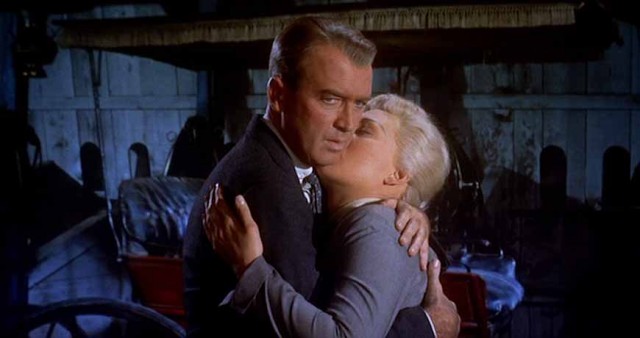
Select screenings of The Green Fog will be accompanied by Alfred Hitchcock’s 1958 mind-altering, fetishistic psychological thriller, Vertigo, which heavily influenced Guy Maddin, Evan Johnson, and Galen Johnson’s San Francisco montage. Based on Boileau-Narcejac’s 1954 novel, D’entre les morts, the film delves deep into the nature of fear and obsession. Jimmy Stewart stars as John “Scottie” Ferguson, a police detective who retires after his acrophobia leads to the death of a fellow cop. An old college classmate, wealthy businessman Gavin Elster (Tom Holmore), asks Scottie to look into his wife’s odd behavior; Elster believes that Madeleine (Kim Novak) is being inhabited by the spirit of Carlotta Valdes, her great-grandmother, a woman who committed suicide in her mid-twenties, the same age that Madeleine is now. Scottie follows Madeleine as she goes to Carlotta’s grave, visits a portrait of her in a local museum, and jumps into San Francisco Bay. Scottie rescues her, brings her to his house, and starts falling in love with her. But on a visit to Mission San Juan Bautista, tragedy strikes when Scottie can’t get to the top of the tower because of his vertigo. After a stint in a sanatorium, he wanders the streets of San Francisco where he and Madeleine had fallen in love, as if hoping to see a ghost — and when he indeed finds a woman who reminds him of Madeleine, a young woman named Judy Barton (Novak), he can’t help but try to turn her into his lost love, with tragedy waiting in the wings once again.
VERTIGO

Scottie experiences quite a nightmare in Alfred Hitchcock classic

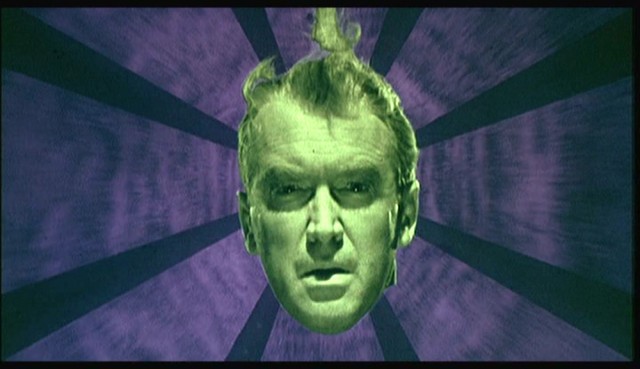
Vertigo is a twisted tale of sexual obsession, much of it filmed in San Francisco, making the City by the Bay a character all its own as Scottie travels down Lombard St., takes Madeleine to Muir Woods, stops by Ernie’s, and saves Madeleine under the Golden Gate Bridge. The color scheme is almost shocking, with bright, bold blues, reds, and especially greens dominating scenes. Hitchcock, of course, famously had a thing for blondes, so it’s hard not to think of Stewart as his surrogate when Scottie insists that Judy dye her hair blonde. Color is also central to Scottie’s psychedelic nightmare (designed by artist John Ferren), a Spirographic journey through his mind and down into a grave. Cinematographer Robert Burks’s use of the dolly zoom, in which the camera moves on a dolly in the opposite direction of the zoom, keeps viewers sitting on the edge of their seats, adding to the fierce tension, along with Bernard Herrmann’s frightening score. Despite their age difference, there is pure magic between Stewart, forty-nine, and Novak, twenty-four. (Stewart and Novak next made Bell, Book, and Candle as part of the deal to let Novak work for Paramount while under contract to Columbia.)

The production was fraught with problems: The screenplay went through Maxwell Anderson, Alec Coppel, and finally Samuel A. Taylor; shooting was delayed by Hitchcock’s health and vacations taken by Stewart and Novak; a pregnant Vera Miles was replaced by Novak; Muir Matheson conducted the score in Europe, instead of Herrmann in Hollywood, because of a musicians’ strike; associate producer Herbert Coleman reshot one scene using the wrong lens; Hitchcock had to have a bell tower built atop Mission San Juan Bautista after a fire destroyed its steeple; and the studio fought for a lame alternate ending (which was filmed). Perhaps all those difficulties, in the end, helped make Vertigo the classic it is today, gaining in stature over the decades, from mixed reviews when it opened to a controversial restoration in 1996 to being named the best film of all time in Sight & Sound’s 2012 poll to a recent digital restoration.
NEW YEAR, NEW FUTURES

I Am Not Your Negro

Brooklyn Museum screening of I Am Not Your Negro will be followed by discussion of activism with James Baldwin’s niece

Brooklyn Museum
200 Eastern Parkway at Washington St.
Saturday, January 6, free, 5:00 – 11:00
212-864-5400
www.brooklynmuseum.org

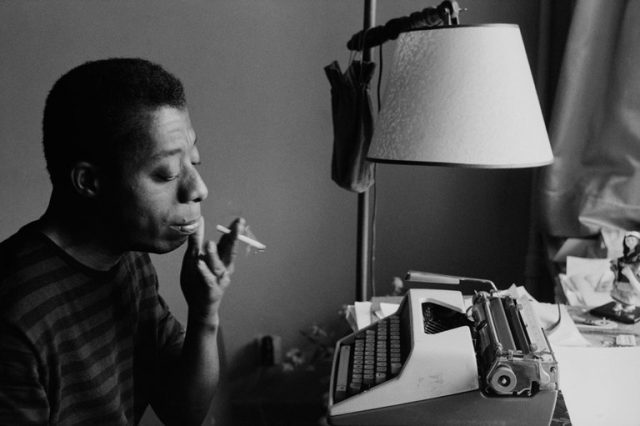
The Brooklyn Museum looks to 2018 with its January First Saturday program, “New Year, New Futures.” There will be live music by Sinkane, BEARCAT, Zaven of Resonator Collective (an in-gallery soundscape for the terrific exhibition “Proof: Francisco Goya, Sergei Eisenstein, Robert Longo”), and New Kingston; a curator tour of “Rodin at the Brooklyn Museum: The Body in Bronze” with Lisa Small; a hands-on art workshop in which participants can make zines inspired by “Proof”; a community talk with Murad Awawdeh, the vice president of advocacy at the New York Immigration Coalition; a screening of the Oscar-nominated documentary about James Baldwin, I Am Not your Negro (Raoul Peck, 2017), followed by a discussion with activists Jessica Green and Aisha Karefa-Smart (Baldwin’s niece); a Feminist Book Club event focusing on the 1970 book Sisterhood Is Powerful: An Anthology of Writings from the Women’s Liberation Movement, edited by Robin Morgan, hosted by Glory Edim of Well-Read Black Girl based on selections by Judy Chicago; pop-up gallery talks on “Roots of ‘The Dinner Party’: History in the Making”; a Brooklyn Dance Festival movement workshop and live performances; pop-up poetry with DéLana R. A. Dameron (Weary Kingdom) and Rickey Laurentiis (Boy with Thorn), followed by a signing; and a NYLaughs comedy showcase with Negin Farsad, Nimesh Patel, and Jordan Carlos, hosted by Ophira Eisenberg and followed by a discussion on humor, activism, and crisis. In addition, the galleries will be open late so you can check out “Roots of ‘The Dinner Party’: History in the Making,” “Soulful Creatures: Animal Mummies in Ancient Egypt,” “Proof: Francisco Goya, Sergei Eisenstein, Robert Longo,” “Arts of Asia and the Middle East,” “Infinite Blue,” “Ahmed Mater: Mecca Journeys,” “Rodin at the Brooklyn Museum: The Body in Bronze,” “A Woman’s Afterlife: Gender Transformation in Ancient Egypt,” and more.

HIROSHI SUGIMOTO: GATES OF PARADISE

(photo by Richard Goodbody)

Hiroshi Sugimoto followed the journeys of the Tenshō Embassy through Italy for photographic series (photo by Richard Goodbody)

Japan Society
333 East 47th St. at First Ave.
Through January 7, $12
212-715-1258
www.japansociety.org

In his 2005-6 Japan Society exhibition “History of History,” Tokyo-born multidisciplinary artist Hiroshi Sugimoto explored time and spirituality by including his photographic works alongside artifacts from his personal collection dating from the prehistoric era to the fifteenth century. Throughout his career, he has constructed his own professional history by photographing dioramas at natural history museums (“Still Life”), capturing electrical discharges on photographic dry plates (“Lightning Fields”), focusing on the horizon line across the ocean (“Seascapes”), shooting wax figures to look like paintings (“Portraits”), using long exposures to reveal the blinding soul of movie palaces (“Theaters”), and turning one thousand gilded wooden Buddha statues at Sanjῡsangen-dō (Hall of Thirty-Three Bays) in Kyoto into a dizzying film (Sea of Buddha). His latest Japan Society show, “Hiroshi Sugimoto: Gates of Paradise,” on view through January 7 as part of the institution’s 110th anniversary celebration, returns to historical investigation, from a larger cultural perspective rather than a personal one.

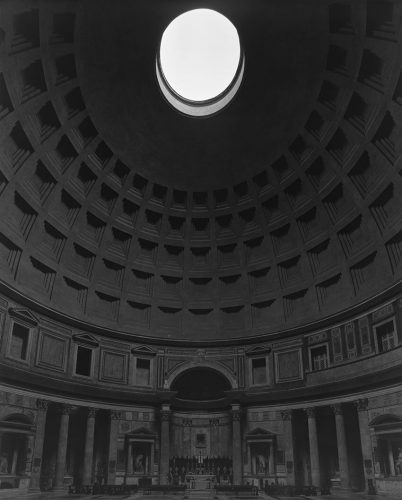
Hiroshi Sugimoto, Pantheon, Rome, gelatin silver print, 2015 (© Hiroshi Sugimoto.)

Hiroshi Sugimoto, “Pantheon, Rome,” gelatin silver print, 2015 (© Hiroshi Sugimoto)

In 2015, while Sugimoto, who is based in Japan and New York City, was traveling through Italy photographing theaters, he learned of the fascinating story of Mancio Ito, Miguel Chijiwa, Juliao Nakaura, and Martinao Hara, four young Japanese men who were sent to Europe in 1582 to experience Western Christian culture. Known as the Tenshō Embassy, they returned eight years later with much information that influenced Japanese and nanban hybrid art, taught by Jesuit missionaries, which combined Eastern and Western subjects and techniques. Sugimoto decided to follow their journey, taking photographs of landmark structures and artworks the young men most likely saw, including the Pantheon in Rome, the Leaning Tower of Pisa, the Siena Duomo, the Duomo in Florence, the Villa Farnese, the Pietà by Michelangelo, and the Teatro Olimpico in Vicenza. Those works are displayed along with related historical objects that add intriguing context. “Pope Gregory XIII welcomed the four boys because he saw them as renewing the spirit of the three wise men coming from the East to pay homage to the newborn Christ,” Sugimoto explains in his artist statement. “That sense of mutual surprise from over four centuries ago still flows, not quite wholly absorbed, in my bloodstream.”

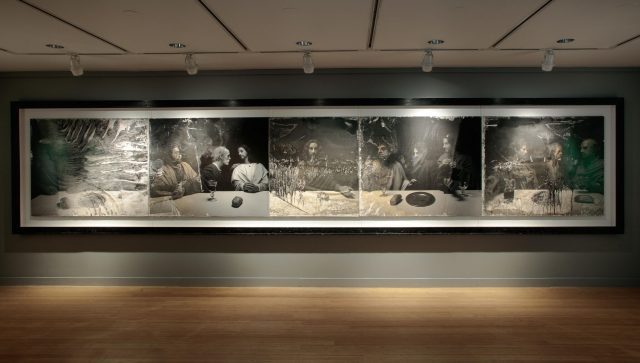
Hiroshi Sugimoto, The Last Supper: Acts of God, gelatin silver print, 1999–2012

Hiroshi Sugimoto, “The Last Supper: Acts of God,” gelatin silver print, 1999–2012 (© Hiroshi Sugimoto)

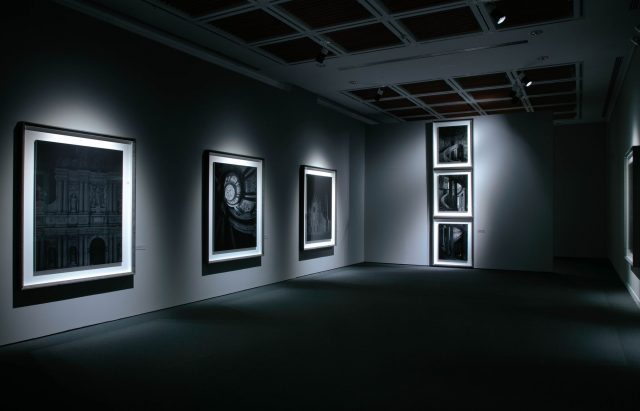
Sugimoto, who will turn seventy this year, produced silver gelatin prints of the places, casting the images in an austere, ghostlike darkness. The hole at the top of the inside of the Pantheon glows with light. The winding staircase at Villa Farnese unfolds in a captivating vertical triptych. The long hallway of the Teatro Olimpico beckons. In its own room, “The Last Supper: Acts of God” features Sugimoto’s more-than-twenty-two-foot-long horizontal photograph of Leonardo da Vinci’s iconic painting; the photo was significantly damaged when Sugimoto’s Chelsea studio was flooded by Hurricane Sandy. However, the destruction lends new meaning to the work, with some sections sharp and distinct, others looking melted and severely scratched — and adding what appears to be a halo around the head of Jesus. “I chose to interpret this as the invisible hand of God coming down to bring my monumental, but unfinished, ‘Last Supper’ to completion,” Sugimoto writes. “Leonardo completed his ‘Last Supper’ over five hundred years ago and it has deteriorated beautifully. I can only be grateful to the storm for putting my work through the same half millennium of stresses in so short a time.” Sugimoto’s photograph is accompanied by a fourteenth-century Japanese bust of Christ’s head that has been badly damaged.

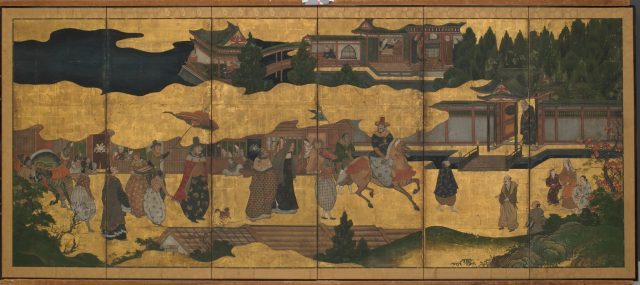
A Portuguese Ship

Unidentified artist, “A Portuguese Trading Ship Arrives in Japan,” pair of six-panel folding screens, ink, color, gold, and gold-leaf on paper, early 17th century (Feinberg Collection)

Sugimoto has curated a collection of letters, portraits, scrolls, screens, and other objects that reveals the cross-cultural exchange between Japan and Europe that emerged during the “Christian Century” of the 1500s as missionaries came to the East and converted many Japanese. “A Portuguese Trading Ship Arrives in Japan,” consisting of a pair of early-seventeenth-century six-panel nanban folding screens, uses both European and Japanese techniques to relate the story of the West meeting the East. The details in the individual sections are worth examining at length to explore the architecture, manner of dress, and facial expressions. A bamboo vase, hanging scroll letter, and tea scoop belonging to tea master Sen no Rikyū refers to chanoyu, “the way of tea,” a ritual that was the focus of Sugimoto’s Rikyu-Enoura, an original theatrical production that ran in early November as part of Japan Society’s “NOH NOW” series.

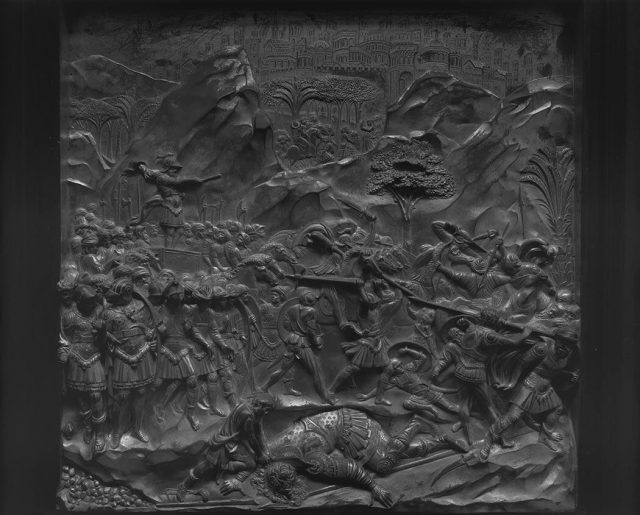
Hiroshi Sugimoto

Hiroshi Sugimoto’s “Gates of Paradise” includes a photo of Ghiberti’s rendering of David slaying Goliath (© Hiroshi Sugimoto)

In the final room, Sugimoto debuts his latest series, “Gates of Paradise,” large-scale photographs of the bronze doors created by Lorenzo Ghiberti for the Baptistery of St. John in Florence from 1425 to 1452. Dubbed the “Gates of Paradise” by Michelangelo, the work underwent a major decades-long renovation and was moved to the Opera del Duomo Museum in 2012, where Sugimoto saw them. There are ten pieces from the black-and-white series, gelatin silver prints that give the bronze doors a different, haunting look. Among the subjects are Adam and Eve, Cain and Abel, Noah, Abraham, Jacob and Esau, Solomon, David, and Joshua, in biblical scenes that sometimes require a bit of entertaining deciphering. (And don’t miss Sugimoto’s “Red and White Plum Blossoms Under Moonlight,” a stunning platinum and palladium print on two screens that he produced in commemoration of the three hundredth anniversary of the birth of Japanese artist Ogata Kōrin.) It is an engaging and stimulating conclusion to the exhibit, for which Sugimoto also redesigned Japan Society’s lobby pond and upstairs corner garden, adding a stainless-steel sculpture to each. On January 6 from 6:00 to 9:00, in conjunction with the closing of the show, Japan Society is hosting “Escape East @ 333,” the next edition of its monthly mixer for art enthusiasts, with a viewing of the exhibition, live music from DJ Aki, and sake tastings; admission is free with advance registration.

SHANGHAI DANCE THEATRE: SOARING WINGS

The Shanghai Dance Theatre makes its NYC debut with Soaring Wings at Lincoln Center

Shanghai Dance Theatre makes its NYC debut with Soaring Wings at Lincoln Center

David H. Koch Theater at Lincoln Center
20 Lincoln Center Plaza
January 5-7, $22-$167
212-496-0600
davidhkochtheater.com

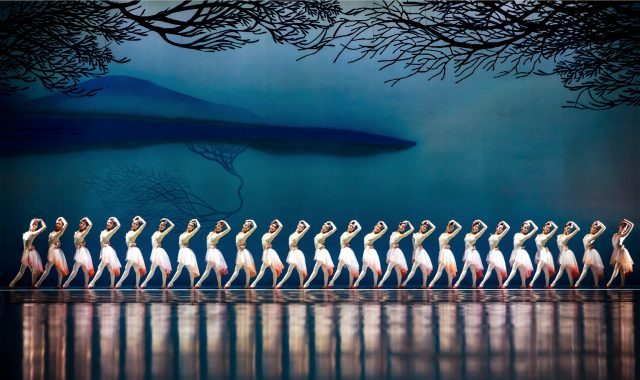
Shanghai Dance Theatre makes its New York debut January 5-7 at the David H. Koch Theater at Lincoln Center with Soaring Wings, an evening-length celebration of harmony about the “bird of good fortune,” the Japanese crested ibis. Set to traditional Chinese music, the environmentally conscious work celebrates the interdependence between nature and humanity, building the theme around the rediscovery of ibises in Shaanxi Province in 1981, thought to be in extinct in China and Japan as the result of twentieth-century modernization. Presented by China Arts and Entertainment Group as part of its Image China program, which began in 2009 “as a bridge of cultural exchanges between China and other countries,” Soaring Wings features more than two dozen dancers, including principals Zhu Jiejing and Wang Jiajun. Zhong Jiani’s lush, elegant costumes bring the endangered species to beautiful life; the show is written by Luo Huaizhen, with music by Guo Sida, direction and choreography by Tong Ruirui, lighting by Xing Xin, makeup by Xu Bin, and props by Li Hongchao. The award-winning Shanghai Dance Theatre, which was founded in 1979 and melds Chinese classical dance with ballet and folk traditions, has been traveling the world with Soaring Wings and such other productions as Fragrance, so its New York debut is greatly anticipated.

WINTER 2018 PERFORMANCE FESTIVALS

The Hendrix Project

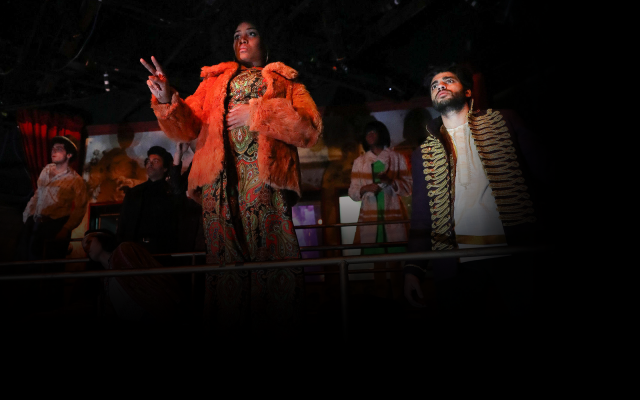
The Hendrix Project kicks out the jams at the BRIC House as part of the Public Theater’s Under the Radar festival (photo by Nicolas Savignano)

Once upon a time, January was considered a relative artistic wasteland, as people suffered from a post-holidays letdown with a dearth of high-quality movies and Broadway shows opening up. But this century continues to fill that void with more and more cutting-edge, experimental, and offbeat music, dance, and theater with a growing list of performance festivals around the city. You can catch cabaret at Pangea, opera at Prototype, dance at American Realness, the 92nd St. Y, and New York Live Arts, jazz at JazzFest, Irish theater at Origin’s 1st, and a little of everything at Under the Radar and COIL, the latter back where it belongs at the renovated PS122. Below are only some of the highlights of this exciting time to try something that might be outside your comfort zone and take a chance on something new and different to kick off your 2018, especially with the majority of tickets going for about twenty-five bucks.

UNDER THE RADAR
Public Theater and other venues
425 Lafayette St. by Astor Pl.
January 4-15
www.publictheater.org

After by Andrew Schneider, performed by Alicia ayo Ohs and Andrew Schneider, with Kedian Keohan and Peter Musante, January 4, 6, 7, 8, 11, 13, 14, Public Theater, Martinson Hall, $25

Parallel Lives: Billie Holiday & Edith Piaf, created and directed by Nona Hendryx, performed by Joey Arias, Tamar Kali, Liza Jesse Peterson, and Etienne Stadwjck, January 5-6, Joe’s Pub, $45

The Gates: An Evening of Stories with Adam Gopnik, January 5, 10, 12, 13, 14, Public Theater, Newman Theater, $25

The Hendrix Project, by Roger Guenveur Smith & CalArts Center for New Performance, performed by Samantha Barrow, Morgan Camper, Hannah Cruz, Jasmine Gatewood, Heaven Gonzalez, Ariyan Kassam, Liam O’Donnell, Dante Rossi, Henita Telo, Max Udell, Ieva Vizgirdaite, and Christopher Wentworth, January 11-14, BRIC House, $25

Pursuit of Happiness, Nature Theater of Oklahoma & EnKnapGroup, NYU Skirball, January 12-14, $25

(photo by Philip Groshong)

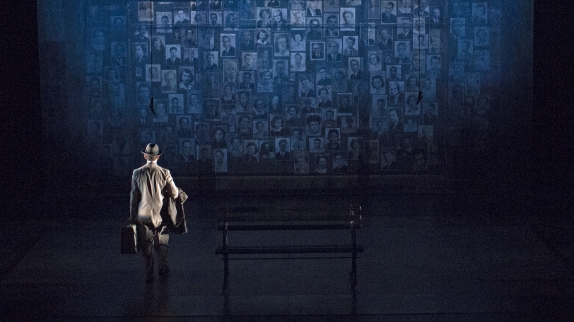
Gregory Spears and Greg Pierce’s Fellow Travelers goes back to the Lavender Scare of the 1950s (photo by Philip Groshong)

PROTOTYPE
Multiple venues
January 7-20
www.prototypefestival.org

Acquanetta, by composer Michael Gordon, librettist Deborah Artman, director Daniel Fish, and conductor Daniela Candillari, with Mikaela Bennett, Amelia Watkins, Eliza Bagg, Timur, and Matt Boehler, Gelsey Kirkland Arts Center, January 9-13, $30-$75

Out of Bounds — Breaking Ice: The Battle of the Carmens, by Alicia Hall Moran, new vocal work for an ice-skating audience, January 11, Bank of America Winter Village at Bryant Park, free, 1:40; January 14, location TBD, free, 2:30

Fellow Travelers, by composer Gregory Spears, librettist Greg Pierce, director Kevin Newbury, and conductor George Manahan, with Aaron Blake, Joseph Lattanzi, Devon Guthrie, Vernon Hartman, Marcus DeLoach, Christian Pursell, Paul Scholten, Alexandra Schoeny, and Violetta Lopez, January 12-14, Gerald W. Lynch Theater at John Jay College of Criminal Justice, $30-$55

Out of Bounds: The Future Is Open, by Tori Wrånes, newly commissioned site-specific work, Washington Square Park, Northwest Corner, January 18-19, free, 5:30

MIchelle Ellsworth’s The Rehearsal Artist is an intimate experience at American Realness

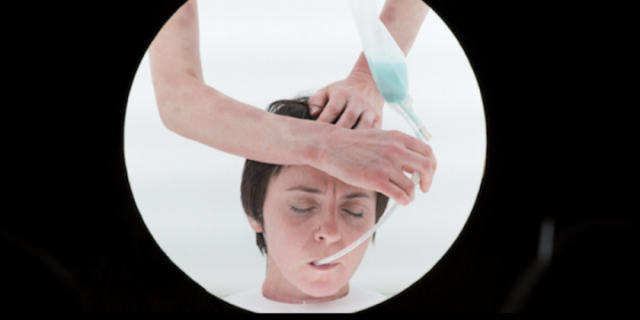
Michelle Ellsworth’s The Rehearsal Artist promises an intimate experience at American Realness

AMERICAN REALNESS
Abrons Arts Center and other venues
466 Grand St. at Pitt St.
January 9-16
americanrealness.com

The Rehearsal Artist, by Michelle Ellsworth, January 9-11, the Invisible Dog Art Center, $25, 1:15 – 8:45

Variations on Themes from Lost and Found: Scenes from a Life and Other Works by John Bernd, by Ishmael Houston-Jones and Miguel Gutierrez, with Nick Hallett and Jennifer Monson, Danspace Project, January 9, 11, 12, 13, $22-$25

#PUNK, by nora chipaumire, Abrons Arts Center Playhouse, January 11-13, $25

I <3 PINA, by Neal Medlyn, Abrons Arts Center Experimental Theater, January 11, 12, 13, 14, 16, $25

This, by Adrienne Truscott, Abrons Arts Center Playhouse, January 14-16, $25

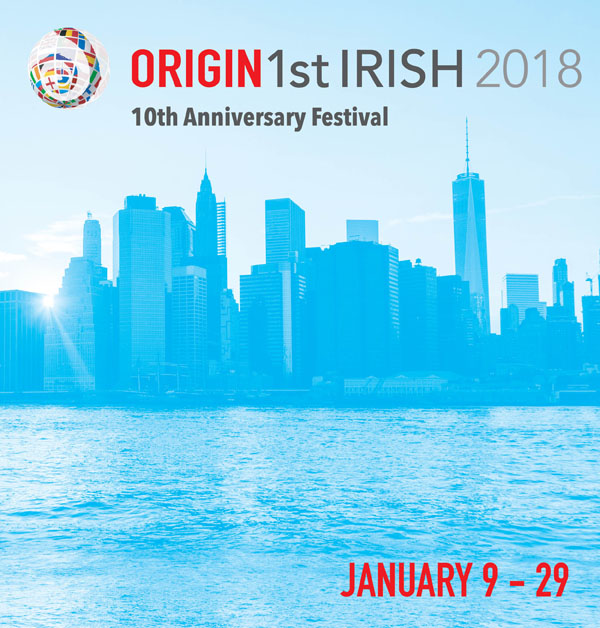
origin irish 1st

ORIGIN’S 1st IRISH FESTIVAL
Multiple venues
January 9-29
www.1stirish.org

Dyin’ for It, by Derek Murphy, with Maria Deasy, Adam Petherbridge, Sarah Street, and Aoife Williamson, the Cell, January 17-28, $30

Guy Walks into a Bar, by Don Creedon, New York Irish Center, January 18, 25, $20-$25, 7:15

ShakesBEER with an Irish Twist, pub crawl, Stone St., January 27, February 3, $49 (includes four drinks), 3:00

Dear Mr. Beckett: Letters from the Publisher, with Billy Carter and Olwen Fouéré, the Irish Consulate, January 29, free with advance RSVP, 1:00

WINTER ALT-FEST
Pangea NYC
178 Second Ave.
January 10-16
www.pangeanyc.com

Salty Brine: How Strange It Is, January 10, 17, 24, 31, February 7, $20, 7:30

Penny Arcade: Longing Lasts Longer, January 11, 14, $20, 7:00

Sven Ratzke: From Amsterdam to Mars, January 14, $20, 9:00

Tammy Faye Starlite: An Evening of Light, Tammy Faye channels Nico, accompanied by Keith Hartel, January 16, $20, 7:00

WINTER JAZZFEST NYC
Multiple venues
January 10-17
www.winterjazzfest.com

Gilles Peterson hosts British Jazz Showcase, with the Comet Is Coming, Nubya Garcia, Yazz Ahmed, and Oscar Jerome, Le Poisson Rouge, January 10, $20-$25, 7:00

Winter JazzFest Marathon, more than fifty artists at eleven venues, January 12-13, $50-$60 one day, $85-$95 both days

Ravi Coltrane Presents Universal Consciousness: Melodic Meditations of Alice Coltrane, Le Poisson Rouge, January 14, $35-$45, 7:00

A Tribute to Geri Allen, with Angela Davis, Esperanza Spalding, Craig Taborn, Dee Dee Bridgewater, Farah Jasmine Griffin, Ingrid Jensen, Jack DeJohnette, Jaimeo Brown, Jeff Tain Watts, Kassa Overall, Kris Davis, Linda May Han Oh, Maurice Chestnut, Mino Cinelu, Ravi Coltrane, S. Epatha Merkerson, Tia Fuller, Vijay Iyer, and others, benefit for the Geri Allen Estate, the New School Tishman Auditorium, January 15, $35-$100

Deerhoof Meet Wadada Leo Smith and Nicole Mitchell: Maroon Cloud, Le Poisson Rouge, January 17, $25-$35, 8:00

COIL
Performance Space 122
150 First Ave.
January 10 – February 4
www.ps122.org/coil-2018

Body of Work, by Atlanta Eke, PS122, January 10-11, $25

visions of beauty, by Heather Kravas, PS122, January 10-13, $25

Jupiter’s Lifeless Moons, by Dane Terry, PS122, January 12, 13, 14, 16, 17, $25

he his own mythical beast, by David Thomson, PS122, January 31, February 1, 2, 4, $25

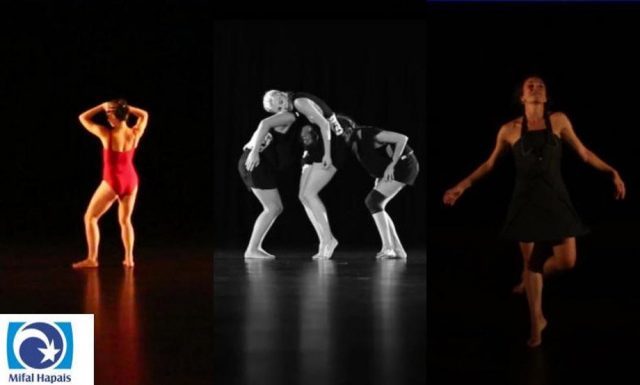
Our of Israel returns to the 92nd St. Y for its eighth season

Our of Israel returns to the 92nd St. Y for its eighth season

OUT OF ISRAEL: 70 YEARS OF ISRAEL, 70 YEARS OF DANCE / OPEN DOORS: 92Y HARKNESS DANCE CENTER ARTISTS IN RESIDENCE SHOWCASE
92nd St. Y
www.92y.org

Out of Israel: works by choreographers Itzik Galili and Roi Assaf performed by Troy Ogilvie, a solo by Roni Chadash, a new composition by DANAKA collective, and films by Joseph Bach and Shamel Pitts, guest curated by Dana Katz, January 12 at 12 noon and January 13 at 8:00, $10 in advance, $20 at the door

Open Doors: works by choreographers Joanna Kotze, Kensaku Shinohara, Pam Tanowitz, and Larissa Velez-Jackson with Jillian Peña, January 12 at 8:00 and January 13 at 4:00, $25-$29

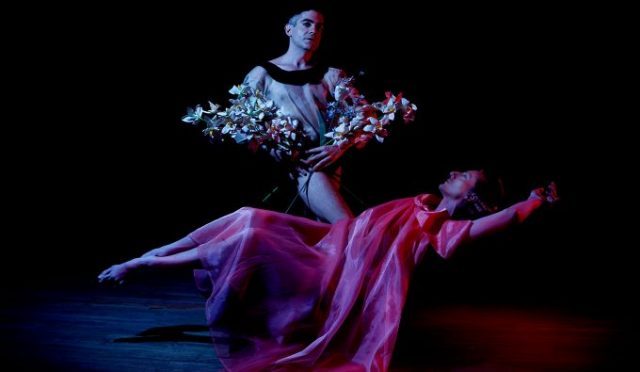
Jack Ferver will present

Jack Ferver will present his work-in-progress Everything Is Imaginable as part of Live Artery at New York Live Arts

LIVE ARTERY
New York Live Arts
219 West 19th St.
January 13-15
newyorklivearts.org

Saturday, January 13, $10 each
Abby Zbikowski, abandoned playground (excerpt), 12 noon; Kimberly Bartosik, I hunger for you (work-in-progress), 2:00; RoseAnne Spradlin, “X,” 3:00; Netta Yerushalmy, Paramodernities (work-in-progress), 5:00; Susan Marshall, Construction (collaboration with So Percussion) and Closed System (work-in-progress), 6:00; Walter Dundervill, Skybox (excerpt), 7:00

Sunday, January 14, $10 each
Joanna Kotze, What will we be like when we get there (work-in-progress), 1:00; Kota Yamazaki, Darkness Odyssey Part 2: I or Hallucination (excerpt), 4:00; Bill T. Jones/Arnie Zane Company, The Deep Blue Sea, 5:00; Deborah Hay/Eric Geiger, Jess Humphrey & Leslie Seiters, Pause, 6:00; RoseAnne Spradlin, “X,” 8:00; Jack Ferver, Everything Is Imaginable (work-in-progress), 8:30

Monday, January 15, $10 each
Netta Yerushalmy, Paramodernities (work-in-progress), 11:00 am; Jennifer Nugent & Paul Matteson with Ted Coffey, Visual Proof, 1:00; Jack Ferver, Everything Is Imaginable (work-in-progress); 3:30; Joanna Kotze, What will we be like when we get there (work-in-progress), 5:00; Kimberly Bartosik, I hunger for you (work-in-progress), 6:30

WELCOME, 2018!

The New Year made a brief appearance on the ground in Times Square before getting ready to usher in 2018 (photo by twi-ny/mdr)

The New Year made a brief appearance on the ground in Times Square before getting ready to usher in 2018 from up high (photo by twi-ny/mdr)

MODERN MATINEES — CONSIDERING JOSEPH COTTEN: TOO MUCH JOHNSON

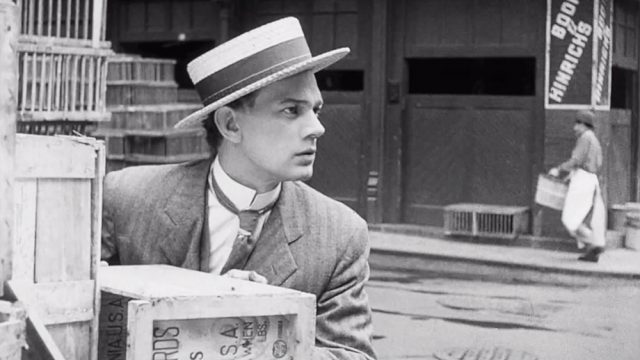
Joseph Cotten is on the run from a jealous husband in Orson Welles Too Much Johnson

Joseph Cotten is on the run from a jealous husband in Orson Welles’s recently rediscovered and restored Too Much Johnson

TOO MUCH JOHNSON (Orson Welles, 1938)
MoMA Film, Museum of Modern Art
11 West 53rd St. between Fifth & Sixth Aves.
Wednesday, January 3, 1:30
Thursday, February 15, 1:30
212-708-9400
www.moma.org

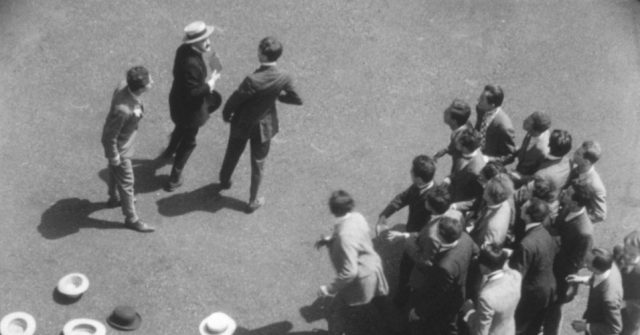
In August 2013, a 35mm nitrate workprint containing the raw footage of what was to be Orson Welles’s professional debut as a film director was discovered in a warehouse in Pordenone, Italy, home of an annual silent film festival. Consisting of sixty-six unedited, purposefully silent minutes, the film had been shot to accompany the Mercury Theatre’s streamlined staging of William Gillette’s 1894 farce, Too Much Johnson. Unfortunately, when the theatrical production opened in 1938 in a Connecticut theater, the filmed segments couldn’t be shown, spoiling the show’s chances to eventually make it to Broadway — various reports claim that the footage was not finished in time; the Stony Creek Theater lacked the proper projector; Paramount, which owned the rights to the play, demanded a fee; or it just wasn’t safe to screen the film in the theater. But you can see the raw footage at MoMA on January 3 and February 15 at 1:30, the first screening accompanied by a live score by Ben Model, the second by Makia Matsumara. Restored and preserved by George Eastman House, Too Much Johnson is a wacky, breathless tale of lust, passion, and betrayal, as Leon Dathis (Edgar Barrier) catches his wife (Arlene Francis) cheating on him with the dapper Augustus Billings (Joseph Cotten). Dathis sets out after Billings, chasing him through the streets, around a basket shop, and across the rooftops of Lower Manhattan, predominantly in the Meatpacking District — if you look closely, you can see the elevated railroad tracks that became the High Line. Dathis is joined by residents and storekeepers from the neighborhood and a pair of Keystone Kops (John Houseman and Herbert Drake) as they desperately try to catch the cad. The cast also includes Ruth Ford as Billings’s wife, Mary Wickes as Mrs. Battison, and Howard I. Smith as Cuba plantation owner Joseph Johnson.

The hats come off

The hats come off in rediscovered Welles footage meant to accompany Mercury Theatre stage production

In his cinematic debut, Cotten, who would team up with Welles on The Magnificent Ambersons, Citizen Kane, Journey into Fear, and The Third Man, shows quite an aptitude for slapstick comedy, à la Harold Lloyd, fearlessly portraying Billings, doing all the stunts himself, including several very dangerous ones. Meanwhile, Lenore Faddish (Virginia Nicolson, Welles’s wife at the time) and Harry MacIntosh (Guy Kingsley) are preparing to go to Cuba together (Tomkins Cove along the Hudson doubles for Cuba), which does not make her father (Eustace Wyatt) very happy. Welles and cinematographer Harry Dunham use silent-film tropes, from fast-paced action to overemoting to lush close-ups — and yes, the dastardly villain actually twirls his mustache — as well as what would become Welles’s trademark deep focus; the uncut footage features multiple takes, scenes shot from different angles, funny mistakes made by the cast and crew, clearly fake palm trees, a duel without swords, and long takes that would have likely been edited down later. One of the funniest bits involves Dathis and hats, which leads into a suffragette march. The whole thing is a hoot, but just be prepared and know that it’s not a fully realized, fully chronological story with a beginning, middle, and end. Fans of Welles, silent comedies, and Cotten will go crazy for it. And yes, the title means what you think it does. (You can see a home-movie clip of Welles directing the film here.) Too Much Johnson is screening as part of the MoMA series “Modern Matinees: Considering Joseph Cotten,” which runs January 3 to February 28 and also includes the Welles collaborations in addition to Shadow of a Doubt, Gaslight, Duel in the Sun, The Abominable Dr. Phibes, Soylent Green, Hush…Hush, Sweet Charlotte, and other films by the underrated radio, TV, stage, and screen star, who was never nominated for an Oscar, Emmy, Grammy, or Tony.