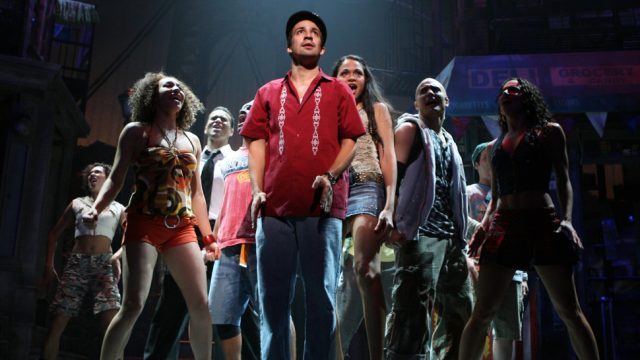
Lin-Manuel Miranda and the original cast of In the Heights will reunite at third annual BroadwayCon (photo by Joan Marcus)
Jacob K. Javits Convention Center
655 West 34th St. (11th Ave. between 34th & 39th Sts.)
January 26-28, $220 General Pass, $90 Day Pass
www.broadwaycon.com
www.javitscenter.com
The third annual BroadwayCon returns to the Javits Center January 26-28 with a full slate of theater-related programming. The Gold Passes ($395) and Platinum Passes ($1000) are sold out, so you better hurry if you want to get a General Pass ($220) or Day Pass ($90). Among this year’s guests are Lin-Manuel Miranda, Laura Benanti, Carolee Carmello, LaChanze, Mo Rocca, Jenn Colella, Alex Brightman, Stephanie J. Block, Liz Callaway, cofounders Anthony Rapp and Melissa Anelli, Steven Levenson, Gideon Glick, Kathleen Marshall, Ruthie Ann Miles, Leigh Silverman, Bryce Pinkham, and Mauritz von Stuelpnagel, participating in photo and autograph sessions, workshops, panel discussions, show spotlights, and more. Below are only some of the highlights.
Friday, January 26
Royal Romanovs: An Anastasia Meetup, with Nia Harvey, Margo Jones Room, 10:00 am
The American Theatre Wing: 100 Years, 100 Voices, 100 Million Miracles, with Allison Considine, Dale Cendali, Heather Hitchens, and Patrick Pacheco, Vinnette Carroll Room, 11:00
The Broadway Ensemble Panel, moderated by Nikka Lanzarone and Mo Brady, Ruth Mitchell Room, 12 noon
Singalong, Hildy Parks Room, 1:00
From Stage to Screen: Going Behind the Curtain of a Broadway Production, with Bonnie Comley, Stewart F. Lane, Gio Messale, Hal Berman, and Lonny Price, Willa Kim Room, 2:00
Everything You’ve Ever Wanted to Know About the Theatre But Were Afraid to Ask, Renee Harris Room, 3:00
The BroadwayCon 2018 Opening Ceremony, with Anthony Rapp and Melissa Anelli, MainStage, 4:30
¡Atención! In the Heights Reunites 10 Years Later, with Janet Dacal, Alex Lacamoire, Luis A. Miranda Jr., Lin-Manuel Miranda, Javier Muñoz, Karen Olivo, and Olga Merediz, MainStage, 5:00
Show Spotlight: Frozen, with Robert Lopez, Greg Hildreth, and Kristen Anderson-Lopez, MainStage, 7:00
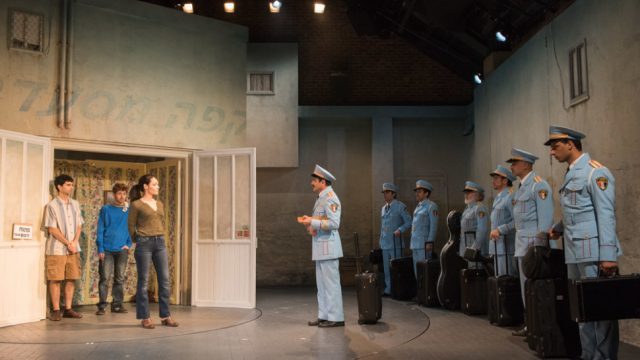
The Band’s Visit takes center stage at BroadwayCon on Saturday (photo by Ahron R. Foster)
Saturday, January 27
Are We Living in Another Golden Age of the Broadway Musical? with William Cortez-Statham, Renee Harris Room, 10:00
Out on Broadway, with Patrick Hinds, Jay Armstrong Johnson, Tyler Hanes, and Caesar Samayoa, Willa Kim Room, 11:00
The Life and Art of Erté, with Stephan, Ruth Mitchell Room, 12 noon
Cosplay Fashion Show, MainStage, 1:00
All My Revels Here Are Over: Remembering the Comet, with Harley Ann Kulp and Chelsea MacKay, Margo Jones Room, 2:00
Follies: The Original Production Reunion, with Jennifer Ashley Tepper, Steve Boockvor, Denise Pence, Ted Chapin, Mary Jane Houdina, Kurt Peterson, and Jonathan Tunick, Ruth Mitchell Room, 3:00
Being a Critic of Color, with Wei-Huan Chen, Naveen Kumar, Kelundra Smith, Karen d’Souza, Jan Simpson, and Jose Solís, Willa Kim Room, 4:00
Show Spotlight: The Band’s Visit, MainStage, 5:00
BroadwayCon Blizzard Party Line, with Melissa Anelli, Anthony Rapp, and David Alpert, MainStage, 7:00
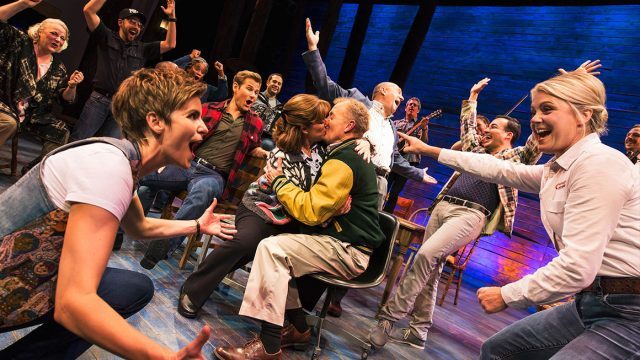
BroadwayCon celebrates the surprise success of Come from Away on Sunday (photo by Matthew Murphy)
Sunday, January 28
Broadway, the Flops! A Singalong Spectacular, with Christian Regan and Rachel Buksbazen, Hildy Parks Room, 10:00
Playing Non-Fiction: The True Story Behind Come from Away, with Chad Kimball and Kevin Tuerff, Margo Jones Room, 11:00
Theater People Live Show! with Patrick Hinds, Willa Kim Room, 12 noon
After Anatevka, with Alexandra Silber and Ruthie Fierberg, Hildy Parks Room, 1:00
No Sex Please, We’re British: The Lord Chamberlain’s Censorship of West Side Story and a Post-War Generation, with Rachel Kwiecinski, Ruth Mitchell Room, 2:00
Spectacular! When the Golden Age of Broadway Met the Golden Age of Television, with Allan Altman, George Dansker, and Jane Klain, Willa Kim Room, 3:00
Structure! The Musical, or Everything You Need to Know About Musicals You Can Learn from Star Wars, with Sammy Buck, Willa Kim Room, 4:00
The Closing Ceremony, MainStage, 5:00
 The New York Jewish Film Festival gets under way January 10 with an intriguing look at enigmatic filmmaker Michał Waszyński, the director of one of the most important Yiddish movies of all time, the 1937 supernatural tale The Dybbuk. In The Prince and the Dybbuk, directors Piotr Rosolowski and Elwira Niewiera find that discovering who Waszyński was is like chasing a ghost, as he continually reinvented himself while being haunted by a past he tried to erase. Like the characters in many of the films he produced and directed, he was constantly searching for his true identity as he journeyed from Poland and Germany to Italy and Spain. “He was in his world, so mysterious and exciting. Nobody really knows what he’s really like,” one of his assistant directors, Enrico Bergier, says. Throughout the eighty-minute documentary, friends, relatives, colleagues, and others describe Waszyński, who produced and/or directed nearly 150 films, as a gentleman, Jewish, Catholic, noble-minded, lonely, elegant and refined, an exceptional boss, generous, isolated, very smart, a larger-than-life character, an aristocrat, a bit strange, and a mythomaniac. He married a countess, dubbing himself the Polish Prince, and took one of his actors, Albin Ossowski, to gay restaurants. “He was longing for his youth,” Ossowski says. He hobnobbed with Orson Welles, Sophia Loren, Audrey Hepburn, and Claudia Cardinale. He appeared in Joseph L. Mankiewicz’s 1954 film, The Barefoot Contessa. He was singled out by Josef Goebbels as an enemy. He was involved with such 1960s blockbusters as El Cid and The Fall of the Roman Empire as well as smaller Eastern European films, most famously The Dybbuk, about a young bride possessed by a spirit. Rosolowski and Niewiera, who previously collaborated on the award-winning Domino Effect, include newsreel footage, family photos, home movies, a behind-the-scenes promotional piece narrated by James Mason about the making of Anthony Mann’s budget-busting The Fall of the Roman Empire, spoken excerpts from Waszyński’s diaries, and clips from such Waszyński films as His Excellency the Shop Assistant, Unknown Man of San Marino, Dvanáct kresel, Gehenna, Wielka Droga, Zabawka, and Znachor, many of which feature lost characters.