twi-ny recommended events

PERFORMANCE SPACE NEW YORK EAST VILLAGE SERIES: AVANT-GARDE-ARAMA

Performance Space New York is reborn in the East Village

Performance Space New York is reborn in the East Village

Performance Space New York
150 First Ave. at East Ninth St.
Sunday, February 18, free, 6:00 pm – 1:00 am
212-352-3101
performancespacenewyork.org

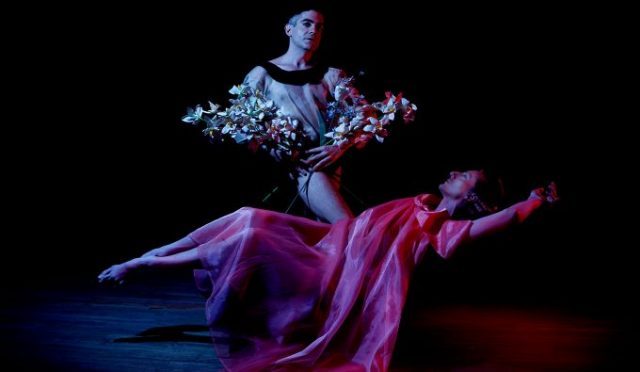
After a major renovation, one of downtown’s best and most diverse venues is back, as Performance Space New York, formerly known as PS122, celebrates its return with a free event on Sunday night, “Avant-Garde-Arama.” Kicking off the East Village Series, the festivities will feature live performances from six to nine on several stages by a vast array of creators, including Adrienne Truscott, Erin Markey, Hamm, Holly Hughes, John Kelly, John Zorn, La Bruja of Nuyorican Poets Cafe, Penny Arcade, Pharmakon, Reggie Watts, and Sister Jean Ra Horror, among many others. At nine, a dance party takes over, with JD Samson, Justin Strauss, and more. The evening’s hosts are the Factress (Lucy Sexton), Carmelita Tropicana, and Ikechukwu Ufomadu. On its website, the venue declares, “Performance Space New York was born in the East Village in 1980 as Performance Space 122 when a group of local artists occupied the empty building that had been home to Public School 122 and started making performance work as a passionate rejection of corporate mainstream culture. Today, almost forty years later, Performance Space New York is faced with a radically transformed neighborhood unaffordable for young artists and a national political climate that feeds off social inequity more than ever. Moving back into our newly renovated spaces, the inaugural East Village Series asks what kind of art organization we need to become in light of this ever-more-exclusionary social and political context.” The East Village Series continues through June with such presentations as “Focus on Kathy Acker,” “Women’s History Museum,” Diamanda Galás and Davide Pepe’s Schrei 27, a world premiere by Sarah Michelson, Tiona Nekkia McClodden’s CLUB, Penny Arcade’s Bitch! Dyke! Faghag! Whore!, and Chris Cochrane, Dennis Cooper, and Ishmael Houston-Jones’s Them.

JIMMY TITANIC

(photo by Carol Rosegg)

Colin Hamell portrays more than twenty characters in one-man show at the Irish Rep (photo by Carol Rosegg)

Irish Repertory Theatre
W. Scott McLucas Studio Theatre
132 West 22nd St. between Sixth & Seventh Aves.
Tuesday – Sunday February 18, $50
212-727-2737
irishrep.org

Playwright Bernard McMullan takes audiences from the fiery furnaces of hell to the heavens above in the seventy-five-minute one-man show Jimmy Titanic, cruising along at the Irish Rep through February 18. The play was first performed in 2012 in tribute to the centennial of both the birth and death of the RMS Titanic, which sank on April 14-15, 1912, after hitting an iceberg on its maiden voyage. The show is now back with its stalwart captain, Colin Hamell, who has been with it since the beginning, steering it around the world. Hamell serves as narrator/guide as well as playing every character, including Jimmy Boylan, who works on board with his best friend, Tommy Mackey, who helped build the luxury liner at the Harland and Wolff shipyard in Belfast and knows all there is to know about the Titanic. Hamell portrays more than twenty characters in all, from Jimmy and Tommy and other crew members to numerous fictional passengers, the editor of the New York Times, the mayor of Belfast, the real-life John Jacob Astor, Jacques Futrelle, and Senate committee chairman William Alden Smith, and the angel Gabriel, St. Peter, and God. The play works best when Jimmy is on board the “ship of dreams,” relating stories about how it was built, sharing details about its overall impressiveness, and assisting people trying to survive as it begins sinking. Those scenes are chock-full of surprising facts as Hamell floats across Michael Gottlieb’s tight set, a series of riveted metal panels representing the inside of the bottom of the ship, where the men toil in mind-numbing heat. Gottlieb also designed the effective lighting, which changes colors as the tale continues with director Carmel O’Reilly (McMullan’s Return of the Winemaker) at the helm.

(photo by Carol Rosegg)

Colin Hamell teaches how to shovel coal in Bernard McMullan’s Jimmy Titanic (photo by Carol Rosegg)

The scenes on board the ship are genuinely gripping as Hamell reveals how passengers of different backgrounds, from class to ethnicity to gender, faced peril. Whenever McMullan steers the story back up to heaven, the energy is drained as Hamell portrays Gabriel as a cunning thief, Peter as a selfish lapdog, and God as a gangster. The scenes in the newsroom, the US Senate, and the Belfast mayor’s office offer a look into how the media, politics, and economics dealt with the disaster, but the show drags a bit until it shifts back to the commotion rising on the ship. To those not familiar with many of the facts, it is shocking to learn that there were far more passengers traveling in second and third class than in first, and how there were travelers from more than thirty nations, many seeking a new life in America. “Titanic was primarily an emigrant ship,” Jimmy says, while also talking about the large crew: “Two hundred and forty men worked below in the stokeholds. Only a quarter of them survived. Of the eighty lads working that night on the eight to midnight shift, just twelve made it out.” Jimmy is also proud to point out how most everyone reacted in the midst of the crisis. “The prospect of what lay ahead that night brought out instincts you never knew you had. People were trying to do the right thing. Saving themselves and their loved ones,” he explains. Despite its drawbacks, Jimmy Titanic offers a unique and compelling view of one of the worst tragedies of the twentieth century, focusing on the men behind the scenes.

TIBET HOUSE US BENEFIT CONCERT

tibet house concert 2018

Who: Artistic director Philip Glass, Carly Simon, Blood Orange (Dev Hynes), St. Paul and the Broken Bones, Rhiannon Giddens, Angel Olsen, Stephin Merritt, Resistance Revival Chorus, Techung, and Los Vega, with the Patti Smith Band and the Scorchio Quartet and an invocation by monks from the Drepung Gomang Monastery, with honorary chairs Maggie Gyllenhaal, Peter Sarsgaard, Uma Thurman, and Arden Wohl
What: Thirty-first annual concert raising funds for the nonprofit Tibet House US, celebrating the Year of the Earth Dog and Tibetan New Year
Where: Carnegie Hall, Stern Auditorium / Perelman Stage, 881 Seventh Ave. at 57th St., 212-247-7800
When: Saturday, March 3, $35-$200 (special packages with the concert, party, and more start at $500), 7:30
Why: Tibet House US was founded in 1987 at the request of the Dalai Lama, “dedicated to preserving Tibet’s unique culture at a time when it is confronted with extinction on its own soil”; the annual benefit concert is always one of the cultural highlights of the year in New York City, and this time the show will have a special focus on equality and human rights given what is currently happening in the United States as well as around the world.

RETURNING TO REIMS

(photo by Teddy Wolff)

Paul (Bush Moukarzel), Katy (Nina Hoss), and Toni (Ali Gadema) get down to business in Returning to Reims (photo by Teddy Wolff)

St. Ann’s Warehouse
45 Water St.
Tuesday – Sunday through February 25, $46-$56
718-254-8779
stannswarehouse.org
www.schaubuehne.de

Politics become personal — and vice versa — in Schaubühne Berlin’s multilayered, highly intellectual, and hypnotic Returning to Reims, which opened last night at St. Ann’s Warehouse in Dumbo. “It’s multilayered. It’s multilayered filmmaking. That’s my style,” director Paul (Bush Moukarzel) explains to actress Katy (Nina Hoss) as studio engineer Toni (Ali Gadema) looks on and the audience laughs, in on the joke; the quote is a reference to Returning to Reims director Thomas Ostermeier himself, a man not known to take the easy route in the many multilayered works he has made with Schaubühne Berlin, most recently evident in the fierce, unforgettable Richard III the company staged at BAM late last year. As the audience enters the theater at St. Ann’s, Paul and Toni are immersed in conversation in their glassed-in tech booth in a large, spare recording studio (austerely designed by Nina Wetzel, who also did the costumes); between them, on the back wall, is a copy of Gil Scott-Heron’s 1970 album, Small Talk at 125th and Lenox. They leave to get coffee and Katy walks in and begins rehearsing her reading of French writer and philosopher Didier Eribon’s 2009 memoir, Returning to Reims. Toni and Paul return and Katy starts her performance within the performance, reading in a subtle, deliberate monotone that is mesmerizing.

Her reading is accompanied by projections on a big screen behind her, archival footage in addition to newly filmed scenes (by Ostermeier and Sébastien Dupouey) of Eribon returning to Reims and speaking with his mother in her home. What at first appears to be the recording of an audiobook is revealed to be narration for a documentary about Eribon and his book, in which he examines his relationship with his father, his family’s communism, his homosexuality, and the social contract. “In taking as my point of theoretical departure the idea that the complete break I had made with my family was due to my homosexuality . . . had I not at the same time offered myself reasons for avoiding the thought that this was just as much a break with the class background I came from?” Eribon’s very French investigation of pedigree and sexuality asks, continuing, “I was a class traitor, one whose only concern was to put as much distance as possible between himself and his class of origin, to escape from the social surroundings of his childhood and his adolescence.”

Nina Hoss is mesmerizing in (photo by Teddy Wolff)

Nina Hoss is mesmerizing in Thomas Ostermeier’s inventive adaptation of Didier Eribon memoir (photo by Teddy Wolff)

As actress and director begin to spar, conspiracy theories, discussions of wealth and power, and what to do about genuine evil emerge from the text, while efforts to define the responsibilities of actress versus director illuminate the mutual responsibilities of citizens to call out injustice. Katy continues to act up, telling Paul that the images being projected are confusing and don’t relate to what she is reading. She is not just complaining about Paul’s choices as director — and Ostermeier’s too, since some of the projections are just as confusing to the audience — but also questioning the very nature of audiovisual storytelling, both film and theater, self-referentially reflecting, perhaps, on the creation of the play itself. All the characters go home and come back a week later for the next session, in which Paul breaks the fourth wall, Toni raps, Gil Scott-Heron upends the social order with “Whitey on the Moon” (“I can’t pay no doctor bills / but whitey’s on the moon / Ten years from now I’ll be payin’ still / while whitey’s on the moon”), and Katy relates Eribon’s family experiences to those of her own, in essence asking each one of us where we fit in. “Basically it reminds me of my father; he was born in 1929, the same year of Eribon’s father,” Katy says. But it’s really Hoss’s own family she is talking about; her father was a cofounder of the Green Party in the Bundestag, and it’s clips from his life that are being projected onscreen. “He had the same background, he came from the working class, from a communist family, but he chose not to surrender to the circumstances. He went a different way. It would be good to have a little bit of that in the film. A little bit of hope,” Katy tells Paul.

Hoss (Phoenix, Barbara), perhaps best known in America as German intelligence agent Astrid on Homeland, is magnetic as Katy, the rhythm of her delivery floating in the air and reaching deep into your body; even though she spends most of the time looking down and reading, it’s nearly impossible to take your eyes off her, except to glance at what’s on the screen. Meanwhile, the score by Nils Ostendorf and the sound design by Jochen Jezussek surrounds the audience from all sides. The two-hour Returning to Reims occasionally veers off track, but Ostermeier (An Enemy of the People, The Cut) always steers it back with the help of Hoss; the two previously collaborated on Schaubühne Berlin’s The Little Foxes and Bella Figura. It’s multilayered with extra helpings of meta; in fact, it works better the more poetic license and theatrical leeway you give it as Ostermeier lifts Eribon’s words to a global level in an age where identity politics and neoliberalism are failing and populists have seized the day around the world. “I’m just thinking about the ending. Why you’re ending it like this,” Katy says to Paul. “Now you’re ending with this big task for the Left. Who’s going to do this? It’s a kind of classic, didactic ending.” In Ostermeier’s vision of society, there is a lot to be learned, and done, and the arts are as good a place as any to start.

FLIGHT

flight 2

The Heath in the McKittrick Hotel
542 West 27th St. between Tenth & Eleventh Aves.
Daily through April 20, $45
212-904-1880
mckittrickhotel.com
www.voxmotus.co.uk

Emursive productions, the innovative team that has brought such successful immersive shows as Sleep No More and The Strange Undoing of Prudencia Hart to the McKittrick Hotel in Chelsea, has done it again with Vox Motus’s Flight, a very different, much more settled kind of presentation that melds art, theater, and literature into something wholly new. The gripping story, which unfolds over about sixty tense minutes, was adapted by Oliver Emanuel from Australian journalist Caroline Brothers’s 2012 debut novel, Hinterland. For those of you who like surprises and prefer not to know anything about a show before heading to the theater, that is all I am going to tell you, other than I highly recommend it for fans of experimental, unusual methods of storytelling — you can stop right here and go get tickets now. (Also, it is definitely not for kids; no one under fourteen will be admitted.) For those of you who need to know more, read on for further details, although I strongly suggest you don’t. The primary reason I am sharing more information is to sing the praises of the people behind this unusual adventure.

Vox Motus’s Flight can be experienced at the McKittrick Hotel through March 25 (photo by Beth Chalmers)

Vox Motus’s Flight can be experienced at the McKittrick Hotel through March 25 (photo by Beth Chalmers)

SPOILERS AHEAD! Entering the show takes place via a number of anteroom-type spaces: a special elevator, a coat check, a train car, and a dim, curtained space, from which theatergoers are led one-by-one into even darker private booths. Directed by Jamie Harrison and Candice Edmunds of Scottish theater company Vox Motus (The Infamous Brothers Davenport, Slick), Flight reveals itself in tiny dioramas that revolve past you on a carousel; the parade of scenarios of many shapes and sizes produces an effect similar to that of viewing graphic novel panels. The tale follows two young Afghan brothers, eight-year-old Kabir (voiced by Nalini Chertty) and fifteen-year-old Aryan (Farshid Rokey), as they flee their home country in search of freedom, a path that will take them across Europe as they encounter terrible danger, awful hardship, and moments of delight, with a third-person narrator (Emun Elliott) serving as guide. Each diorama, many of which feature the sun or the moon in the background, is designed by Harrison and Rebecca Hamilton, with tiny figures trapped in tiny rooms, forced to work on a farm, and in transit, always frightened that they will be caught. The dioramas are lit like movie sets by Simon Wilkinson, with a compelling score and sound design by Mark Melville. Part art installation, part immersive theater, Flight, the title of which refers to the brothers’ passage toward freedom as well as Kabir’s desire to fly through the air, is a timely look at what so many refugees must do to escape their violent country and find a new home, risking their life for a little bit of food and a place to sleep without fear. It’s a harrowing journey that is intelligently depicted by Vox Motus, avoiding treacly sentimentality and instead focusing on a simple narrative and the genuine peril the boys, and so many refugees and illegal immigrants around the world and in America, face on a daily basis. The production, which won a Herald Angel Award at the 2017 Edinburgh Fringe Festival, continues at the McKittrick Hotel through April 20. Don’t hesitate to get on board, while you still enjoy your own freedom.

STEFAN FALKE — MOKO JUMBIES: THE DANCING SPIRITS OF TRINIDAD

(photo © Stefan Falke)

Stefan Falke will be at Deutsches Haus at NY for special conversation about his moko jumbies photos on February 12 (photo © Stefan Falke)

Who: Stefan Falke, Laura Anderson Barbata
What: Exhibition opening and artist talk
Where: Deutsches Haus at NYU, 42 Washington Mews
When: Monday, February 12, free, 6:00
Why: From 1997 to 2004, German-born, New York-based photographer Stefan Falke photographed Trinidadian stilt walkers, known as moko jumbies, collecting his pictures in the book Moko Jumbies: The Dancing Spirits of Trinidad (Pointed Leaf Press, 2005, $65). Falke will be at NYU’s Deutsches Haus on February 12 at 6:00 for the opening of his latest exhibition, featuring photos of the Dragon Keylemanjahro School of Art & Culture in Cocorite, which have never been on view in New York City before. Falke, who has also published La Frontera, portraits of artists on either side of the US-Mexico border, will be speaking with Mexico City native Laura Anderson Barbata, a multidisciplinary artist who lives and works there and in Brooklyn and who has also photographed moko jumbies for her project “Transommunality.” “Moko Jumbies: The Dancing Spirits of Trinidad” continues at Deutsches Haus through March 31.

PARTY FACE

(photo by Jeremy Daniel)

Oscar-winning actress Hayley Mills returns to the New York stage in Party Face (photo by Jeremy Daniel)

Stage II at New York City Center
Thursday – Monday through April 8, $38-$128
212-581-1212
www.partyfaceplay.com

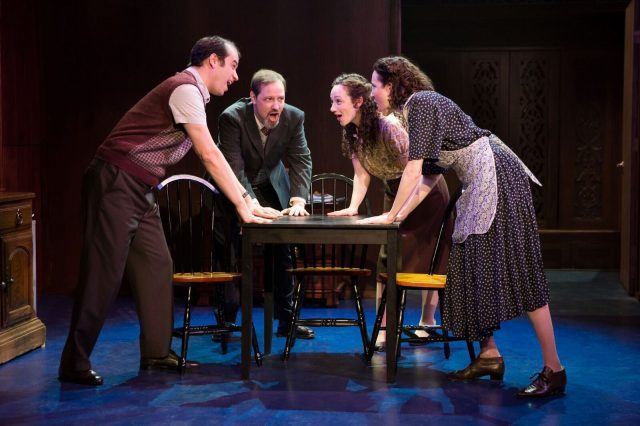
There’s a good amount of fun to be had in Isobel Mahon’s Party Face, continuing at New York City Center’s Stage II through April 8. But there’s also something just a little bit off, detracting from the overall impact of the play, which was named Best Production at the 1st Irish Awards. The night I went, the onstage clock was an hour fast, so when one character arrives early, the party host says, “It’s only twenty to . . . I said eight.” But the time on the clock was actually twenty to nine, and no one ever corrected the issue as the play continued and the clock kept real, running time. Of course, I don’t know if the clock is off for every performance, that maybe it is supposed to represent how everything is askew in this self-contained world, but there are other problems as well — in addition to some pure pleasures. Recently released after a stay in a psychiatric ward, Mollie Mae (Gina Costigan) is hosting a small gathering to show off the new extension on her kitchen, which features an impressive refrigerator, large cabinets, and a marble island in the center, with one corner smashed up. It’s her domineering, judgmental mother, Carmel (Hayley Mills), who has arrived early, bearing fancy nibbles to counteract her daughter’s low-rent crisps and hummus. She has also arrived with her share of quips belittling Mollie, complaining about her makeup, what she’s wearing, and even the flowers she has put out. “Oh, lovely flowers,” the impeccably dressed and styled Carmel, who is all about appearance, says. “’Course, in my day you never saw a lily outside of a funeral parlor.” Mollie is upset when Carmel tells her that she has taken the liberty of inviting one of Mollie’s neighbors, Chloe (usually played by Allison Jean White, but we saw her understudy, Alison Cimmet), an overly glamorous gossip queen who never misses a chance to stick it to Mollie, all in the guise of being a caring friend. They are soon joined by Mollie’s sister, Maeve (Brenda Meaney), a tough, cynical divorcee who rolls her eyes at most of what her mother and Chloe say. The last guest is Bernie (Klea Blackhurst), an oddball woman who met Mollie in the mental hospital and has a liking for wrapping everything in cling film, the British term for plastic wrap. Insults fly, secrets are revealed, and all kinds of objects get wrapped in cling film as the five very different women relentlessly go at it; the only sign of a man is an offstage topiary bush in the shape of male genitalia, trimmed by Mollie’s absent husband, an architect named Alan.

(photo by Jeremy Daniel)

A small gathering results in a series of revelations in Isobel Mahon’s Party Face (photo by Jeremy Daniel)

Party Face might not be The Women, but Mahon (So Long, Sleeping Beauty; Box of Frogs) has created five overly caricatured but recognizable ladies who deliver some very funny, if sometimes a bit obvious, dialogue. Mentioning her husband, the superficial and vapid Chloe states, “Turlough says, ‘Chloe, you’re such a good listener, you mustn’t let people take advantage.’ But as I say, ‘Turlough, it’s what gives my life meaning. And I think meaning is so important in life.” Carmel continually sides with Chloe, who is like the daughter she never had, as she keeps taking shots at both Mollie and Maeve. When Carmel discusses how she and her friends have all gotten Botox, Maeve says, “Jesus, it’s an epidemic; your lunches’ll be great gas, sixteen at the table and not a twitch between you.” Carmel replies, “Oh, you can mock, Maeve; wouldn’t do you any harm to have it done yourself. You’re not blessed with Mollie’s good skin.” But it’s Bernie who saves the day, and the play, with her strange pronouncements, her fear of germs, and her genuine honesty. When Chloe asks her if anyone else from their “little community” is coming, Bernie replies, “Well, I asked a couple from our obsessive-compulsive encounter group but they’re both agoraphobics, so they wouldn’t come out.” The audience is virtually another guest at the party, which takes place on Jeff Ridenour’s cozy kitchen / living room set. In her off-Broadway directing debut, Amanda Bearse (Married with Children, Fright Night) keeps all the characters busy, although some of the slapstick is too forced. It’s a joy to see Mills, a child star who appeared in such films as The Parent Trap, Whistle down the Wind, Pollyanna, and Tiger Bay, in such an intimate venue at City Center. No stranger to the stage, she won a Theatre World Award for her 2000 performance in Noël Coward’s Suite in Two Keys and more recently toured with her sister, Juliet Mills, in James Kirkwood’s Legends! Mills, now seventy-one, is delightful as Carmel, an extravagant, vain, and sexy woman who cares most about how things affect her. Costigan (The Suitcase under the Bed, Crackskull Row), Meaney (Indian Ink, Incognito), and Cimmet (Amelie, The Mystery of Edwin Drood) are all solid but they are overshadowed by Blackhurst (Everything the Traffic Will Allow, Hazel), who is impossible to stop watching as she delivers funny lines or keeps wrapping whatever she can get her hands on. Of course, she does so with see-through cling film, so the objects are still visible, much like the party faces that the other women first put on but ultimately pull away to reveal their true selves. Several of the late revelations come out of thin air, attempting to explain some of the interactions between Carmel and her daughters, but it reduces the energy, which is perhaps most evident in the ever-present chunk missing from Mollie’s marble kitchen island. Now, if only I could figure out what’s up with that clock.