twi-ny recommended events

GOODBYE RHINOS: THE LAST THREE

(photo by twi-ny/mdr)

Eco-warriors Gillie and Marc Schattner have installed “Goodbye Rhinos: The Last Three” in Astor Plaza (photo by twi-ny/mdr)

Astor Place
Daily through May, free
www.goodbyerhinos.org
flickr slideshow

Australian husband-and-wife sculptors and eco-warriors Gillie and Marc Schattner sought to make a statement when they installed “Goodbye Rhinos: The Last Three,” a life-size rendering of the last three living northern white rhinos — females Najin and Fatu and male Sudan — balancing one on top of the other in Astor Plaza. They got even more attention than they expected when shortly after the installation, forty-five-year-old Sudan died at Ol Pejeta Conservancy in Kenya. Sponsored by Nat Geo Wild, the tallest rhino sculpture in the world was created “to inspire, educate, and mobilise a global community to raise their voices and affect real change against rhino horn sales,” according to the Schattners’ website. Gillie and Marc spent time with Sudan, his daughter Najin, and his granddaughter Fatu in March 2017; you can watch a video of their interactions with the three rhinos and the making of the sculpture here. Sudan was too old to mate, and Najin and Fatu are infertile, so they can’t even breed with the other four species of rhinos; thus, nothing can be done about their impending extinction except to raise awareness and funds to prevent the end of other animals, particularly those that are illegally poached for their horns or tusks, supposed medicinal benefits, or trophies for hunters.

(photo by twi-ny/mdr)

“Goodbye Rhinos: The Last Three” calls attention to illegal poaching and the potential extinction of certain animal species in Africa (photo by twi-ny/mdr)

“In urban environments, it’s easy for humans to forget our impact on the world,” Gillie said in a statement. “Marc and I believe it’s never been more critical to connect people to nature so that we’re visibly confronted with what we’re doing to the planet.” Gillie and Marc, who have worked together for more than twenty-five years, have taken their “Travel with Love” public art project around the world, featuring anthropomorphized crabs, paparazzi dogs, Taz the Tasmanian tiger, various magpies, and their characters Dogman and Rabbitgirl. “Our mission is to collect at least one million goodbye messages and put them towards a petition for approaching governments about eliminating the demand for rhino horns through education,” Gillie added, encouraging people to post photos on social media, use their app, donate to the Ol Pejeta Conservancy, and go to Kenya to see Najin and Fatu. Trophy hunting is moving artists to take action in many ways; coincidentally, two-time Pulitzer Prize winner Lynn Nottage’s powerful new play,

MoMA PRESENTS: TAMER EL SAID’S IN THE DAYS OF THE LAST CITY

In the Last Days of the City

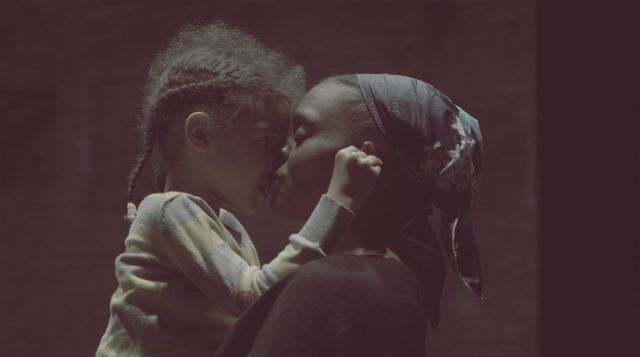
Khalid (Khalid Abdalla) experiences loss of many kinds in Cairo in Tamer El Said’s In the Last Days of the City

IN THE LAST DAYS OF THE CITY (Tamer El Said, 2016)
Museum of Modern Art, MoMA Film
11 West 53rd St. between Fifth & Sixth Aves.
April 27 – May 3
212-708-9400
www.moma.org
bigworldpictures.org

Tamer El Said’s extraordinary debut feature, In the Last Days of the City, is an elegiac love letter to his deeply troubled hometown, Cairo, as well as a treatise on the responsibilities filmmakers have to their art and to society as a whole. Almost ten years in the making, the film was shot between 2008 and 2010, finishing shortly before the Arab Spring uprising in January 2011 in Tahrir Square, and was not completed and screened until 2016, when it started winning prizes at festivals around the world. It finally receives its New York theatrical release at the Museum of the Modern Art, running April 27 through May 3, where El Said will take part in a postscreening conversation on opening night at 7:00; in addition, on April 30 at 7:00, MoMA’s “Modern Mondays” series will present “An Evening with Tamer El Said,” in which the director will discuss Cairo’s Cimatheque — Alternative Film Centre, which he and actor and activist Khalid Abdalla cofounded in 2012 to help grow independent cinema in Egypt. In the Last Days of the City is about loss of all kinds; Abdalla (The Kite Runner, United 93) stars as Khalid, a thirtysomething filmmaker living in Cairo whose life is unraveling: His girlfriend, Laila (Laila Samy), has left him, he needs to find a new apartment, his hospitalized mother (Zeinab Mostafa) is very sick, and his city is crumbling right before his eyes. He meets with three friends and fellow filmmakers, Hassan (Hayder Helo), from Baghdad, Tarek (Basim Hajar), an Iraqi living in Berlin, and Bassem (cinematographer Bassem Fayad), from Beirut. They decide that each of them is going to film their cities and send the footage to Khalid, who will incorporate it into the work he is already making but has reached a block. Throughout, radios and televisions report state news about Hosni Mubarak, the Egyptian football team, and the Muslim Brotherhood, revealing Egypt to be a country on the brink of something big, but neither the characters nor the filmmaker expected what actually occurred.

Khalid (Khalid Abdalla) looks over a Cairo about to undergo radical change in Tamer El Said’s In the Last Days of the City

Four friends meet in Cairo and decide to collaborate on a film in Tamer El Said’s In the Last Days of the City

Fayad captures a city bathed in a golden glow and facing an ominous future. Historic locations are surrounded by buildings turned into rubble. El Said and editors Mohamed Abdel Gawad, Vartan Avakian, and Barbara Bossuet cut between the film and the film-within-the-film, as Khalid interviews Maryam (Maryam Saleh), Hanan (Hanan Youssef), Laila, and others, trying to find out more about himself and his past as well as the Cairo he loves and fears. In a nod to the French New Wave, the camera occasionally continues on a subject with the dialogue not synced — for example, they look out contemplatively, their mouth not moving, their words heard in voice-over. The camera often loses focus, blurring the character as Khalid wrestles with various aspects of his life and career. Most of the film is improvised — El Said initially wrote a fake script in order to get permits, then went through numerous rehearsals before starting shooting. Although there are autobiographical elements, including Khalid living in El Said’s own apartment, the director considers it more of a personal venture and not about himself, a melding of fiction and reality. The film moves with the pace and rhythm of the city as a cloud hangs over it; while it was clear that something was going to happen, El Said did not anticipate the revolution that took place, centered in Tahrir Square. He also chose not to film any of the actual riots and protests and instead decided to participate and join the fight. It’s an option that Khalid does not take in the film; there are several scenes in which he sees violence but decides to either walk away or photograph it without trying to stop it or report it.

In the Last Days of the City is very different from the 2011 documentary Tahrir, in which Italian director Stefano Savona immediately went to Cairo upon hearing about the rebellion, got right in the middle of the action, and released the film shortly after the events. In the Last Days of the City is very much about the filmmaker’s role in the social contract. One of the reasons it took so long for El Said to complete the film was because he and Khalid, who was a major figure in Jehane Noujaim’s 2013 documentary, The Square, also about the Arab Spring, spent several years constructing and establishing Cimatheque, an arts institution where independent filmmakers can flourish in a country without any kind of cinematic infrastructure. Of course, there were budgetary issues as well. In the end, even though In the Last Days of the City very specifically searches for the soul of Cairo, it could really be about any person trying to find his or her place in their hometown, as change — personal, political, societal — looms on the horizon.

THE METROMANIACS

(photo by Carol Rosegg)

David Ives’s The Metromaniacs is a nonstop laugh fest (photo by Carol Rosegg)

Red Bull Theater
The Duke on 42nd St.
229 West 42nd St. between Seventh & Eighth Aves.
Tuesday – Sunday through May 26, $75-$95 ($45 with code MANIAC3)
www.redbulltheater.com
dukeon42.org

It’s easy to go crazy for The Metromaniacs, David Ives’s gleeful romp set during the poetry craze in 1738 France. Ives’s third collaboration with director Michael Kahn, in which they present long-lost French comedies (following Corneille’s The Liar in 2010 and Regnard’s The Heir Apparent in 2011), The Metromaniacs is a “transladaptation” of Alexis Piron’s scandalous 1738 La Métromanie (“The Poetry Craze”), based on a real-life incident in which Voltaire declared his love for a French poetess who turned out to be a man using a woman’s name in order to get published. (Although La Métromanie was performed at the Comédie Française, Piron never got into the Académie Française because he had also written “Ode to the Penis.”) The two-act, 105-minute Red Bull production, which opened Sunday night at the Duke on 42nd St., is entirely in delectable rhyming verse, and Ives never misses a chance for a devilishly clever quatrain or couplet. The story takes place in the elegant home of Francalou (Adam LeFevre), a wealthy wannabe poet whose work is looked down upon. To send up the establishment, he has been publishing ridiculous pastorals under the female pseudonym Meriadec de Peaudoncqville. Francalou is throwing a small party for his virginal daughter, Lucille (Amelia Pedlow), who is returning home from university; the shindig will include a play written for the occasion by Francalou, called The Metromaniacs, set in the parlor, which has been turned into a silly sylvan forest with fake trees and rocks. (The fab set is by James Noone.) Francalou has cast the saucy maid, Lisette (Dina Thomas), as his daughter. “Of course, I only wrote it for a laugh. / But here and there’s a joke, a paragraph, / A rhyme or two I might not call un-juicy. / What a choice welcome-home gift for my Lucy!” he declares. The guests at the party are Damis (Christian Conn), a young poet, using the pseudonym Cosmo de Cosmos, who is determined to meet and wed Meriadec de Peaudoncqville; Mondor (Adam Green), Damis’s valet, who has the hots for Lisette, thinking she is Lucille; Dorante (Noah Averbach-Katz), a dullard who is seeking Lucille’s hand but knows that will be difficult, given that his father is immersed in a legal battle with Francalou; and Baliveau (Peter Kybart), Damis’s uncle and a judge who wrongly believes that his nephew is away at law school, which he is paying for. Over the course of one wild night, lust, love, literature, and the law are thoroughly mocked through cases of mistaken identity and purposeful deception that grow more hysterical by the minute.

(photo by Carol Rosegg)

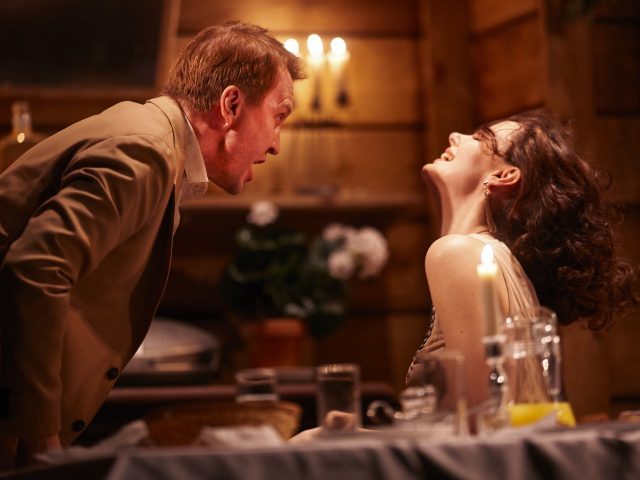
Lucille (Amelia Pedlow) and Lisette (Dina Thomas) discuss love and literature in The Metromaniacs (photo by Carol Rosegg)

The Metromaniacs is chock-full of bawdy humor, physical slapstick, playful anachronisms, asides to the audience, splendid costumes by Murell Horton, awesome wigs by Dori Beau Seigneur, inside jokes, and spectacular rhyming verse. Early on, Lisette says of Lucille, “I’d be amazed if she were ever wived, / Locked in her room reading since she arrived. / See, she’s a metromaniac. That’s her curse.” Dorante asks, “Crazy for subways?” Lisette responds, “No, crazy for verse. / An inflammation of the mental bursa. / Where verse becomes your vice — and vice-a-versa.” Occasionally a character will pause ever so slightly, giving the audience the opportunity to guess what rhyme might be next, something that gets a little harder with such words as “dramaturgy,” “chartreuse,” “Brittany,” “distich,” and, over and over, “incognito.” The seven-person cast might be having even more fun than the audience. At one point the night I saw it, a prop misfired, and Conn and Averbach-Katz couldn’t control themselves, trying their best to hold back laughter as they quickly ad-libbed and the audience erupted. Perdlow is establishing herself as one of the leading period comedians in New York, having previously cracked wise in Red Bull’s ’Tis Pity She’s a Whore and Kate Hamill’s Pride and Prejudice. Thomas (Tribes, Clever Little Lies) is a hoot as Lucille, Lefevre (Awake and Sing, The Diary of Anne Frank) is goofily charming as Francalou, Conn (The School for Scandal, Venus in Fur) is cool and confident as Damis, and Green (The Witch of Edmonton) lends just the right amount of manly slime to Mondor. Tony nominee Kahn (Show Boat, Cat on a Hot Tin Roof) refuses to allow a dull moment in this nonstop laugh fest, which also can be rather self-referential. Here’s a gem from Damis about Francalou, but it could just as well be about Tony winner Ives (Venus in Fur, All in the Timing): “Oh, he’s a lovely man, don’t get me wrong. / Generous and open, sunshine all day long. / But then in middle age he gets this itch / And now he writes the most appalling kitsch. Oh, sure, he’ll say he wrote it ‘for a laugh’ — / Then make you sit through every lumbering gaffe. / Tonight we’re putting on his so-called ‘play’ . . . ? / But wait. I see him coming. Run away!” Of course, don’t run away; run to the Duke to catch this high-falutin’ comic extravaganza, which continues through May 26.

BRIC OPEN: BORDERS

BRIC House exhibit serves as inspiration for four-day free festival on borders (photo by twi-ny/mdr)

BRIC House exhibit serves as inspiration for four-day free festival about borders (photo by twi-ny/mdr)

BRIC House
647 Fulton St., Brooklyn
April 26-29, free (advance RSVP recommended)
718-683-5600
www.bricartsmedia.org

The theme of this year’s BRIC OPEN festival is “Borders,” four days of free programs focusing on borders both real and imagined, physical and ideological. The series is being held in conjunction with the exhibition “Bordering the Imaginary: Art from the Dominican Republic, Haiti, and Their Diasporas,” a collection of sculpture, painting, installation, and video that, in the words of BRIC contemporary art vice president Elizabeth Ferrer, “consider the complicated interrelated histories of two Caribbean countries that share a single island, their tradition of cultural and social exchange, and the social injustices that have long burdened the people of both nations.” The exhibit includes impressive work by Raquel Paiewonsky, Pascal Meccariello, Fabiola Jean-Louis, iliana emilia garcia, Patrick Eugène, and others. “Borders” begins April 26 at 7:00 with “Art Intersecting Politics,” a conversation between Paola Mendoza and Darnell L. Moore, preceded by a spoken-word performance by slam poet Venessa Marco. Friday night’s schedule consists of a concert by Blitz the Ambassador, Lido Pimienta, and the Chamanas (as well as a screening of Blitz’s fifteen-minute film, Diasporadical Trilogia), the ninety-minute walking tour “Borders We Carry” led by Kamau Ware through downtown Brooklyn, an Immigration Action Fair, and Alicia Grullón’s “Empanar!” mobile art project.

On Saturday, there will be a family art-making workshop in which participants can add to a Building Bridges mural; a Greenlight Bookstore pop-up shop; a “Drawn Together” workshop led by “Bordering the Imaginary” artists Vladimir Cybil Charlier, Antonio Cruz, and garcia; Juanli Carrión’s “Memelismos: Memories from the Other Side” participatory storytelling installation; more walking tours; screenings of short films and Jeremy Williams’s On a Knife Edge; the discussions “Reflections on the DACA and the DREAM Act: Erika Harrsch & Yatziri Tovar” and “Haiti-NYC-DR: Reflections from the Diaspora,” the latter with Suhaly Bautista-Carolina, Edward Paulino, Albert Saint Jean, Ibi Zoboi, and moderator Carolle Charles; and a RAGGA x BRIC dance party with DJs Oscar Nñ of Papi Juice, Serena Jara, LSXOXOD, and Neon Christina and a live performance by Viva Ruiz. Sunday features a gallery tour and the closing talk “Biscuits without Borders” by Jess Thorn, aka Touretteshero. In addition, the exhibitions “Under the Same Sky . . . We Dream” by Erika Harrsch and “What time is it there?” by Katie Shima will be on view throughout the festival.

TRIBECA FILM FESTIVAL: DUCK BUTTER

Duck Butter

Sergio (Laia Costa) and Naima (Alia Shawkat) attempt to have sex once an hour over an entire day in Duck Butter

DUCK BUTTER (Miguel Arteta, 2018)
Tribeca Film Festival: Thursday, April 26, Regal Cinemas Battery Park 11-10, 9:00
www.tribecafilm.com
Village East Cinema
181-189 Second Ave. at 12th St.
Opens Friday, April 27
212-529-6799
www.villageeastcinema.com
www.theorchard.com

The behind-the-scenes story of the making of Duck Butter, having its final world premiere screening at the Tribeca Film Festival on April 26 before opening at the Village East the next day, turns out to be better than the film itself. That doesn’t mean there isn’t lots to appreciate about the too-intimate drama, which chronicles the ups and downs, fears and desires of two women experiencing a full relationship in a twenty-four-hour period. Director Miguel Arteta (Beatriz at Dinner, Chuck & Buck) and actress Alia Shawkat (State of Grace, Arrested Development) initially wrote a script about an eighteen-month relationship between a man and a woman that featured a twenty-four-hour period in which they get to know each other by having sex once every sixty minutes. One friend advised that they instead make the movie just about the twenty-four hours, so they began looking for a male actor to star opposite Shawkat. After coming up empty, they decided that Laia Costa (Bandolera, Victoria), who had already been cast in a smaller role, was right for the part. They stripped the script down to its bare essentials, allowing the two actresses to improvise most of their dialogue as the main section of the film was claustrophobically photographed by Hillary Spera in about twenty-seven hours, giving it a cinéma vérité feel.

Duck Butter

Sergio (Laia Costa) and Naima (Alia Shawkat) come together and drift apart in Miguel Arteta’s Duck Butter

After being fired by Mark and Jay Duplass from a show starring characters played by Lindsay Burdge and Kumail Nanjiani, the uptight, overly contemplative Naima (Shawkat) calls the free-spirited Sergio (Costa), a singer she met at a lesbian club. Sergio suggests that they forego the standard dating rituals — “We can skip time!” Sergio declares — and instead spend the next twenty-four hours inside, making love once every hour as they explore who they are and speak only the truth, not playing any romantic games. But what starts out being exciting and sexy soon transforms into something else as they go through in one day what new partners usually go through in years. The film was executive-produced by the Duplass brothers, who portray themselves; Shawkat recently played the bisexual Lila on Transparent, which stars Jay Duplass as Josh Pfefferman. Duck Butter — the title phrase is explained in the film, but you might want to Google it when you’re not at work — also features Hong Chau as Glow and Kate Berlant as Kathy, a lesbian couple who are friends of Naima’s. Costa (who is also an associate producer on the film) and Shawkat (also an executive producer) have a sweet chemistry, but the film is extremely bumpy, jumping around too much as Arteta attempts to squeeze too much into ninety minutes. Some scenes will get you hot, some will make you laugh, but others will make you cringe. The whole experiment is an intriguing idea; perhaps it might have worked better if there were less back story, or more. It ends up being so private at times that you practically have to look away, which is not generally what a filmmaker wants from the audience.

TRIBECA FILM FESTIVAL SPOTLIGHT DOCUMENTARY: HOUSE TWO

Staff Sergeant Frank Wuterich and filmmaker Michael Epstein in Haditha, Iraq, in 2008 during the making of House Two (photo courtesy  of  Viewfinder  Productions)

Director Michael Epstein films Staff Sergeant Frank Wuterich in Haditha, Iraq, while investigating details of 2005 massacre (photo courtesy of Viewfinder Productions)

SPOTLIGHT DOCUMENTARY: HOUSE TWO (Michael Epstein, 2018)
Thursday, April 26, Regal Cinemas Battery Park 11-3, 8:45
www.tribecafilm.com
www.netizensfilm.com

Don’t be scared off by the title of House Two; it’s not a sequel to a horror film you didn’t see. But that doesn’t mean it isn’t downright frightening. On November 19, 2005, the Haditha Massacre took place, in which a small unit of U.S. Marines shot and killed two dozen Iraqis, including women and children, in a bedroom in a location identified as “House Two.” The Marines were searching for those responsible for setting off an IED nearby. The next year, following a Time magazine story about the incident, Oscar-nominated, Emmy-winning director Michael Epstein decided to make a film about the trial of Staff Sergeant Frank Wuterich, who was charged with eighteen counts of murder. In order to get as much behind-the-scenes information as possible without having to surrender it to the court or the military, Epstein actually became an official part of Wuterich’s defense team, gaining full access to its strategy and all those involved, beginning with Wuterich himself. In exchange, the legal team agreed that Epstein would have ownership of all footage he shot and that he could use it in any way he saw fit; thus, he had complete control over the documentary, and the legal team would even indemnify him for any resulting libel claims from them or Wuterich. What Epstein found out about the case is utterly shattering, a widespread conspiracy to cover up the incident — which recalled the 1968 My Lai Massacre in Vietnam — with a shocking revelation of who was ultimately in charge of the whitewashing.

Staff Sergeant Frank Wuterich and filmmaker Michael Epstein in Haditha, Iraq, in 2008 during the making of House Two (photo courtesy  of  Viewfinder  Productions)

Staff Sergeant Frank Wuterich tries to remember what really happened in Haditha while facing murder charges House Two (photo courtesy of Viewfinder Productions)

What was expected to take about eighteen months turned into a ten-year saga for Epstein, who met with Wuterich extensively as well as with his family, even returning to the scene of the crime to help Wuterich remember exactly what happened and who pulled the triggers when. Epstein speaks at length with Wuterich’s legal team, consisting of former Marine Corps Judge Advocate Neal Puckett, former Marine major Haytham Faraj, and Lt. Col. Colby Vokey, former head of the Regional Defense Council West for the Marine Corps. He also interviews NCIS special agents Michael Maloney and Thomas Brady, who discuss the forensic evidence in great detail and what likely happened at House Two, which doesn’t mesh with the prosecution’s case. But the more the agents and Wuterich’s legal team discover about four other members of the unit who were present at House Two (and House Four) — Private First Class Umberto Mendoza, Corporal Sanick DelaCruz, Lance Corporal Justin Sharratt, and Lance Corporal Stephen Tatum — the more doubt is cast on who actually was responsible for the killings, raising questions that top Marine brass seem to want to sweep under the rug as soon as possible.

(photo courtesy  of  Viewfinder  Productions)

Michael Epstein spent ten years immersing himself in the case involving Staff Sergeant Frank Wuterich’s role in the Haditha Massacre (photo courtesy of Viewfinder Productions)

House Two is a tough, tense procedural that goes beyond fly-on-the-wall docs, immersing the viewer in the narrative, particularly as new facts are brought to light but not everyone is willing to accept them. Epstein’s camera reaches some remarkable places as he reveals more about the Marines who were in Haditha at the time of the massacre and exposes a series of lies that keep growing bigger and bigger. Because he was part of the legal team, Epstein (The Battle over Citizen Kane, LennoNYC) has a clear bias; at times he can be heard off camera leading his interview subject onto a certain path. But as he later shows, there appears to be no legitimate other side of the case, as the Marine prosecutors rely on a shaky, and shady, house of cards that is destined to fall. It’s fascinating listening to Maloney, an expert who was among the first to question the original story; Faraj is also a riveting figure, not afraid to get right in Wuterich’s face to find out what happened in what he calls “a very ugly chapter in Marine Corps history.” But by the end, justice and the truth don’t matter; the reputation of the U.S. military is more important than a bedroom full of innocent dead Iraqis. As Epstein notes in his director’s statement, looking at all the evidence, “a clear, unambiguous picture emerged: In Haditha the Marines under Wuterich’s command committed murder.” That doesn’t mean anyone will pay for the crime. House Two has one more world premiere screening left at the Tribeca Film Festival, on April 26 at 8:45; its previous screenings caught the attention of the Pentagon, which is reviewing the incident and deciding what, if anything, to do next.

JASPER JOHNS: A LIFE’S WORK

brooklyn public library jasper johns

Who: Caitlin Sweeney, John Yau, William Villalongo, Martha Wilson
What: Roundtable on Jasper Johns’s career and preserving the work of living artists
Where: Brooklyn Public Library, Central Branch, 10 Grand Army Plaza, 718-230-2100
When: Thursday, April 26, free but advance RSVP recommended, 7:30
Why: In conjunction with the publication of the five-volume Jasper Johns Catalogue Raisonné of Painting and Sculpture (Wildenstein Plattner Institute), the Central Branch of the Brooklyn Public Library is hosting a free panel on April 26 with senior researcher and WPI director of digital publications Caitlin Sweeney, art critic and curator John Yau, painter and collagist William Villalongo, and performance artist and Franklin Furnace founder Martha Wilson. They will discuss the career of Georgia-born artist Jasper Johns, who will be turning eighty-eight on May 15, as well as the importance of preserving the work of a living artist. A catalog will enter the collection of the library as part of the event.