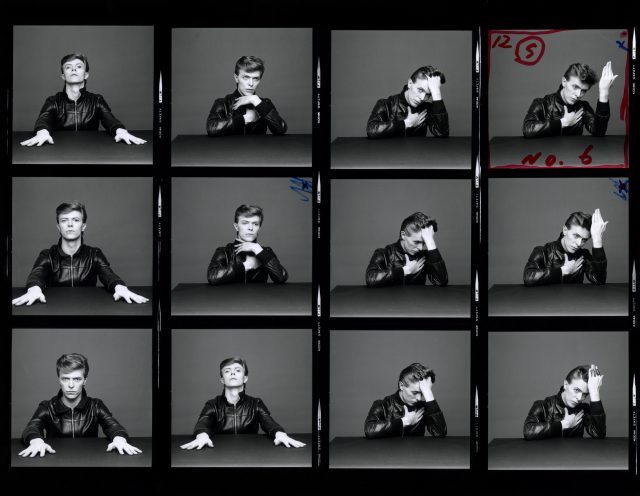
Heroes contact sheet, 1977 (photograph by Masayoshi Sukita. © Sukita/The David Bowie Archive)
Brooklyn Museum
200 Eastern Parkway at Washington St.
Morris A. and Meyer Schapiro Wing and Iris and B. Gerald Cantor Gallery, fifth floor
Daily through July 15, $20-$35
212-864-5400
www.brooklynmuseum.org
Any major career survey of gender-bending, genre-redefining, multidisciplinary, intergalactic superstar David Bowie must be innovative, unique, cutting-edge, and unusual, for nothing less would do justice to the man born David Jones in Brixton in 1947. The Brooklyn Museum’s “David Bowie is,” the most successful exhibition in the institution’s history, is just that, an illuminating exploration of the actor, musician, singer-songwriter, fashion icon, painter, video artist, husband, father, and more. Given unprecedented access to Bowie’s personal archive, the wide-ranging, highly ambitious, immersive multimedia presentation collects hundreds of items, from sketches of his parents to his baby pictures, from handwritten lyric sheets to books that influenced him, from posters of his early bands to drawings of his costumes and sets for live performances, among a multitude of other memorabilia and paraphernalia. One section is devoted to a single song, “Space Oddity,” with video, photographs, screenprints, album artwork, music sheets, related toys, and more, another looks at his various stage personas (the Thin White Duke, Ziggy Stardust, Hamlet), and another explores his work in film and theater, including Labyrinth, The Man Who Fell to Earth, The Elephant Man, The Last Temptation of Christ, Basquiat, and The Image. A five-minute clip from the 1969 promotional film Love You till Tuesday features “The Mask (A Mime),” in which Bowie performs as a mime.
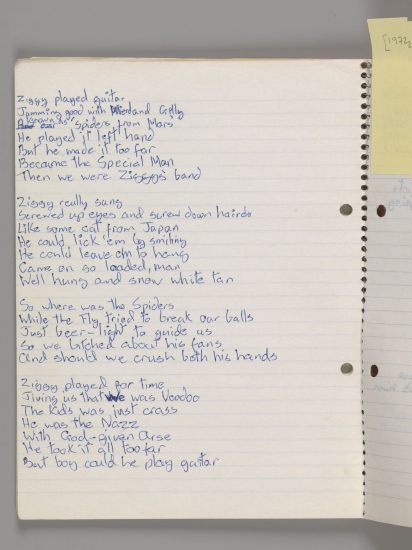
Original lyrics for “Ziggy Stardust,” by David Bowie, 1972 (Courtesy of The David Bowie Archive. Image © Victoria and Albert Museum)
Organized by the Victoria and Albert Museum in London, the show gets everything right that MoMA’s 2015 disaster, “Björk,” got wrong. Purchasing timed tickets in advance, visitors traverse the exhibition at their own pace and in whatever order they would like, wearing headphones that, in a move of genius, react to where they are physically. Thus, when you’re in front of a video screen depicting Bowie performing “The Man Who Sold the World” on Saturday Night Live, that is what you are hearing. Turn around and take a few steps in any direction and the audio will switch to whatever you are now looking at, whether it’s an interview with designer Kansai Yamamoto, Bowie’s preparations for the never-made Diamond Dogs film, or a small room dedicated to his final record, Blackstar. There is something to experience in almost every nook and cranny, so sometimes it is fun to let the audio guide you, attracted by what you hear instead of what you see.
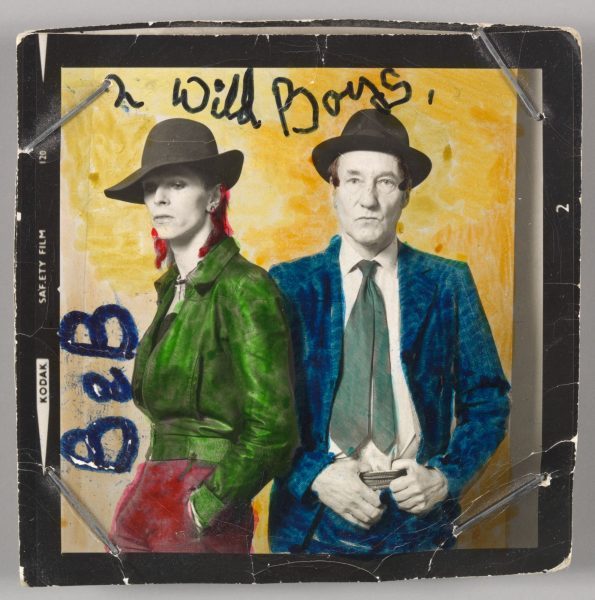
David Bowie with William Burroughs, February 1974 (Photograph by Terry O’Neill with color by David Bowie. Courtesy of The David Bowie Archive. Image © Victoria and Albert Museum)
Among the items to watch out for are a series of line drawings that serves as an artistic conversation between Bowie and Laurie Anderson; Guy Peellaert’s original painting for the Diamond Dogs album cover; the original lyrics to “Rebel, Rebel”; a Bowie painting of Iggy Pop in a Berlin landscape; a letter from Jim Henson to Bowie about Labyrinth; a John Lennon sketch (“For Video Dave . . .)”; Bowie’s script for the Lazarus musical; a Bowie doodle on a cigarette pack; a telefax from Elvis Presley; and Bowie’s charcoal drawing of his adopted home, New York City. The exhibition culminates in high style in a room blasting the original “Heroes” video and live footage of “Rebel, Rebel” from the Reality Tour and “Heroes” from the Concert for New York City, headphones off, everyone experiencing transcendence as one. “Though nothing, nothing will keep us together / We can beat them, forever and ever / Oh, we can be heroes just for one day,” Bowie declares, leaving behind a remarkable legacy that will continue to keep people together, believing that every one of us has the possibility of being a hero. On July 7 (exhibition ticket required, 8:00), Resonator Collective will perform a Bowie tribute, on July 14 ($16, 2:00), there will be a conversation between Daphne Brooks and Jack Halberstam about Bowie’s lasting influence, and on July 15 ($16, 2:00), the final day of the exhibit, the museum hosts the discussion “The Soulfulness of David Bowie” with Carlos Alomar, Robin Clark, and Christian John Wikane. After seeing the exhibit, you’ll have yet more ways to end the already tantalizing sentence fragment “David Bowie is . . .”
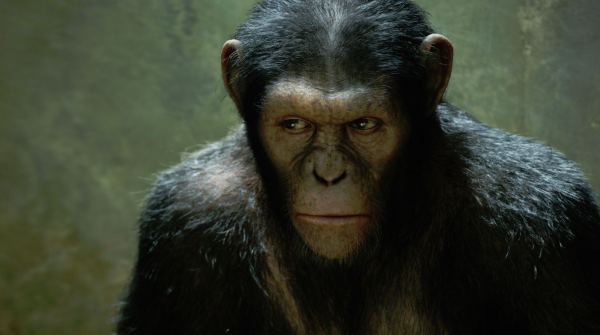
 Director Rupert Wyatt and writers Rick Jaffa and Amanda Silver reimagine Pierre Boulle’s original Planet of the Apes story in the exciting and inventive reboot Rise of the Planet of the Apes. Taking elements from the first five Apes films, especially the fourth flick, Conquest of the Planet of the Apes, the blockbuster is a more science-based thriller that delves into the evolutionary (and devolutionary) nature of humans and animals. James Franco stars as Will Rodman, a scientist working on the anti-Alzheimer’s drug ALZ-112 for Gen-Sys, a big pharmaceutical company run by Steven Jacobs (David Oyelowo). After a demonstration for potential investors goes terribly wrong, Jacobs orders all of the ALZ-112 test subjects to be destroyed, but the baby of the primary subject survives and is brought home by Will, who raises Caesar (a motion-captured Andy Serkis) as if the chimpanzee were his own child, with the help of his scientist girlfriend, Caroline (Slumdog Millionaire’s Freida Pinto) and his father (John Lithgow), who was suffering from Alzheimer’s but is seeing remarkable improvement as Will secretly treats him with the controversial drug. As Caesar grows up, he gains insight into the state of the world, especially how apes are forced to literally live like caged animals, and soon he is ready to do something about it. Rise of the Planet of the Apes is no mere remake or summer popcorner capitalizing on the fame of the series (for that, see Tim Burton’s terrible 2001 disaster); instead, it is a moving, thoughtful study of the development of mammalian intelligence and the very basic need to be free. Wyatt (The Escapist) moves things along at a slow pace in the first half of the film, allowing Caesar’s character to blossom, leading to a believable revolution that culminates in an action-packed showdown on the Golden Gate Bridge. Serkis, who previously played such motion-capture characters as Gollum and King Kong, breathes remarkable life and emotion into Caesar, so much so that there was Oscar buzz around his performance.


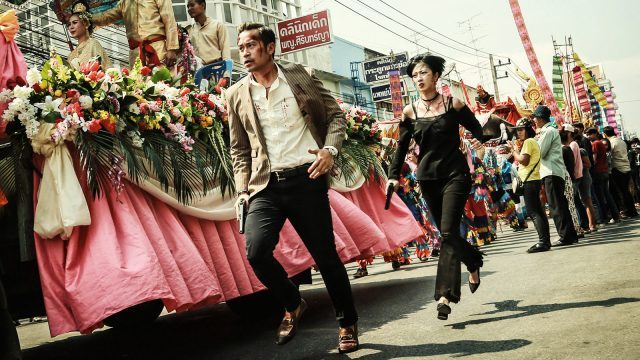
 Hong Kong-born filmmaker Oxide Pang Chun has his work cut out for him in The Big Call, a thriller about phone scams somewhat more complicated than the classic Nigerian cons. “It’s a war with keyboards,” one character proclaims, and indeed, much of the film is spent showing people on their smartphones and typing at computers, trying to explain the often inexplicable plot, which is riddled with ridiculous twists and turns yet still has its compelling moments and, ultimately, foot and car chases, torture, and violence. After his high school teacher commits suicide because of a scam, young cop Ding Xiaotian (Cheney Chen) begins investigating a ring of high-tech thieves who trick and/or threaten people in order to drain their bank accounts. Run by lovers Lin Ahai (Zhang Xiaoquan) and Liu Lifang (Gwei Lun-mei), the operation recruits women and essentially imprisons them in Thailand, where they make the calls in a carefully orchestrated system that rarely fails. They have been infiltrated by Xu Xiaotu (Jiang Mengjie), an ambitious officer who went to the academy with Ding, who has joined the Anti-Telecommunication Fraud Centre, where he butts heads with Inspector Tan Sirong (Zhang Zhaohui). When Lin Xiaoqin (Peng Xinchen), Lin’s sister, gets scammed and Taiwan mastermind Lu Chixiong (Luo Dahua) makes an aggressive bet with Lin Ahai, the risks rise and the blood-spilling ratchets up.