twi-ny recommended events

SKINTIGHT

(photo by Joan Marcus 2018)

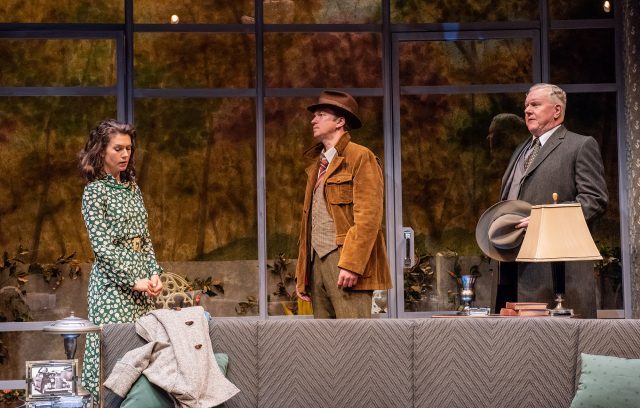
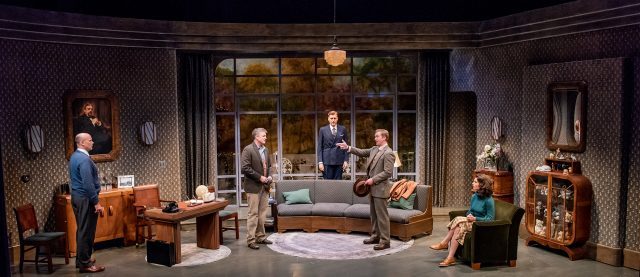
Benjamin Cullen (Eli Gelb), Jodi Isaac (Idina Menzel), and Trey (Will Brittain) don’t exactly get comfortable with one another in Skintight (photo by Joan Marcus 2018)

Laura Pels Theatre
Harold and Miriam Steinberg Center for Theatre
111 West 46th St. between Sixth & Seventh Aves.
Tuesday – Sunday through August 26, $119
212-719-1300
www.roundabouttheatre.org

Joshua Harmon’s fourth play is another clever and insightful, if occasionally repetitive and overwrought, drama of family relationships. In Bad Jews, a trio of siblings squabble over a treasured heirloom. In Significant Other, a gay man can’t find love while his girlfriends each get married. And in Admissions, privilege and merit come to the fore when students at a boarding school apply to college. In Skintight, making its world premiere at the Roundabout’s Laura Pels Theatre, Harmon delves into sex, love, aging, and lust in a dysfunctional Jewish clan. Tony winner Idina Menzel stars as Jodi Isaac, a mother and lawyer facing a midlife crisis when her husband, Greg, leaves her for a much younger woman. In desperate need of unconditional support, she pays an unannounced visit to her father, Elliot (Jack Wetherall), a wealthy clothing entrepreneur who is about to turn seventy and hates surprises. “While Greg and I were at that resort, like, not to be graphic, Daddy, but while we were having like the best sex of our lives, our adult lives, this person was getting her diaper changed, because she didn’t yet possess the motor skills to wipe her own ass,” Jodi says. But that doesn’t exactly gain Elliot’s sympathies; not only is he not exactly a warm and fuzzy father and grandfather, but he’s living with twenty-year-old stud Trey (Will Brittain), with whom he rides motorcycles and goes out to nightclubs. “There has got to be more to life than sex with a hot young thing,” Jodi adds, not seeing the comparison. When her self-involved gay twenty-year-old son, Benji (Eli Gelb), who’s been studying abroad in Budapest, arrives, Elliot worries that he might be interested in Trey. The tension mounts as the birthday dinner approaches and nobody is really listening to what anyone else is saying.

(photo by Joan Marcus 2018)

A dysfunctional family looks back at its past in latest Joshua Harmon play (photo by Joan Marcus 2018)

Harmon fills Skintight with plentiful one-liners and keen observations — “It’s not an achievement, to not die,” Jack tells his daughter about not wanting to make a big deal of his milestone birthday — and three-time Obie-winning director Daniel Aukin (Bad Jews, Admissions, 4000 Miles) guides the characters with an assured hand as they make their way through Lauren Helpern’s appropriately cold, ritzy set, an austere, silver-gray Horatio St. living room and staircase. But it’s difficult to accept Jack and Jodi as father and daughter; they lack that necessary connection that would add potency to their pithy disagreements. And Trey is so over the top, particularly when he walks around in a jockstrap, that he feels like he’s from a different play, reminiscent of Cowboy in The Boys in the Band. In a rare nonmusical stage appearance, Tony winner Menzel (Rent, Wicked), whose family is Jewish and emigrated from Eastern Europe, does well as the constantly complaining Jodi, Wetherall (The Elephant Man, Tamara) is cool and calm as the Calvin Klein-like Elliot, and Gelb (How My Grandparents Fell in Love, The Twenty-Seventh Man) is delicious as Ben, a queer studies major who, when discussing seeing Michelangelo’s “David” in Florence, explains, “They come from all over the world to see a statue a gay guy made of a nice Jewish boy. Makes you think the world isn’t such a bad place after all.” The play also features Stephen Carrasco as Jeff and Cynthia Mace as Orsolya, Elliot’s comic-relief-supplying housekeeping staff. In Skintight, Harmon delves into the nature of superficiality but doesn’t dig quite deep enough, although he still comes up with another entertaining night at the theater, showing again that a world with playwrights such as him isn’t such a bad place after all.

FREE SUMMER EVENTS JULY 8 – 14

Rebecca Manson

Rebecca Manson’s “Closer and the View Gets Wider” will be installed in Tribeca Park on July 9 (photo courtesy Rebecca Manson)

The free summer arts & culture season is under way, with dance, theater, music, art, film, and other special outdoor programs all across the city. Every week we will be recommending a handful of events. Keep watching twi-ny for more detailed highlights as well.

Sunday, July 8
Summergarden: New Music for New York: Juilliard Concert I: New Music for Mixed Ensembles, featuring Tanada II by Shin-ichirō Ikebe, Leonora Pictures by Philip Cashian, and A Sibyl by James Primosch, Abby Aldrich Rockefeller Sculpture Garden, Museum of Modern Art, 8:00

Monday, July 9
Public Art Opening: Rebecca Manson at Tribeca Park, installation of “Closer and the View Gets Wider,” Tribeca Park, 6:00

Tuesday, July 10
Bryant Park Reading Room: Poetry, with Shara McCallum, Jill McDonough, Alessandra Lynch, and Donald Revell, produced in partnership with Alice James Books, Bryant Park, 7:00

Wednesday, July 11
Films on the Green: The Discreet Charm of the Bourgeoisie (Luis Buñuel, 1972), J. Hood Wright Park, 351 Fort Washington Ave., 8:30

Moonstruck

Moonstruck will screen for free at Oculus Plaza on July 13

Thursday, July 12
BRIC Celebrate Brooklyn! Festival: Antibalas, Combo Chimbita, DJ Nickodemus, Prospect Park Bandshell, 7:30

Friday, July 13
Tribeca Drive-In Presents Westfield Dinner and a Movie: Moonstruck (Norman Jewison, 1987), Oculus Plaza, 7:30

Saturday, July 14
NYC Audubon: “It’s Your Tern!” Festival, Governors Island, 12 noon – 4:00

BATSHEVA — THE YOUNG ENSEMBLE: NAHARIN’S VIRUS

(photo by Gadi Dagon)

Batsheva’s Young Ensemble will perform Naharin’s Virus at the Joyce July 10-22 (photo by Gadi Dagon)

The Joyce Theater
175 Eighth Ave. at 19th St.
July 10-22, $10-$86
212-242-0800
www.joyce.org
batsheva.co.il/en

In 1990, choreographer, teacher, and Gaga movement-language developer Ohad Naharin was named artistic director of the Tel Aviv–based Batsheva Dance Company. Later that same year, he started Batsheva – The Young Ensemble as a training ground for emerging dancers. This weekend, Batsheva – The Young Ensemble is performing one of Naharin’s signature works, Naharin’s Virus, at Jacob’s Pillow, followed by a two-week run at the Joyce in Chelsea, from July 10 to 22. The sixty-minute heavily political piece is partly adapted from Peter Handke’s 1966 play, Offending the Audience, about which the Austrian writer has explained, “I first intended to write an essay, a pamphlet, against the theatre, but then I realized that a paperback isn’t an effective way to publish an anti-theatre statement. And so the outcome was, paradoxically, doing something onstage against the stage, using the theatre to protest against the theatre of the moment — I don’t mean theatre as such, the Absolute, I mean theatre as a historical phenomenon, as it is to this day.” Naharin’s Virus, which debuted in 2001 and made its US premiere at BAM in the spring of 2002, features a percussive score of Arabic music by Shama Khader, Habib Allah Jamal, and Karni Postel, along with snippets of Barber, D’Alessio, Stokes, and Parsons.

The Young Ensemble consists of Chen Agron, Mourad Bouayad, Thibaut Eiferman, Ariel Gelbart, Londiwe Khoza, Kornelia Maria Tamara Lech, Ohad Mazor, Robin Lesley Nimanong, Evyatar Omessy, Igor Ptashenchuk, Roni Rahamim, Tamar Rosenzweig, Hani Sirkis, Xanthe van Opstal, Nicolas Ventura, and Paul Vickers. “Handke’s play is about the negation of the theater,” Naharin said in a BAM program note. “The direct, continuous appeal to the public turns the spectator’s mere presence, his self-awareness and his act of listening — into the main issue of the play. He glorifies the public — but means no praise, he scorns them — but means no offense. He contradicts himself. The play empties the stage of all expectations, of all theatrical conventions. A space, a void is created: It is there where my creation takes place!” There will be a Curtain Chat following the July 11 performance, and Young Ensemble rehearsal director Michal Sayfan will be teaching a two-hour master class at Gibney on July 20 ($20, 10:00 am).

WILL RAWLS, UNCLE REBUS

(photo by Maggie Heath)

Will Rawls, I make me [sic], TBA Festival, 2017 (photo by Maggie Heath)

Who: Will Rawls
What: High Line Performance Art
Where: On the High Line at Seventeenth St., Sunken Overlook
When: Tuesday, July 10, through Thursday, July 12, free with RSVP, 6:00 – 8:00 pm
Why: Brooklyn-based choreographer, curator, writer, and performer Will Rawls will present the site-specific Will Rawls, Uncle Rebus on the High Line in the Sunken Overlook at Seventeenth St. and Tenth Ave. on July 10-12 from 6:00 to 8:00; admission is free, but advance RSVP is required. Rawls, who has performed with Shen Wei, Marina Abramović, Nicholas Leichter, Maria Hassabi, Tino Sehgal, Jérôme Bel, Noemie LaFrance, and others and is half of the performance art duo Dance Gang (with Kennis Hawkins), reimagines the controversial Uncle Remus narrator and his Brer Rabbit tales, joining Trinity Bobo, Stanley Gambucci, and Jasmine Hearn, in costumes by Eleanor O’Connell, as they use a custom keyboard to tell a rather different story in the form of a choreographed meditation on language, race, tradition, and the human body.

DAVID BOWIE IS

Heroes contact sheet, 1977 (photograph by Masayoshi Sukita. © Sukita/The David Bowie Archive)

Heroes contact sheet, 1977 (photograph by Masayoshi Sukita. © Sukita/The David Bowie Archive)

Brooklyn Museum
200 Eastern Parkway at Washington St.
Morris A. and Meyer Schapiro Wing and Iris and B. Gerald Cantor Gallery, fifth floor
Daily through July 15, $20-$35
212-864-5400
www.brooklynmuseum.org

Any major career survey of gender-bending, genre-redefining, multidisciplinary, intergalactic superstar David Bowie must be innovative, unique, cutting-edge, and unusual, for nothing less would do justice to the man born David Jones in Brixton in 1947. The Brooklyn Museum’s “David Bowie is,” the most successful exhibition in the institution’s history, is just that, an illuminating exploration of the actor, musician, singer-songwriter, fashion icon, painter, video artist, husband, father, and more. Given unprecedented access to Bowie’s personal archive, the wide-ranging, highly ambitious, immersive multimedia presentation collects hundreds of items, from sketches of his parents to his baby pictures, from handwritten lyric sheets to books that influenced him, from posters of his early bands to drawings of his costumes and sets for live performances, among a multitude of other memorabilia and paraphernalia. One section is devoted to a single song, “Space Oddity,” with video, photographs, screenprints, album artwork, music sheets, related toys, and more, another looks at his various stage personas (the Thin White Duke, Ziggy Stardust, Hamlet), and another explores his work in film and theater, including Labyrinth, The Man Who Fell to Earth, The Elephant Man, The Last Temptation of Christ, Basquiat, and The Image. A five-minute clip from the 1969 promotional film Love You till Tuesday features “The Mask (A Mime),” in which Bowie performs as a mime.

Original lyrics for “Ziggy Stardust,” by David Bowie, 1972. Courtesy of The David Bowie Archive. Image © Victoria and Albert Museum

Original lyrics for “Ziggy Stardust,” by David Bowie, 1972 (Courtesy of The David Bowie Archive. Image © Victoria and Albert Museum)

Organized by the Victoria and Albert Museum in London, the show gets everything right that MoMA’s 2015 disaster, “Björk,” got wrong. Purchasing timed tickets in advance, visitors traverse the exhibition at their own pace and in whatever order they would like, wearing headphones that, in a move of genius, react to where they are physically. Thus, when you’re in front of a video screen depicting Bowie performing “The Man Who Sold the World” on Saturday Night Live, that is what you are hearing. Turn around and take a few steps in any direction and the audio will switch to whatever you are now looking at, whether it’s an interview with designer Kansai Yamamoto, Bowie’s preparations for the never-made Diamond Dogs film, or a small room dedicated to his final record, Blackstar. There is something to experience in almost every nook and cranny, so sometimes it is fun to let the audio guide you, attracted by what you hear instead of what you see.

David Bowie with William Burroughs, February 1974. Photograph by Terry O'Neill with color by David Bowie. Courtesy of The David Bowie Archive. Image © Victoria and Albert Museum

David Bowie with William Burroughs, February 1974 (Photograph by Terry O’Neill with color by David Bowie. Courtesy of The David Bowie Archive. Image © Victoria and Albert Museum)

Among the items to watch out for are a series of line drawings that serves as an artistic conversation between Bowie and Laurie Anderson; Guy Peellaert’s original painting for the Diamond Dogs album cover; the original lyrics to “Rebel, Rebel”; a Bowie painting of Iggy Pop in a Berlin landscape; a letter from Jim Henson to Bowie about Labyrinth; a John Lennon sketch (“For Video Dave . . .)”; Bowie’s script for the Lazarus musical; a Bowie doodle on a cigarette pack; a telefax from Elvis Presley; and Bowie’s charcoal drawing of his adopted home, New York City. The exhibition culminates in high style in a room blasting the original “Heroes” video and live footage of “Rebel, Rebel” from the Reality Tour and “Heroes” from the Concert for New York City, headphones off, everyone experiencing transcendence as one. “Though nothing, nothing will keep us together / We can beat them, forever and ever / Oh, we can be heroes just for one day,” Bowie declares, leaving behind a remarkable legacy that will continue to keep people together, believing that every one of us has the possibility of being a hero. On July 7 (exhibition ticket required, 8:00), Resonator Collective will perform a Bowie tribute, on July 14 ($16, 2:00), there will be a conversation between Daphne Brooks and Jack Halberstam about Bowie’s lasting influence, and on July 15 ($16, 2:00), the final day of the exhibit, the museum hosts the discussion “The Soulfulness of David Bowie” with Carlos Alomar, Robin Clark, and Christian John Wikane. After seeing the exhibit, you’ll have yet more ways to end the already tantalizing sentence fragment “David Bowie is . . .”

MOVIES UNDER THE STARS: RISE OF THE PLANET OF THE APES

Caesar has had quite enough in Planet of the Apes reboot

RISE OF THE PLANET OF THE APES (Rupert Wyatt, 2011)
Father Macris Park
Lamberts Ln. & Arlene St., Staten Island
Friday, July 6, 8:30
718-667-3545
www.apeswillrise.com
www.nycgovparks.org

Director Rupert Wyatt and writers Rick Jaffa and Amanda Silver reimagine Pierre Boulle’s original Planet of the Apes story in the exciting and inventive reboot Rise of the Planet of the Apes. Taking elements from the first five Apes films, especially the fourth flick, Conquest of the Planet of the Apes, the blockbuster is a more science-based thriller that delves into the evolutionary (and devolutionary) nature of humans and animals. James Franco stars as Will Rodman, a scientist working on the anti-Alzheimer’s drug ALZ-112 for Gen-Sys, a big pharmaceutical company run by Steven Jacobs (David Oyelowo). After a demonstration for potential investors goes terribly wrong, Jacobs orders all of the ALZ-112 test subjects to be destroyed, but the baby of the primary subject survives and is brought home by Will, who raises Caesar (a motion-captured Andy Serkis) as if the chimpanzee were his own child, with the help of his scientist girlfriend, Caroline (Slumdog Millionaire’s Freida Pinto) and his father (John Lithgow), who was suffering from Alzheimer’s but is seeing remarkable improvement as Will secretly treats him with the controversial drug. As Caesar grows up, he gains insight into the state of the world, especially how apes are forced to literally live like caged animals, and soon he is ready to do something about it. Rise of the Planet of the Apes is no mere remake or summer popcorner capitalizing on the fame of the series (for that, see Tim Burton’s terrible 2001 disaster); instead, it is a moving, thoughtful study of the development of mammalian intelligence and the very basic need to be free. Wyatt (The Escapist) moves things along at a slow pace in the first half of the film, allowing Caesar’s character to blossom, leading to a believable revolution that culminates in an action-packed showdown on the Golden Gate Bridge. Serkis, who previously played such motion-capture characters as Gollum and King Kong, breathes remarkable life and emotion into Caesar, so much so that there was Oscar buzz around his performance.

Although it is not a remake or a sequel, Rise does fit within the Apes mythology, and it includes numerous tributes to its predecessors: Gen-Sys head Jacobs is named for the producer of the five original films, Arthur P. Jacobs; Gen-Sys chimp handler Robert Franklin (Tyler Labine) is a subtle nod to the director of the first film, Franklin J. Schaffner; the circus orangutan Maurice pays tribute to Maurice Evans, who played the orangutan Dr. Zaius in the original; the chimp Cornelia is a sly combination of favorite characters Cornelius and Dr. Zira from the first flicks; and Brian Cox as John Landon and Tom Felton as Dodge, his son, remember original Apes astronauts Landon (Robert Gunner) and Dodge (Jeff Burton). In addition, at one point a television monitor shows a clip of Charlton Heston playing Julius Caesar, and one of the most famous lines from the original makes an appearance in this reboot, which ends with more than a hint that sequels are to follow, leading to Matt Reeves’s even better Dawn of the Planet of the Apes in 2014 and the excellent War for the Planet of the Apes in 2017. Rise is screening July 6 at 8:30 in the free “Movies Under the Stars” series in Father Macris Park in Staten Island.

BRIC CELEBRATE BROOKLYN! FESTIVAL — LES BALLETS JAZZ DE MONTRÉAL: LEONARD COHEN’S DANCE ME

Leonard Cohen

Les Ballets Jazz de Montréal will present U.S. premiere of Dance Me in Prospect Park on July 6

Prospect Park Bandshell
Prospect Park
Ninth St. & Prospect Park West
Friday, July 6, free, 8:00
www.bricartsmedia.org
www.bjmdanse.ca

In November 2016, Canadian troubadour Leonard Cohen passed away at the age of eighty-two. The poet, singer-songwriter, novelist, and Zen monk left behind a six-decade legacy of investigating love and the human condition like no one else. In 1972, the year after Cohen released one of his masterpieces, Songs of Love and Hate, Les Ballets Jazz de Montréal was founded, a company dedicated to merging classical dance with more contemporary styles. On July 6, the troupe will present the U.S. premiere of Dance Me at the Prospect Park Bandshell as part of the free BRIC Celebrate Brooklyn! Festival. The eighty-minute piece was commissioned, prior to Cohen’s death, for Montreal’s 375th anniversary and debuted in Canada last December. Set to songs from throughout Cohen’s long career and organized around the cycles of existence as experienced through the changing seasons, Dance Me was conceived by BJM artistic director Louis Robitaille and is choreographed by Andonis Foniadakis, Annabelle Lopez Ochoa, and Ihsan Rustem for fourteen performers, with musical direction by Martin Léon, scenic design by Pierre-Étienne Locas, lighting by Cédric Delorme-Bouchard and Simon Beetschen, video by Hub Studio (Gonzalo Soldi, Thomas Payette, and Jeremy Fassio), sound by Guy Fortin, and costumes by Philippe Dubuc. On December 20, 2012, Cohen played the Barclays Center in Brooklyn, opening the show with “Dance Me to the End of Love,” from his 1984 album Various Positions, in which he croons, “Dance me to your beauty with a burning violin / Dance me through the panic till I’m gathered safely in / Lift me like an olive branch and be my homeward dove / Dance me to the end of love.” BJM’s Dance Me should lift the Brooklyn audience in the beautiful confines of Prospect Park.