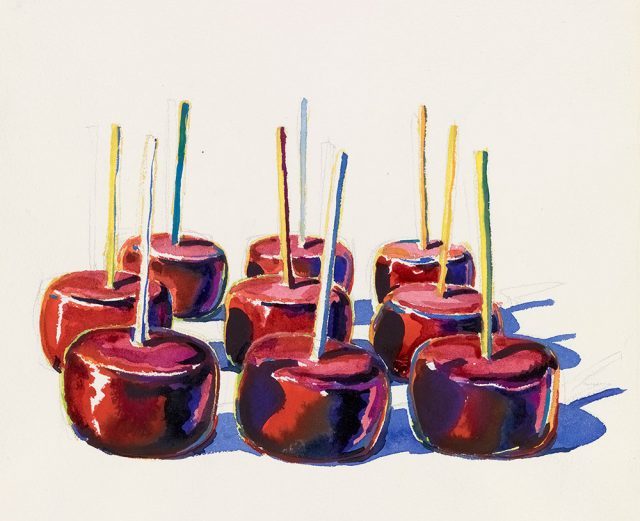
Wayne Thiebaud, “Nine Jelly Apples,” watercolor and graphite, 1964 (Yale University Art Gallery, Gift of George Hopper Fitch, B.A. 1932. Photography by Tony De Camillo. © Wayne Thiebaud/Licensed by VAGA, New York, NY)
Morgan Library & Museum
225 Madison Ave. at 36th St.
Tuesday – Sunday through September 23, $13-$20 (free Fridays 7:00 to 9:00)
212-685-0008
www.themorgan.org
You might be surprised to find out that from 2005 to 2015, Wayne Thiebaud was sixth on the list of top-selling living American artists at auction, totaling more than $163 million in aggregated sales (trailing Jeff Koons, Christopher Wool, Richard Prince, Ed Ruscha, and Jasper Johns and ahead of Robert Ryman, Frank Stella, Robert Indiana, and Cindy Sherman). Or maybe that’s not surprising at all, given how his oeuvre is so viscerally pleasing while also technically adroit, as revealed in the lovely exhibition “Wayne Thiebaud, Draftsman,” continuing at the Morgan through September 23. Now ninety-seven and still working, the Arizona-born, California-raised artist is best known for his luscious paintings of pies, jelly apples, ice-cream cones, and other tasty treats, but the show reveals him to be an expert draftsman through drawings and sketches not only of desserts but of cityscapes and landscapes. His influences range from Willem de Kooning, Franz Kline, Giorgio Morandi, Edgar Degas, and Pierre-Paul Prudh’hon to Krazy Kat cartoonist George Herriman and time spent in trade school and the military and as a commercial artist, window dresser, and graphic designer for Rexall Drugs and Universal Studios. “One day [printer] Kathan [Brown] brought down lunch, which was a cheese sandwich, a couple of olives, and a beer, and I said, ‘Before we eat this, I think I’ll draw it,’” Thiebaud is quoted as saying in the exhibition catalog.
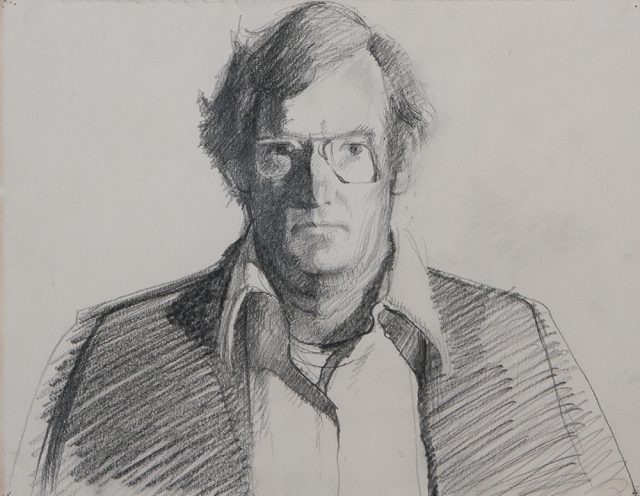
Wayne Thiebaud, “Self Portrait,” graphite, ca. 1970 (From the artist’s studio. © Wayne Thiebaud/Licensed by VAGA, New York, NY)
The show, the first extensive museum survey of Thiebaud’s works on paper, is a panoply of delights, from the 1964 watercolor and graphite “Nine Jelly Apples,” in which the sweet jelly seems to be dripping down the wall, to the 1983 charcoal “Three Roads,” an imaginative rendering of San Francisco streets, from a circa-1970 graphite self-portrait of Thiebaud looking serious to the 1960s-1970s “Page of Sketches with Ties,” four rectangular depictions of numerous ties, from the 1964 brush and ink “Hamburgers,” three rows of the all-American food, to the fantastical 1967-68 “Ridge with Clouds.” Thiebaud is not making any grand statements about consumption or hunger; the self-effacing artist and teacher is merely using his impressive skill to explore various subjects and styles. He also seems to have a penchant for drawing items in multiples of three, although he claims that is not on purpose and has no secret meaning. “Learning to draw is just learning to see more clearly and more organized,” he told curator Isabelle Dervaux in an illustrated talk at the Morgan. “That’s another side benefit of learning to draw. You’re going to learn to see a lot better and a lot deeper.”
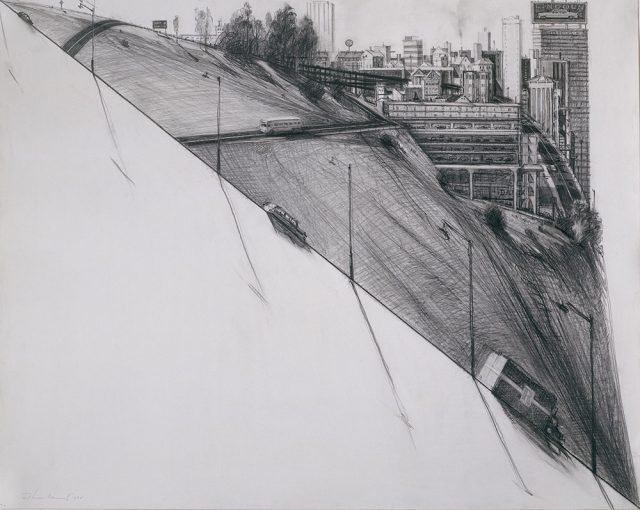
Wayne Thiebaud, “Diagonal City,” graphite, 1978 (Collection of Harry W. and Mary Margaret Anderson. © Wayne Thiebaud/ Licensed by VAGA, New York, NY)
Thiebaud’s works have a way of getting inside your head, offering up sweet memories. Walking through the exhibit, I was like, well, a kid in a candy store. I thought of the first hamburger I had at Wetson’s, of the candy store down the street from my elementary school, of how rarely I saw my father wearing a tie, of a cake my aunt used to make for my birthday, the first time I licked an ice-cream cone and the ice cream dripped onto my hand, of a childhood friend’s dog, and of getting lost while wandering through parts of San Francisco and New York City. Dervaux has done a marvelous job laying out the show, dividing it into such themes as “Foodstuff,” “Tradition,” “Early Drawings,” and “Cityscapes and Landscapes,” creating compelling juxtapositions that tell us yet more about Thiebaud and his methods. It’s a joy to experience these works, many of which have never before been shown publicly. “Most of these are private drawings — to find out something, to make notations, or just to experiment,” Thiebaud has said. “You want to feel that these are things that will never be seen.”
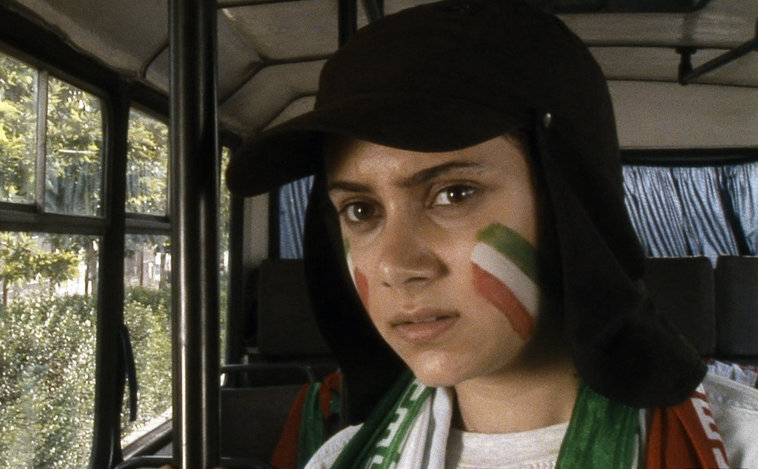
 For nearly thirty years, Iranian cinema has been an integral part of the international film world, with stellar works by such directors as Mohsen Makhmalbaf, Abbas Kiarostami, Asghar Farhadi, Bahman Farmanara, Jafar Panahi, and others. One thing many of these films have in common is cinematographer Mahmoud Kalari, who has shot some of the preeminent Iranian films, offering a new vision of the politically troubled country. MoMA is honoring the former photojournalist’s career, which includes more than five dozen feature films, with “The Eye of Iran: Cinematographer Mahmoud Kalari,” a series consisting of twelve of his major works, running September 16-30. On September 18 and 20, MoMA will be screening Panahi’s Offside, a brilliant look at gender disparity in modern-day Iran, filmed on location in and around Tehran’s Azadi Stadium with a talented cast of nonprofessional actors. Although it is illegal for girls to go to soccer games in Iran — because, among other reasons, the government does not think it’s appropriate for females to be in the company of screaming men who might be cursing and saying other nasty things — many try to get in, facing arrest if they get caught. Offside is set during an actual match between Iran and Bahrain; a win will put Iran in the 2006 World Cup. High up in the stadium, a small group of girls, dressed in various types of disguises, have been captured and are cordoned off, guarded closely by some soldiers who would rather be watching the match themselves or back home tending to their sheep. The girls, who can hear the crowd noise, beg for one of the men to narrate the game for them. Meanwhile, an old man is desperately trying to find his daughter to save her from some very real punishment that her brothers would dish out to her for shaming them by attempting to get into the stadium.
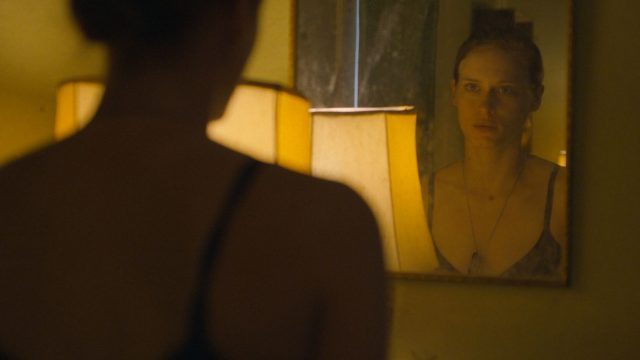
 Louisiana-born, Los Angeles-based filmmaker Ramaa Mosley follows up her debut, the 2013 comedy The Brass Teapot, with the intense gothic thriller Lost Child. After serving two tours in the army, Fern Shreaves (Leven Rambin), upon the death of her father, returns to the dilapidated Ozarks home where she was raised. Suffering from PTSD — she insists she will never pick up a gun again — she has come back primarily to reconnect with her troubled, missing brother, Billy (Taylor John Smith). But instead she finds and takes in a mysterious young boy, Cecil (Landon Edwards), who appears to be living in the vast forest by her house. The polite ragamuffin child doesn’t say much about where he’s from, but when strange things start happening to Fern, Dr. Gill (Mark Ingalsbe) and dangerous forest-dwelling nut job Fig Karl (Kip Collins) warn her that Cecil is a tatterdemalion, a demonic figure literally sucking the life out of her. Fern becomes friendly with Mike Rivers (Jim Parrack), a sweet-natured bartender and child services worker who pooh-poohs the local folklore and thinks it best if Cecil continues to stay with her to avoid placement in foster care. But Fern is not used to making the right choices, either for herself or others, as events reach a fever pitch.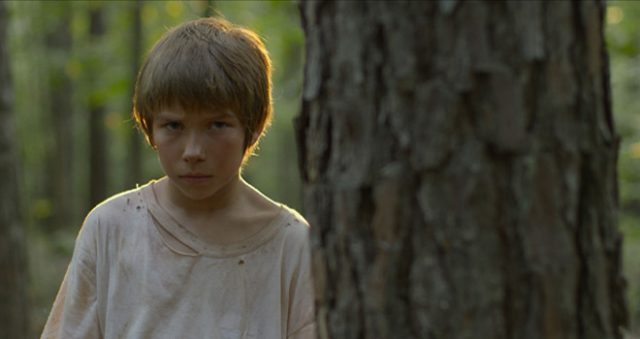
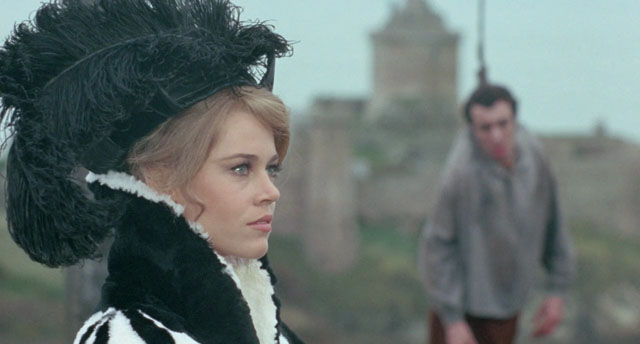
 The Quad gets right to the heart of the matter in the title of its new series, “Some Are Better than Others: The Curious Case of the Anthology Film.” Also known as an omnibus, anthology films are compilations of shorter works, often by master directors, on a specific theme. The Quad festival, running September 14-27, includes Aria, in which ten directors, among them Robert Altman, Jean-Luc Godard, Derek Jarman, Nicolas Roeg, and Ken Russell, make films inspired by opera pieces; the four-part 1945 British horror anthology Dead of Night; Lumière and Company, in which forty-one international filmmakers create fifty-two-second films using original equipment from the Lumière brothers; and Twilight Zone — The Movie, with Joe Dante, John Landis, George Miller, and Steven Spielberg revisiting classic episodes from the Rod Serling TV program. It is rare that all of the short films are of equal quality — hence, “Some are better than others” — and such is the case with the 1968 trilogy of Edgar Allan Poe stories, Spirits of the Dead.