twi-ny recommended events

LOST CHILD

Lost Child

Fern Shreaves (Leven Rambin) takes a long, hard look at herself in Ramaa Mosley’s Lost Child

LOST CHILD (Ramaa Mosley, 2018)
Cinema Village
22 East 12th St. between University Pl. & Fifth Ave.
Opens Friday, September 14
212-529-6799
www.bgpics.com
www.cinemavillage.com

Louisiana-born, Los Angeles-based filmmaker Ramaa Mosley follows up her debut, the 2013 comedy The Brass Teapot, with the intense gothic thriller Lost Child. After serving two tours in the army, Fern Shreaves (Leven Rambin), upon the death of her father, returns to the dilapidated Ozarks home where she was raised. Suffering from PTSD — she insists she will never pick up a gun again — she has come back primarily to reconnect with her troubled, missing brother, Billy (Taylor John Smith). But instead she finds and takes in a mysterious young boy, Cecil (Landon Edwards), who appears to be living in the vast forest by her house. The polite ragamuffin child doesn’t say much about where he’s from, but when strange things start happening to Fern, Dr. Gill (Mark Ingalsbe) and dangerous forest-dwelling nut job Fig Karl (Kip Collins) warn her that Cecil is a tatterdemalion, a demonic figure literally sucking the life out of her. Fern becomes friendly with Mike Rivers (Jim Parrack), a sweet-natured bartender and child services worker who pooh-poohs the local folklore and thinks it best if Cecil continues to stay with her to avoid placement in foster care. But Fern is not used to making the right choices, either for herself or others, as events reach a fever pitch.

Lost Child

Landon Edwards makes a big impression in film debut, Lost Child

Mosley cowrote and produced the film with her Brass Teapot partner, Tim Macy, whose father lives in West Plains, Missouri, where Lost Child — originally titled Tatterdemalion — was shot, primarily with nonprofessional actors on an extremely low budget of $15,000. The film is beautifully photographed by Darin Moran, turning the forest into a character unto itself. Rambin, who played Glimmer in The Hunger Games and Athena Bezzerides on True Detective, gets deep into her role as Fern, who is desperately searching for some kind of family to hold on to, her eyes in almost constant motion. Arkansas native Edwards is exceptional as Cecil, reminiscent of Lucas Black in American Gothic, keeping viewers on edge as he harbors dark secrets. Named Best Narrative Feature at the 2018 Kansas City Film Festival, Lost Child — the title could describe several figures in the movie — evokes such works as Robert Mulligan’s The Other, Mervyn LeRoy’s The Bad Seed, Jodie Foster’s Nell, and François Truffaut’s The Wild Child while feeling wholly original. Mosley maintains a creepy, tense atmosphere every step of the way, investigating ideas of family and responsibility, enhanced by David Baron and Chris Maxwell’s subtle, revealing score and southern country-folk songs by Arkansas native Ashley McBryde. (The final song over the closing credits is sung by Rambin.) A twist on a familiar trope, Lost Child is fresh and contemporary while solidly connecting to our ancient human fears of the forest — and weird children.

SOME ARE BETTER THAN OTHERS — THE CURIOUS CASE OF THE ANTHOLOGY FILM: SPIRITS OF THE DEAD

Metzengerstein

Jane Fonda plays a sexy countess in husband Roger Vadim’s Metzengerstein

SPIRITS OF THE DEAD (TRE PASSI NEL DELIRIO) (HISTOIRES EXTRAORDINAIRES) (Roger Vadim, Louis Malle, and Federico Fellini, 1968)
Quad Cinema
34 West 13th St. between Fifth & Sixth Aves.
Friday, September 14, 7:10; Friday, September 21, 7:00
Series runs September 14-27
212-255-2243
quadcinema.com

The Quad gets right to the heart of the matter in the title of its new series, “Some Are Better than Others: The Curious Case of the Anthology Film.” Also known as an omnibus, anthology films are compilations of shorter works, often by master directors, on a specific theme. The Quad festival, running September 14-27, includes Aria, in which ten directors, among them Robert Altman, Jean-Luc Godard, Derek Jarman, Nicolas Roeg, and Ken Russell, make films inspired by opera pieces; the four-part 1945 British horror anthology Dead of Night; Lumière and Company, in which forty-one international filmmakers create fifty-two-second films using original equipment from the Lumière brothers; and Twilight Zone — The Movie, with Joe Dante, John Landis, George Miller, and Steven Spielberg revisiting classic episodes from the Rod Serling TV program. It is rare that all of the short films are of equal quality — hence, “Some are better than others” — and such is the case with the 1968 trilogy of Edgar Allan Poe stories, Spirits of the Dead.

William Wilson

Alain Delon gets into a heated card game with Brigitte Bardot in Louis Malle’s William Wilson

The film begins with Roger Vadim’s Metzengerstein, in which a lush and lavishly shot Jane Fonda, in spectacular outfits and hairstyles, plays Countess Frederique de Metzengerstein, who has inherited a massive estate and rules it without any inhibitions — yet her devilish debauchery doesn’t quite satisfy her. After an accidental meeting with her calm, easygoing cousin, Baron Wilhelm Berlifitzing, portrayed by her brother, Peter Fonda, she tries to end a long-running feud with his family, resulting in some extremely peculiar moments of lust for him and, later, his horse. Vadim was married to Fonda at the time, adding to the incestuous titillation and bestiality that run through the tale, which was based on Poe’s first published short story.

Toby Dammit

Terence Stamp is an alcoholic, fast-fading Shakespearean star in Toby Dammit

In Louis Malle’s William Wilson, Alain Delon is the title character, an elegant cad who has been followed since childhood by his doppelgänger, who determinedly, and very publicly, rights his wrongs. The film, which is told in flashback as Wilson confesses to a priest that he has killed a man, features a chilling card game with a black-haired, ultra-serious Brigitte Bardot. Malle was not happy with the film, which he took on just for the money; thus, he acquiesced to certain elements because he was told to do so, from casting to certain plot points, going against his instincts. The three-pack concludes with Federico Fellini’s fiercely unpredictable Toby Dammit, adapted by Fellini and Bernardino Zapponi from Poe’s “Never Bet the Devil Your Head: A Tale with a Moral.” Fellini evokes La Dolce Vita and as British actor Toby Dammit (Terence Stamp) is lured to Rome to make a movie in exchange for a Ferrari. Amid bizarre interview segments, an absurdist awards ceremony, and meetings with his overbearing producers, Toby is haunted by a girl with a white ball (Marina Yaru).

Originally advertised as “Edgar Allan Poe’s Ultimate Orgy!,” Spirits of the Dead, narrated by Poe icon Vincent Price, is choppily edited and wildly uneven. The filmmakers deal with fear, fire, eroticism, passion, obsession, power, ennui, and death more directly than they do in their full-length works, but things are also often more unclear. Still, this is a rare chance to see these three shorts together on the big screen. And beware of what Poe wrote in his 1827 poem “Spirits of the Dead”: Thy soul shall find itself alone / ’Mid dark thoughts of the grey tomb-stone; / Not one, of all the crowd, to pry / Into thine hour of secrecy. / Be silent in that solitude, / Which is not loneliness — for then / The spirits of the dead, who stood / In life before thee, are again / In death around thee, and their will / Shall overshadow thee; be still. / The night, though clear, shall frown, / And the stars shall not look down / From their high thrones in the Heaven / With light like hope to mortals given, / But their red orbs, without beam, / To thy weariness shall seem / As a burning and a fever / Which would cling to thee for ever.” Spirits of the Dead is screening at the Quad on September 14 at 7:10 and September 21 at 7:00. The series continues with such other anthologies as Boccaccio ’70 (De Sica, Monicelli, Fellini, Visconti), Far from Vietnam (Klein, Ivens, Lelouch, Varda, Godard, Marker, Resnais), New York Stories (Scorsese, Coppola, Allen), and Seven Women, Seven Sins (Akerman, Cohen, Export, Gavron, Gordon, Ottinger, Sander).

SATELLITE COLLECTIVE’S ECHO & NARCISSUS

Satellite Collectives Echo & Narcissus debuts at the BAM Fisher this weekend

Satellite Collective’s Echo & Narcissus debuts at BAM Fisher this weekend

BAM Fisher, Fishman Space
321 Ashland Pl.
Friday, September 14, 8:00, and Saturday, September 15, 7:30, $25
www.bam.org
satellitecollective.org

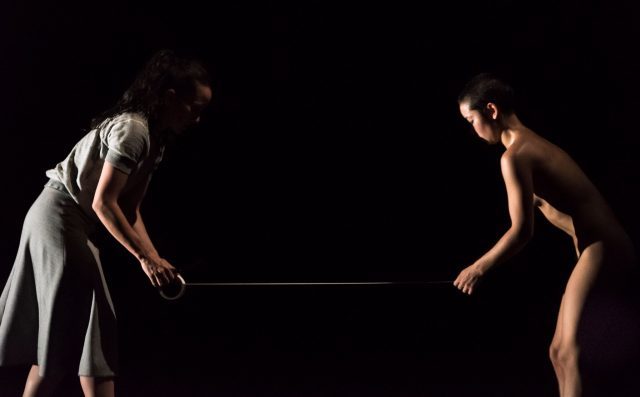
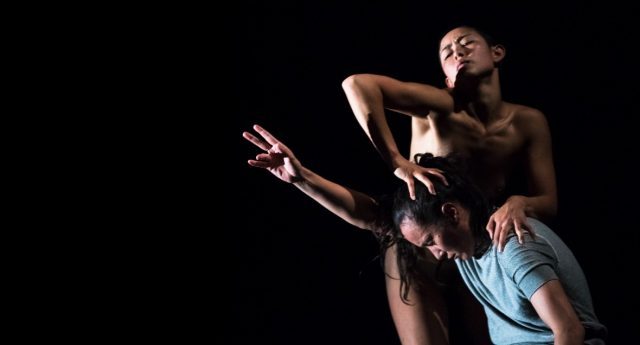
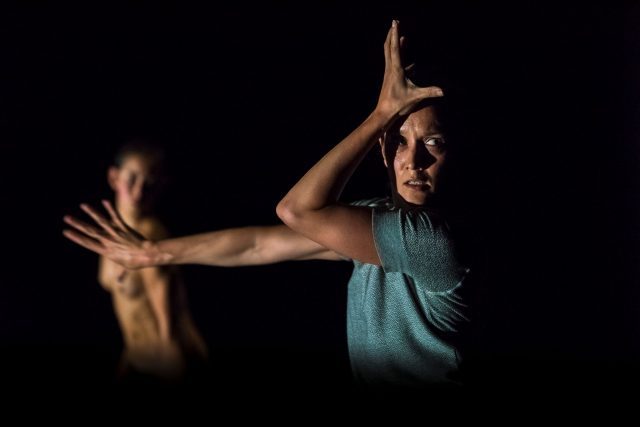
New York City–based Satellite Collective is presenting the world premiere of its latest interdisciplinary ballet collaboration, Echo & Narcissus, at BAM Fisher’s Fishman Space on September 14 and 15. Some forty artists participated in the creation of the immersive work, which includes music, dance, opera, visual art, digital multimedia, and more, with live music and movement by ShoutHouse. The seventy-minute piece is set in New York City in 1971 and deals with such themes as selfishness, love, madness, and transformation in a world where people are obsessed with their own reflections. It was written by Satellite Collective artistic director Kevin Draper, composed by Aaron Severini, choreographed by Norbert De La Cruz III, and directed by Philip Stoddard, with film by Lora Robertson, projection design by Simon Harding, sets by Libby Stadstad, and production design by Draper. Among the performers are dancers Matteo Fiorani, Timothy Stickney, Joslin Vezeau, and Tara Youngmen and singers Christine Taylor Price and Stoddard. “We work at the intersection of dance, visual art, and music — and we use architects and poets as the glue,” Draper said in a statement. “Echo & Narcissus will be our first, focused, evening-length work where group action has to resonate in service to the story. We’re crafting a pretty high level of intensity for the audience.”

BRILLIANT QUIRKY: JEANNE BALIBAR ON FILM

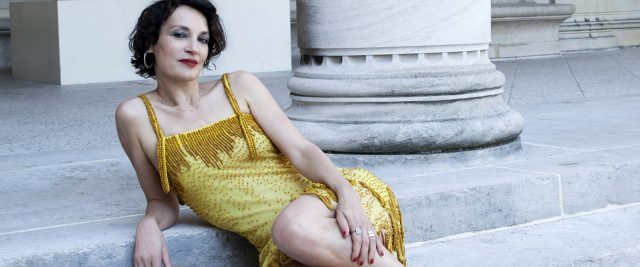
French star Jeanne Balibar will be at FIAF for three special events during October

French star Jeanne Balibar will be at FIAF for three special events during October

French Institute Alliance Française, Florence Gould Hall
55 East 59th St. between Madison & Park Aves.
Tuesday, September 11 & 18, and Tuesdays in October, $14 (free on September 11), 4:00 & 7:30
Les Historiennes October 13, 30-$60, 7:00
212-355-6100
fiaf.org/events

FIAF pays tribute to French stage and screen star Jeanne Balibar with a two-month retrospective consisting of ten of her films, from 1997’s Mange ta soupe and 1998’s Only God Sees Me to a sneak preview of Barbara, her third collaboration with Mathieu Amalric. Despite the subtitle of the CinéSalon series, “Brilliant Quirky: Jeanne Balibar on Film,” the César Award-winning actress will actually be at FIAF as well, for Q&As following screenings of Jacques Rivette’s Tomorrow’s Another Day on October 2 at 7:30 and Barbara on October 9 at 7:30 — in addition to performing live in the one-woman show Les Historiennes in Florence Gould Hall on October 13, featuring Balibar reading essays by Anne-Emmanuelle Demartini, Charlotte de Castelnau, and Emmanuelle Loyer and discussing the profound impact the works have had on her life and career; the three historians will join Balibar in this Crossing the Line world premiere. The film series, which runs September 11 to October 30, also includes Pierre Léon’s L’Idiot and Raúl Ruiz’s Comedy of Innocence, with all screenings followed by a wine and beer reception. Don’t miss this opportunity to see one of the world’s most exquisite actresses in this exciting FIAF presentation.

JACQUES AUDIARD: THE BEAT THAT MY HEART SKIPPED

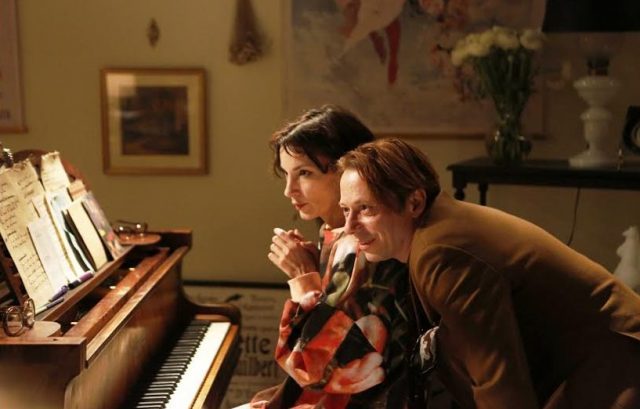
Romain Duris stars in Jacques Audiards The Beat That Skipped My Heart

Romain Duris stars in Jacques Audiard’s The Beat That My Heart Skipped, a remake of James Toback’s Fingers screening at MoMA

THE BEAT THAT MY HEART SKIPPED (Jacques Audiard, 2005)
MoMA Film, Education Center
4 West 54th St. between Fifth & Sixth Aves.
Wednesday, September 12, 4:00
Series runs through September 20
212-708-9400
www.moma.org

In a relatively unique change of pace, the French remade a favorite American underground film. Director Jacques Audiard and screenwriter Tonino Benacquista followed up their international hit Read My Lips (2001) with The Beat That My Heart Skipped, a creative, moody remake of James Toback’s Fingers (1978), which starred Harvey Keitel as a New York City kid forced to choose between the piano and the mob. Audiard moves the film to the mean streets of Paris, where Tom (Romain Duris) attempts to regain his childhood musical virtuosity, which he gave up after his mother’s tragic death. As he begins to train with a Vietnamese piano student-teacher (Linh-Dan Pham) who does not speak French, his crooked partners continue to reel him into their low-rent, dangerous real estate scams. Ever the antihero, Tom also has a poignant love-hate relationship with his father, played by Niels Arestrup in a marvelous yellow get-up. As Tom’s worlds collide, he is constantly aware of protecting his fingers, which he needs to perform Bach’s Toccata in E Minor at an important audition. The film, which takes a while to really develop, is shot in long takes with a handheld camera, keeping Tom boxed into his claustrophobic situation. Songs by Bloc Party and the Kills keep things on edge, mixing well with Bach and Alexandre Desplat’s evocative award-winning score. Winner of eight César Awards, The Beat That My Heart Skipped is screening September 12 at MoMA’s Education Center as part of “Jacques Audiard,” which celebrates the career of the French filmmaker upon the upcoming release of his first English-language feature, The Sisters Brothers; the series continues September 14 with the director’s 1994 thriller, See How They Fall, starring Jean Yanne, Jean-Louis Trintignant, and Matthieu Kassovitz, before concluding with the new work on September 20, with Audiard and costar John C. Reilly participating in a Q&A.

R.R.R.E.D.: A SECRET MUSICAL

R.R.R.E.D.

Stephanie Hicks (Marissa Rosen), Victoria O’Hara (Katie Thompson), GJ Crockett (Matt Loehr), and Craig (Kevin Zak) are trying to save the future of redheads in R.R.R.E.D.

DR2 Theatre
103 East 15th St. between Irving Pl. & Park Ave.
Saturday – Tuesday through September 11, $39-$79
rrredthemusical.com
www.darylroththeatre.com

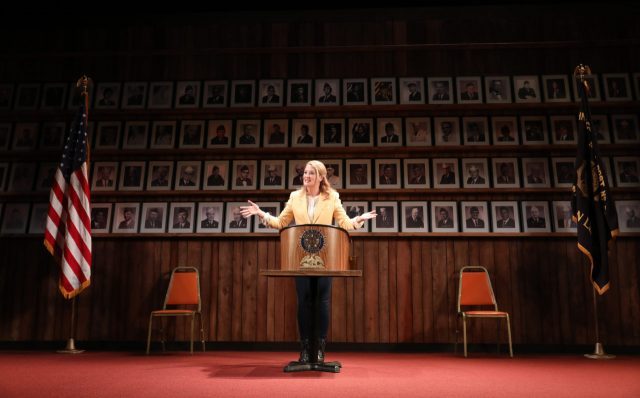
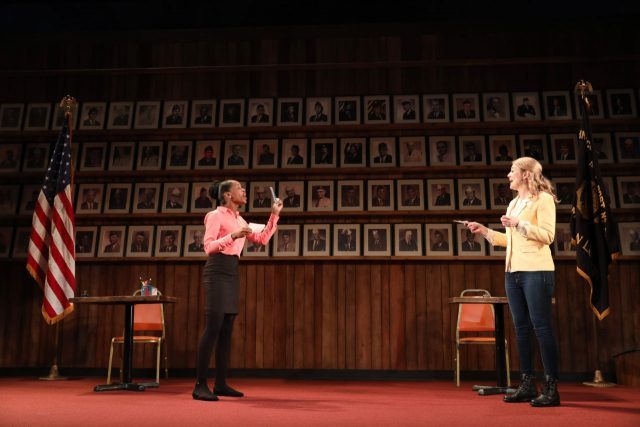
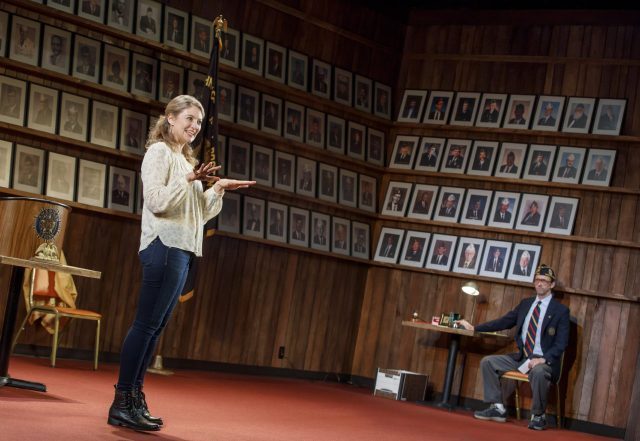
In 2005, the Oxford Hair Foundation predicted that the recessive gene that causes red hair will be so diluted by 2060 that redheads will become extinct. (This was later proved false but keeps popping up on the internet every few years.) In the November 2005 South Park episode “Ginger Kids” inspired by that claim, Eric Cartman lambasts redheads (until he seemingly becomes one and wants to save them), saying, “Like vampires, the ginger gene is a curse, and unless we work to rid the earth of that curse, the gingers could envelop our lives in blackness for all time. It is time that we all admit to ourselves that gingers are vile and disgusting. In conclusion, I will leave you with this: If you think that the ginger problem is not a serious one, think again.” The off-Broadway musical R.R.R.E.D. , which stands for the Real Redheaded Revolutionary Evolutionary Defiance, urges us to fight for the preservation of red-haired men, women, and children, holding secret meetings in the DR2 Theatre to spread ways of keeping gingers alive and well across the planet. These gatherings are led by Victoria O’Hara (Katie Thompson, who wrote the music and lyrics and collaborated on the book with Adam Jackman and Patrick Livingston), joined by her energetic, lively assistant, GJ Crockett (Matt Loehr). They are determined to keep red hair flourishing, coming up with a plan in which redheads need to procreate. “Participation is the key to propagation!” she declares, explaining, “Every time a non-redheaded person manages to woo and win a redhead, another baby is born into a world with one fewer redheaded head.”

R.R.R.E.D.

Victoria O’Hara (Katie Thompson) and GJ Crockett (Matt Loehr) lead a secret meeting at the DR2 Theatre in low-budget musical

A series of “Instructional Tutorial Musical Lessons” (including “Pregnant,” performed by Marissa Rosen as Stephanie Hicks, and “I Like You,” sung by Kevin Zak as Craig) and songs such as “The Rules,” “As Long as It’s Red,” “Revenge,” and “What Good’s a Blonde, Anyway . . .” fight the good fight, but it’s a losing battle. The low-budget, self-effacing show has some very fun moments, but it never comes together to form a cohesive whole. Upon entering the theater, each member of the audience is given a fake name that they must put on their shirt and use instead of their real name — I was Luke Skywalker, while my companion was Elizabeth Perkins — but that conceit just falls by the wayside, never going anywhere. While Thompson (Pump Boys and Dinettes, Big Fish), who evokes a latter-day Kathleen Turner, sports fiery red hair, the other characters don’t. Other elements also lack sense, from wigs to a monitor in the back that depicts photographs and text to support various theories. Director Andy Sandberg (Straight, Application Pending) can’t bring much focus to the show, which has been around since 2008, when an earlier, longer version was presented at the New York Musical Theatre Festival. About twenty-five minutes has been cut from that iteration, but it still is too long. And weekly celebrity guests — Kristen Mengelkoch (Forbidden Broadway) Kate Rockwell (Mean Girls), Christopher Sieber (Shrek the Musical, Tovah Feldshuh (Irena’s Vow) — who sing “Redheaded Stepchild,” feel out of place and gimmicky. In 1988, Tom Robbins wrote in GQ, “Whether they spring from genes disarranged by earthly forces or are ‘planted’ here by overlords from outer space is a matter for scholarly debate. It’s enough for us to recognize that redheads are abnormal beings, bioelectrically connected to realms of strange power, rage, risk, and ecstasy.” Like Robbins, I happen to be a redhead, and, as several characters say in R.R.R.E.D., “My blood bleeds red.” But just as Victoria and GJ are not having much luck saving redheads, it looks like the show itself can’t be saved, as the original closing date of October 21 has been moved up to September 11.

GIACOMETTI

Albert Giacometti, “The Chariot,” bronze, 1950  (photo by twi-ny/mdr)

Albert Giacometti, “The Chariot,” bronze, 1950 (photo by twi-ny/mdr)

Solomon R. Guggenheim Museum
1071 Fifth Ave. at 89th St.
Friday – Wednesday through September 12, $25 (pay-what-you-wish Saturday 5:00-7:45)
212-423-3587
www.guggenheim.org

In his catalog essay “The Quest for the Absolute” for Alberto Giacometti’s 1948 solo show at the Pierre Matisse Gallery in New York, Jean-Paul Sartre began, “I know no one else so sensitive as he is to the magic of faces and gestures. He views them with a passionate desire, as though he were from some other realm. But at times, tiring of the struggle, he has sought to mineralize his fellow human beings: he saw crowds advancing blindly toward him, rolling down the avenues like rocks in an avalanche. So each of his obsessions remained a piece of work, an experiment, a way of experiencing space.” Humanness and space are key to the Guggenheim’s outstanding current retrospective, simply titled “Giacometti,” where large crowds are expected in its final days; the exhibition ends September 12. Although Giacometti, who was born in Switzerland in 1901, spent most of his working life in Paris, and died in 1966, came to New York only once, for a MoMA show in 1965, he has had a long and important relationship with the city.

(photo by twi-ny/mdr)

Two versions of “Spoon Woman” (1927) are side by side, bronze in black, plaster in white (photo by twi-ny/mdr)

Following gallery shows at Pierre Matisse and Julien Levy, Giacometti was given a major exhibition at the Guggenheim’s temporary space in 1955, and nineteen years later the institution mounted a posthumous retrospective in its Frank Lloyd Wright building. The new show is beautifully curated by the museum’s Megan Fontanella and Fondation Giacometti director Catherine Grenier and smartly installed by Derek DeLuco, with the artist’s large and small bronze and plaster sculptures, paintings, drawings, notebooks, and more unfolding chronologically up the Guggenheim’s spiral pathway, revealing a fascinating array of humanity and artistic styles (Surrealism, Cubism, Abstract Expressionism, Egyptian and African), with plenty of room for both the visitor and the work to breathe.

(photo by twi-ny/mdr)

A group of small busts line one bay at the Guggenheim (photo by twi-ny/mdr)

The High Gallery provides a kind of amuse-bouche, a tantalizing look at Giacometti’s designs for an unrealized 1958 project at the Chase Manhattan Bank plaza downtown. Back on the ramp, bays feature black bronze and white plaster versions of the abstract “Spoon Woman,” an early gestation of the more familiar sculptures to come. “Suspended Ball” is a piece of Surrealist illusion. “Woman with Her Throat Cut” and “Hands Holding the Void (Invisible Object)” offer compelling narratives. “Very Small Figurine” is just that, not even two inches tall, in contrast to, for example, “Man Pointing,” which reaches nearly six feet. (If it looks like the man’s left arm is cradling a missing figure, that’s because it is; Giacometti destroyed it, preferring to have the man be more lonely, particularly in the aftermath of WWII.) “City Square” brings together a handful of eight-inch figures that form a little community, while “Four Women on a Base” comprises a quartet of narrow figures who are so thin they nearly disappear. “In the street people astound and interest me more than any sculpture and painting,” Giacometti said. “They form and re-form living compositions in unbelievable complexity. It’s the totality of this life that I want to reproduce in everything I do.”

(phot by twi-ny/mdr)

Guggenheim retrospective begins with Giacometti’s 1962 oil painting of his wife, titled “Black Annette” (photo by twi-ny/mdr)

In “The Nose,” the lengthy proboscis of a figure in an open box pokes outside the plane. “Figurine Between Two Houses” resembles a man in a console television set. A woman stands tall on a small platform with two large wheels in “The Chariot,” which casts stunning shadows below it. Oil paintings such as “Standing Nude,” “Black Annette,” “Diego Standing in the Living Room in Stampa” (Diego was his brother and longtime model as well as a sculptor and designer), and “Jean Genet” prove Giacometti’s intense skill with canvas. The show is so well laid out that a visitor eagerly looks forward to what awaits in the next bay rather than tiring of so many elongated figures; they can seem like a sequence of musical notes, rising and falling as one proceeds through the show. “In space, there is too much,” Sartre quotes Giacometti, but that is not true of this thrilling, must-see retrospective.