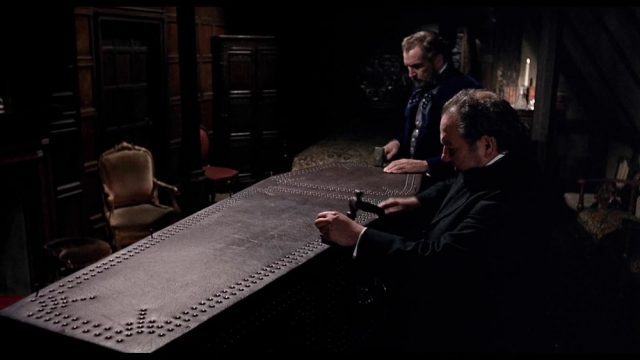
Vincent Price (back) nails his brother into a coffin in Edgar Allan Poe film The Oblong Box
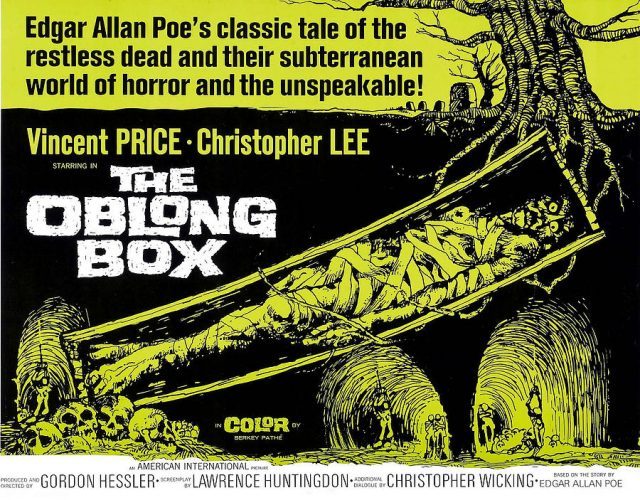
THE OBLONG BOX (Gordon Hessler, 1969)
Quad Cinema
34 West 13th St. between Fifth & Sixth Aves.
Wednesday, October 24, 6:45, and Thursday, October 25, 5:00
212-255-2243 quadcinema.com
Vincent Price made more than 125 films in his long career, including a slew of horror classics and cult favorites, highlighted by seven Edgar Allan Poe collaborations with Roger Corman and key roles in such other great works as Laura, The Ten Commandments, and Edward Scissorhands. So it’s extremely curious that for “Victoria Price presents: Vincent Price x 3,” Price’s daughter has selected three of his lesser-known frightflicks, Michael Reeves’s Witchfinder General) (aka The Conqueror Worm), based on the Poe short story), Jim Clark’s 1974 Madhouse, and Gordon Hessler’s debut, The Oblong Box. Paying tribute to the twenty-fifth anniversary of his death — Price died on October 25, 1993, at the age of eighty-two — Victoria will be at the Quad for screenings of the first two but not the third, leaving it completely up to the audience to figure out just what the heck is going on in this crazy film. Price stars as Sir Julian Markham, a wealthy British man who sees his brother, Sir Edward (played by Alister Williamson and voiced by an unidentified actor), crucified and his face disfigured by a vengeful African tribe. The brothers return to England, where Edward is locked in an upstairs room because, his mind gone, he is a danger to himself and others. He ultimately gets out, setting off on a bloody trail of murder as he meticulously chooses his victims, his face hidden behind a crimson hood.
The American International Pictures production, which is set in 1865, also features Rupert Davies as Kemp, a friend of Julian’s; Uta Levka as Heidi, an unfortunate prostitute; Sally Geeson as Sally, a maid who takes a liking to Edward; Peter Arne as Trench, Julian’s duplicitous solicitor; Hilary Dwyer as Elizabeth, Julian’s fiancée; Harry Baird as N’Galo, a local witch doctor; and the great Christopher Lee as Dr. Newhartt, the first time Price and Lee ever worked together on camera. The Oblong Box bears little resemblance to the Poe story; the movie is a messy mélange of body snatching, throat cutting, voodoo (with a racist depiction of most of the black characters), and mistaken identity, lacking in elements central to Poe’s style. Hessler would go on to make Cry of the Banshee and Scream and Scream Again with Price, in addition to Kiss Meets the Phantom of the Park and Murders in the Rue Morgue. With Halloween around the corner, “Victoria Price presents: Vincent Price x 3,” which runs October 24-25, should get you in the proper mood; Vincent Price has a way of doing that, even in his lesser films.
Long Time Coming: A 1955 Baseball Story reunites players from first integrated Little League World Series
LONG TIME COMING: A 1955 BASEBALL STORY (Jon Strong, 2018)
SVA Theatre
333 West Twenty-Third St. between Eighth & Ninth Aves.
Tuesday, October 23, $10-$15, 7:00 www.longtimecoming.film
To most baseball fans, 1955 was the year the Brooklyn Dodgers finally reached nirvana, winning their first and only World Series, defeating their archrival, the New York Yankees, in seven games. The Dodgers’ roster included three African Americans, future Hall of Famers Jackie Robinson and Roy Campanella and four-time All Star Don Newcombe. But there was another baseball matchup that year that had an impact on the legacy of segregation in the United States: Florida’s Little League State Championship, pitting the all-black Pensacola Jaycees (Rev. Freddie Augustine, Cleveland Dailey, Admiral “Spider” LeRoy, Will Preyer, Willie V. Robinson, Willie Stromas, others) against the all-white Orlando Kiwanis (Jerry Cowart, Gary Fleming, Stewart Hall, Ron Homan, Bill Hudson, John Lane, Danny Rivenbark, more). Jon Strong looks back at the seminal event in his new documentary, Long Time Coming: A 1955 Baseball Story, which features interviews with several members of each team in addition to such baseball legends and civil rights leaders as Hank Aaron, Cal Ripken Jr., Gary Sheffield, Davey Johnson, and Andrew Young.
“I wanted to dig into the uncomfortable, real stories that many find difficult to share,” Strong said in a statement. “Black and white children who grew up in the South, now grown men in their seventies — how can we see them, know them, and most importantly, what can we learn from them for our own lives? Through conversation, I wanted to learn the histories, experiences, and truths in their lives.” The film, which includes music by Keb’ Mo’ and the Brilliance, is making its theatrical premiere at the SVA Theatre on October 23 at 7:00 — the same night the Major League Baseball championship begins, with the Los Angeles Dodgers taking on the Boston Red Sox — followed by a Q&A with the filmmakers and some of the players who participated in this first integrated Little League World Series.
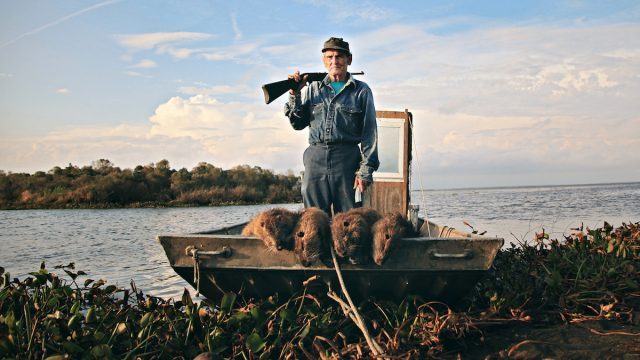
Master nutria hunter Thomas Gonzales shows off his catch in Rodents of Unusual Size
RODENTS OF UNUSUAL SIZE (Chris Metzler, Jeff Springer & Quinn Costello, 2017)
IFC Center
323 Sixth Ave. at Third St.
Tuesday, October 23, 7:30
212-924-7771 www.ifccenter.com www.rodentsofunusualsize.tv
And you thought the rat problem in New York City was bad. “I wanna tell you all a tale that’s crazier than hell,” Louisiana native and Treme star Wendell Pierce says at the beginning of Rodents of Unusual Size, Chris Metzler, Jeff Springer, and Quinn Costello’s eye-opening documentary about the nutria, the twenty-pound web-footed, orange-toothed South American creature that was introduced to Louisiana in the 1930s to boost the fur trade and has wreaked havoc ever since. The rodents multiply like tribbles and destroy so much vegetation that the resulting erosion affects storm surge protection, leading the government to encourage the mass murder of the beast by offering a five-dollar bounty for each tail. The filmmakers visit Delacroix and the Ninth Ward in New Orleans, talking to such nutria hunters as Larry Aucoin, Darrell Aucoin, Liz LeCompte, and Trey Hover, who is killing the swamp rat to help pay for his college education. LeCompte is doing it to protect the environment. “If the land’s gone, then me and my family don’t have a future,” she says, explaining that “Cajun women, they not afraid to get their hands dirty.” Nutria control specialist Michael Beran, who patrols the canal banks and uncovers nutria-built subterranean labyrinths that can also endanger bridges, notes that the nutria is an “invasive species [that] has to be deleted.” Nutria tail assessor John Siemion gets right to the point: “It offers these guys money when there is none,” he says. “This is their income for the year.”
Fashion designer Cree McCree, the founder of Righteous Fur, believes that using nutria pelts for vests, hats, leg warmers, ties, and other clothing should be supported by organizations such as PETA. “I like to think of Righteous Fur as a giant recycling project,” she says. Some restaurants are serving nutria on their menu. James Beard Award-winning chef Susan Spicer of Bayona Restaurant insists, “If you approach it with an open mind, you’ll find it doesn’t have a really bad, swampy taste.” Rebirth Brass Band cofounder and trumpeter Kermit Ruffins barbecues nutria. “It’s definitely like tasting Louisiana. Delicious!” he declares. The filmmakers also speak with Edmond Mouton of the Louisiana Dept. of Wildlife & Fisheries, fur wholesaler Tab Pitre (who skins a few nutria on camera), Bimbo Phillips of the Atakapa-Ishak tribe, Chateau Estates resident Paul Klein (who feeds the buggers), Rick Atkinson of the Audubon Zoo, Chateau Golf & Country Club maintenance manager Brooks Mosley, Louisiana Fur & Wildlife Festival organizer David LaPierre, Fur Queen Beauty Pageant winner Julian Devillier, and Eric Dement, who has a pet nutria. But it’s fisherman and philosopher Thomas Gonzales who the filmmakers keep coming back to. “Never kill something unless you make something with it,” the old man says, later adding, “I’m born to die, so I’m gonna get all the gusto out of this little body that I got.” In Delacroix, a sign reads, “End of the World.” It seems like not even Captain Kirk could cure Louisiana’s nutria dilemma. Rodents of Unusual Size, which also has a fab soundtrack by the Lost Bayou Ramblers, is screening October 23 at 7:30 at IFC, concluding the fall “Stranger Than Fiction” series, and will be followed by a Q&A with codirector and cinematographer Springer.
John Kevin Jones pays tribute to Edgar Allan Poe at historic Merchant’s House Museum (photo by Joey Stocks)
KILLING AN EVENING WITH EDGAR ALLAN POE: MURDER AT THE MERCHANT’S HOUSE
Merchant’s House Museum
29 East Fourth St. between Lafayette St. and the Bowery
October 12-31, $18
212-777-1089 merchantshouse.org www.summonersensemble.org
Purely by coincidence, I saw three one-man shows this week, on three successive nights, and all three have strong reasons for me to recommend them. On Tuesday, I was at the historic Merchant’s House Museum on East Fourth St. to see John Kevin Jones in Killing an Evening with Edgar Allan Poe: Murder at the Merchant’s House. Jones has a kind of cult fan club for his annual one-man version of A Christmas Carol at the museum, a home built in 1831-32 that was occupied continuously by the Tredwell family from 1835 to 1933. The nineteenth century feels very present in the house, which was one of the first twenty buildings to gain landmark status under the city’s 1965 law and functions as a museum, preserving the Tredwell family’s furnishings as they would have appeared when Poe, coincidentally, lived nearby for a time at 85 West Third St. and later in a cottage in the Bronx. Dressed in nineteenth-century-style jacket, vest, top hat, and ascot, Jones celebrates Edgar Allan Poe with three of his most popular writings, preceded by short introductions about each work and Poe’s career.
Forty people are squeezed into the Tredwells’ candlelit double parlor — with a coffin at one end and a dining table at the other — and Jones walks up and down the narrow space between, where the audience is seated on three sides, boldly delivering two classic Poe tales of treachery and murder, “The Tell-Tale Heart” and “The Cask of Amontillado,” both from memory. His deep, theatrical voice resonates through the room as he catches the eye of audience members, adding yet more chills and thrills to the mystery in the air. He then sits down with a book for the long poem “The Raven,” evoking the great Poe actor Vincent Price. Jones, director Dr. Rhonda Dodd, and stage manager Dan Renkin, the leaders of Summoners Ensemble Theatre, keep the focus on Poe’s remarkable narrative technique; you might be watching one man, but you’ll feel like you’re seeing each of Poe’s characters in vivid detail. The sold-out show continues October 22, 23, and 31; tickets for A Christmas Carol, however, are still available.
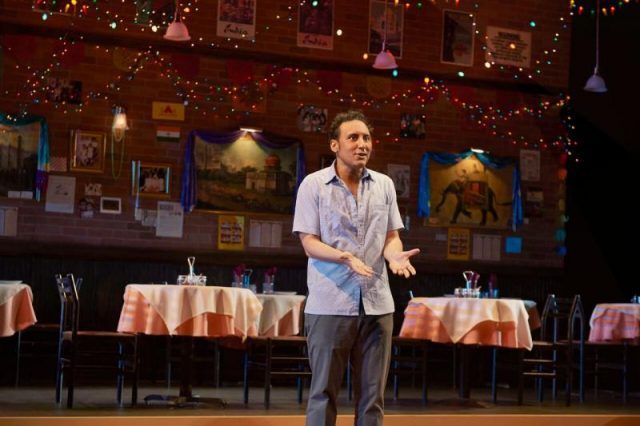
Aasif Mandvi brings back his Obie-winning Sakina’s Restaurant to the Minetta Lane (photo by Lisa Berg)
SAKINA’S RESTAURANT
Audible Theater at Minetta Lane Theatre
18 Minetta Lane between Sixth Ave. and MacDougal St.
Tuesday – Sunday through November 11, $57-$97
sakinasrestaurantplay.com
On Wednesday night I headed to the Minetta Lane Theatre, where Audible has been staging one-person shows that are also available as audios. First, Billy Crudup starred in David Cale’s modern noir Harry Clarke, then Carey Mulligan excelled in Dennis Kelly’s intense Girls & Boys, and now Aasif Mandvi has brought back his Obie-winning 1998 show, Sakina’s Restaurant. Born in India and raised in England, Mandvi studied with acting teacher Wynn Handman, whose students have also included solo specialists Eric Bogosian and John Leguizamo. In the slightly revamped autobiographical tale, directed by Kimberly Senior (Disgraced, The Niceties), Mandvi plays six characters, beginning with Agzi, an eager young man who is leaving his small, tight-knit Indian village to go to America, where he will be sponsored by Hakim (his father’s real name) and Farrida, who run Sakina’s Restaurant on, of course, East Sixth St. Before leaving, Agzi promises his mother he will write to her from all across the United States. “I will even write to you from Cleveland! Cleveland, Ma! Home of all the Indians!”
Mandvi (Disgraced, Halal in the Family) creatively slips into each character, adding glasses, a tie, a dress, or a Game Boy to delineate among Hakim, a serious man who wants only the best for his family; Farrida, who desires more out of her mundane life; their high-school-age daughter, Sakina, who has an American boyfriend and wants to immerse herself in Western culture but who has already been promised to an Indian man by their fathers; their younger son, Samir, who doesn’t really care about anything but his immediate enjoyment; Ali, Sakina’s nervous intended in the arranged marriage; and Agzi, who is not having as exciting a time as he imagined in America. Wilson Chin’s set looks just like several Sixth St. Indian restaurants I’ve been to. The story itself occasionally drags and has trouble skirting stereotypes, but Mandvi is superb, warm and likable, particularly when he talks directly to the audience as Agzi, sharing his hopes and dreams.
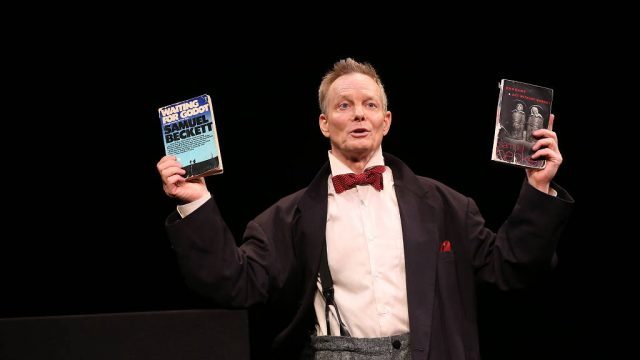
Bill Irwin shares his love of all things Samuel Beckett at the Irish Rep (photo by Carol Rosegg)
ON BECKETT
Irish Repertory Theatre
Francis J. Greenburger Mainstage
132 West 22nd St. between Sixth & Seventh Aves.
Tuesday – Sunday through November 4, $50-$70
212-727-2737 irishrep.org
On Thursday night I was at the Irish Rep to see On Beckett, Bill Irwin’s very personal exploration of the work of Samuel Beckett and, in many ways, a combination of the two previous one-man shows I saw, evoking John Kevin Jones’s mastery of Edgar Allan Poe’s texts and Aasif Mandvi’s expert handling of multiple characters. For eighty-seven minutes, Tony-winning actor and certified clown Irwin delves into his vast enthusiasm for Beckett’s writings without ever becoming professorial or pedantic. “I am not a ‘Beckett scholar’ — nooo. Nor am I a Beckett biographer,” he admits. “Mine is an actor’s relationship with this language. By which I mean the deep knowledge that comes from committing words to memory, and speaking them to audiences.” Irwin (Old Hats, Who’s Afraid of Virginia Woolf?) performs selections from Beckett’s 1955 collection Texts for Nothing, his 1950s novels The Unnamable and Watt, and the Irish writer’s most famous play, Waiting for Godot, significantly altering his delivery style, voice, and rhythm for each work.
Irwin adds fascinating insight to Beckett and his oeuvre, discussing the Nobel Prize winner’s punctuation and pronoun usage, his identity and heritage, the possible influence of vaudeville on his work, his detailed stage directions, and other intricacies. “Was Beckett a writer of the body, or of the intellect?” Irwin asks. “Smells like a question you could waste a lot of time on, but I think you can say that he was a writer acutely attuned to silhouette.” His appreciation of Beckett echoes that of Jones’s for Poe, while his simple but effective costume changes — switching among numerous bowlers, putting on baggy pants and clown shoes — work like Mandvi’s to distinguish individuals. Irwin spends a significant part of the show on Waiting for Godot, discussing the correct pronunciation of the title character’s name, examining the role of Lucky, and reminiscing about the production he appeared in with Robin Williams, John Goodman, Steve Martin, and Nathan Lane. Charlie Corcoran’s spare black set consists only of a podium and two rectangular boxes that Irwin can rearrange for various purposes. Irwin is a delight to watch, his passion for Beckett infectious. He occasionally goes off topic in comic ways, wrestling with a microphone and toying with the podium, but he eventually gets back on track for an enchanting piece of theater about theater.
The following evening, my string of one-man shows came to an end with the Wheelhouse Theater’s new adaptation of Kurt Vonnegut’s Happy Birthday, Wanda June, opening Tuesday at the Duke. Bringing the theme full circle, Wanda June features a ferocious performance by Jason O’Connell, whom I saw last year in his own solo outing, The Dork Knight, about his lifelong affinity for Batman.
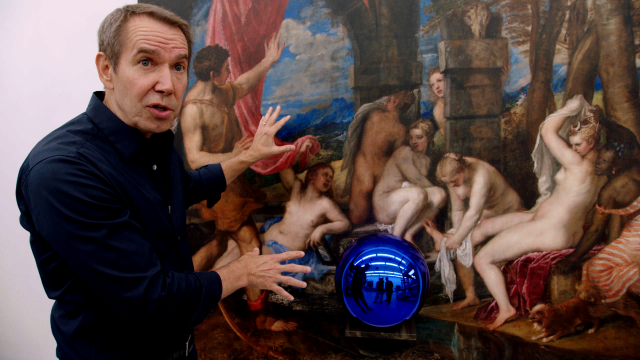
Jeff Koons is one of numerous artists who discuss their relationship with money in Nathaniel Kahn’s The Price of Everything
THE PRICE OF EVERYTHING (Nathaniel Kahn, 2018)
Quad Cinema
34 West 13th St. between Fifth & Sixth Aves.
Opens Friday, October 19
212-255-2243 www.thepriceofeverything.com quadcinema.com
On October 4, a framed painting titled “Girl with Balloon” by British street artist and provocateur Banksy began shredding itself upon being sold for $1.4 million at a Sotheby’s auction, shocking and delighting the art world. Was Banksy, whose very name evokes cold, hard cash, making a sly comment on the art market, on auctions, on the intrinsic value of a work of art? In the immediate aftermath, there was general confusion about just what the buyer had purchased and whether she had to keep it at all. In many ways that stunt exemplifies what Nathaniel Kahn’s highly artistic documentary, The Price of Everything, is all about. Kahn, who was nominated for Oscars for his 2003 film, My Architect: A Son’s Journey, which explored the legacy of his father, Louis Kahn, and his 2006 short, Two Hands, about pianist Leon Fleisher, this time trains his camera on the volatile global art market. “Art and money have always gone hand in hand,” superstar auctioneer Simon de Pury says. “It’s very important for good art to be expensive. You only protect things that are valuable. If something has no financial value, people don’t care. They will not give it the necessary protection. The only way to make sure that cultural artifacts survive is for them to have a commercial value.”
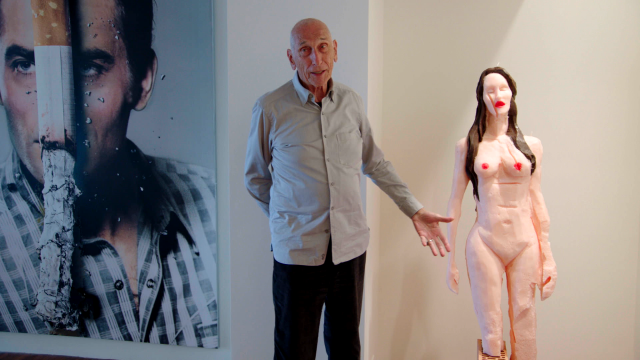
Traveling to art fairs, galleries, museums, and studios, Kahn gets a wide range of opinions on the subject, from such art-world denizens as Amy Cappellazzo of Sotheby’s, who savors the chase and the deal and has her own definition of “money shot”; collectors Inga Rubenstein, Holly Peterson, and, primarily, husband-and-wife Stefan Edlis and Gael Neeson, with Edlis getting a lot of screen time showing off his vast collection and discussing various pieces and artists in detail (“There are a lot of people who know the price of everything and the value of nothing,” Edlis says. “The art world is capricious.”); curators Paul Schimmel and Connie Butler; art historians Alexander Nemerov, who talks about the “pricelessness” of Old Master paintings at the Frick, and Barbara Rose, who compares art on the auction block to pieces of meat; gallerists Mary Boone, Jeffrey Deitch, and Gavin Brown (who sees art and money as Siamese twins); and ever-philosophical and acerbic New York magazine art critic Jerry Saltz, who laments the prospect of great works of art being sold to private collectors, perhaps never again to be seen by the public.
Octogenarian Larry Poons shuns the global art market in The Price of Everything
Kahn also speaks with numerous artists who give their own views on what constitutes value, including Jeff Koons, who is in his busy studio, where his large team is creating his Gazing Ball series, intricate copies of classic canvases, each adorned with a reflective blue ball; octogenarian Larry Poons, who is working on dazzling paintings at his home in the woods of Upstate New York; Gerhard Richter at the opening of his exquisite 2016 painting and drawing show at Marian Goodman Gallery, explaining, “Money is dirty”; Njideka Akunyili Crosby, the rising Nigerian-born, LA-based artist who works in photo-collage and reaching new levels of success; critical and popular favorite George Condo, who exuberantly puts the finishing touches on a painting; and photorealist painter Marilyn Minter, known for her glittery pieces.
Stefan Edlis shows off his collection and his unique approach to buying and selling art in The Price of Everything
Kahn is building up to the hotly anticipated Sotheby’s auction “The Triumph of Painting: The Steven & Ann Ames Collection,” where each of the above artists has a work for sale, although they will not be profiting from it since they don’t own the pieces. There’s terrific archival footage of the 1973 Scull auction, which changed the art world forever, where Robert Rauschenberg approaches Robert Scull after a work of his just sold for an exorbitant price and Scull embraces the artist, claiming that it was good for both of them, even though Scull is the one who pockets the cash. Kahn is ever-present in the documentary, never seen but often heard asking questions, trying to get to the bottom of the beguiling relationship between art and money in the twenty-first century, concluding with a beautiful Michael Snow–like shot that in many ways sums it all up. An HBO Documentary Films presentation, The Price of Everything opens at the Quad on October 19, with Q&As and introductions featuring Kahn, producers Jennifer Stockman, Debi Wisch, and Carla Solomon, and editor Sabine Krayenbühl taking place at select screenings through October 25. Let’s leave it to Poons to have the last word: “There are no rules about what is going to be good and what is gonna be bad. Art doesn’t give a shit. It never has.”
Alexandria Bombach’s On Her Shoulders is an extraordinary film about an extraordinary human being. In August 2014, the Yazidis of Northern Iraq were attacked by ISIS, who raped and killed thousands of Yazidis in what amounted to a genocide, turning countless women into sex slaves. Twenty-one-year-old Nadia Murad survived and later escaped the horror and has been on a mission ever since, traveling around the world to share her story in order to save and protect this ethno-religious minority, who have been scattered throughout refugee camps. “What must be done so a woman will not be a victim of war?” she demands. For a year, Bombach followed Nadia and Murad Ismael, executive director of Yazda, a global organization dedicated to supporting the Yazidis and other vulnerable groups, as Nadia met with media and politicians while hoping to be able to address the UN General Assembly. They go to Canada, Germany, Greece, and America, occasionally joined by human rights lawyer Amal Clooney, Yazda deputy executive director Ahmed Khudida Burjus, and former International Criminal Court prosecutor Luis Moreno Ocampo, as she makes her case to anyone who will listen.
Nadia is not a born activist; she has taken up the cause because she can’t see any other option. In the process, however, she has become a remarkable speaker and a reluctant hero to her people, but it takes a toll on her. As she tells her story, she must relive over and over again the atrocities she personally experienced and meet with men, women, and children who are suffering terribly and often break down into tears upon just being in her presence. “As a girl, I wish I didn’t have to tell the people this happened to me. I mean, I wish it hadn’t happened to me so I wouldn’t have to talk about it,” she explains. “I wish people knew me as an excellent seamstress, as an excellent athlete, as an excellent makeup artist, as an excellent farmer. I didn’t want people to know me as a victim of ISIS terrorism.”
Nadia Murad and Murad Ismael stand tall in Alexandria Bombach’s extraordinary On Her Shoulders
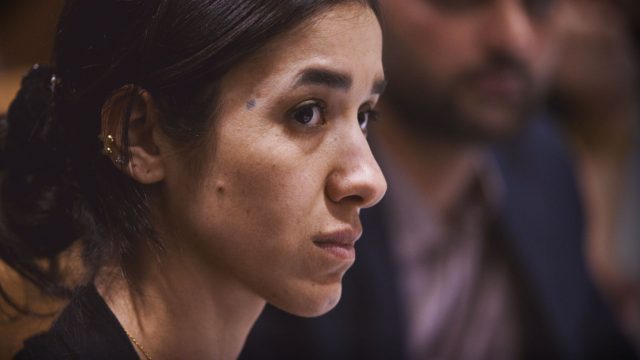
Bombach, who directed, edited, and photographed the film — using a small, handheld Canon EOS 5D Mark III to be as unobtrusive as possible — treats Nadia with a deep respect and sensitivity, being very careful not to exploit her even further, nor does she put her on a pedestal. She focuses her camera on Nadia’s striking face and her expressive eyes, which are filled with a mix of horror and hope, tired beyond their years. Throughout the film, Bombach (Frame by Frame, Common Ground) includes clips of an interview she conducted with Nadia near the end of their time together. Nadia’s long black hair and black top nearly fade into the black background, her face and neckline prominent as she speaks openly and honestly about her mission. Nadia barely ever allows herself to smile, refusing to feel joy when there is still so much work to be done; she will not stop until there is justice and accountability for what is happening to the Yazidis. It’s heartbreaking when she says, “I can’t bear to live this kind of life.” In a rare moment out of the public spotlight, she is in a kitchen cooking, and it is absolutely delightful, a much-needed break from the intense pressure that hovers over her. On Her Shoulders is a deeply affecting, heart-wrenching film that will leave you emotionally exhausted but also energized to take action. “I want women and girls to see themselves as something special,” Nadia — who was awarded the 2018 Nobel Peace Prize — says, refusing to acknowledge that she herself is special indeed. Winner of numerous festival awards, On Her Shoulders opens October 19 at Village East, with Bombach participating in several Q&As on Friday, Saturday, and Sunday.
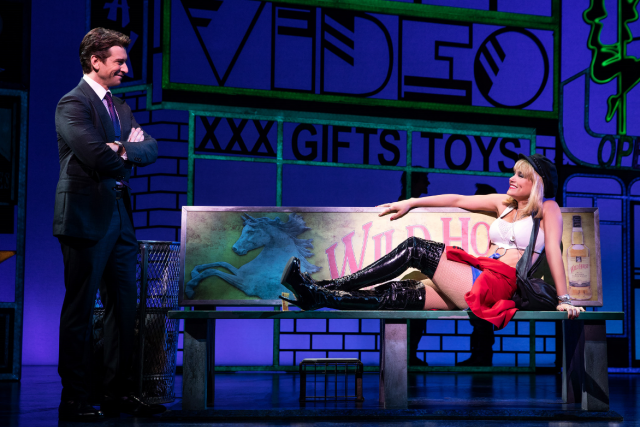
Andy Karl and Samantha Barks have some pretty big shoes to fill in Pretty Woman (photo by Matthew Murphy 2018)
Nederlander Theatre
208 West 41st St. between Seventh & Eighth Aves.
Tuesday – Sunday through June 8, $99-$275
877-250-2929 prettywomanthemusical.com
The very enjoyable Broadway musical adaptation of Garry Marshall’s 1990 Cinderella story, Pretty Woman, is more about finding one’s place in the world, both geographically and psychologically, than merely the tale of a hooker with a heart of gold finding her Prince Charming. And speaking of place, Samantha Barks, who plays Vivian, the role that made Julia Roberts a star in the movie, has found where she belongs, center stage on Broadway, delivering an inspiring, Tony-worthy performance. The story is fairly straightforward: Vivian Ward (Barks), a broke prostitute, meets a wealthy financier, Edward Lewis (Andy Karl taking on the Richard Gere part), who treats her to the high life in order to pull off a major deal. As their public deception proceeds, both wonder whether something more is going on as they each search for somewhere to call home. (She lives in a walk-up rat trap, while he resides in a posh hotel.) “Tell me, what’s your dream? / I know you’ve got one / It’s like a map to your life / You’ll be lost until you’ve caught one,” sings a shabbily dressed Happy Man (Eric Anderson) on the seedier side of Hollywood Blvd., where he offers free maps to help people find their way.
Eric Anderson does double duty as the Happy Man and Mr. Thompson in Broadway adaptation of hit movie (photo by Matthew Murphy 2018)
“Don’t you want to get out of here?” Vivian asks her friend, fellow prostitute Kit De Luca (Orfeh, Karl’s real-life wife), who replies, “Get out of where? Where do you want to go?” A moment later Vivian sings, “I look around and what I see / Is I don’t belong here, this isn’t me. . . . I know where I’d choose to go / If I could disappear / Anywhere but here / Anywhere but here.” When Vivian meets Edward, he has taken a few wrong turns and does not know how to get back to his hotel. She asks him to pay ten dollars for her help and he says, “You can’t charge me for directions.” She smartly replies, “I can do anything I want to, baby. I ain’t lost.” But of course, they both are lost. “I can take you anywhere / ’Cause anything’s possible,” the Happy Man says as he dramatically changes into a regal concierge outfit and the set transforms into the exclusive Beverly Wilshire Hotel, where Edward lives on the top floor, even though he’s afraid of heights. Edward is working with his shifty lawyer, Phillip Stuckey (Jason Danieley), attempting a hostile takeover of a ship-building company owned by James Morse (Kingsley Leggs); it’s no accident that Edward has no real care for the business itself, which specializes in making vessels that take people to other places primarily for pleasure. As Vivian blossoms à la Eliza Doolittle, she and Edward grow very close, but they have a deal with an end date; at the start they were both in it for the money, but soon they’re thinking about the future in a different way.
Samantha Barks busts out in rip-roaring performance in Pretty Woman (photo by Matthew Murphy 2018)
One of my regular theater companions refused to join me, concerned that the show would be offensive, that it would celebrate outdated, antifeminist views about women as decorative possessions, to the point that a woman realizes survival means selling herself — and her love — like a product. But the book, by Garry Marshall and the film’s screenwriter, J. F. Lawton, and the music and lyrics, by Bryan Adams (yes, the Canadian pop star) and Jim Vallance, often put Vivian in charge, or at least have her and Edward on equal footing, although it occasionally teeters on the edge. “Don’t want this feelin’ to go away / When I think about where I was yesterday / It’s so amazing — I can’t believe / That a billionaire would care about a girl like me / I’ve got money to spend / I’ve got champagne on ice / There’s a smile on my face / I’m getting’ treated real nice,” she sings like a classic golddigger before reevaluating what she wants out of life. Barks (Les Misérables, Chicago) and three-time Tony nominee Karl (Groundhog Day,Rocky) have an instant chemistry together, with solid support from Tony nominee Orfeh (Legally Blonde, Footloose) and Anderson (Waitress, Kinky Boots), who nearly steals the show as both the Happy Man and Mr. Thompson. (Keep a watch out for Tommy Bracco, who purloins some moments of his own as Giulio, the hotel bellman.) David Rockwell’s set design rockets between wealth and poverty, while Gregg Barnes’s costumes, particularly for Barks, are fab. Gleefully directed and choreographed by Tony winner Jerry Mitchell (Kinky Boots, Legally Blonde), Pretty Woman turns out to be a rather pleasant surprise — led by a breakout performance by Barks.

 And you thought the rat problem in New York City was bad. “I wanna tell you all a tale that’s crazier than hell,” Louisiana native and Treme star Wendell Pierce says at the beginning of Rodents of Unusual Size, Chris Metzler, Jeff Springer, and Quinn Costello’s eye-opening documentary about the nutria, the twenty-pound web-footed, orange-toothed South American creature that was introduced to Louisiana in the 1930s to boost the fur trade and has wreaked havoc ever since. The rodents multiply like tribbles and destroy so much vegetation that the resulting erosion affects storm surge protection, leading the government to encourage the mass murder of the beast by offering a five-dollar bounty for each tail. The filmmakers visit Delacroix and the Ninth Ward in New Orleans, talking to such nutria hunters as Larry Aucoin, Darrell Aucoin, Liz LeCompte, and Trey Hover, who is killing the swamp rat to help pay for his college education. LeCompte is doing it to protect the environment. “If the land’s gone, then me and my family don’t have a future,” she says, explaining that “Cajun women, they not afraid to get their hands dirty.” Nutria control specialist Michael Beran, who patrols the canal banks and uncovers nutria-built subterranean labyrinths that can also endanger bridges, notes that the nutria is an “invasive species [that] has to be deleted.” Nutria tail assessor John Siemion gets right to the point: “It offers these guys money when there is none,” he says. “This is their income for the year.”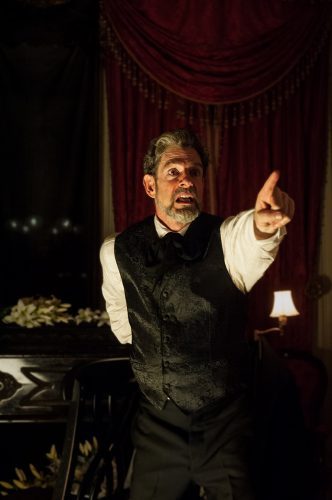
 On October 4, a framed painting titled “Girl with Balloon” by British street artist and provocateur Banksy began shredding itself upon being sold for $1.4 million at a Sotheby’s auction, shocking and delighting the art world. Was Banksy, whose very name evokes cold, hard cash, making a sly comment on the art market, on auctions, on the intrinsic value of a work of art? In the immediate aftermath, there was general confusion about just what the buyer had purchased and whether she had to keep it at all. In many ways that stunt exemplifies what Nathaniel Kahn’s highly artistic documentary, The Price of Everything, is all about. Kahn, who was nominated for Oscars for his 2003 film, My Architect: A Son’s Journey, which explored the legacy of his father, Louis Kahn, and his 2006 short, Two Hands, about pianist Leon Fleisher, this time trains his camera on the volatile global art market. “Art and money have always gone hand in hand,” superstar auctioneer Simon de Pury says. “It’s very important for good art to be expensive. You only protect things that are valuable. If something has no financial value, people don’t care. They will not give it the necessary protection. The only way to make sure that cultural artifacts survive is for them to have a commercial value.”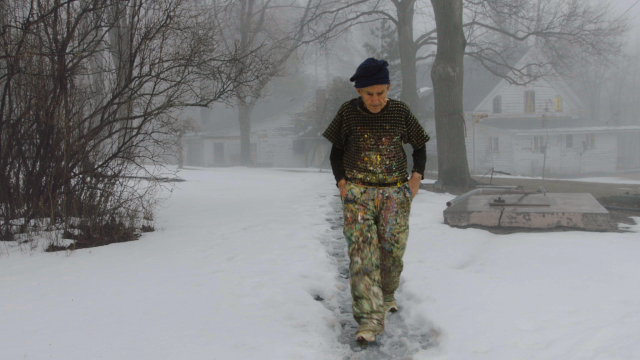
 Alexandria Bombach’s On Her Shoulders is an extraordinary film about an extraordinary human being. In August 2014, the Yazidis of Northern Iraq were attacked by ISIS, who raped and killed thousands of Yazidis in what amounted to a genocide, turning countless women into sex slaves. Twenty-one-year-old Nadia Murad survived and later escaped the horror and has been on a mission ever since, traveling around the world to share her story in order to save and protect this ethno-religious minority, who have been scattered throughout refugee camps. “What must be done so a woman will not be a victim of war?” she demands. For a year, Bombach followed Nadia and Murad Ismael, executive director of Yazda, a global organization dedicated to supporting the Yazidis and other vulnerable groups, as Nadia met with media and politicians while hoping to be able to address the UN General Assembly. They go to Canada, Germany, Greece, and America, occasionally joined by human rights lawyer Amal Clooney, Yazda deputy executive director Ahmed Khudida Burjus, and former International Criminal Court prosecutor Luis Moreno Ocampo, as she makes her case to anyone who will listen.