twi-ny recommended events

SIX BY KORE-EDA

Maborosi kicks off six-film tribute to Hirokazu Kore-eda as appetizer to his latest, Shoplifters

Maborosi, starring Makiko Esumi, kicks off six-film tribute to Hirokazu Kore-eda as appetizer to his latest, Shoplifters

Film Society of Lincoln Center, Walter Reade Theater
165 West 65th St. between Eighth Ave. & Broadway
November 19-22
www.filmlinc.org
www.kore-eda.com

To celebrate the theatrical release of Japanese auteur Hirokazu Kore-eda’s latest work, Shoplifters, the Palme d’Or winner that opens November 23, the Film Society of Lincoln Center is presenting six of the master’s earlier tales, concentrating on his exquisite depiction of family life. Running November 19-22, the mini-festival provides a terrific entry into the oeuvre of Kore-eda, a visionary who tells a story like no one else. “Six by Kore-eda” begins with his first fiction film, Maborosi, which followed three documentaries (Lessons from a Calf, However . . . , August without Him). After Yumiko’s husband, Ikuo (Tadanobu Asano), mysteriously commits suicide, she (Makiko Esumi) gets remarried and moves to her new husband’s (Takashi Naitō) small seaside village home with her son (Gohki Kashima), where she begins to put her life back together. This stunning film is marvelously slow-paced, lingering on characters in the distance, down narrow alleys, across gorgeous horizons, with very little camera movement by cinematographer Masao Nakabori. Maborosi, the only one of his films he didn’t write — the screenplay is by Yoshihisa Ogita, based on the novel by Teru Miyamoto — is a stunning debut from one of the leading members of Japan’s fifth generation. It is screening at the Walter Reade Theater on November 19 at 6:30 and November 22 at 9:00

AFTER LIFE

Guides interview the deceased in Hirokazu Kore-eda’s After Life

AFTER LIFE (WANDÂFURU RAIFU) (Hirokazu Kore-eda, 1998)
Film Society of Lincoln Center, Walter Reade Theater
Monday, November 19, 8:45
Thursday, November 22, 7:00
www.filmlinc.org

Kore-eda’s second narrative feature, After Life, is an eminently thoughtful film about two of his recurring themes: death and memory. Every Monday, the deceased arrive at a way station where they have three days to decide on a single memory they can bring with them into heaven. Once chosen, the memory is re-created on film, and the person goes on to the next step of his or her journey, to be replaced by a new batch of souls. The way station is staffed by guides, including Takashi Mochizuki (Arata), Shiori Satonaka (Erika Oda), and Satoru Kawashima (Susumu Terajima), whose job it is to interview the new arrivals and help them select a memory and then bring it to life on-screen. Some want to take with them an idyllic moment from childhood, others a remembrance of a lost love, but a few are either unable to or refuse to come up with one, which challenges the staff. Twenty-one-year-old Yūsuke Iseya declares, “I have no intention of choosing. None,” while seventy-year-old Ichiro Watanabe (Taketoshi Naito) is having difficulty deciding on the exact moment, reevaluating and reflecting on the life he led. As the week continues, the guides look back on their lives as well, sharing intimate details, one of which leads to an emotional finale.

AFTER LIFE

After Life explores life, death, memory, heaven, and the art of filmmaking

Kore-eda, who previously examined memory loss in the documentary Without Memory and explored a family’s reaction to death in the brilliant Still Walking, interviewed some five hundred people about what memory they would take with them to heaven, and some of those nonprofessional actors are in the final cut of After Life, blurring the lines between fiction and reality. After Life is also very much about the art of filmmaking itself, as each memory is turned into a short movie created on a set and watched in a screening room. In fact, the film was inspired by Kore-eda’s memories of his grandfather’s battle with what would later be identified as Alzheimer’s disease; the director has also cited Ernst Lubitsch’s 1943 comedy, Heaven Can Wait, as an influence, and the Japanese title, Wandâfuru raifu, means “Wonderful Life,” evoking Frank Capra’s holiday classic. But Kore-eda never gets maudlin about life or death in the film, instead painting a memorable portrait of human existence and those simple moments that make it all worthwhile — and will have viewers contemplating which memory they would take with them.

Hirokazu Kore-eda’s Nobody Knows offers a heartrbreaking look at a unique family

NOBODY KNOWS (DAREMO SHIRANAI) (Hirokazu Kore-eda, 2004)
Film Society of Lincoln Center, Walter Reade Theater
Tuesday, November 20, 6:00
Thursday, November 22, 4:00
www.kore-eda.com

Based on a true story that writer-director Kore-eda read about back in 1988, Nobody Knows is a heartwarming, heartbreaking film about four extraordinary half-siblings who must fend for themselves every time their mother takes off for extended periods of time. Japanese TV and pop star YOU makes her feature-film debut as Keiko, a young woman who has four kids by way of four different men. When she’s home, she shows affection for the children, but the problem is, she’s rarely home. Instead, twelve-year-old Akira (Yagira Yuya) must take care of the shy Kyoko (Kitaura Ayu), who handles the laundry; the troublemaker Shigeru (Kimura Hiei), who can’t follow the rules; and sweet baby Yuki (Shimizu Momoko), who likes chocolates and squeaky shoes. At first, it is charming and uplifting watching how Akira handles the complicated situation — the other kids are not allowed outside because the landlord will evict them if he finds out about them, and Akira even helps teach the family, who do not attend school — but as Keiko disappears for longer periods of time, the children’s lives grow more dire by the day as food and money start running out. Kore-eda, who also edited and produced this powerful picture, has created a moving, involving film that nearly plays like a documentary, avoiding melodramatic clichés and instead wrapping the audience up in the closeted life of four terrific kids whose tragic existence will ultimately break your heart.

LIKE FATHER, LIKE SON

A father (Masaharu Fukuyama) must reevaluate his relationship with his son (Keita Ninomiya) in yet another Hirokazu Kore-eda masterpiece

LIKE FATHER, LIKE SON (SOSHITE CHICHI NI NARU) (Hirokazu Kore-eda, 2013)
Film Society of Lincoln Center, Walter Reade Theater
Tuesday, November 20, 8:45
Wednesday, November 21, 1:30
www.ifcfilms.com

International cinema’s modern master of the family drama turns out another stunner in the Cannes Jury Prize winner Like Father, Like Son. Ryota Nonomiya (Masaharu Fukuyama) thinks he has the perfect life: a beautiful wife, Midori (Machiko Ono), a successful job as an architect, and a splendid six-year-old son, Keita (Keita Ninomiya). But his well-structured world is turned upside down when the hospital where Keita was born suddenly tells them that Keita is not their biological son, that a mistake was made and a pair of babies were accidentally switched at birth. When Ryota and Midori meet Yudai (Lily Franky) and Yukari Saiki (Maki Yoko), whose infant was switched with theirs, Ryota is horrified to see that the Saikis are a lower-middle-class family who cannot give their children — they have three kids, including Ryusei (Shôgen Hwang), the Nonomiyas’ biological son — the same advantages that Ryota and Midori can. Meanwhile, the two mothers wonder why they were unable to realize that the sons they’ve been raising are not really their own. As the two families get to know each other and prepare to switch boys, Ryota struggles to reevaluate what kind of a father he is, as well as what kind of father he can be.

LIKE FATHER, LIKE SON

Like Father, Like Son explores the power of blood connections and the concept of nature vs. nurture

Kore-eda wrote, directed, and edited Like Father, Like Son, imbuing the complex story with an Ozu-like austerity, examining a heartbreaking, seemingly no-win situation — one of every parent’s most-feared nightmares — with intelligence and grace. Musician and actor Fukuyama gives a powerfully understated performance as Ryota, a work-obsessed architect struggling to keep everything he has built from crumbling all around him. Novelist and actor Franky is excellent as his polar opposite, a man with a very different kind of verve for life. In Like Father, Like Son, Kore-eda, whose own father passed away ten years before and whose daughter was five years old when the film was made, once again explores the relationship between parents and children, this time focusing on the strong bonds created by both love and blood.

Real-life brothers Ohshirô Maeda and Koki Maeda star as close siblings in Hirokazu Kore-eda’s masterful I Wish

I WISH (KISEKI) (Hirokazu Kore-eda, 2011)
Film Society of Lincoln Center, Walter Reade Theater
Wednesday, November 21, 4:00
Thursday, November 22, 1:30
www.magpictures.com/iwish

Kore-eda’s I Wish is an utterly delightful, absolutely charming tale of family and all of the hopes and dreams associated with it. Real-life brothers Koki Maeda and Ohshirô Maeda of the popular MaedaMaeda comedy duo star as siblings Koichi and Ryu, who have been separated as a result of their parents’ divorce. Twelve-year-old Koichi (Koki) lives with his mother (Nene Ohtsuka) and maternal grandparents (Kirin Kiki and Isao Hashizume) in Kagoshima in the shadow of an active volcano that continues to spit ash out all over the town, while the younger Ryu lives with his father (Joe Odagiri), a wannabe rock star, in Fukuoka. When Koichi hears that if a person makes a wish just as the two new high-speed bullet trains pass by each other for the first time the wish will come true, he decides he must do everything in his power to be there, along with Ryu, so they can wish for their family to get back together. Kore-eda once again displays his deft touch at handling complex relationships in I Wish, the Japanese title of which is Kiseki, or Miracle.

Originally intended to be a film about the new Kyushu Shinkansen bullet train, the narrative shifted once Kore-eda auditioned the Maeda brothers, deciding to make them the center of the story, and they shine as two very different siblings, one young and impulsive, the other older and far more serious. Everyone in the film, child and adult, wishes for something more out of life, whether realistic or not. Ryu’s friend Megumi (Kyara Uchida) wants to be an actress; Koichi’s friend Makoto (Seinosuke Nagayoshi) wants to be just like his hero, baseball star Ichiro Suzuki; and the brothers’ grandfather wants to make a subtly sweet, old-fashioned karukan cake that people will appreciate. Much of the dialogue is improvised, including by the children, lending a more realistic feel to the film, although it does get a bit too goofy in some of its later scenes. Written, directed, and edited by Kore-eda, I Wish is a loving, bittersweet celebration of the child in us all.

Hirokazu Kore-eda’s STILL WALKING is a special film about a dysfunctional family that should not be missed

Hirokazu Kore-eda’s Still Walking is a special film that honors such Japanese directors as Mikio Naruse, Yasujiro Ozu, and Shohei Imamura

STILL WALKING (ARUITEMO ARUITEMO) (Hirokazu Kore-eda, 2008)
Film Society of Lincoln Center, Walter Reade Theater
Wednesday, November 21, 6:30
Thursday, November 22, 9:15
www.aruitemo.com

Flawlessly written, directed, and edited by Hirokazu Kore-eda, Still Walking follows a day in the life of the Yokoyama family, which gathers together once a year to remember Junpei, the eldest son who died tragically. The story is told through the eyes of the middle child, Ryota (Hiroshi Abe), a forty-year-old painting restorer who has recently married Yukari (Yui Natsukawa), a widow with a young son (Shohei Tanaka). Ryota dreads returning home because his father, Kyohei (Yoshio Harada), and mother, Toshiko (Kirin Kiki), are disappointed in the choices he’s made, both personally and professionally, and never let him escape from Junpei’s ever-widening shadow. Also at the reunion is Ryota’s chatty sister, Chinami (You), who, with her husband and children, is planning on moving in with her parents in order to take care of them in their old age (and save money as well). Over the course of twenty-four hours, the history of the dysfunctional family and the deep emotions hidden just below the surface slowly simmer but never boil, resulting in a gentle, bittersweet narrative that is often very funny and always subtly powerful.

The film is beautifully shot by Yutaka Yamazaki, who keeps the camera static during long interior takes — it moves only once inside the house — using doorways, short halls, and windows to frame scenes with a slightly claustrophobic feel, evoking how trapped the characters are by the world the parents have created. The scenes in which Kyohei walks with his cane ever so slowly up and down the endless outside steps are simple but unforgettable. Influenced by such Japanese directors as Mikio Naruse, Yasujiro Ozu, and Shohei Imamura, Kore-eda was inspired to make the film shortly after the death of his parents; although it is fiction, roughly half of Toshiko’s dialogue is taken directly from his own mother. Still Walking is a special film, a visual and psychological marvel that should not be missed.

MOTHER OF THE MAID

(photo by Joan Marcus)

Joan Arc (Grace Van Patten) tries to reassure her ma, Isabelle (Glenn Close), in Jane Anderson’s Mother of the Maid (photo by Joan Marcus)

Anspacher Theater, the Public Theater
425 Lafayette St. at Astor Pl.
Tuesday through Sunday through December 23, $110
212-539-8500
publictheater.org

This decade has seen diverse takes on the story of Joan of Arc, the real-life fifteenth-century saint who led the bloody battle to return the French crown to French hands and put Charles VI on the throne. Each one, of course, focused on Joan herself, a young girl who claims to see visions of Saint Catherine, who commands her to lead the charge. Among the twenty-first-century Joans are Laura K. Nicoll in Reid Farrington’s The Passion Project at 3LD, Marion Cotillard in Côme de Bellescize’s concert staging of Arthur Honegger’s Joan of Arc at the Stake at Avery Fisher Hall, Jo Lampert in David Byrne’s Joan of Arc: Into the Fire at the Public, and Condola Rashad in George Bernard Shaw’s Saint Joan on Broadway. But playwright Jane Anderson utilizes a different approach in Mother of the Maid, an intimate and involving play continuing at the Public’s Anspacher Theater through December 23. The protagonist here is Joan’s mother, Isabelle Arc, wonderfully portrayed as a religious, somewhat frumpy, very serious woman by six-time Oscar nominee, three-time Emmy winner, and three-time Tony winner Glenn Close, decidedly less glamorous and elegant than in her recent Broadway appearances in Sunset Boulevard and A Delicate Balance.

“Isabelle Arc is a god-fearing woman,” she tells the audience in the third person at the start. “She can neither read nor write and her skirts smell ripe as a cheese. But she can do all sorts of handy things such as gutting a lamb, lancing a boil, and hiding the family valuables during a raid. She’s never blamed God for a blessed thing.” She lives on a farm with her husband, Jacques (Dermot Crowley), their son, Pierre (Andrew Hovelson), and Joan (Grace Van Patten); they are a peasant family barely getting by. So Joan’s parents and Pierre don’t take too kindly to her announcement that Saint Catherine is ordering her to go into battle to put the dauphin on the throne. “I’m having holy visions, Ma,” Joan explains. “She fills me. She slays me. She takes me apart,” she adds about the saint. Her father whips her while Pierre and Isabelle watch. “I’m not confused. I’m furious. You’re a stubborn, reckless girl and you have no idea what you’re doing,” Isabelle says. But when local priest Father Gilbert (Daniel Pearce) informs them that the Bishop of Vaucouleurs believes that Joan is the Virgin Maid foretold in prophecies, Isabelle relents. “Our girl’s been chosen and we both should be fierce proud,” she says to Jacques. So Joan heads off on her journey, accompanied by her brother, leaving their parents to wait and worry.

(photo by Joan Marcus)

Joan (Grace Van Patten) shows off her sword expertise to her brother, Pierre (Andrew Hovelson), in New York premiere at the Public (photo by Joan Marcus)

Mother of the Maid is a moving, poignant mother-daughter drama; at its heart is the age-old story of a beloved child leaving the nest, only in this case on the wings of angels, and with a bit more at risk. Van Patten holds her own with Close, employing a tough Brooklyn tomboy image as Joan’s power rises, then falls. John Lee Beatty’s cramped wood-based set features a revolving section that rotates from farm to royal court to dungeon, sharply lit by Lap Chi Chu. Jane Greenwood’s period costumes range from bright, bold colors to more earthy tones. Emmy winner Anderson (Olive Kitteridge, Defying Gravity) and Emmy-nominated director Matthew Penn (The Root), who worked with Close on the television series Damages, focus on the relationship between the characters, which also include the Lady of the Court (usually played by Kate Jennings Grant, although I saw a fine Kelley Curran), who is accustomed to the luxuries the Arcs have never known, and her lady-in-waiting, Monique (Olivia Gilliatt). Most of the action occurs offstage, but the narrative never feels explanatory; instead, it’s a potent look at family and responsibility, a familiar historical tale told from a different perspective, breathing new life into an ever-beguiling warhorse, anchored by a pair of outstanding actors, one as a nearly forgotten woman trying to adapt to the present, the other ready to leap into the future.

FAMILY MATINEES: LIYANA

Liyana

Phumlani is one of several orphans in Swaziland creating an adventure story in Liyana

LIYANA (Aaron & Amanda Kopp, 2017)
Museum of the Moving Image, Bartos Screening Room
35th Ave. at 36th St., Astoria
Saturday, November 17, and Sunday, November 18, $15 ($9 ages three to seventeen), 11:00 am
718-777-6800
www.movingimage.us
www.liyanathemovie.com

Liyana is a bittersweet, heart-tugging film about the power of storytelling and the depth of the human mind and heart. In 2003, husband-and-wife filmmakers Aaron and Amanda Kopp visited the rural Likhaya Lemphilo Lensha orphanage in their native country of Swaziland. Most of the children living there lost their parents to violence or the ongoing HIV/AIDS epidemic. A few years later, they asked South African actress, writer, and activist Gcina Mhlophe to come to the orphanage to work with the kids: Their project is for the kids to make up their own fairy tale. The boys and girls do not talk about princes and princesses, fancy balls and lush palaces. Instead, the group, primarily Phumlani, Nomcebo, Sibusiso, Mkhuleko, and Zweli, develops a tense and thrilling adventure about a young girl named Liyana who takes off with a prized bull to try to rescue her twin brothers who were captured by marauding thieves. “The kids that we are working with, they come from the very dark side of life. They’ve been hungry, they’ve been in so much pain and abused and suffering so early in life,” Mhlophe explains. “They have those images playing over and over and over in their minds. Working with a fictional character allows a child to delve into places that you’ve covered and stored away. So many of these children’s real-life experiences are going to end up on this fictional character.”

Liyana

Shofela Coker’s stunning animation brings orphans’ story to life in Liyana

As the kids continue describing the tale in impressive depth, the Kopps, who directed, produced, and photographed the film, show them working on the orphanage farm; going to a health clinic for checkups; wandering through the gorgeous landscape as if on their own adventure; and painting, drawing, and making collages about Liyana. Nigerian visual artist Shofela Coker, who serves as art director with Amanda Kopp, brings Liyana’s story to life through compelling 3D animation that editors Davis Coombe and Aaron Kopp beautifully weave into the main narrative, which features a compelling score by South African composer Philip Miller, William Kentridge’s longtime collaborator. What’s happening in the animation often references what the children are doing and saying, forming a lovely, often subtle juxtaposition. The tale is a brutal one, as Liyana faces one frightening situation after another; the kids do not make it easy for her. But as the story goes on, you don’t have to be a psychiatrist or child specialist to see how the fictional world they are creating relates to their own lives. When they say that Liyana must “overcome fear” and “hold on to hope,” they are really talking about their own approach to daily existence. “It’s more difficult to live your life than writing a story,” one child notes, while another says, “In your own life maybe there is no hope but sometimes you need to keep pushing.” These are remarkable statements coming from such young children; clearly, they have already experienced heartbreak and terror in their brief lives, although they also burst with bright smiles. One child gets right to the point: “I want my story to end well,” he declares.

Liyana

Children in Likhaya Lemphilo Lensha orphanage in Swaziland collaborate and connect in unique ways in Liyana

Executive produced by actress and activist Thandie Newton and winner of more than two dozen festival awards around the world, Liyana is a stunning achievement, a unique and powerful film about the human spirit even in the darkest of times. Mhlophe, who has written such books as The Snake with Seven Heads, Love Child, and Queen of the Tortoises and toured the world with her play Have You Seen Zandile?, does such a wonderful job with the kids, getting their creative juices flowing in such positive ways. It’s a joy to watch her and the children come up with a genuinely exciting tale that just happens to be layered with such meaning in a country where 25% of the adults have HIV/AIDS and there are 200,000 orphans. Liyana is screening at the Museum of the Moving Image on November 17 and 18 at 11:00 in the morning as part of the “Family Matinees” series. Don’t miss this genuine treasure of a film.

BILL SHANNON: TOUCH UPDATE

(photo courtesy Kelly-Strayhorn)

Bill Shannon’s multidisciplinary Touch Update will be presented at New York Live Arts this week (photo courtesy Kelly Strayhorn Theater)

New York Live Arts
219 West 19th St. between Seventh & Eighth Aves.
November 14-17, $15-$20, 7:30
212-924-0077
newyorklivearts.org
www.whatiswhat.com

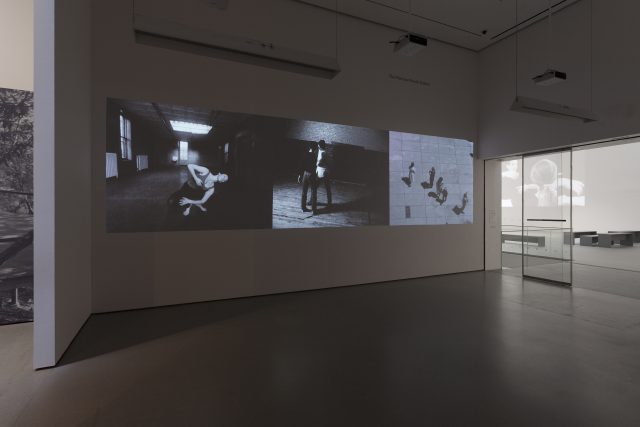
Extraordinary multidisciplinary artist Bill Shannon brings his latest project, the multimedia Touch Update, to New York Live Arts this week, accompanied by special programs. Shannon is best known for his performances and unique technique using crutches, as he was born with a degenerative hip condition. But that hasn’t stopped Shannon from skateboarding through the Financial District, moving through Duarte Square and Governors Island, and appearing at the Maker Faire in Queens. Over the years, he has been adding cutting-edge technology to his performances and installations, culminating in Touch Update, which incorporates dance, theater, prerecorded and live video, and a cubist mask onto which images are projected; Shannon met with neuroscientists to get everything just right. “It’s built around basic philosophical questions about humanity: Can people change?” he says in an online promo piece in which he also calls the show “a response to the filter of social and digital media and how humans interact.” The seventy-minute work, which was developed at a residency at the Kelly Strayhorn Theater in Pittsburgh, includes reverse engineering of the Shannon Technique for those who do not require crutches and will be performed by Raphael Botelho Nepomuceno, Ron Chunn Jr., Teena Marie Custer, Anna Thompson and Taylor Knight of slowdanger, Jacquea Mae, Cornelius Henke, and David Whitewolf. The November 15 show will be followed by a Stay Late Conversation moderated by Jennifer Edwards; there will also be a Reverse Engineering Workshop ($15) on November 17 at 1:00 and a lecture, “The Condition Arriving” ($10, $5 with ticket), the same day at 5:00.

SHOAH: FOUR SISTERS / THE LAST OF THE UNJUST

Holocaust survivor Ruth Elias tells her amazing story to Claude Lanzmann — and sings — in The Hippocratic Oath

Holocaust survivor Ruth Elias tells her amazing story to Claude Lanzmann — and sings — in The Hippocratic Oath

CLAUDE LANZMANN’S FOUR SISTERS (Claude Lanzmann, 2017)
Quad Cinema
34 West 13th St. between Fifth & Sixth Aves.
Opens Wednesday, November 14
212-255-2243
quadcinema.com
cohenmedia.net

“You are very well informed,” Holocaust survivor Ruth Elias tells filmmaker Claude Lanzmann in The Four Sisters: The Hippocratic Oath. Thanks to the Paris-born Lanzmann, a French resistance fighter during WWII, we are all very well informed about so many of the atrocities perpetrated by the Nazis, told to him in moving, powerful stories by “living witnesses” for decades. In The Four Sisters, which made its world premiere at the New York Film Festival in October, the Shoah director, who passed away in July at the age of ninety-two, focuses on the extraordinary experiences of four strong women who survived concentration camps, each one originally interviewed for Shoah. “The more I thought about these four women, the more the necessity to bring the spotlight on these female faces of the Shoah seemed important,” Lanzmann explains in his director’s note about deciding to turn them into four separate portraits. “Each of them deals with a little-known chapter of the Holocaust, each from a unique point of view. . . . The incredible strength in each of them has to exist in its own right, and yet the exceptional quality they all share also had to come through — that searingly sharp, almost physical intelligence, and an irrepressible survival instinct which could not be extinguished, despite an apparently certain death awaiting them.” The four-part film is being told in two parts at the Quad beginning November 14, Hanna & Paula and Ruth & Ada.

Ada Lichtman details her time in Sobibór in The Merry Flea

Ada Lichtman details her time in Sobibór in The Merry Flea

In The Hippocratic Oath, Ruth Elias tells her remarkable story from the Nazi occupation of Czechoslovakia in March 1939 to her deportation in April 1942 to Theresienstadt, where she was reunited with and married her boyfriend, to her pregnancy in the winter of 1943, which led to her being sent to Ravensbrück and Auschwitz, where she met Dr. Josef Mengele, who chose to use her baby in an inhuman experiment. Filmed in a little garden, Elias, an accordion player, is firm and direct as she shares the details of precisely what happened, her dark eyes seemingly sent back to Eastern Europe as her words bring it all to vivid life; one can visualize each location, each movement, each glance. The camera occasionally turns to Lanzmann, smoking a cigarette as he listens to her, mesmerized, just as the audience is. Lanzmann is more active in Baluty, walking along the shore in Panama City, Florida, with Paula Biren, whose story begins in Lodz, Poland. An elegant woman, Biren needs a little more prodding to speak, which she does very carefully, with a brutally cold honesty. She describes how Lodz was turned into a ghetto, how she became a police officer there, and then was sent to Auschwitz, where her younger sister and mother were killed, followed by her father’s death shortly thereafter. Lanzmann supplements the film with archival photographs of Lodz. Throughout The Merry Flea, Ada Lichtman is cleaning and mending dolls; it is eerie as viewers eventually find out why. Lichtman, from the Polish town of Wieliczka, relates her story of being captured by the Germans and sent to Sobibór, speaking at a determined, almost eager pace, sometimes skipping around so that Lanzmann has to interject to get her back on track or to go into more specifics, particularly regarding her treatment at the hands of a Nazi officer named Wagner and her description of cattle cars where naked men, women, and children were forced to dance with one another. The camera occasionally shifts to her husband, who she met in the camps; he stares ahead almost blankly, with hollow, haunted eyes, then hides his head in his hands. The sound of traffic outside can be heard, as if coming from another time and place.

Hanna Marton has a frightening tale to tell Claude Lanzmann in Noah’s Ark

Hanna Marton has a frightening tale to tell Claude Lanzmann in Noah’s Ark

Finally, in Noah’s Ark, Lanzmann introduces Hungarian native Hanna Marton, who sits calmly in a chair, holding a small notebook as she speaks in Hebrew, the director sitting right in front of her, nearly knocking knees; in the film’s production notes, Lanzmann explains, “I’ve never heard an account that is as constantly, relentlessly painful as the one that Hanna Marton gave me when I filmed her during the shoot for Shoah in her Jerusalem apartment.” Her eyes sometimes tearing up, Marton, continually on edge and at times defensive, talks about the early Zionist movement in her hometown of Cluj, the capital of Transylvania; discusses how Jews were used by the Hungarian army, which supported Germany and Italy, as living mine detectors; details the creation of the Kolozsvár ghetto in May 1944 as a way to quickly exterminate Jews; and delves into her involvement with the Kastner train, a deal made between Jewish-Hungarian lawyer Rudolf Kastner and Nazi Obersturmbannführer Adolph Eichmann. The Four Sisters is no mere addendum to Shoah, nor is it a footnote to Lanzmann’s long, important career; together, the four films make a powerful statement about hatred and bigotry, about violence and war, and about the indomitable strength and spirit of women, especially during the war and its aftermath. They are also a terrifying reminder that given the state of the world today, it’s not impossible that something like this could happen again, even right here in America, as there are fewer and fewer concentration-camp eyewitnesses, Holocaust deniers litter the internet, nations build walls and fences to keep out refugees, and a sitting president insists that some white supremacists are “very fine people.”

Claude Lanzmann and Benjamin Murmelstein discuss the Holocaust in revealing documentary

Claude Lanzmann and Benjamin Murmelstein discuss the Holocaust in revealing documentary

THE LAST OF THE UNJUST (LE DERNIER DES INJUSTES) (Claude Lanzmann, 2013)
Quad Cinema
34 West 13th St. between Fifth & Sixth Aves.
Wednesday, November 14, 6:35, and Monday, November 19, 6:35
212-255-2243
quadcinema.com
www.cohenmedia.net

For more than forty years, late French filmmaker Claude Lanzmann documented the Holocaust and the birth of the state of Israel in such provocative and powerful films as Israel, Why; Sobibór, October 14, 1943, 4 p.m.; and his nine-and-a-half-hour masterpiece, Shoah. In 1997, he made A Visitor from the Living, built around a 1979 interview with International Red Cross worker Maurice Rossel, who led a delegation inspecting the Nazis’ so-called “model ghetto” of Theresienstadt, which turned out to be a glorified concentration camp. Lanzmann returns to the Czech camp in The Last of the Unjust, an utterly fascinating 218-minute documentary consisting of a series of interviews he conducted in Rome in 1975 with Rabbi Benjamin Murmelstein, the only Jewish Elder to survive the Holocaust. For years, Murmelstein, who was appointed directly by and reported to Obersturmbannführer Adolph Eichmann, has been declared a Nazi collaborator, by writer Hannah Arendt and many others, even being arrested, imprisoned, and tried by Czech authorities. But in The Last of the Unjust, he paints a vivid portrait of everyday life in Theresienstadt, claiming he was not a collaborator but instead was doing whatever he could to improve conditions for the Jews there.

Claude Lanzmann

Claude Lanzmann visits Theresienstadt in film about the model ghetto’s last Jewish Elder

He poignantly describes not knowing about gas chambers and trains to Auschwitz and proudly defends his actions, referring to himself as the “last of the unjust.” Murmelstein has a spectacular memory, vividly recalling specific moments, answering all of Lanzmann’s questions with a bold honesty and correcting long-held misbeliefs concerning Theresienstadt. A cool, cigarette-smoking Lanzmann is seen in the old interviews and he also appears in new footage shot as he visits the camp and other relevant locations, geographically linking the past and the present. Between Murmelstein’s amazing storytelling ability and Lanzmann’s sharing of his personal perspective, the film never gets boring or repetitive over the course of its three-and-a-half-hour length. In the written introduction, Lanzmann states, “It took me a long time to come to the realization that I didn’t have the right to keep this to myself.” He indeed did a great service by not keeping this to himself, making yet another poignant document of the Holocaust as seen through the eyes of a unique and thoroughly intriguing witness. The Last of the Unjust is screening at the Quad on November 14 and 19 at 6:35 (the November 14 show will be introduced by Lanzmann assistant Laura Koeppel) as part of the “Claude Lanzmann’s Cinema of Remembrance” series, which continues through November 21 with such other works as Napalm; Sobibór, October 14, 1943, 4 p.m.; Israel, Why; A Visitor from the Living and The Karski Report; Shoah in two sections; and Tsahal.

THE GUILTY

(photo by Nikolaj Moller)

Jakob Cedergren stars as a cop on the edge in gripping thriller by debut director Gustav Möller (photo courtesy of Magnolia Pictures)

THE GUILTY (DEN SKYLDIGE) (Gustav Möller, 2018)
Quad Cinema
34 West 13th St. between Fifth & Sixth Aves.
November 13-15
212-255-2243
quadcinema.com
www.theguiltyfilm.com

Danish director Gustav Möller’s debut feature, The Guilty, is a furiously intense, brilliant edge-of-your-seat procedural. Jakob Cedergren stars as police officer Asger Holm, who has been demoted to working in an emergency call center pending an investigative hearing into a mysterious incident; if the investigation exonerates him, he’ll be back out on the street, where he wants to be. The night before the hearing, he’s at the center, sitting in front of a computer, taking calls on a headset, mostly dismissing people’s problems with a shrug and a lack of concern, although his prowess is evident when he quickly gets to the bottom of things with callers who don’t tell him the full story. But then Iben Østergård (Jessica Dinnage) phones in, a distraught woman who apparently has been kidnapped by a crazed man (Johan Olsen), leaving her six-year-old daughter, Mathilde (Katinka Evers-Jahnsen), and infant home alone. Holm faces many of his own demons as he desperately tries to save Iben, demanding favors from dispatchers, including his friend and colleague Bo (Jacob Hauberg Lohmann); his partner, Rashid (Omar Shargawi), who is supposed to testify for him the next day; and others even as they warn him he is overstepping and needs to back off. It’s a pulse-pounding race against time as Holm continues to break the rules and protocol in order to rescue Iben — as if saving her would save him too, achieving the redemption he seeks.

The Guilty

Asger Holm (Jakob Cedergren) is battling more than just time in The Guilty (photo courtesy of Magnolia Pictures)

Denmark’s official submission for the 2019 Oscar for Best Foreign Language Film, The Guilty, which was written by Olsen with Emil Nygaard Albertsen, is a nonstop thrill ride and character study that takes place completely in the call center and in real time. Olsen, who also is the lead singer in two rock bands, maintains the frantic pace primarily through words, in addition to Cedergren’s facial expressions; the audience is caught up in the fierce action even though it is only heard, never seen. Cinematographer Jasper Spanning, editor Carla Luffe, and supervising sound editor Oskar Skriver expertly upend the claustrophobic nature of the story by making it seem like we can see the car chase, Iben’s terror, and Mathilde’s horrible situation. Of course, each viewer will see things slightly differently, bringing their own experiences and biases into the tale. Winner of audience awards at Rotterdam and Sundance, The Guilty is centered by an unrelenting performance by Cedergren (Submarino, Terribly Happy) as a man on a mission — and harboring some dark secrets — as the plot twists and turns. Don’t miss it.

RUPTURE

rupture

Art During the Occupation Gallery, Bushwick
119 Ingraham St., Buzzer 05
Ground Floor Main Gallery, Brooklyn Fire Proof Building
Tuesday, November 13, and Wednesday, November 14, $15, 7:30
www.art-during-the-occupation-gallery.com

Art During the Occupation Gallery in Bushwick is temporarily deinstalling its current exhibition, David B. Frye’s “Return of the Mack,” in order to present the two-night experiential art performance Rupture. The thirty-five-minute piece features dance and choreography by Lexie Thrash and Kelsey Kramer, featuring performance artist Eric Gottshall, sound artist Adriana Norat, and musical artist Sonpekiza, exploring ideas of fear, pessimism, displacement, and death through music, movement and wearable sculpture. Tickets are $15; the shows begin at 7:30 and will be followed by a reception with the artists.